
47 KiB
CORE FRAMEWORK SECTION 1: STRATEGY
Table of Contents
- Document Structure Rules
- Shared Files Folder
- Determine your interests, passions and talents
- Where do you have leverage
- Determine your business idea
- Develop your backstory
- Determine your vision, mission (values), culture
- Broadly define your customer personas
- A Product vs Brand Company
- Construct your brand pillars
- Determine viability of your business idea
- Characteristics for a great product (or business idea)
- Lasting Competitive Advantage
- Growth Strategies
- Stakeholder Matrix
- Why is this a good business opportunity for ME?
- Goals
- Scorecard
- Decision Making, Problem Solving, Risk Analysis, Managing Distractions
- Putting it all together and final thoughts on strategy
- Key Strategic Pitfalls
Document Structure Rules
See https://docs.google.com/document/d/109vex84XpU5FE-hYg4oFfU_NNXWqsuJxrtkdBVpzZtA/edit?usp=sharing
Shared Files Folder
Any files referenced will be in the shared folder: https://drive.google.com/drive/folders/0B23QMv-jQxTtY215c0pDcHdFZXc?resourcekey=0-fH3i1G05ZHgQOypRn6q79Q&usp=sharing
Determine your interests, passions and talents
Starting and growing a business can be all-consuming and it is important that you enjoy it. Otherwise, you are more likely to burn out. Joy in your business springs from your deepest interests, passions and talents. Interests are wanting to know or learn about something - they are more intellectual in nature. Passion is what is in your heart and what you feel - they are more emotional. Talents are innate (existing from birth) and what you are good at.
It is critical to spend the time and effort on finding out what these are. Questions to help get you started: What engages your mind? What are your strengths and weaknesses? What can bog you down on a daily or weekly basis from forward progress? What do you look forward to doing every day? What do you dread doing? What do you do that you lose total track of time? What comes easy to you? What is your leverage? One way to define leverage is where you can push with less effort than others and get more results What do you “get” quicker than others What turns you off or shuts you down? What makes your pulse race and your eyebrow arch? What industries, categories and products do you love and why? See this https://edsoehnel.com/personality-discovery-template/ for a template. Mine is here if you want an example.
Resources that might help you answer these questions: http://edsoehnel.com/is-your-startup-the-right-match-for-your-interests-passions-and-talents/
The best business idea for you springs from your interest, passions and talents because you will more readily see problems that require solutions, which you can create into a business, and you will have more of that deep drive to get it done.
Interests and passions can evolve over time, but talents are the same. Seek opportunities where you can actively use your talents so they get stronger and better the more you use them. Try to stay away from working on weaknesses and delegate those, unless they are the weak link in whatever you need to accomplish and have no choice to delegate (which is often the case for startups, where founders have to be jack of all trades). Interests and passions are influenced by experiences, good and bad, which is why they can evolve.
See https://edsoehnel.com/a-simple-and-elegant-way-to-figuring-out-how-to-succeed-in-a-business/
Where do you have leverage
This is a question in the section on Interests, Passions and Talent, but I am pulling out here because there is internal leverage, which I define as you have a talent that allows you to push and get more with less effort than others (covered above). But external leverage is to list resources you already have that give you leverage. They can be knowledge, experience, contacts/network, money, etc..
Determine your business idea
What is your business idea, including the category and general products? See more here about leverage and composability: https://eddiesoehnel.com/composable-and-leverage-both-mean-the-same-and-important-to-consider-in-anything-i-do-heres-why-and-how-to-make-this-thought-discussion-practical-for-everyday-use-to-increase-wealth/
x
Develop your backstory
A backstory is a technique I learned from Russell Brunson in his book, DotCom Secrets. Get it on Amazon here: http://amzn.to/2gmNpVf A backstory is one of the many elements of Russell’s Attractive Character approach for marketing and sales. I think it is important to think about your backstory now because it might help you achieve more fit and alignment between you and what you intend to sell. But realize that you don’t have to have a backstory, but I think as an early-stage startup, it can really help.
A backstory helps your customers identify with you and what you are trying to sell. If you can relate what your product did for you, then customers who are in the same place you were before you created and used your product, will be able to identify that they too can get to where you are now through your product. The backstory helps customers see where you came from and makes you and your product more real to them. It hooks them. By following you - ie...buying your product...they presumably will be able to follow you and get to where you are now. For example, backstories are used heavily in health products, whether it be weightloss, supplements, fitness or other health related products. Go find an ad for virtually any product in the health space and good chances it will be connected to someone’s backstory. A backstory does not have to be you; it can be someone else’s backstory that you use, but I think it is better if it is you. In all honesty, you should be using the products you sell and they should be providing you with the same benefits you will want to advertise. A backstory helps connect you, the person, to your customers. Consumers want authentic products made by real people. If they see that through your backstory, then they are more likely to identify with you and your company and trust in you. A backstory should answer why you are doing what you are doing.
Develop your backstory. What brought about your product/business idea? How has it helped you? Detail what you were before your product/business idea, and now after. How have you improved and benefited?
.
Determine your vision, mission (values), culture
Sketch out your 5 year vision, your mission/values and what kind of culture you want in your company
An explanation for how these elements work together: http://edsoehnel.com/vision-mission-values-culture-goals-and-strategy/ See also: https://edsoehnel.com/elements-of-a-company-vision/
These should align with your interest, passions and talents.
Create a list of companies that you admire which you can research further to model in your startup
Broadly define your customer personas
You’re best customer may be a lot like you, especially if your business becomes an extension of your interests, passions and talents. 👈👈
A persona uses a collection of demographic factors (age, income, gender, location) and psychographic factors ( habits, hobbies, spending habits, values, desires, goals, needs, motivations) to identify your Ideal customer who you want to take a specific action. A persona puts a face and personality to your ideal customer, which makes it easier to think about their needs and problems and how you can create your business and products that appeal to that persona. That specific action is to buy and use your product, and you define that use in terms of benefits and outcomes.
Define your ideal customer by creating a rough persona. Keep it simple and do only basic research if you need to.
A Product vs Brand Company
Most companies start out with a product idea that is better than alternatives. The goal over time is to move towards a brand out of the product idea because products can be copied or usually get improved upon so they lose their competitive advantage. The brand is what will keep customers coming back. Some startups can start with brand - think of a celebrity or influencer - and use the brand to launch products. But this is not the normal route. Another way to visual what is my company: see this graphic 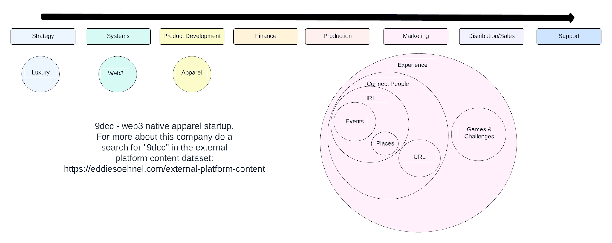
Construct your brand pillars
A brand is the sum of all facets, features and characteristics of a company (or individual), both good and bad, which are a result of the company’s interactions with suppliers, manufacturers, service providers, distributors, resellers, employees, customers, the general public, owners/investors – basically, every stakeholder to the company. I also like this that defines a brand:  Brand development and management can get complex and consume resources that most startups and small companies cannot afford, but it does not have to be resource intensive. One of the best ways I have found to develop and manage a brand is through brand pillars. Brand pillars are like a unique recipe to a company that is made up of a set of ingredients. While the ingredients might be common, it’s their combination that makes the recipe unique. The key here is to develop a recipe that no other company can successfully replicate, so that the recipe stays unique and differentiated in the marketplace, and ensure it can be defended. The last word defend – is crucial, because an enduring brand is one that the company can successfully protect in the marketplace against competitors.
For example, one food company I worked with developed the following brand pillars: Manage quality through direct sourcing of product. The company purchases product directly from farmers, bypassing intermediaries. This gives the company an edge in ensuring the product it purchases meets standards for quality and freshness. Free of allergens. The company’s products are free from common allergens found in many competitor products and produced in its own facilities so it can guarantee purity. Produced in the USA. Many competitors produce overseas. The company believes it can more effectively manage quality control through domestic production and further believes that made in the U.S.A. is an important marketing differentiator. These brand pillars serve the company at several different levels. They guide the company in its internal sourcing and production practices and the types of products it brings to market, and the company can use these brand pillars in its marketing to help differentiate itself from the competition. The company’s research indicates that these brand pillars form a unique recipe that no competitor can currently match. While it’s possible that may change, the company believes that it can successfully build enough brand equity before that happens to sustain its business. Brand pillars serve to guide you in your everyday actions and when you follow those brand pillars, you end up developing the brand that you want.
Here is my worksheet for developing brand pillars. Do your best to answer the questions in it, even though you may not have the operating history yet to complete them. You can always come back to this worksheet to further develop your brand pillars later, but do your best now to identify them. https://edsoehnel.com/brand-development/
Ways to standout
Polarization You can’t please everyone and have a company and products that are everything to everyone, so take a stand for what you believe in and you will more readily attract those people that believe in the same. 👈👈 Bring the things you care about into the open. Being neutral and you attract no one. If you polarize, you have those that get you and those that do not. But those that get you may become great customers with high lifetime value who give you word- of-mouth marketing. A startup has to capture attention, and taking a stand is one way to potentially do that. Don’t be afraid of being controversial, but not in a disrespecting way.
What do you stand for that you can build into your brand pillars?
Unique persona How can you use your unique persona to help your business stand out? Look at personalities in different industries with large social followings to see how they do it. Each one of us is unique. Don’t try to copy what everyone else is doing to fit into social norms. Embrace your uniqueness and let to shine. This could become the foundation for capturing customer attention, where you infuse your unique personality into your business. How have your past experiences shaped your persona into what it is now? Your backstory can help you develop a unique persona that attracts people to you and your business. Your unique persona can also include your style for how you come across to others.
When I say the name “Steve Jobs”, what are the first few words that might come to mind. Besides “Apple”, how about blue jeans and black turtleneck? That was Steve’s signature look, and helped define his style and unique persona.
I think a unique style and persona is not forced, but something that comes naturally to you which others are attracted to.
What is your unique style and persona and how can you use it to help your business stand out?
Determine viability of your business idea
The process for qualifying an idea is generally hard because your first iteration may likely not be the final and best idea. Your business idea should naturally evolve as you think about it and do research. Ever remember someone telling you to look for the good in people or a situation…you know, “the glass is half-full” thinking? Well, when considering a business idea, don’t do it that way. You need to do the opposite. I like to start from the perspective that my idea is a bad one and I am going to do some research to prove that. If I start with that mindset, it helps keep me from falling in love with the idea, where I will be much more prone to discount information that qualifies it as a bad idea. 👈👈 This critical attitude forces me to look at all the negatives and check them off my list. If the negatives are not proving out, then I am more likely to have a good idea.
A great way to develop an idea for a business is to figure out a product that solves a problem you are having. Odds are, if you have a problem, so do other people. 👈👈
Use the following questions to help determine the viability of your idea: Primary questions: What pain, need, problem, unmet demand or customer delight does your idea provide? What keeps them up at night? Identify the specific needs that correspond to a good market opportunity. For example, you probably don’t want to enter a market where customers are extremely happy with how well the existing products meet their needs. When you develop a new product or improve an existing product, you want to address customer needs that aren’t adequately met: their “underserved” needs. Are there gaps in existing offerings where you can deliver solutions around desires consumers did not even know they had? What is your “WOW” factor. How would consumers be impressed such that you give them a feeling of “WOW” and make a memorable impression on them? How can you surprise them in unexpected but delightful ways that they do not see coming? Customers are going to judge your product in relation to the alternatives, so the relative degree to which your product meets their needs in a clearly differentiated and impactful way depends on the competitive landscape. Do your potential customers know they have a need, problem, unmet demand and do they care? Seriously…do they care? Enough to spend money on it? Can you solve it quickly?
See Section 3: Product Development for more about WOW
Dissect your idea further with the following: Scene or situation: focus on the moment of frustration with the customer. What is going on? What is the user about to attempt? Desired outcome: what is the user trying to accomplish? Why is this important? Attempted approach: without your new product, how does the user go about the task? Interfering factors: what goes wrong? How and why does it go wrong? Economic Consequences: so what? What is the impact of the user failing to accomplish the task productively?
What is the product category does not exist?
Don't talk about your product; instead talk about what's in their heads. It's probably frustration and that's pretty powerful. Categories don't just pop out of the air, you're always replacing something. The category may be new, but the need is not. So one quick way to hijack people's attention is to find the current battle alternative and position against it. If you want attention, it's helpful to be against something but it can also backfire. Choose your enemy carefully. The thing you're against has to be something people won't feel bad opposing and avoid naming specific companies instead consider one of these options. David versus Goliath: examples are big banks or insurance conglomerates. Achilles heel: if incumbents have an annoying feature, or trick you can vilify like hidden fees, long contracts and minutes expiring.
Help With Coming Up With Business Idea This approach copied directly from tweet deck here. This approach leverages one of my favorite business frameworks: Clayton Christensen’s Model of Disruptive Innovation. In simple terms, it says that innovators can win market share by serving a segment of the market that is over or underserved by the big incumbent’s offering. Basically, upstarts can win market share by serving one sub-segment of a big market extremely well. Provide the exact level of product/service needed and use it as a wedge to expand. Ok, now let’s get tactical. Here’s how you can use the framework to generate business ideas: Step 1: Identify a Big Market Start broad and pick a market. You should generally try to pick a market you know something about—though operating in it, investing in it, researching it, etc. Make sure it’s a big. Examples: Banking, Insurance, HR Management. Ideal markets are both big and inefficient. As a simple rule of thumb, if you’ve experienced stress in your interactions with a market, it’s a fair assumption that it’s inefficient. Financial services (banking, insurance, etc.) is a great example of a big, inefficient market. Step 2: Identify an Underserved Niche. Sketch out the components of the value chain within the market.I find it helpful to actually sketch it out—it makes it easier to visualize and find openings.Research the sub-segments and identify niches and communities within the market. Reddit is a great tool for identifying fervent micro-communities. It’s a legitimate treasure trove of ideas. Twitter is another useful tool for this research. The goal of this research is to pick a niche that is over or underserved by the incumbent offerings. A few examples to bring this to life: Business banking is a big market. Startups are a niche that is underserved by standard banking products. Business legal and tax is a big market. Creators are a niche that is underserved by standard business legal and tax management. Step 3: Talk to 100 People in Niche Go talk to as many people as possible within that niche. Find them on LinkedIn, Twitter, etc. Ask questions:What are your pain points? What causes stress? What do you wish you had? Log responses—tag key identifiers to consolidate. Step 4: Compile Data & Assess. After logging the responses from all of your calls, zoom out and assess the results. With a large enough N, common themes will appear. What are the biggest stressors for your niche? What are the pain points that incumbents aren’t solving? The stressors and pain points that rise to the top are your business ideas. Let the data guide you to water. This general approach has worked for tons of unicorns and high-flying startups. If it worked for them, it can work for you.
Revenue Model
In this subsection, you also want to think about how your idea will make money. What is your revenue-model? Much of how you end up making money can flow from the strategic elements in this section and creating alignment between them and how you make money. With a consumer product, it is generally easy because you create a product and you sell it. That is your revenue model. But there are many more nuances to this that, such as: Does your product have a service component that earns revenue? Is there a subscription component? Is there a product insurance component to charge? Are you partnering with an IP owner? Are you the IP owner? Are you a reseller of other products that compliment your product, so you are a reseller in addition to being the manufacturer?
In a perfect world, what is the absolute best outcome or dream that your product/service delivers for the customer? Can you engineer backwards based on that outcome and pull together the right resources to achieve it? 👈👈
How does your idea take advantage of trends? See Trends tools: https://edsoehnel.com/tools-for-discovering-and-analyzing-trends/
See:: https://edsoehnel.com/qualifty-an-idea-for-a-cpg-or-consumer-product-business/ See: https://edsoehnel.com/questions-to-ask-yourself-to-help-you-innovate-in-your-company/
Characteristics for a great product (or business idea)
In my experience, a great startup business idea is one with at least 1 or more of these characteristics:
| Intellectual Property You have some sort of defensible intellectual property, like a process, a patent, data, expertise or a product.
By defensible, I mean you can defend it from competitors copying, reverse engineering or getting around it.
And, your IP creates a significant enough differentiation to your target customers that they want to buy your product and not direct or substitute competitors. They are captive to you and only you. To me, having a product or service (or process, patent, data, expertise) that people are willing to pay you for, which is defensible in that you cannot be copied or disrupted (from Clayton Christensen), is a big factor in business success. 👈👈 | |
Do you have IP that you can defend?
| Unique Distribution Channel You have a way to market and distribute your product that no other or few competitors can take advantage of.
The best example is your own subscriber list, whether its email, Youtube, podcast, or other social channels. | |
Do you have a unique distribution channel?
| “WOW” Product This is what I advocate to all companies.
Develop a product with such great product-market fit that consumers think…”WOW”. | |
See Section 3: Product Development for more about WOW
Timing
Bill Gross analyzed 100 of his companies he funded and discovered that the one factor that had the most influence on success was timing. Is the idea way too early and the world's not ready for it? Is it early, as in, you're in advance and you have to educate the world? Is it just right? Or is it too late, and there's already too many competitors? I think understanding timing of your business idea is done through the existence of buyers; see Section 3: Product Development, and trends; See Future Planning document. Narrative market fit (timing) and product market fit NMF just needs a story whose time has come, no fundamentals required. PMF has to earn every inch through raw utility, value to users. The best assets have both.
This section is also a blog post: https://edsoehnel.com/the-3-things-and-only-things-that-make-for-a-great-business-idea/
See “The Art of Discovering Breakthrough”, another look at how to achieve uniqueness and competitive advantage: Products: https://docs.google.com/document/d/1QcCQJAgcS9Y2RV1ZESbuMAwFb5iAPzqjHfilmPXoJhE/edit?usp=sharing
Lasting Competitive Advantage
Branding and distribution are the only real ways to achieve lasting competitive advantage. And to get that you need to do create positive experiences for customers that tie them to the brand. See experience marketing here: https://docs.google.com/presentation/d/1_Ogd2U3qDk4yG-ppCCCWh1e40C3c9022rUdf0VE0isw/edit?usp=sharing
Growth Strategies
Your orientation
Are you product centric, marketing centric, or sales centric? Product centric means you are more of a product developer who is focused on developing unique and superior products. You spend your thoughts, time, energy and resources more on thinking about and developing products with features and benefits that you hope will sell themselves. You seek to build the marketing into your product Marketing centric means you are more of a marketer who is focused on using marketing to capture your target market’s attention and communicate the superiority of your product over competitors. You spend your thoughts, time, energy and resources more on marketing your product. Sales centric means you are more of a salesperson who is focused on selling your product to other resellers (retailers, distributors, affiliates, influencers, drop shippers, etc), who in turn will sell for you. You spend your thoughts, time, energy and resource more on one-on-one selling. As a startup founder, you have to be all three, but you can emphasize certain ones that fit your talents more than others. If you are purely one over the other two, then you might need to earlier rather than later add partners or external resources who can compensate for you in those areas that you spend no thoughts, time, energy or resources on. Which area you emphasize can also change as you grow.
Are you product centric, marketing centric, or sales centric? Knowing that will dictate how you might want to grow your opportunity.
Marketplace methods
Explanations for this diagram follow. 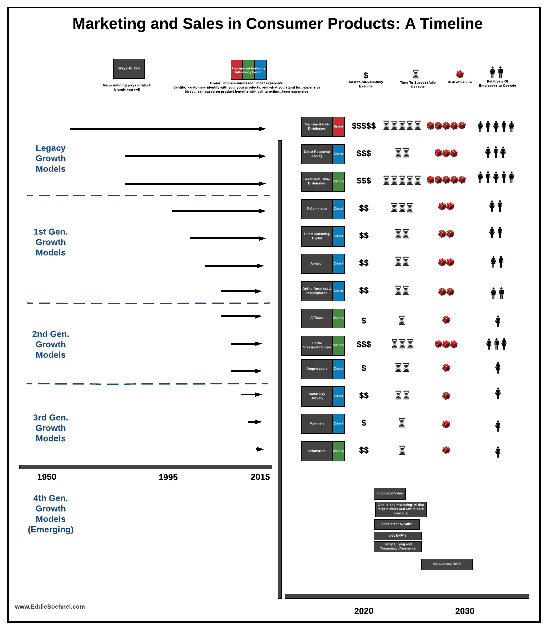
Predominant marketing influencing factors The three predominant marketing influencing factors are direct marketing (product centric), brand marketing (reputation centric), and grass roots (identity centric). Direct (product) marketing is you appeal directly to individual customers through advertising that has calls to action to purchase your product. In this method, you have to demonstrate the superiority of your product to get them to act. 👈👈 The customer may not know you so you have to sell them on your product. This method tends to be cheaper to use to generate sales and has immediate response so you know if it is working or not, but relies on a truly superior product that captures attention. Brand (reputation) marketing is you appeal indirectly to individual customers through advertising that emphasizes maximum impressions so that as your customers see your ads more and more, they will remember to purchase your product when they have a need. In this method, you are relying more on your reputation from previous products or advertising to get your consumers to purchase. This method tends to be more expensive to use to generate sales and also takes time before it works, so you do not know if it is working until time has passed to see if sales are generated. Grassroots (Identity) marketing is when you appeal directly to individual customers through advertising that emphasizes creating a connection with your customers based on what you stand for or what you are trying to do. In this method, customers identify with who you are and what you stand for, which causes them to want to support you by buying your products. This method tends to be more expensive to use to generate sales and also takes time before it works, so you do not know if it is working until time has passed to see if sales are generated.
The Lean & Agile Framework emphasizes direct marketing in the earlier stages of growth because it is cheaper to use, more profitable and carries less risk. 👈👈
Sales models Here is a list of general high-level consumer product sales models to choose from. Legacy growth models Mainline retail distribution: develop, produce and sell a product through traditional brick and mortar retailers. Direct response analog: develop, produce and sell a product through traditional direct response (TV, radio and print infomercials) with call center order fulfillment and direct to consumer shipping. Grassroots retail distributors: develop, produce and sell a product through traditional small distributors to smaller retailers in fragmented channels. 1st generation growth models E-commerce: develop, produce and sell a product through your online website/store. Direct digital marketing: develop, produce and sell a product through online advertising. Amazon: develop, produce and sell a product through Amazon’s marketplace. Online resellers & marketplaces: develop, produce and sell a product through other online marketplaces. 2nd generation growth models Affiliates: develop, produce and sell a product through online affiliates. Affiliates promote your product for you to their audience (website visitor, newsletter subscriber and social followers) Social grassroots online: develop, produce and sell a product through social (getting likes, follows, etc). Dropshippers: develop, produce and sell a product through dropshippers. Dropshippers are like affiliates, but instead, they setup their own storefronts and send the order to you for you to fulfill. 3rd generation growth models Same-day delivery; develop, produce and sell a product through Amazon marketplace for same-day delivery. Funnels: develop, produce and sell a product through sales funnel approaches. Funnels are a particular type of e-commerce cart that leads buyers through the sales and e-commerce process with value-added offers designed to ascend the buyer up a value chain. Influencers: develop, produce and sell a product through influencers with email lists, social followers, or other mass appeal. This is similar to affiliates but influencers are more like celebrities or popular personalities that people follow for entertainment purposes, whereas affiliates tend to get followings due to some sort of utility they offer. 4th generation growth models New growth models that appear to be emerging.
The Lean & Agile Framework emphasizes direct marketing selling direct-to-consumer via shipping through more progressive methods listed that are cheaper to successfully execute, take less time to successfully execute, have lower risk of failure, with less headcount and overhead to operate, and offer higher profit margins over legacy models. 👈👈 This is not to say that the more brand and grassroots centric approaches are not important; they may be, but later in a company’s stage of growth when there is proof of concept, recurring sales and cash flow to support these more expensive methods. The Lean & Agile Framework is designed to let a company operate using any of the methods listed, except for future methods that are as yet to be developed. In this case, the Framework tries to anticipate what needs to be built into the company now to effectively operate and compete in environments that will have those future methods. The above is a post: https://edsoehnel.com/consumer-product-growth-strategies/
Virtually any product can now be shipped and is being shipped. There is no longer any reason why a startup has to go straight to retail on launch, considering that direct-to-consumer offers much higher profit margins. Consider retail later once there is traction and cash flow to afford retail. 👈👈
What sales models might you start with and why and which ones might you adopt later and why? Just list some general reasons based on what you know about your idea and your category. You can refine this later as you learn more. Based on which models you select and their timing, what kinds of resources will you need to execute them (monetary and expertise).
Additional growth strategies
Revolutionary products that create clear points of differentiation
vs.
Evolutionary products with subtle points of differentiation
High margin, high quality and possibly less volume
vs.
Low margin, lower quality and greater volume
Niche product plays
vs.
Mass market product plays
Required spend (ex: food)
vs.
Discretionary spend (ex: entertainment)
The lean & agile framework is focused on helping startups achieve sales and staying power. As a result, it emphasizes and teaches growth strategies in the left column. The assumption is that most consumer product startups do not have a lot of cash, so this framework seeks to generate growth based on that assumption. If a company has cash to invest in growth, then it has more flexibility in the kinds of growth strategies to utilize. As the company grows, it can adopt strategies that are more evolutionary product, less margin, volume driven in more mass market categories. This framework is designed to accommodate that. Required vs discretionary spend is harder to pinpoint because what one customer thinks of as required, another thinks of as discretionary. Having a lot of cash to invest in an opportunity is very dangerous. It just allows you to dig a bigger hole, faster that you can’t climb out of and in my personal experience, increases the potential for failure. I argue that you are better off with limited cash to start. Once you get traction, sales and growth and have worked out the kinks in your operation, then that is the time to consider investing for lots of growth. Test thoroughly before you invest! 👈👈
Stakeholder Matrix
See https://docs.google.com/document/d/1qzYPuzYkfY2cY8Q3naGuXT9bmZjxZXDKr8nUOjLaJkY/edit?usp=sharing
Why is this a good business opportunity for ME?
After running through all the above exercises, step back and answer this question from the perspective of not just your professional goals, but also your personal goals and needs. What does it fulfill for you personally? Why are you doing this? What will you have to sacrifice to start your own company? Are you prepared to do that? There are always sacrifices and tradeoffs to anything we do in life.
Goals
Once you have developed big picture items listed above, set goals. Goals are designed to help get you closer to your vision. When you break down your vision into smaller chunks - or goals - they are easier to think about and accomplish rather than trying to tackle a big vision or objective. You are more likely to succeed when you break things down into smaller goals. You can set as many goals as you want, but don’t overwhelm yourself; try to set goals and timing for completion around some core elements, like product development, product launch, marketing and sales, revenue and net income. You could then further break these goals down into quarterly goals. Do the best you can with the information you have.
Dream, Plan, Evaluate and Ship Here’s another way think about setting goals: Dream in years Plan in months Evaluate in weeks Ship daily Prototype for 1X Build for 10X Engineer for 100X What is required to cut the timeline in half? What needs to be done to double the impact?
As you get further into the framework in Section 2: Systems, and Section 3: Product Development, you will get more information so that you can come back to this section to refine your goals and timelines.
An explanation for how goals works with vision, mission/values, culture and strategy: http://edsoehnel.com/vision-mission-values-culture-goals-and-strategy/
SMART is a common framework for defining goals. A SMART goal is: Specific – Target a specific task, area or metric for improvement. Measurable – Includes a clear quantifiable measurement of success. Assignable – Includes who will own the goals. Realistic – The goal should not be impossible. Time-specific – There should be a clear deadline or timeline.
Scorecard
Get use to measuring and tracking. The framework uses a lot of measuring and tracking. It is well-know that whatever gets measured, tracked and reported is more likely to improve. 👈👈 One way to measure and track that is useful in this section is via a scorecard. 👈👈 Score yourself along the following areas on a scale from 1 (none) 10 (a lot):
Business: Cash to fund your business and growth Non-cash resources to help grow your business (people, free legal help, space to work, etc) Knowledge and expertise to know how to grow your business Personal: Family or other personal responsibilities
Think about what your North Star metric is for the business. Define it and quantify now, as it can align your entire business to that metric. See section 2 for discussion about this metric.
You can add as many other areas as you want based on your own situation. These are a few general ones to get you started. The goal with this scorecard is to find out where you are now relative to what you need to build your business, which feeds back into your goals.
Decision Making, Problem Solving, Risk Analysis, Managing Distractions
Putting it all together and final thoughts on strategy
You have to have flow in this entire Strategy section. Who you are and what is deep down inside you should manifest into your business, your products, your actions, your operations and your brand. 👈👈 When this is aligned, it becomes easier to do it because your company is an extension of you. 👈👈 You are not compartmentalizing or putting up false fronts or trying to be someone else and creating something that is not you. 👈👈 If you do not have alignment, eventually you will lose. Maybe your company is successful, but you might lose your happiness or you might lose your purpose. And life is too short to try and make your money then go do what you really want to do or what your purpose is. You will have more happiness and I argue, much greater impact on this world when your company is just an extension of who you are. 👈👈 With alignment, it will make it much easier to bring and sustain passion for your biz, especially during the tough times. See “Emotional_journey_of_anything_great” 2018👈👈 With alignment, you will be empowered, which is where you are at peace with what you want to do and you will have much less fear and trepidation, and much more confidence, grit and resolve. When you believe 100% in what you are doing without any doubt, that translates into very powerful forward motion and hard work becomes a lot easier and fun. 👈👈 Misalignment should make you question why you are doing what you are doing. You may still want to or need to move forward without alignment, but knowing that will help you anticipate the difficulties associated with misalignment. 👈👈 James Clear wrote: “Find a game where the probabilities favor you and keep taking shots.” The game where probabilities favor you is one where your interests, passions and talents collide. This section should help you better understand yourself, your strengths and weaknesses, what distracts you and trips you up from moving forward, where you are at (the Scorecard) and what you need to build your business. 👈👈 This section should help you define your broad growth strategy. 👈👈
When I ask people who are successful what is the one thing that they owe to their success, most say it comes down to this: try a lot of things, fail at most, but through all those failures, you find a few that succeed. 👈👈 See https://edsoehnel.com/the-secret-to-business-success/
Do your best to complete this Section 1. You may find (at least for me) that as you especially work through Sections 2, 3 and 4 of the framework, you will get more details and intelligence into your business and may need to revisit this section 1 to make adjustments or major changes. 👈👈
How this section works with the other parts of the framework is that you set an overall growth strategy (balanced with risk analysis), which guides your work in your systems, products, product development, marketing and sales (all tactics), which all feeds into your budgets and forecasts. 👈👈 If you do not like what your budgets and forecasts are telling you, then you will at least have to go back to adjust tactics, and may have to go further back to change or refine your strategy, which trickles back down into your systems, products, product development, marketing and sales. 👈👈 It is a dynamic and iterative loop that is constantly in motion. 👈👈
When starting out with a business idea, I use the Framework headers in one document as a g guide and start dumping information into the appropriate section. See the document here: https://docs.google.com/document/d/1N70yL5rduFuKIWjNI0iAbnn0sujyF5CdRf0twy3vNyw/edit?usp=sharing
Key Strategic Pitfalls
Looking back at all my past ventures, I have distilled down three very key things that either caused my past businesses to fail or not reach their full potential. They are as follows: Timing Either too early, or too late, but timing risk can be minimized via the next; Runway Not enough runway to help maximize potential, which can result from not enough cash/investment, spending too much too early or spending on the wrong things, or unrealistic expectations about when success should occur. Play the long game, always. That is where people win. Even if timing is too early (the market is not there yet), or too late (market mature with lots of competition), having enough runway and companies can usually pivot accordingly to get it right . Personality misalignments, greed, fear and ego Personality We covered it above. Make sure anyone who is involved in the business has the right personality mix and skill set for their job. Greed Gets in the way where people get too greedy and look out for themselves more than the business. Minimize this risk through incentives that help motivate the right behavior. Fear Can play a role where people do not act out of fear when they should act. Minimize this risk through incentives that help motivate the right behavior. Ego Social standing and rejection. People are afraid of making mistakes and being wrong in the context of how it will make them look towards others. It can be fear of failure, but deeper than that, it is fear of rejection because of that failure. As a result, they strongly trend towards making decisions to protect their reputation, position, status/social standing. Irrelevance. People feel pride in gaining knowledge, experience, and senior positions, but when the market changes and their knowledge and experience is not worth what it used to be, or does not provide the value it used to, they are afraid of being cast aside or having to step aside. People have great fear of this and will go to great lengths to protect themselves from becoming irrelevant. Again, its fear of rejection. Identity and beliefs. Often people’s work, experience and life history coalesces to form a certain identity. If that identity is threatened, they will go to great lengths to protect it. That is why facts and data can stare people straight in the face yet people will discount them because they do not fit with their identity and/or beliefs. As a result, they make decisions to protect themselves, their identity and beliefs, but which hurt the company. The risks associated with protecting social standing, irrelevance, identity and beliefs can be minimized by creating the proper incentives that will motivate the right behavior that gets people acting in the best interests of the company and not themselves. But people also have to take personal responsibility to always be learning new things and keeping up with what the market needs. Companies can help here through incentives that motivate people to keep learning and progressing forward.