128 KiB
Insights Hub Posts - Last 6 Months
Generated: 2026-06-16
Source tag: External Platform Posts
Unintended Consequences
Date: 2026-06-13
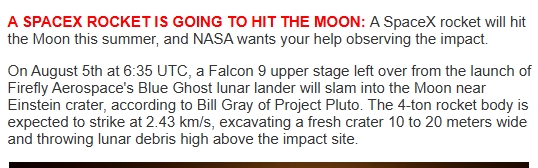
NASA is crashing a rocket into the moon to create a crater, throwing debrit into orbit that could present a future risk to humans and spacecraft who now have to avoid shrapnell traveling at thousands of miles per hour. Gee...what could go wrong.
Does a perfect currency exit? Maybe
Date: 2026-06-12
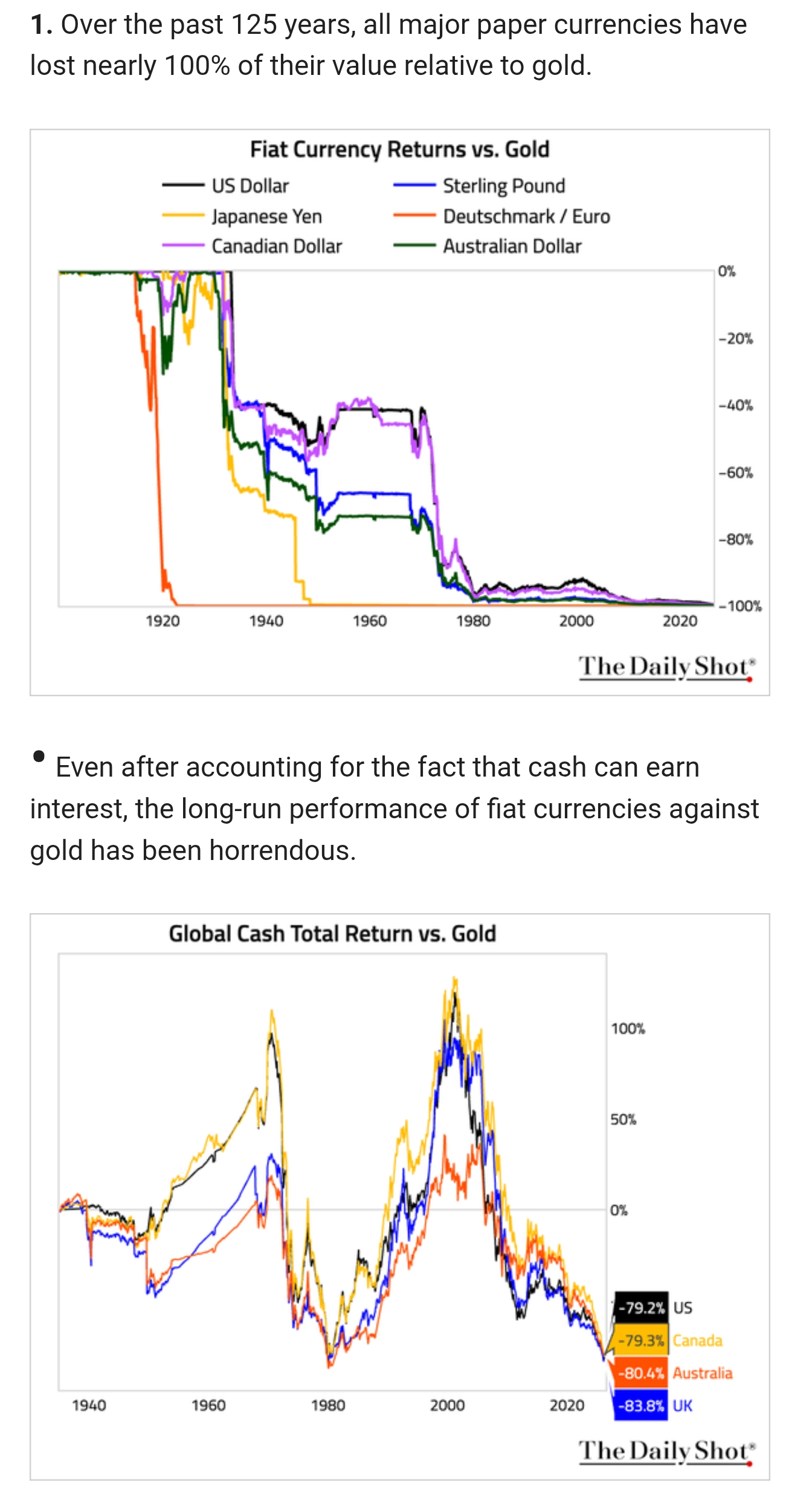
All paper or fiat currencies including the mighty U.S. dollar neer hold their value against other assets. The reason is because governments, including the U.S., print more to primarily fund government debt, which means as more float around, they increase inflation, which means they become worth less and less. No perfect currency has ever existed, including Gold. Crypto is more useless than fiat currencies. Does a perfect currency exist? Maybe. I've seen discussion around using energy, or KwH, as units of currency which honestly, on paper, actually makes sense. I wrote it up for my own understanding here and add to this document when I read something new around the concept: https://docs.google.com/document/d/1Uk13wPyuNwkFU397lGw5jvddsSVr2tckLFtYCQOs3Z8/edit?usp=sharing
AI can replace execution, but not taste...um, no
Date: 2026-06-11
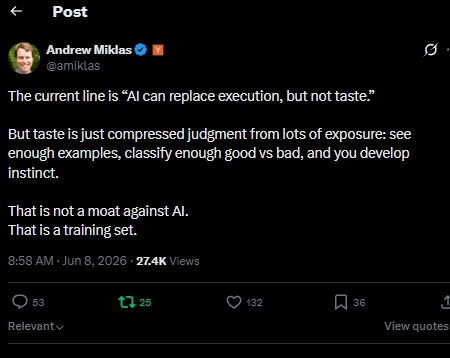
Wow. what a perfectly, succint, brutally truthful and correct answer. I hear this line a lot - AI can replace execution, but not taste - and this post sums up a perfect response. Intelligence, know how, experience, taste - they count for almost nothing in the AI era. It is ownership of scarce assets that are competitively defensible which produce income. And each of us has more than we think...see my framework here to help you figure out your's. https://docs.google.com/document/d/1_citc66qAkKL2IXAuPOvnor9P0hfxQbZ2z8daQnCxNQ/edit?usp=sharing
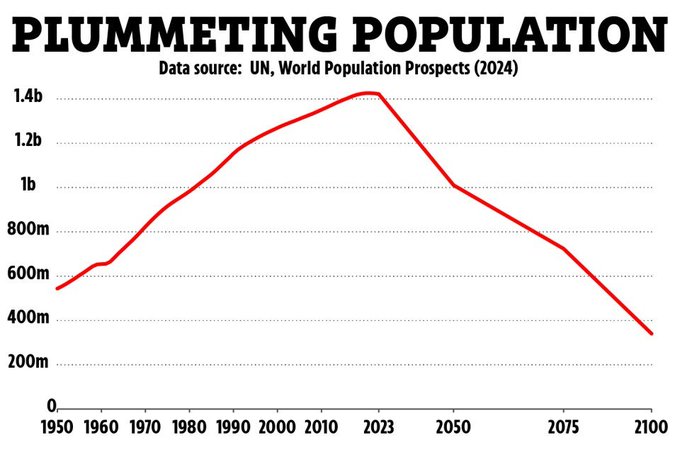
China population decline
Date: 2026-06-11
The math on China's population decline is a loss of 140 million every 10 years for the rest of the century, assuming we start at 1.4 billion now. But we really do not know China's population and I have read that estimates may be closer to 900 million right now. So how does China maintain its manufacturing dominance to a world dependent on it, until the world can reshore on its own? Robotics and automation. So maybe they maintain GDP and output and relative strength in economic capacity. It is looking like decades before the world can reshore, so the hope is China can keep it together before then.
AI boom, crash, then relentless growth
Date: 2026-06-11
It is really import to get different perspectives on the AI boom. I tend to live in the AI boom echo chamber, so I really value people like this author who require us to pause. My take: the potential and demand for AI will arrive (this author does not think so), but the timing could be later, which means valuations cannot support what we have now, which means we have a crash that wipes out investors. That does not mean AI fails - it just means valuations get adjusted. My concern is who gets wiped out - the chumps in this case - and that is likely to be the retail investor. All the new hyperscalers are going public this year, and existing one are already public. The original investors and their market makers will be sufficiently out to have made a killing on their investment. The retail public is their exit strategy. Amazon is a perfect analog: went public, then fell ~95% in the bust, took 10-years to recover, then did incredible the following 10-years. Great long-term investment, but it wiped out retail investors who did not have the capacity to hold on for decades to see their investment pay off. I think the same story repeats again. https://www.wheresyoured.at/ai-is-slowing-down/
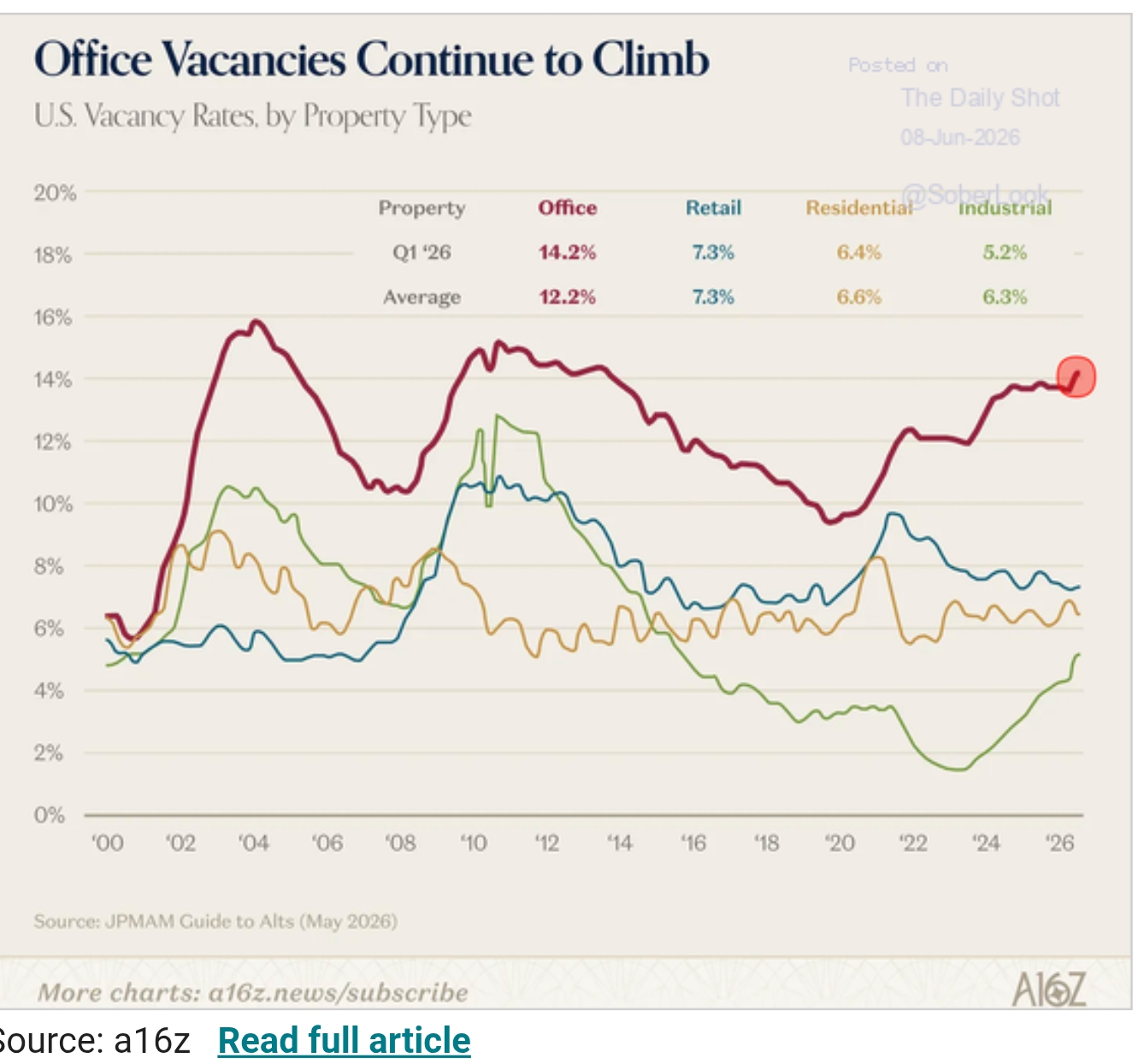
Real Estate Vacancies
Date: 2026-06-10
No surprise we're needing less office space and I expect that to continue as AI reduced employment goes down and entrepreneurship goes up. A shame that manufacturing is also climbing as well. We lack effective government policies to turn this around and Asia is just too strong at present for us to try and recover more.
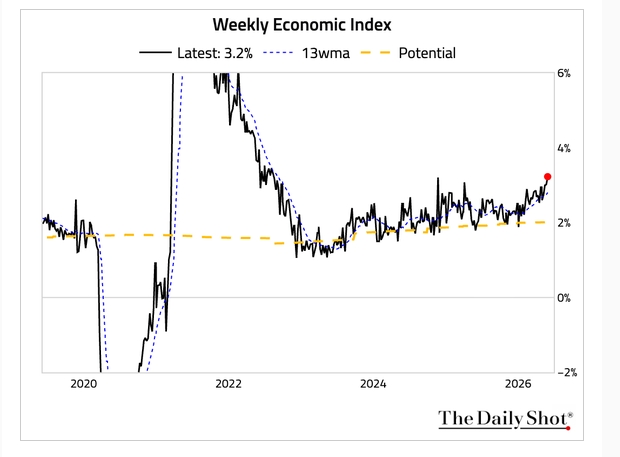
Weekly economic index strongest growth since 2022
Date: 2026-06-08
This is in aggregate, so some sectors like tech and the top 10% of income earners are motoring along and pulling the rest of the economy along.
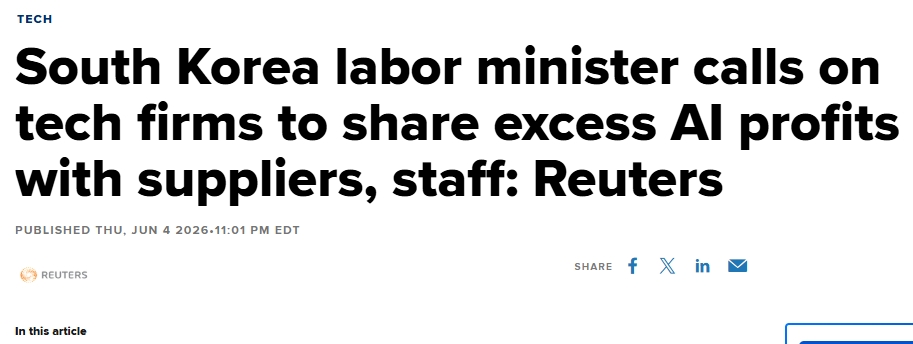
Tech firms called to shared AI profits
Date: 2026-06-08
It is not just in the U.S. but elsewhere where backlash against AI is occuring. And its not really AI or data centers, is the profits flowing to the few, leavingh behind the consequences to everyone else. Wealth inequality...that is the root issue.
AI taking jobs is playing out
Date: 2026-06-08
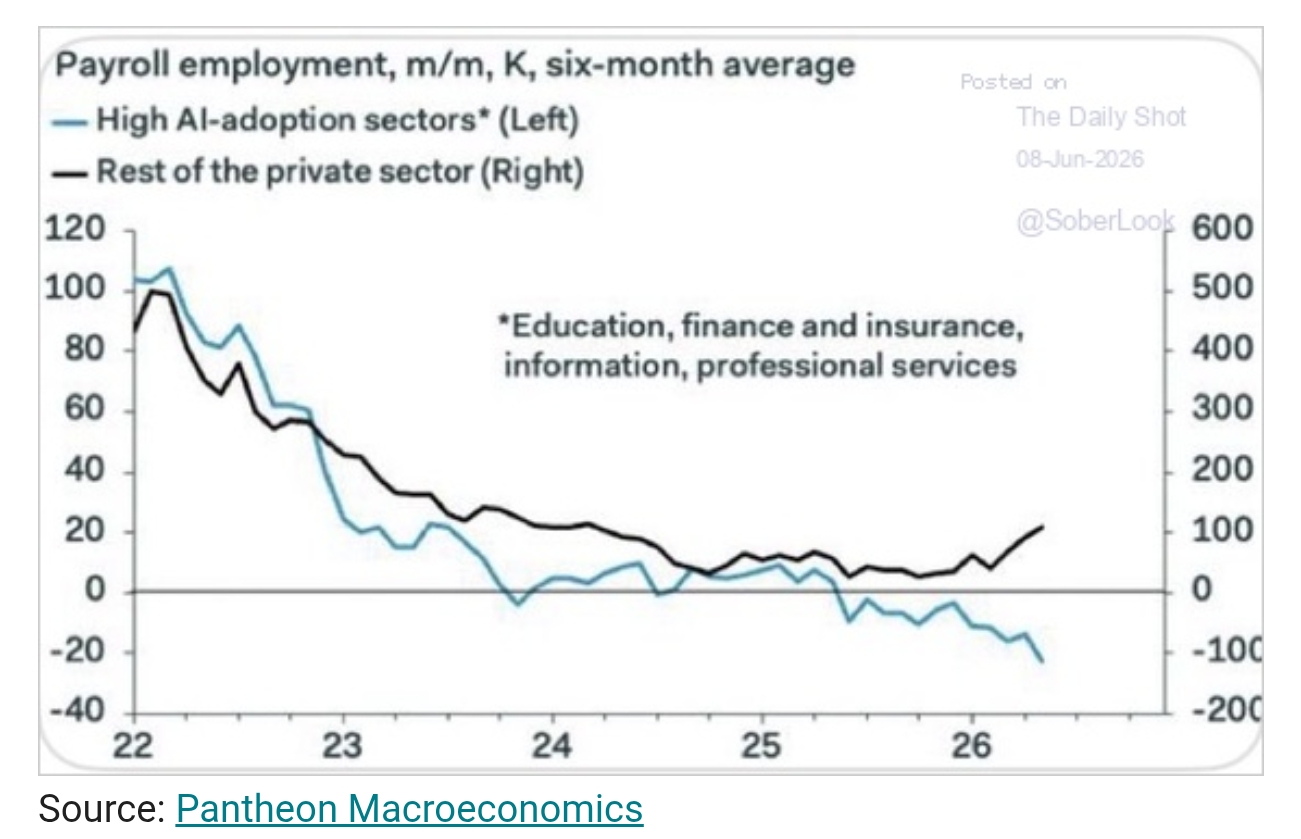
So far this is playing out as has been predicted the last few years - AI is eliminating jobs in sectors where it is being adopted. And it will happen to the other sectors as well. So many people have jumped on the Jevons Paradox bandwagon, how AI is going to increase jobs. I am not so sure. I think AI is different this time. I think AI will force more entrepreneurship and reduce jobs. We become business owners and asset owners, not employees. Net net I think we will benefit broadly, but the transition is going to be rough, as jobs evaporate and entrepreneurship lags. I've posted recently uptick in business formation and anecdotally, I see in my circles that many people are creating new business with AI. So, the transition is underway, but it will be rough (already is for job seekers).
Who's the chump?
Date: 2026-06-08
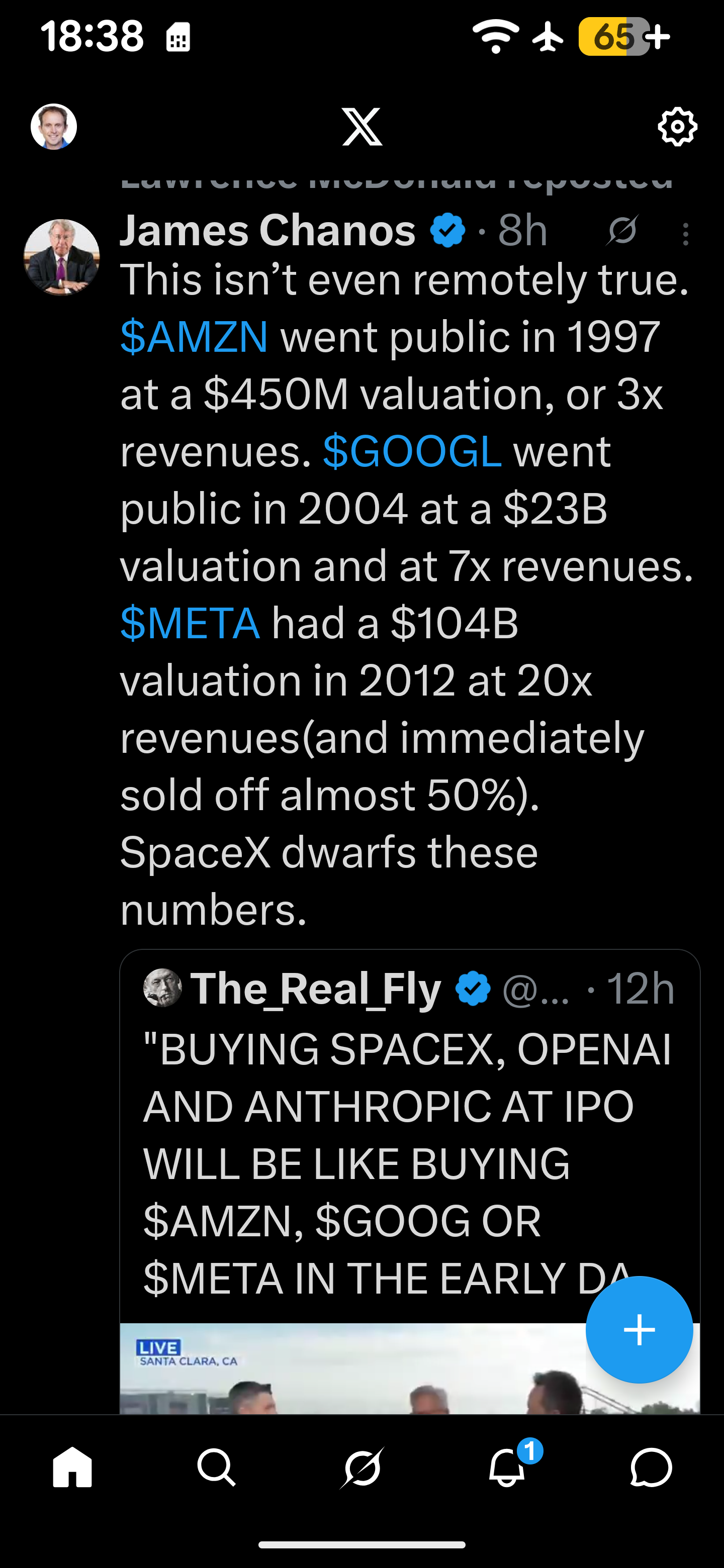
I'm starting to feel like the chump in this story. I learned a long time ago that when everyone is on the same side of the boat, the risk of capsizing goes up, and the hype around a SpaceX IPO is at a level I’ve never seen in my lifetime. The original investors, market makers, and funds don’t really care because they get paid regardless of what happens after the stock starts trading. That leaves retail investors, who often end up being everyone else’s exit strategy—the chumps. A chump, after all, is someone who is gullible, easily deceived, or easily taken advantage of. If someone truly wants exposure to SpaceX, it may make more sense to wait until the lock-up periods expire, the smart money has had a chance to exit, the stock inevitably takes a hit, and then consider buying at a much lower price.
Global demand destruction upcoming?
Date: 2026-06-07
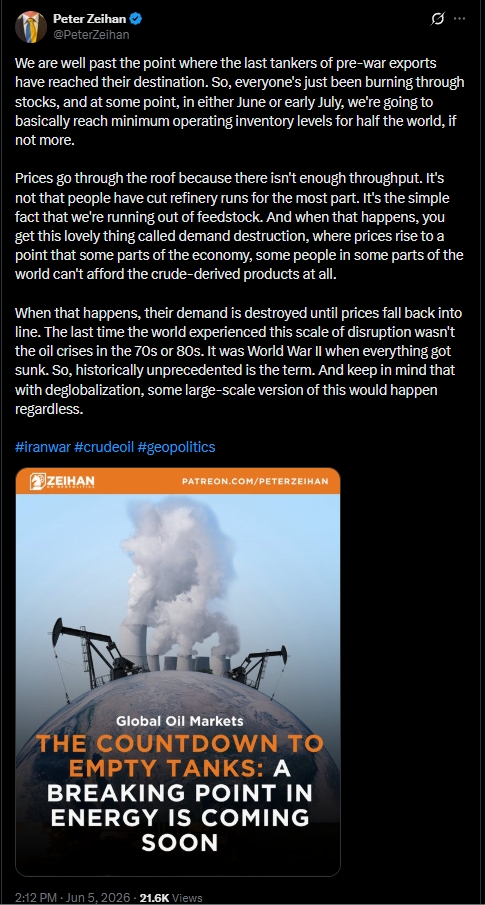
Will the Hormuz disruption trigger a level of demand destruction not seen since World War II? I've seen credible arguments on both sides. Some analysts warn of severe economic consequences, while others—equally respected—argue that the global economy is far more resilient and adaptable than many assume, making such an outcome unlikely. So who will be right? As is often the case, the answer may lie somewhere in between. The coming months will reveal whether this becomes a historic economic shock or another crisis that markets and supply chains ultimately absorb.
Current equity valuation metrics comparison since 1900.
Date: 2026-06-06
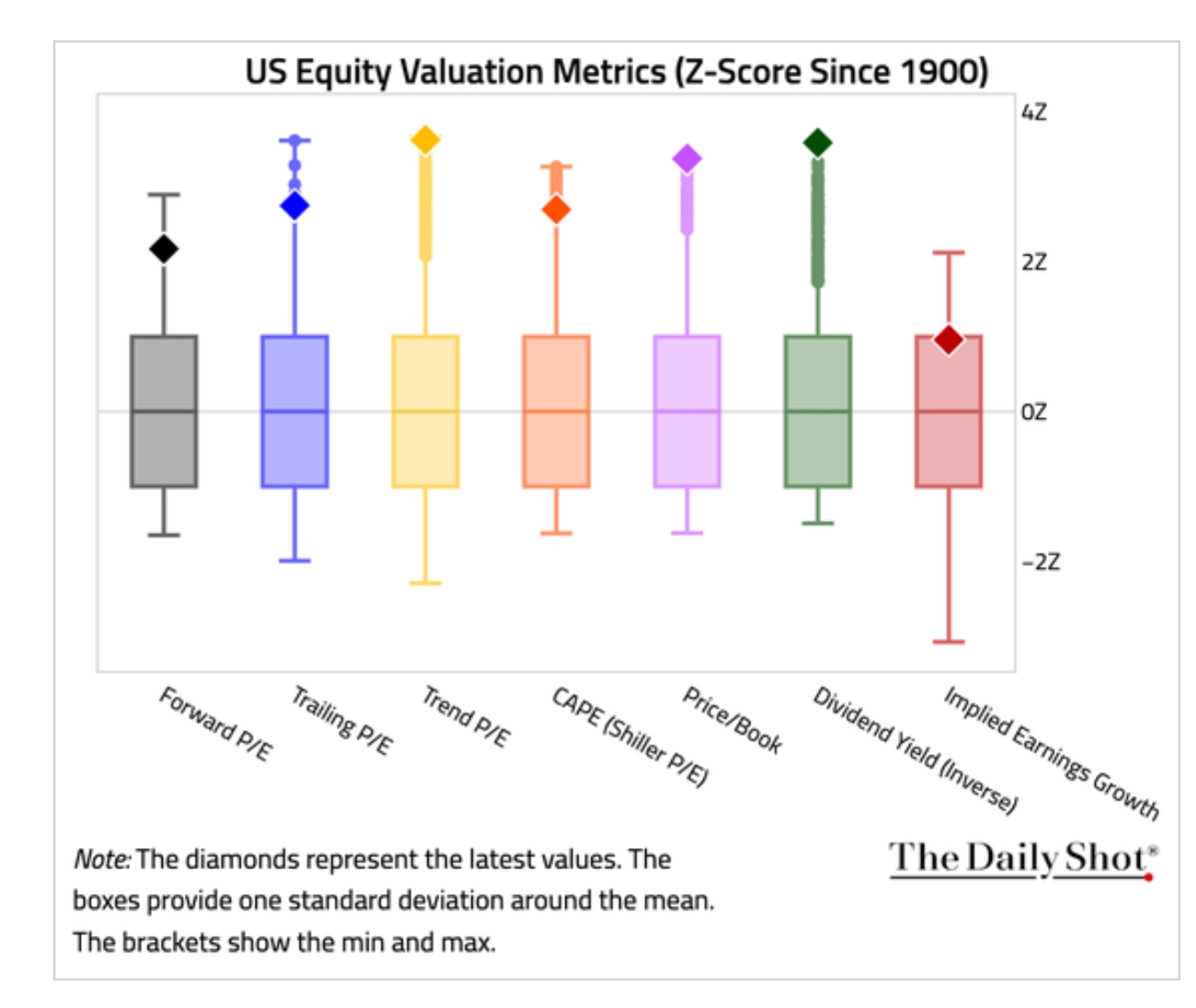
These metrics are crazy. Are things truly different this time, or are we setting up for a painful reversion to the mean in equity prices?
Save compute!
Date: 2026-06-06
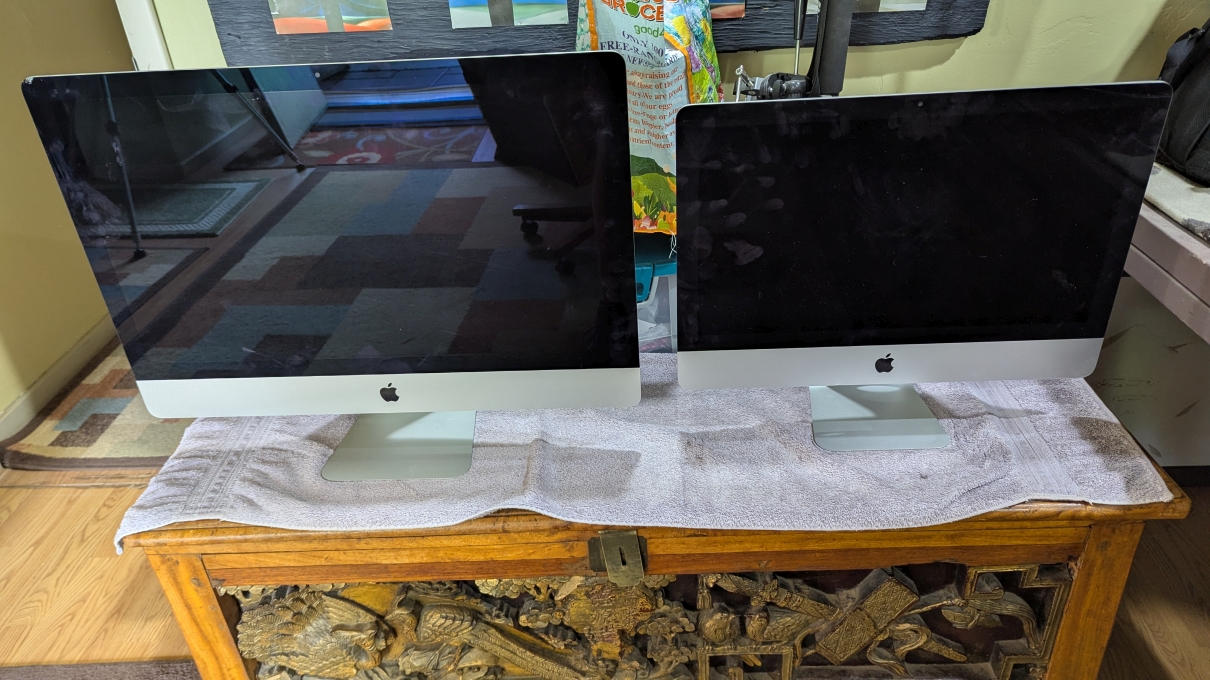
Why am I thrilled to get for free an 11 and 14 year old mac PCs? I put out the word last year to customers of my pet business to give me old computers that are sitting in their closets unused, either because they upgraded or for Microsoft, they got bricked from the Windows 11 upgrade. I turn them into Linux servers and add them to my edge data center I built. Compute is compute - I don't care where it comes from - and we desparately need it. And free comptute is even better. And it is all powered by my own solar array I built, so even old inefficient machines work for me. My oldest machine in my stack is an 2006 Dell Inspiron that can only do basic processing. I name the machines after the dogs in the household where they came from; these are Geneva and Harper. Save your old computers! Turn them into Linux servers to power apps that AI builds for you. Or send them to me. I will put them to good use.
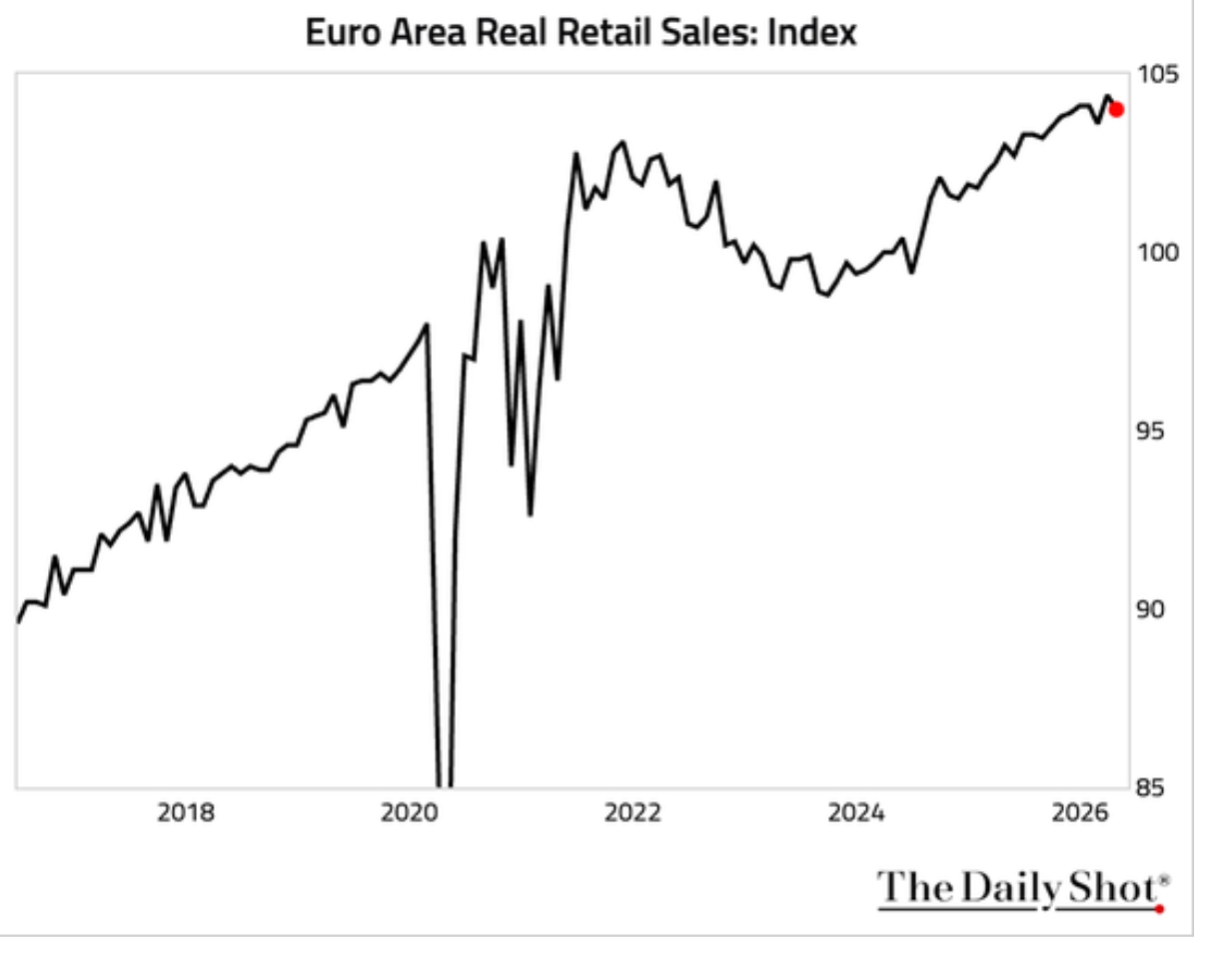
Euro area real retail sales index
Date: 2026-06-06
Interesting the growth curve is the same pre-pandemic, but it has clearly notched down to a lower path.
Low earth orbit is the new control sphere, not oceans; chinese 90% model; rising food prices is what causes wars; the societies with cheap energy, demographic tailwinds, and control of the commanding heights of the tech economy. China. The United States. Parts of South America.
Date: 2026-06-06
See Brave New World Mauldin email June 6 2026 - good article on above key items
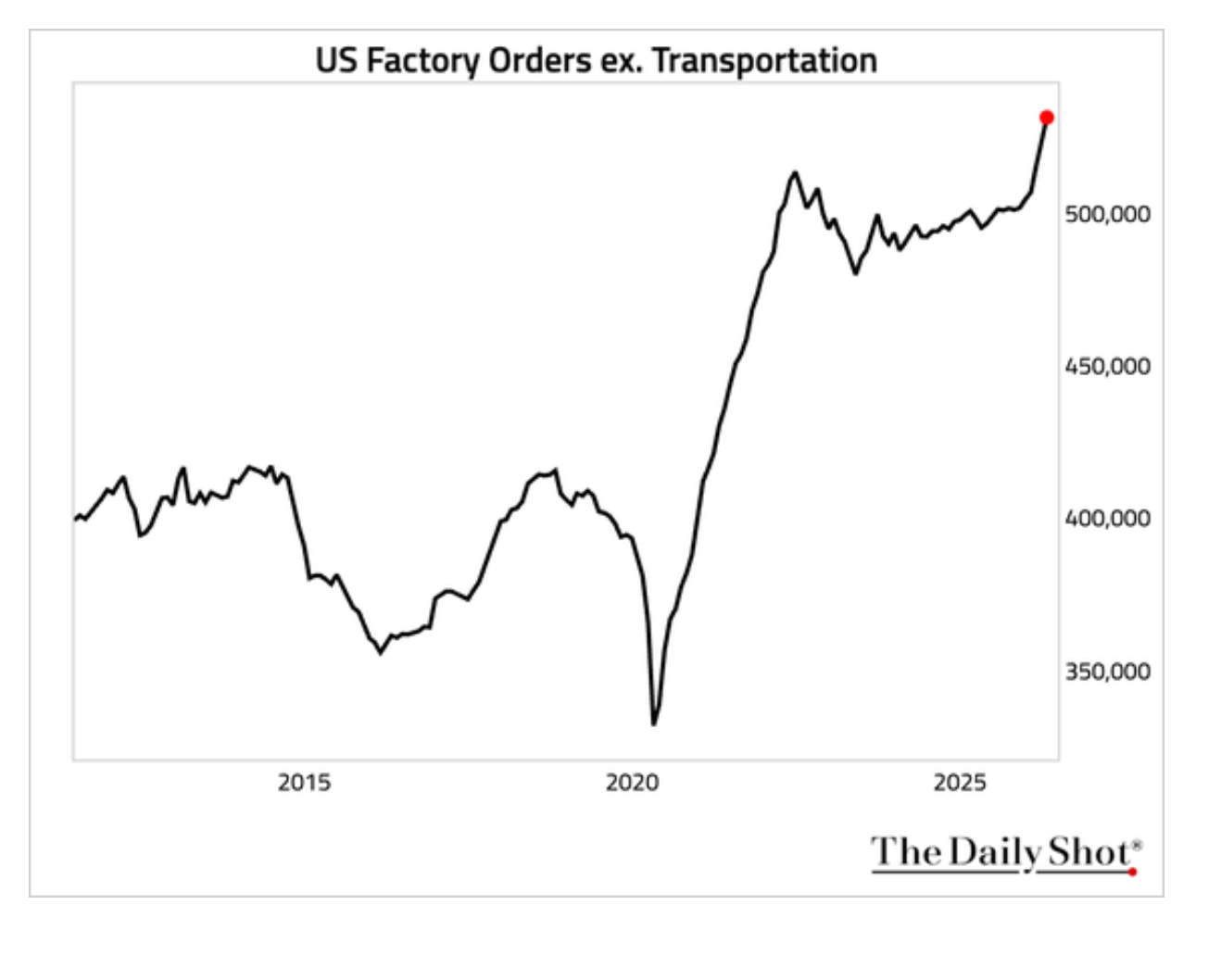
Nominal growth - or actually decline - in factory orders
Date: 2026-06-05
This chart is very misleading on first look. This is nominal numbers, so accounting for inflation over this period, fatory orders would actually be lower in todays dollars versus 15 or so years ago.
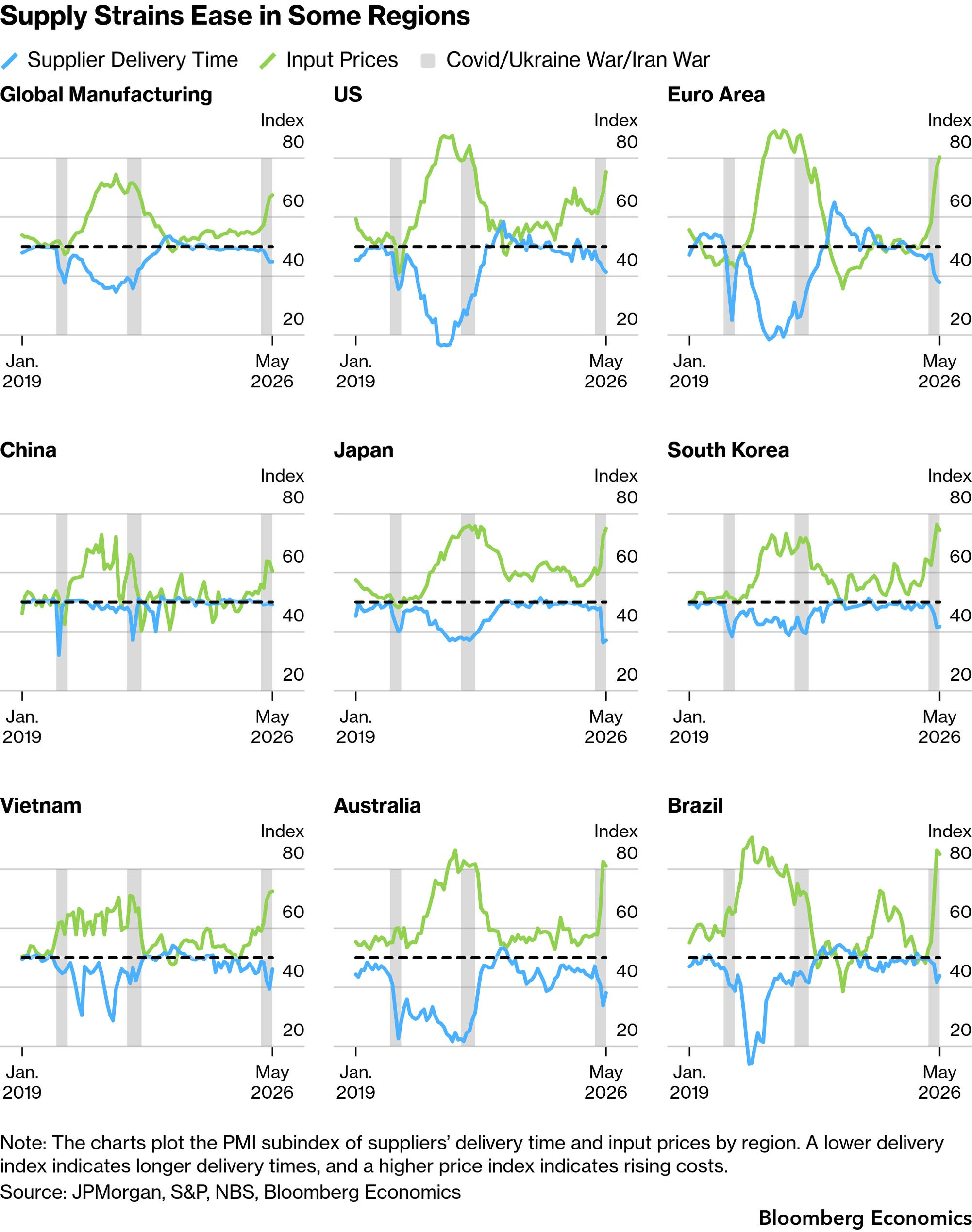
Inflation surge across the globe
Date: 2026-06-05
Input prices across manufacturing surging - less so in the U.S. compared to other countries.
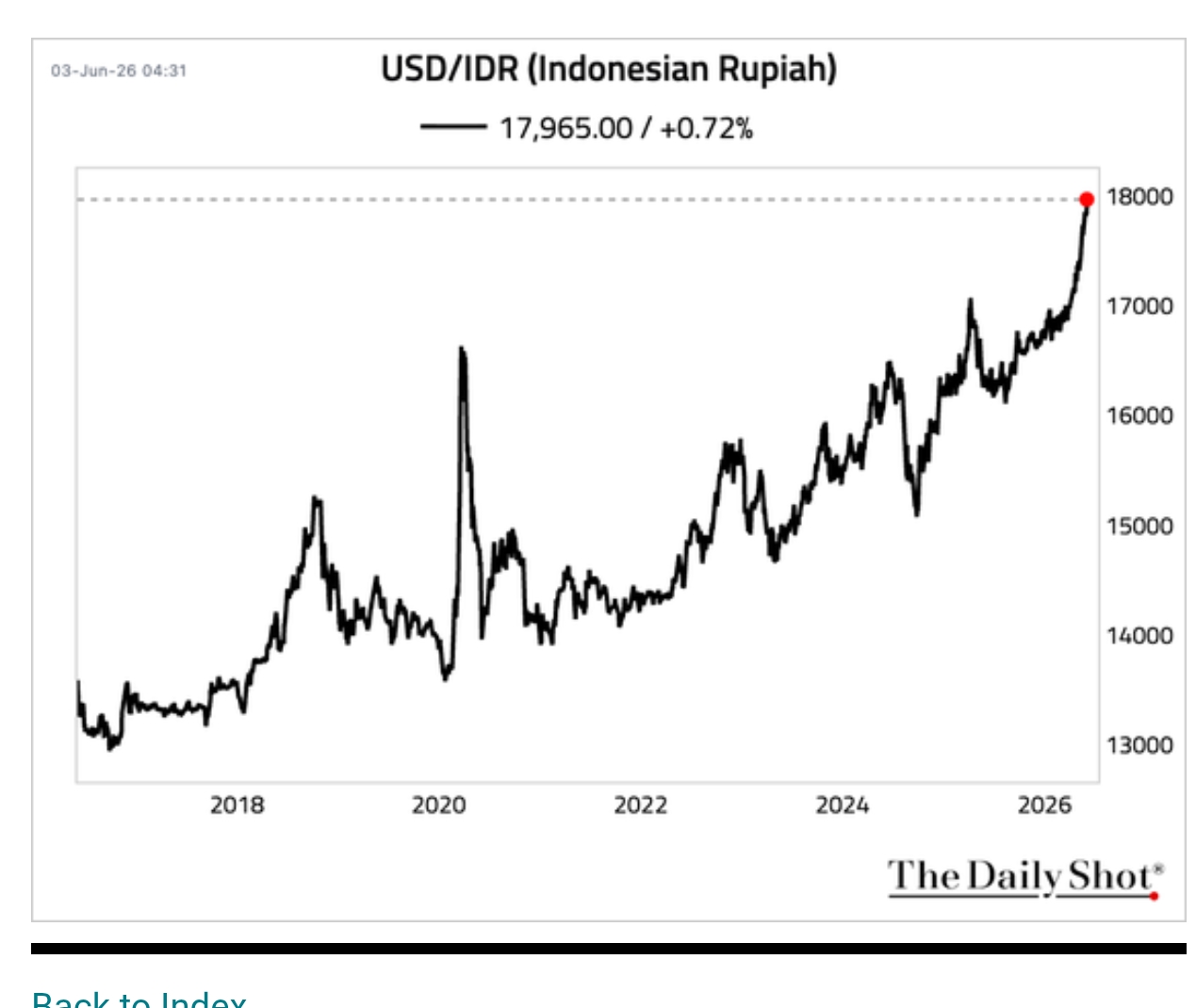
IDR weakening over the long-term
Date: 2026-06-05
The Indonesian rupiah has been on a long-term weakening trend compared to the U.S. dollar. THe country is doing fine generally and a more stable emerging market, but the U.S. just continues to be the epicenter for economic growth relative to everyone else and demand for U.S. dollars is only going up.
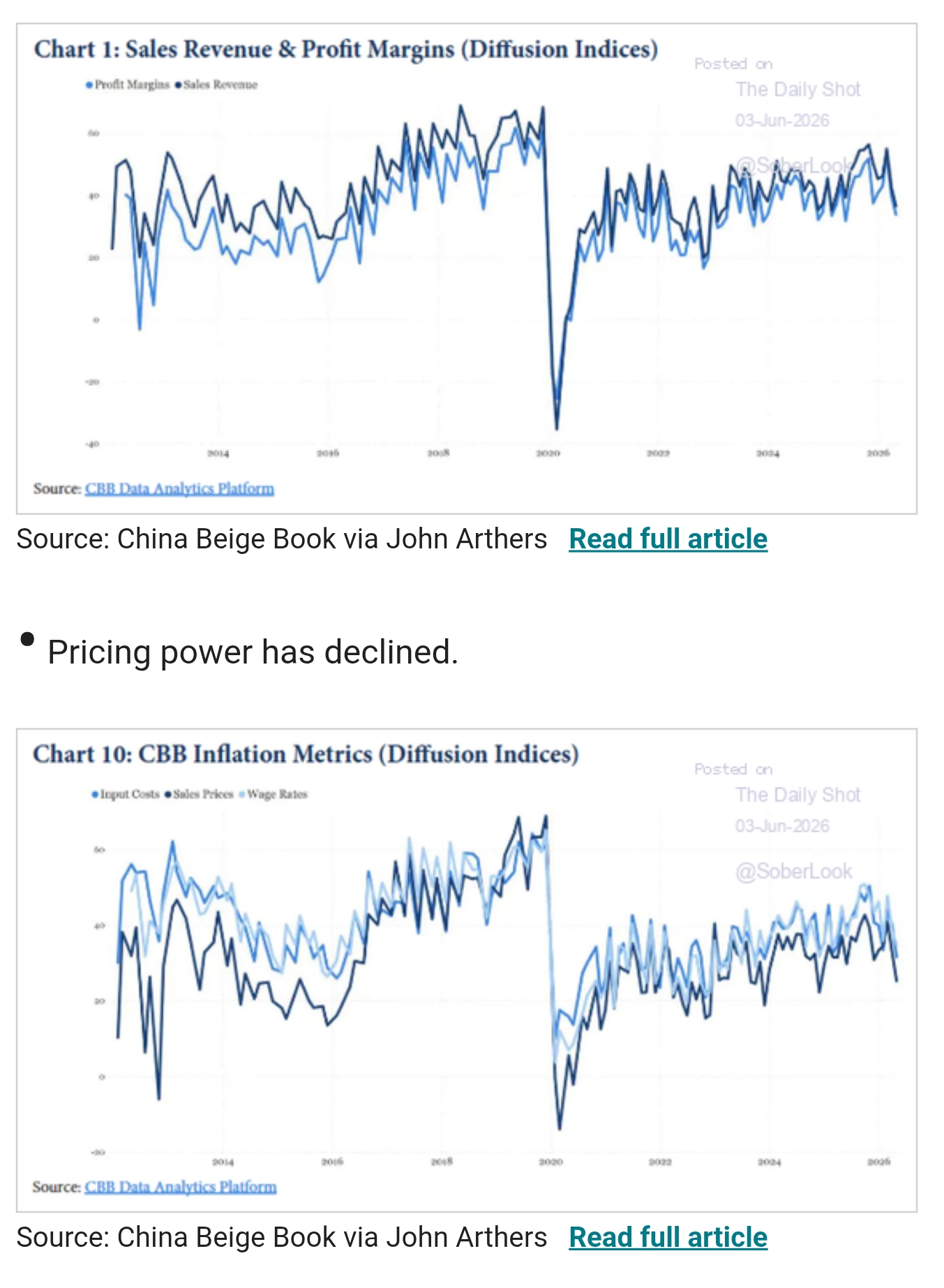
China Beige book revenue and profit margins
Date: 2026-06-04
The world cannot live without China because of its manufacturing, so it is an economy I watch. If they falter, the world can't get products. You never know how truthful data is coming out of China (or even now the U.S., for that matter).
Weekly business formation higher
Date: 2026-06-04
Weekly business formation are higher, likely because of AI, but does not neccessarily mean they are making money and also probably means disruption of existing businesses. So, is AI transforming the economy ? Yes. Will it lead to growth, more income, more meaningful employment? History suggests yes, over time, but the transition will be rough.
S&P 500 margins increasing... a lot
Date: 2026-06-04
Tech has lifted S&P 500 profit margins to record highs. The only industry powering overall U.S. growth right now.
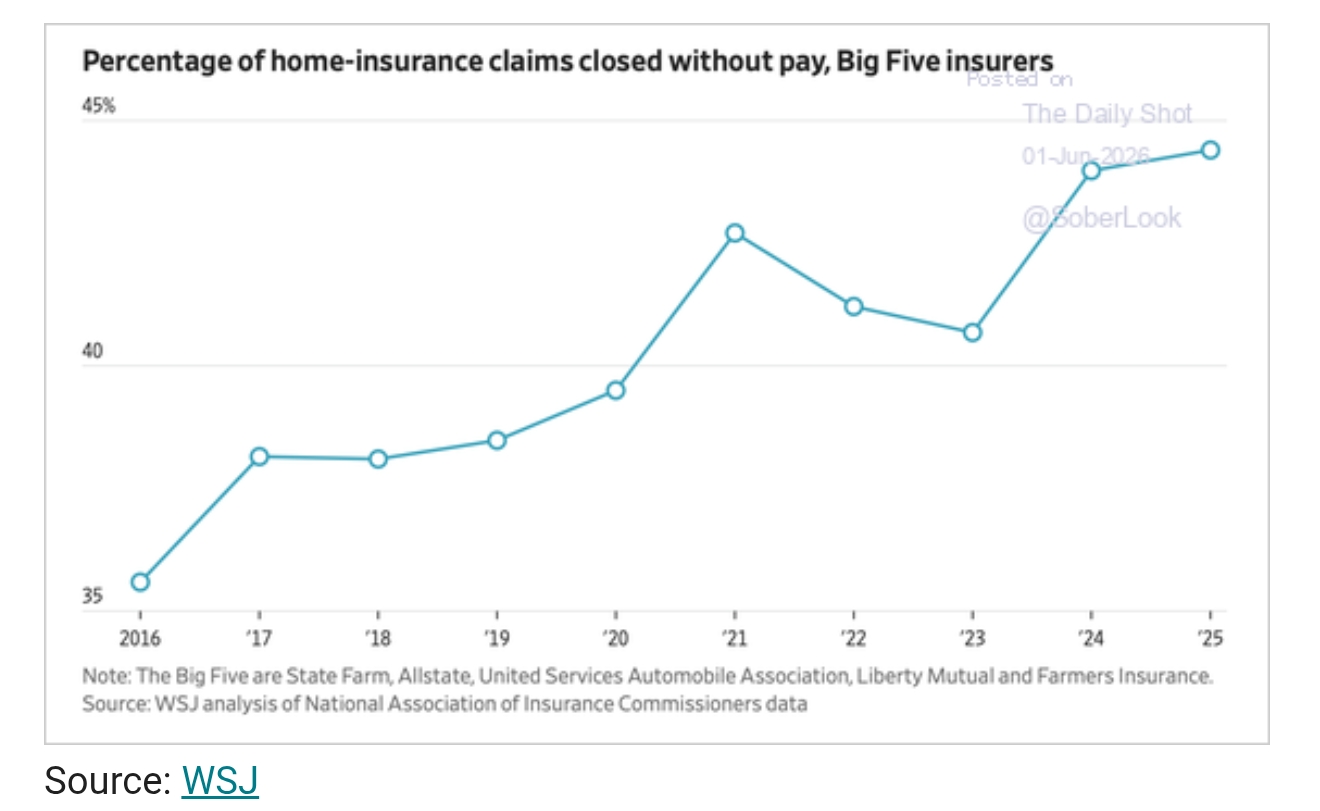
insurance claims that were closed without any payment to the policyholder by the five largest U.S. home insurers
Date: 2026-06-03
Insurance claims that were closed without any payment to the policyholder by the five largest U.S. home insurers, a factor of many things: more weather realted damages, more scrutiny because insurance is a an increasingly tougher business, higher deductibles and losses come in under them, increased use of exclusions and policy limitations, more damage reported due to storm-chasing contractors, fraud.
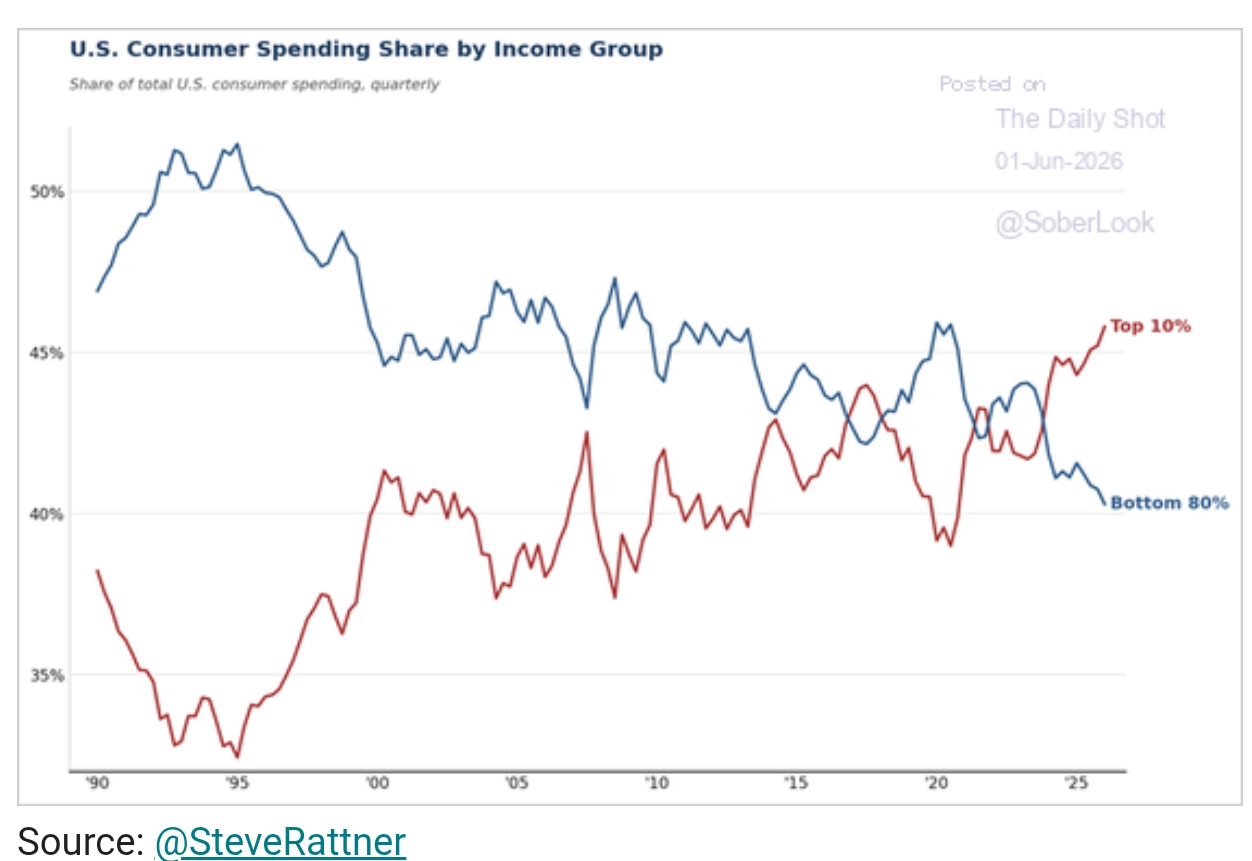
Spending by the top 10% is pulling further ahead
Date: 2026-06-02
A bad trend that shows no signs of reversing. But I have confidence this will get fixed when we realize that the source of our past and future success is a vibrant and healthy middle class, and we are serious about addressing it.
A frothy-market indicator or something different
Date: 2026-05-31
Here we see how much leverage retail investors are using to invest in public markets. Margin balances surged after 2020, corrected somewhat, and are now moving higher again. Is this a sign of frothy markets similar to past cycles and a warning of an impending decline? Perhaps, but I’m not convinced. We are experiencing an explosion of new investment platforms, tools, and opportunities that make it easier than ever for retail investors to participate. At the same time, we may be in the early stages of an economic supercycle driven by emerging technologies—AI, automation, robotics, energy, and other innovations—that increasingly reinforce and accelerate one another. There will certainly be drawdowns and corrections along the way, but I currently lean toward a multi-decade expansionary period rather than a prolonged era of sideways markets or secular bear market conditions.

Mexico and Canada show stagnate growth
Date: 2026-05-25
Mexico and Canada show stagnant GDP growth over the last decade, compared to the U.S., which in aggregate is growing due mainly to the tech boom.
We get hired to solve problems or grow revenue, not completing tasks
Date: 2026-05-20
This article is making the rounds and it gets some things right. Other things not so, because it depends on the industry you are in. My $.02: we no longer get hired to do tasks, we get hired to solve problems that save time and money, or we get hired to grow revenue. That is it. Completing tasks is increasignly the job of AI, not humans. https://auren.substack.com/p/if-you-cant-get-a-job-today-its-your
China's implosion
Date: 2026-05-20
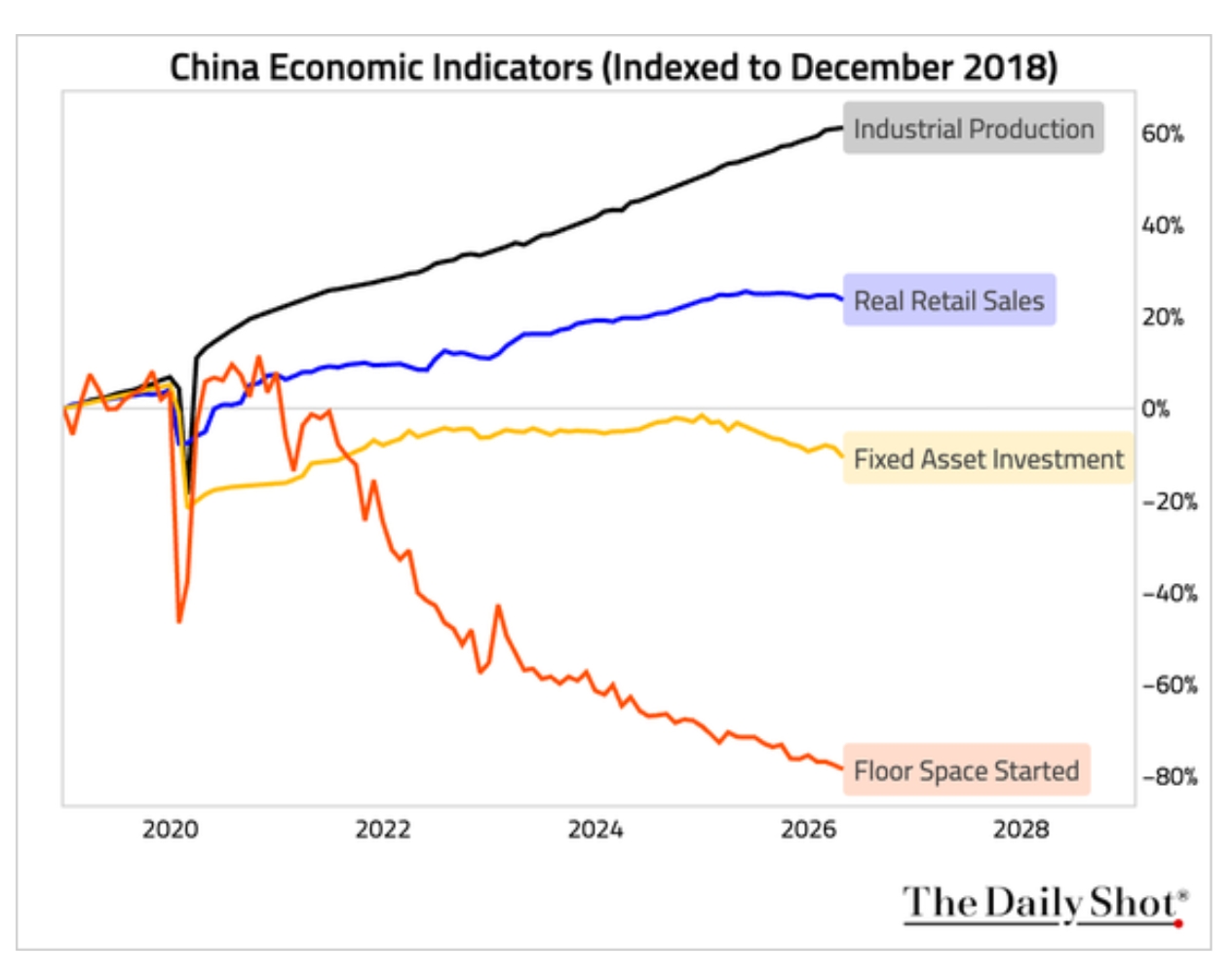
This chart captures China in a nutshell. Exploding industrial production, falling consumer spending, stagnant production investment and a collapsing real estate market. The country is really imploding because of demographics, a property sector that is in decline (again, demographics) massive production capability that cannot be absorbed locally (again, demographics), and a world that is starting to put up barriers to China’s manufacturing to protect local industries. A tough situation for the country. What can it do?
Are we at the start of an investment boom or in the later innings?
Date: 2026-05-20
Investment booms now and then. Two charts here seemingly at odds with each other. One says we are stretched, the other says we still have a long way to go. Who is right? I would lean heavily towards the second chart, even going further and saying we are in the early innings of this investment boom because the late-1990s boom was focused on tech sectors, while the investment boom now is starting to span across all sectors, not just tech. And we have barely started in robots/automation. That in itself may dwarf what we see now.
Weekly analysis from emails of 700+ consumer brands - and a recent pattern emerging described as participation systems
Date: 2026-05-20
5 years ago, I began subscribing to emails from consumer brands into a dedicated Gmail account. Now, I have an agent analyze the last week’s email to surface anything interesting, in context of a playbook I created that tracks emerging strategies, tactics, technologies and business models for consumer brands. Then, I do macro analysis across several months of data to surface any patterns. Here is an interesting analysis that popped up. A clear pattern emerging across the consumer brand landscape is that brands are evolving from simply selling products into building what can best be described as participation systems. A participation system is a business model where the customer is no longer just a buyer at the end of a transaction, but an ongoing participant inside a broader ecosystem of experiences, identity, community, contribution, rewards, data, resale, events, content, or co-creation. This is seen repeatedly in the research and is an extension of experience marketing. Across the industry, brands are increasingly trying to create recurring engagement loops where customers contribute attention, creativity, identity, data, inventory, advocacy, or participation — not just dollars. This shift matters because participation systems create stronger retention, richer first-party data, higher switching costs, more resilient communities, and entirely new monetization layers beyond selling physical goods. In many ways, the product is becoming the entry point into an ongoing relationship system rather than the final outcome itself. I added this to my playbook, with is in this google doc: https://docs.google.com/document/d/1yKLjiqvipAuj4livF-NEDwwFqNIQf191A5tzN9KPA1Y/edit?usp=sharing
Household stress reduction
Date: 2026-05-18
Thus far 2026, our pet business is returning right at average (our goal) in revenue and activity, which is good. We tend to have customers who are less price sensitive and in higher income groups and we have differentiated the business to be unique among competitors. But we are also raising prices on a few product lines to compensate for inflation and recent research suggests we are a bit underpriced compared to the competition. Challenges are managing costs due to inflation, which we do pretty well and last few years, we have dramatically reduced costs because of AI helping us take out the middle of contractors, specialists, SAAS providers, etc.
My website builder open sourced
Date: 2026-05-15
I’ve previously open sourced multiple tools around SEO, GEO and findability in the AI era. I am now releasing a fully working AI-native website publishing system to compliment that. This is not another website builder. The goal is to dramatically reduce complexity, cost, technical overhead, SEO dependency, plugin bloat, and even hosting costs while making websites maximally findable and usable by AI agents and AI search systems. The key insight: most people will not replace WordPress, Shopify, Wix, or existing websites — they will augment them with an AI-native layer optimized for AI discovery and machine readability. Even more interesting, local AI models like Codex and Claude already understand the builder and can help you modify and deploy your own site from simple Markdown content. I believe this is where publishing, findability, and business infrastructure are heading. Open sourced here: https://projects.eddiesoehnel.com/adminprojects/indx-front-website
Household stress reduction
Date: 2026-05-15
Some positive data on household stress reduction. Here we see probability of missing a minimum debt payment over the next 4-months has gone down, after a long uptrend since 2020. I have continued to warn about widepspread economic stress approaching the end of this decade, and we have to be prepared for that. However, I am wondering if that will materialize and starting to think differently as I see new data. It is possible that the long-awaited start of our next economic supercycle has begun. The innovation boom coming from AI is well at hand and just over the horizon, the boom in robotics/automation, which may become the biggest industry ever. These could help smooth out the rough patches coming up as a result of government debt, climate change, wealth inequality and other imbalances built over the last 80-years that need to be corrected. I still expect pain, but it could be more confined to certain sectors rather than the economy-at-large.
Medicare shifting to AI
Date: 2026-05-13
The shift is happening. Health care has to change to lower costs and improve outcomes, and the only way that can happen is with AI. Hopefylly we can leverage AI in time before the system implodes under the weight of government debt, costs, regulations and our addiction to unhealthy food, which drives it all. https://techcrunch.com/2026/05/12/medicares-new-payment-model-is-built-for-ai-and-most-of-the-tech-world-has-no-idea/
China's divergence
Date: 2026-05-13
Interesting chart showing China's industrial production vs its real retail sales. Clearly, China is more and more dependent on industrial production (which gets exported) rather than an internal consumer driven economy, which continues to trend down due to population decline, debt and the fact that China was never able to build a robust consumer-driven economy like the U.S. If the country does not export, it is in serious trouble. Many argue it is already in serious trouble because it has too much manufacturing capacity and no way for the world to absorb it.

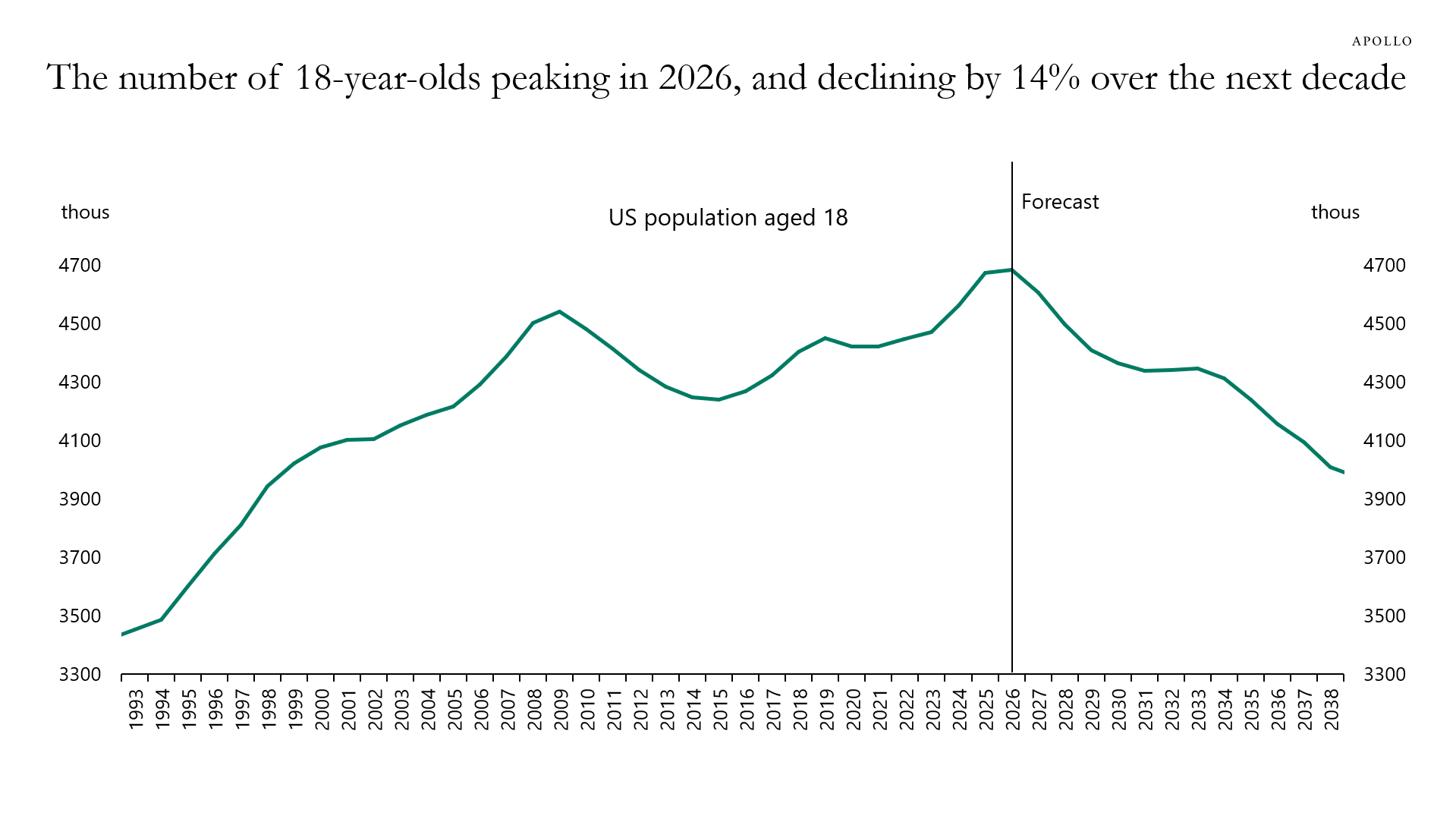
Record High Number of 18-Year-Olds in the US Today
Date: 2026-05-13
I did not see this coming. There is a record high number of 18-year-olds in the US today.
Untitled
Date: 2026-05-10
Do this now. This is so important. Take your AI skill-building to an entirely new level. Download (or, specifically, curl in terminal) this repo, provide read access to Codex or Anthropic on your local workstation, and ask it to analyze the skills in this repo to surface best practices and tempaltes. Even better, if your use git for your projects, give your local AI read access to your local git directory so it has more context on creating a skill template for your needs. Then ask it to help you improve your existing skills in your projects. Huge learnings when I did this. https://github.com/garrytan/gbrain
Untitled
Date: 2026-05-10
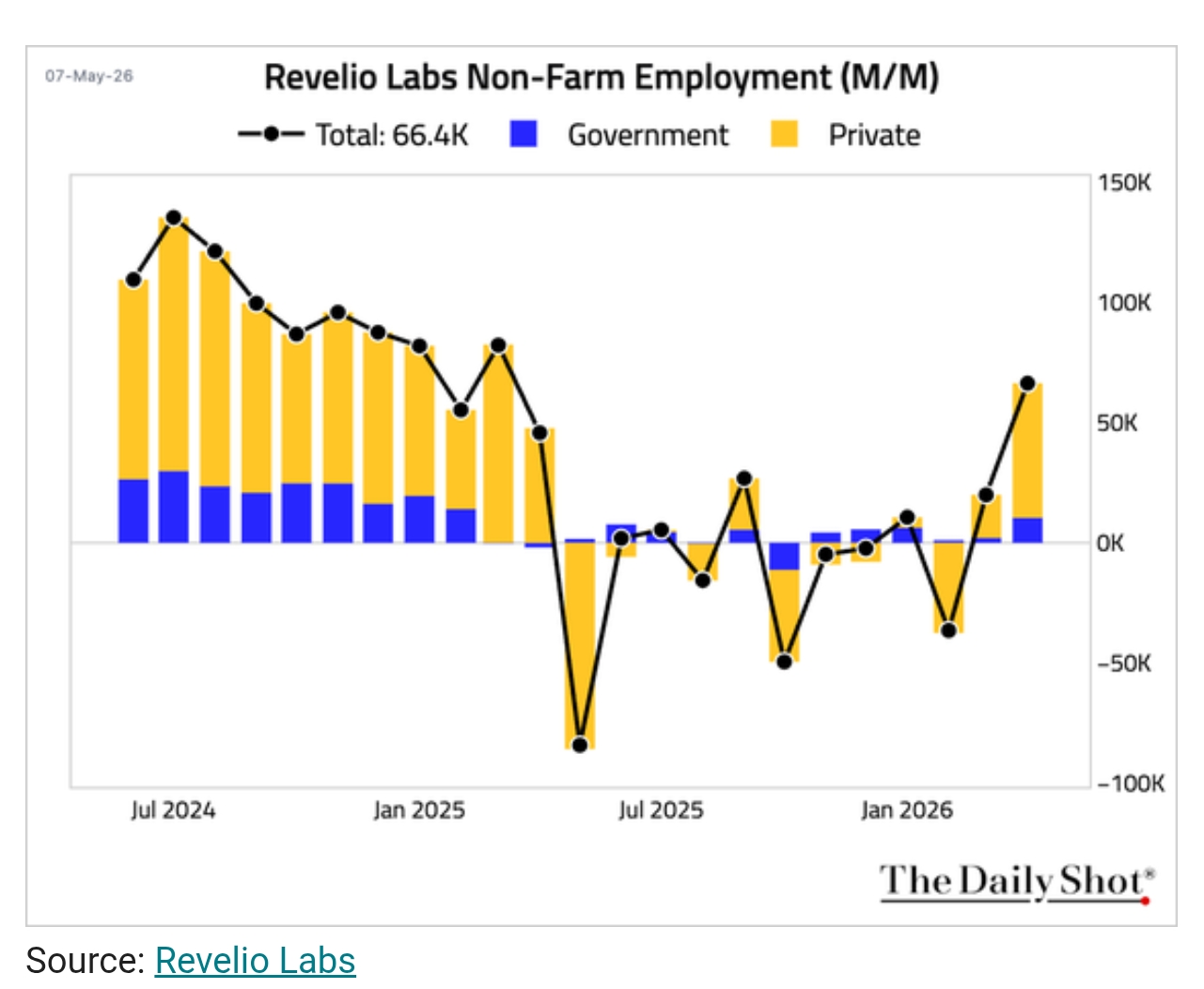
Appears a nice up trend has emerged in nonfarm employment.
Untitled
Date: 2026-05-10
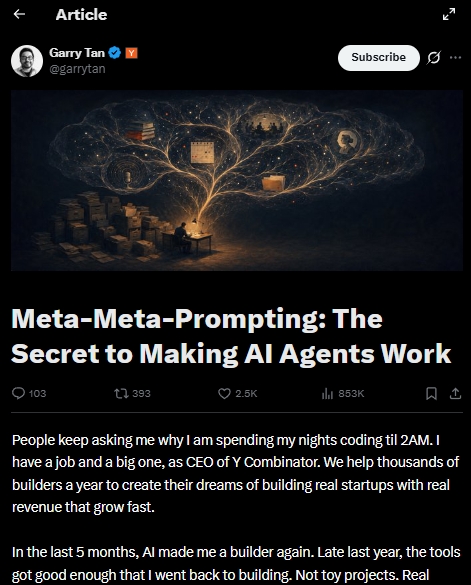
Great project and another great read. There is so much latent value sitting in each of our file and email systems that can now be unleashed. But it is more than that. If each of us can enable this for ourselves, then the next step is our agents start talking to each other, networking at the speed of compute and bringing all that hidden value to light in ways we cannot imagine. Everyone has to start down this path that @garrytan has pioneered. It is how we re-energize our economy and empower prosperity for all. https://x.com/garrytan/status/2053127519872614419
Untitled
Date: 2026-05-04
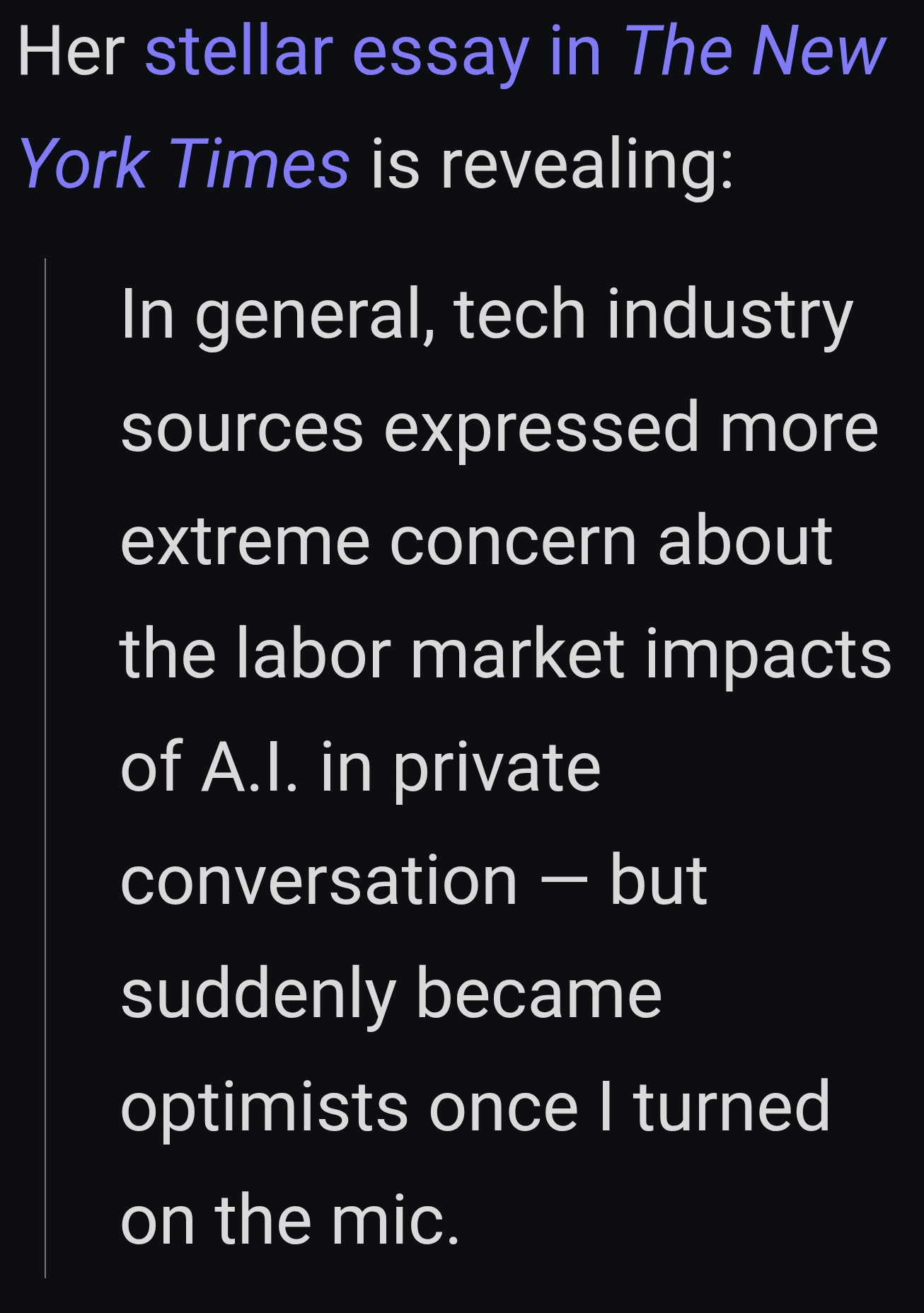
Not just privately but increasingly in public, many technology leaders are raising concerns about the coming impact of AI and automation on employment and communities—especially as economic pressure builds on the U.S. middle class, which remains critical to long-term prosperity. In response, new solution frameworks are emerging, including Universal Basic Income (UBI) and Universal Compute Allocation (UCA). UBI redistributes money generated from productivity gains driven by technology, while UCA reallocates access to compute—effectively converting AI-driven capacity into real-world goods and services that individuals can use directly (for example, accessing an AI doctor for medical care). All of this could be coming fast...like inside this decade.
Untitled
Date: 2026-05-04
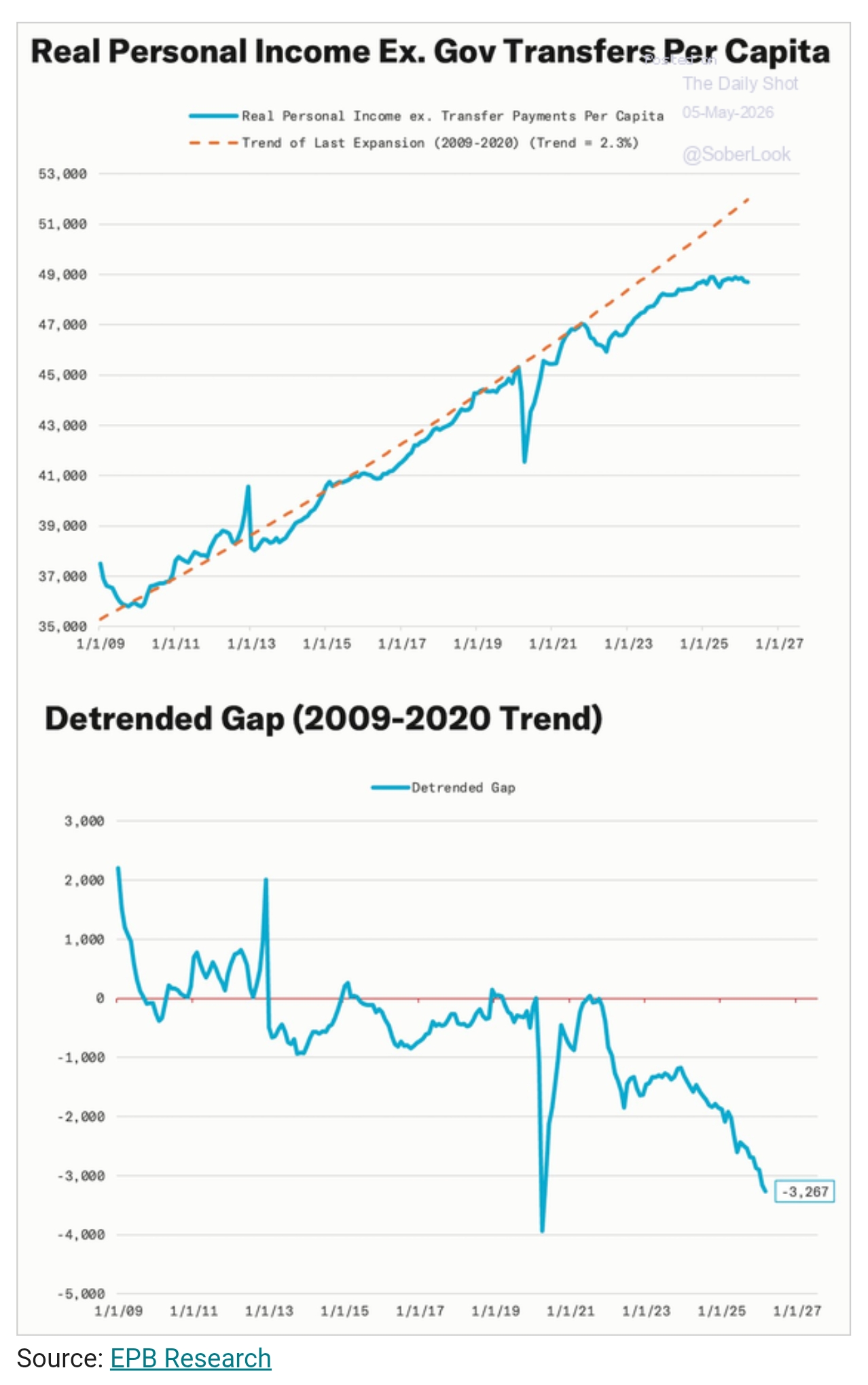
Averaged over each person (per capita), we see personal incomes really slipping vs trend line. The detrended gap shows how far the data is below the hisotrical long-term trend line. And it has been trending down since 2011. Wealth has concentrated, which means income gains have concentrated amongst the top wealth brackets. This is why we have such weak consumer sentiment, pressure on the middle class, political dissatisfaction, slowing discretionary spending and an overall anemic economy. THe only way out of this is to embrace and bring innovation forward, not remain stuck in the past. Innovation is the only thing that will save us - engineer new products/services, create new jobs, fix our climate change, reverse soverign debt. The faster each of us embraces innovation, the faster we get through these difficulties.
Untitled
Date: 2026-05-03
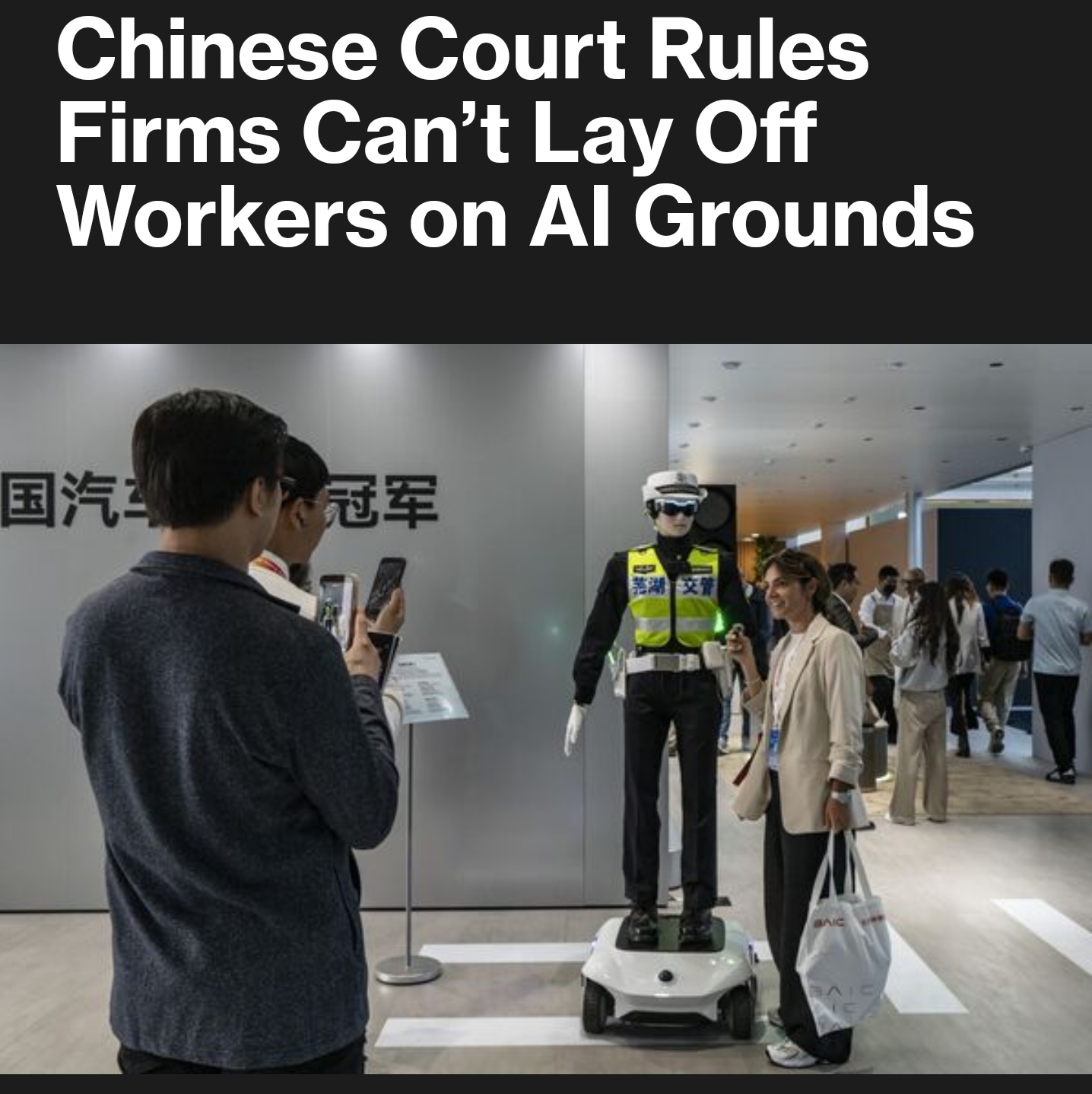
Will courts in the U.S. rule that firms cannot lay off workers on AI grounds, like China? No, not this extreme. But we could very well see a tax levied on firms based on the efficiency gains made using AI and automation, returned to people via a universal basic income (UBI). The dynamics of AI and jobs is that we will see reduced employment as firms shed workers, but a corresponding increase in entrepreneurship as people use AI to create entirely new products and services. We see both happening already.
Untitled
Date: 2026-05-02
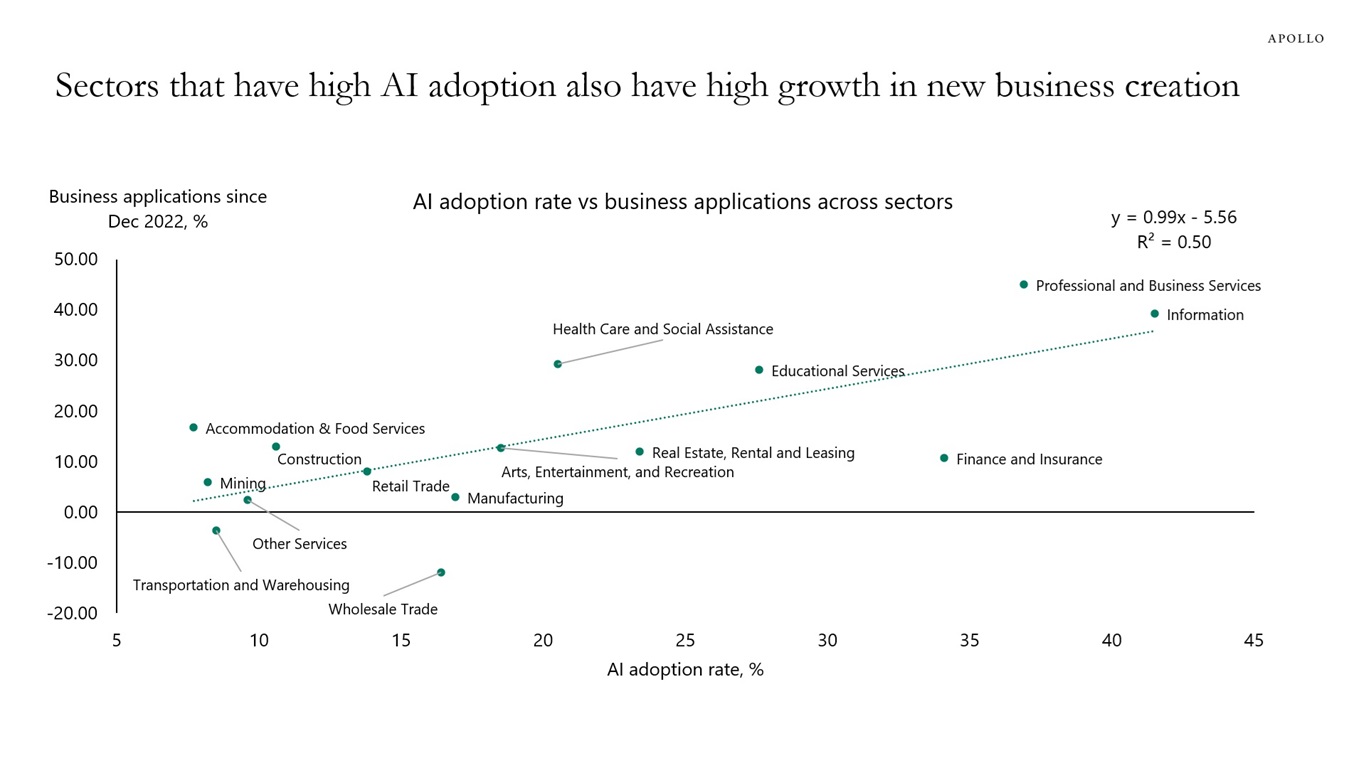
This data shows how AI adoption varies across sectors alongside the range of business applications emerging within each. A clear pattern is forming: higher AI adoption correlates with greater new business formation. As sectors adopt AI, they unlock new products, services, and operating models, expanding the surface area for entrepreneurship. This, in turn, attracts builders who want to create using these technologies.The implication is straightforward: sector growth increasingly depends on embracing emerging technologies. Adoption doesn’t just improve existing businesses; it catalyzes entirely new ones.
Untitled
Date: 2026-05-02
What took months and significant ivestment can now be done inside weeks by anyone. This article points to the risks of automated, AI-driven platforms operated at scale by individuals, which can increase correlations and create system vulnerabilities with agents all move in the same direction.
Untitled
Date: 2026-05-02
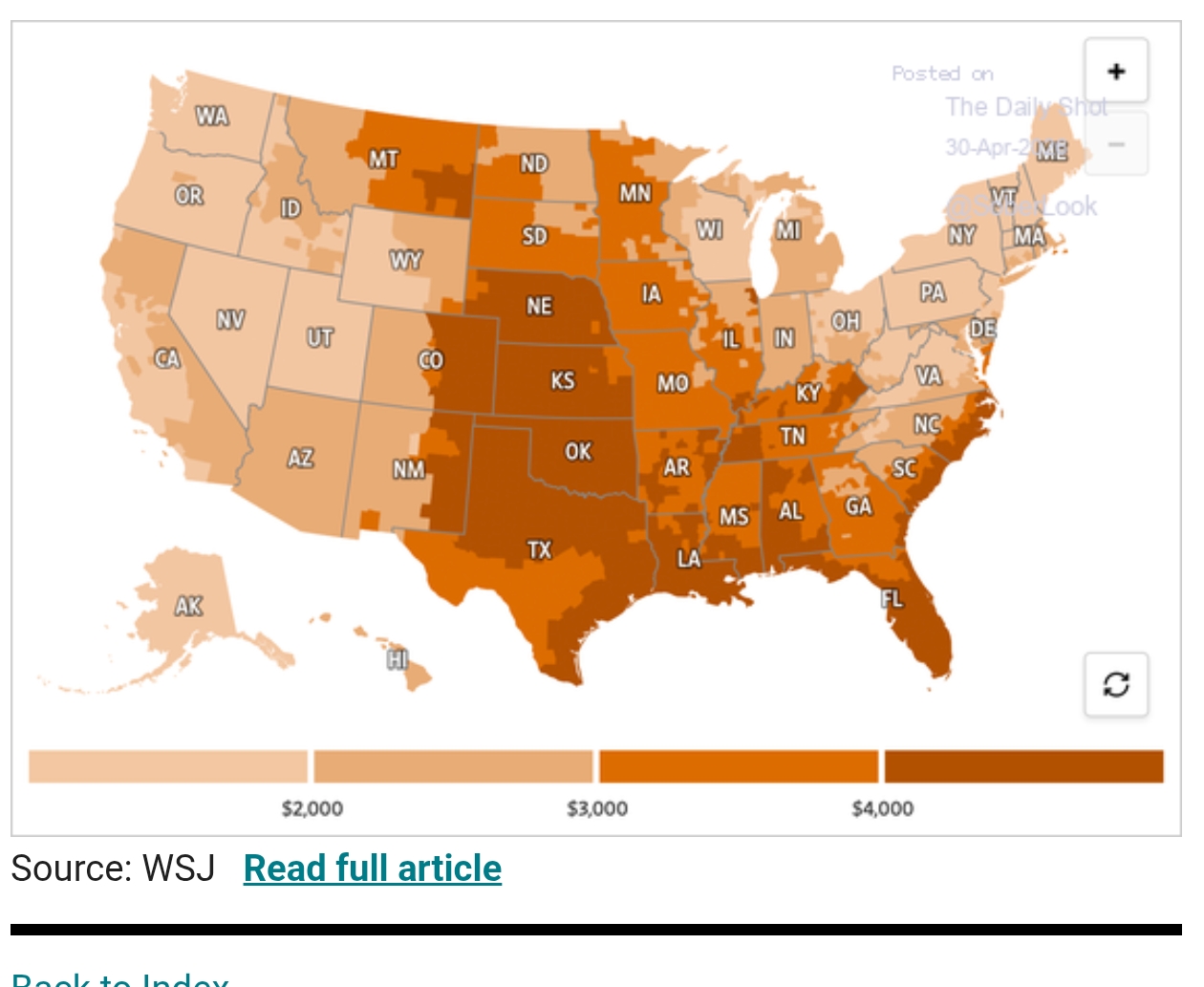
The range of home insurance premiums across states. South and midwest gets amplified by severe storms that have been increasing in these regions.
Untitled
Date: 2026-04-26
Our past and still current (but rapidly shifting) economy was built on labor - employees and capital - money. 85% of the basis for taxes is built on labor (income and payroll). But a tech-based economy means far fewer laborers, which means they will have to become owners and entrepreneurs. We are shifting from employees to owners. But that also means the tax basis has to change dramatically, not just to more corporate taxes, but also there is more and more talk about taxing the efficiencies earned from technologies. A model many are looking at is the Alaska Permanent Fund Dividend (PFD) that distribus annual cash payments to resident from oil revenues. I can see somethiing similar, distributing gains from technology to citizens. https://apfc.org/
Untitled
Date: 2026-04-26
This blow me away. I copied this out of an article: What makes Lila extraordinary is scale. Their AI has accumulated over 10 trillion tokens of scientific reasoning data, generated entirely by AI models reasoning through the scientific method against experimental results. For context, the usable subset of the internet for training LLMs is roughly 15 trillion tokens. By the end of 2026, Lila’s scientific reasoning dataset will exceed twice the size of the internet used to train frontier LLMs. All of it is original scientific thought. And crucially, Lila trains across all scientific domains simultaneously: life sciences, chemistry, materials science, energy. This matters because many of history’s greatest breakthroughs came from cross-domain insights. Penicillin was discovered by a biologist who noticed something strange about a mold. CRISPR was found by microbiologists studying bacterial immune systems. The transistor emerged from quantum physics applied to materials science. Me again. This original data trove is amazing, and so many little startups are doing just this. The innovation explosion is coming the likes we have never seen, not just in medicine, but physics, energy, material science.
Untitled
Date: 2026-04-26
This announcement underlies an enormously important shift happening. Traditional SAAS products with logins and interfaces are being replaced by AI. That is, you tell AI what you want to see, and it goes and gets it and constructs the dashboard you want to see at the time you request it. That means that all that middleware of software that sits between data and the user is becoming less imnportant. The data itself is being rebuilt to reflect who can do what with it and how. More than that, the data is becoming portable, so rather than relying on databases themselves, it is moving to JSON structures that are just files. So rather than have big, expensive SAAS products, it is moving towards modular, far less costly structures that are easier for anyone to use. AI is becoming the operating system and the front end. Imagine your business does not have a website, but just data files and when an AI (or could be a non-AI bot) or a consumer requests your info, it just gets it and displays it. Think of how much cheaper it would be for you to do away with websites and front ends and designing it all? I am starting to make this shift myself, dramatically reducing my costs and complexity of maintaining websites. https://www.salesforce.com/news/stories/salesforce-headless-360-announcement/
Untitled
Date: 2026-04-26
I’ve outlined in my future prediction work that stablecoins represent a new economic layer that will significantly expand global commerce. They enable entirely new products and services that weren’t previously viable. If you want to learn more how you can create new products and services yourself because of stablecoins, review my google doc about the skills and jobs of a future with AI dominating. It has tons of ideas about how to make money in the emerging AI era. This article reinforces the stablecoin trend. Stablecoins are materially cheaper to use, offer faster settlement, and provide greater security than traditional payment rails. Adoption has accelerated, with total transaction volume rising sharply—particularly following the passage of the GENIUS Act last year. While consumer-to-consumer activity still accounts for the majority of volume, consumer-to-business transactions are growing at a faster rate. What is not yet reflected in the data is machine-to-machine commerce—transactions between AI agents—which is likely to surpass human transaction volume within the next decade. Another notable shift: stablecoins have historically been used primarily for cross-border payments due to their cost and speed advantages over wire transfers. That is now changing. Domestic usage is expanding rapidly, with both businesses and consumers increasingly using stablecoins in place of traditional payment methods. https://a16zcrypto.substack.com/p/stablecoins-are-going-local
Untitled
Date: 2026-04-26
Great charts in this short article. The upshot is that the world's value - relfected in earnings - is based on compute. As everything is becoming electrified and is being produced and controled by software and AI, values and earnings are being driven by compute. A company the switches to using compute is able to drive more value and earnings than companies which do not. To keep up, it is not just companies, but consumers must also migrate their lives to compute, because it will drive more income and reduce costs. Compute will also help solve challenges - environmental, health, resource constraints, wealth inequality. The entire value chain of the future is becoming based on compute. https://www.a16z.news/p/charts-of-the-week-software-ate-the
Untitled
Date: 2026-04-26
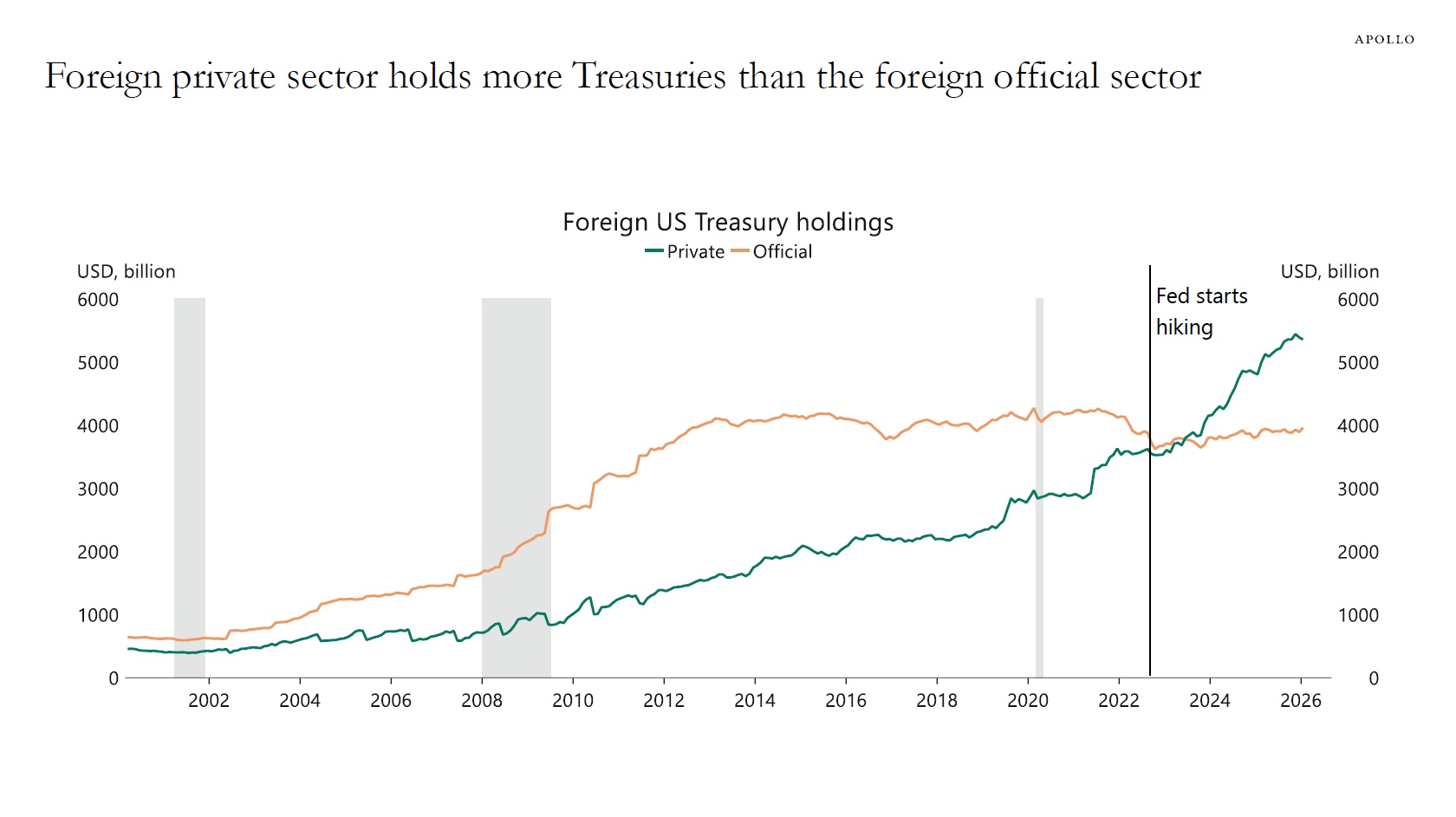
For the first time, foreign private investors hold more US Treasuries than foreign central banks. This makes the treasury market more sensitive to the return expectations of private capital, which is more price sensitive. This means that private capital can demand higher rates from the U.S. government in order to hold its debt, which gets reflected in rates that businesses and consumers pay for debt like business loans and mortgages. Via https://www.apollo.com/wealth/the-daily-spark/foreign-private-capital-has-overtaken-central-banks-in-the-treasury-market
Untitled
Date: 2026-04-25
Automation in product development is moving from the digital world into the physical, driven by AI. Writing code with AI is already standard—now that capability is extending into hardware and real-world prototyping. AI systems can rapidly design, build, and iterate physical products at speeds and scale far beyond human teams. The next phase is full-cycle automation: humans collaborate with AI on ideas, then hand off to systems that prototype, test, and manufacture autonomously. Distribution is automating, too, with autonomous tansportation that includes door delivery using robots in neightborhoods. https://www.corememory.com/p/a-hundred-robots-are-running-a-bio-medra-michelle-lee
Untitled
Date: 2026-04-24
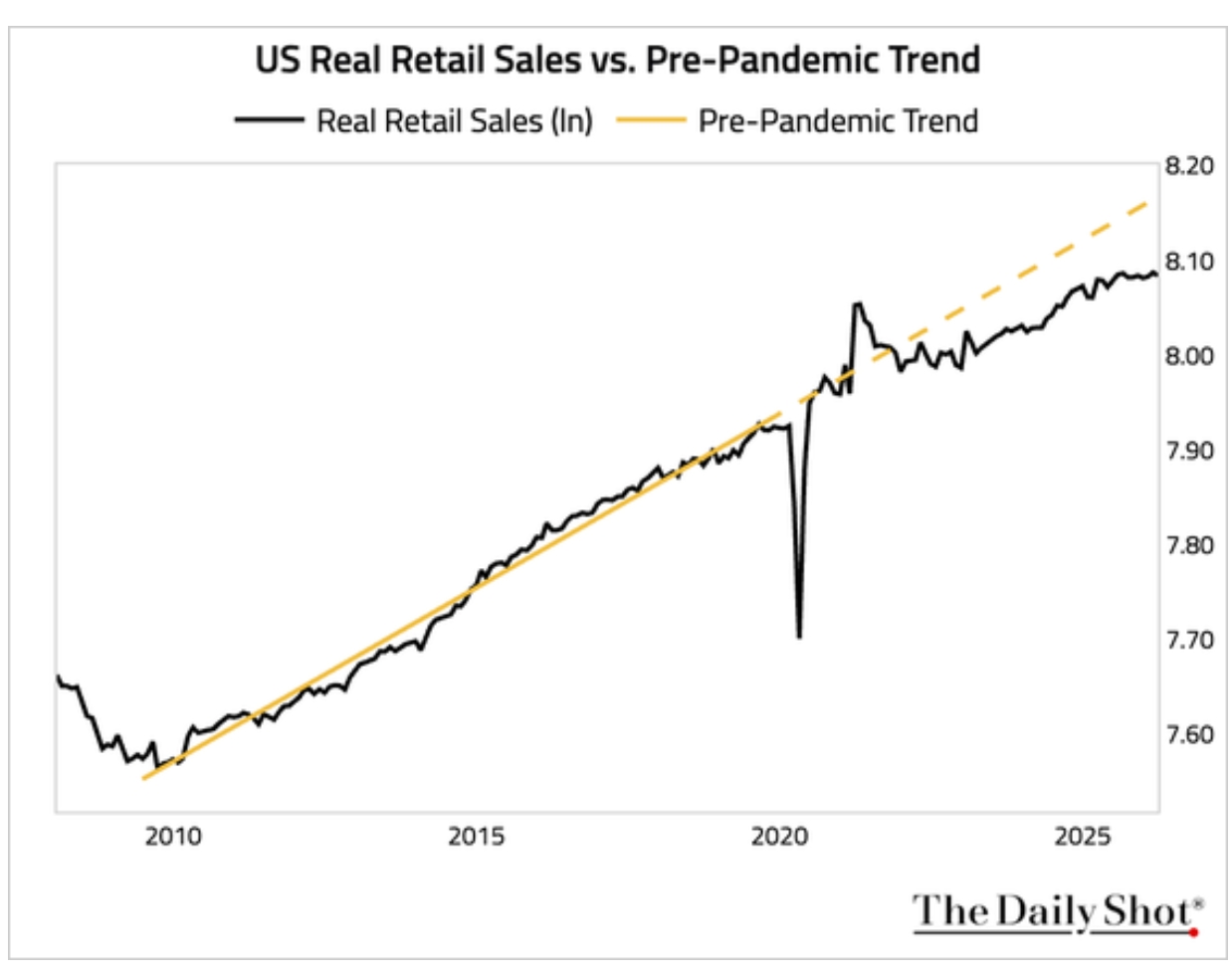
U.S. real retail sales vs. pre-pandemic trend. After adjusting for price increases, it continues below long-term trend. I project this to be the norm the remainder of this decade.
Untitled
Date: 2026-04-23
Building agents is quite technical at present; eventually this will abstract away so it becomes less technical. This article covers marketing engineers - new roles needed to build and manage agents. This engineer role will be critical across functions in a company. linkedin.com/posts/therealmarvin_marketing-engineers-are-the-hire-of-2026-activity-7450397673012215808-HjPg
Untitled
Date: 2026-04-23
From solar panel supplier I use - in LA warehouse: Trina black frame dual glass: 435w/445w: $0.245/w JA 455w bifacial black frame: $0.245/w; Znshine full black bifacial 450w: $0.23/w; HT full black bifacial 455w:$0.22/w Canadian 585w bifacial dual glass: $0.22/w; Trina 585w/610w bifacial dual glass: $0.22/w; Jinko 460w/465w/470w:$0.245/w
Untitled
Date: 2026-04-21
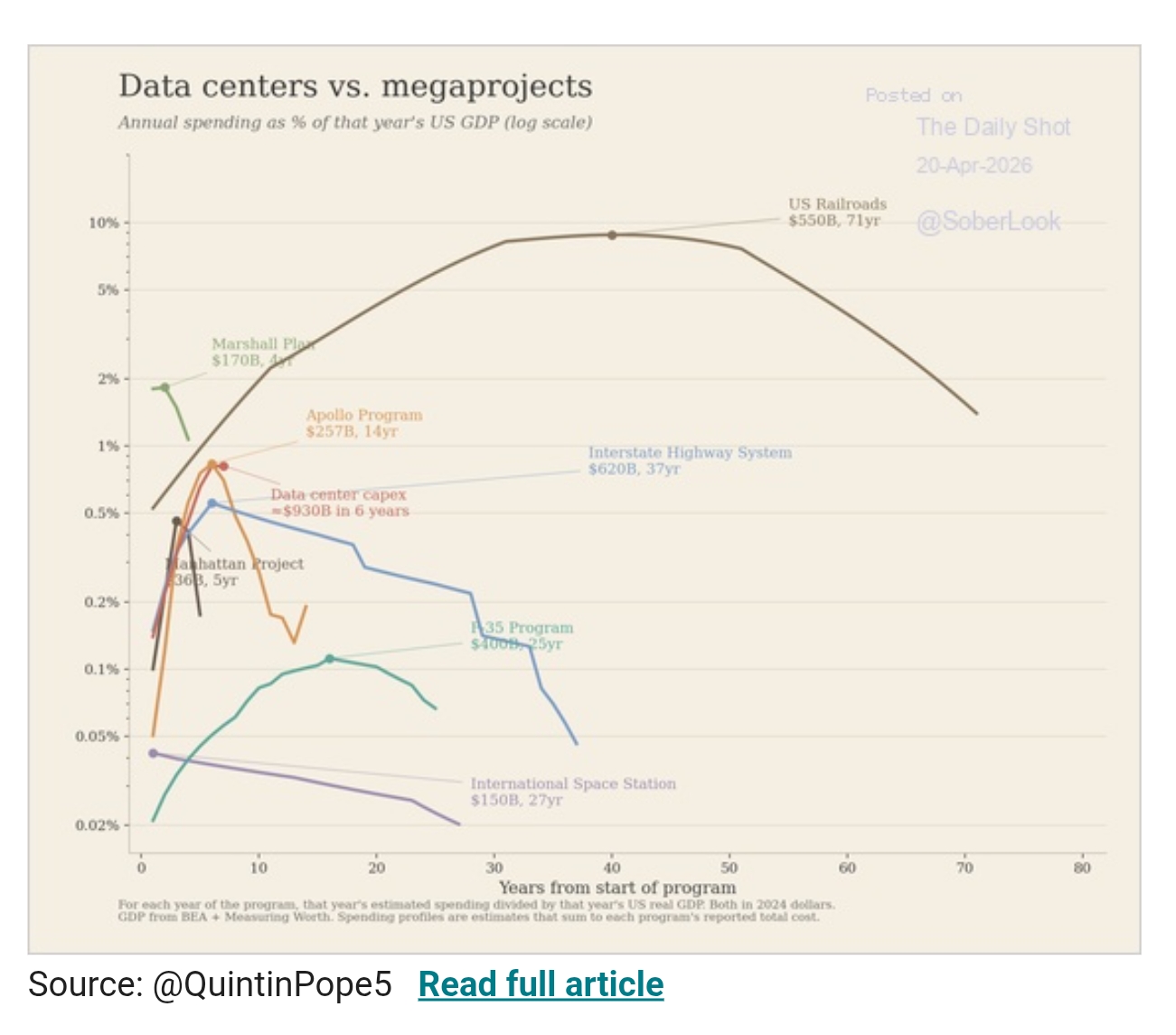
Fascinating analysis on data center spend versus other megaprojects in context of GDP. Nothing comes even close to Railroads. Will data center expansion close the gap? We certainly need it as demand is dramatically outstripping supply at present.
Untitled
Date: 2026-04-20
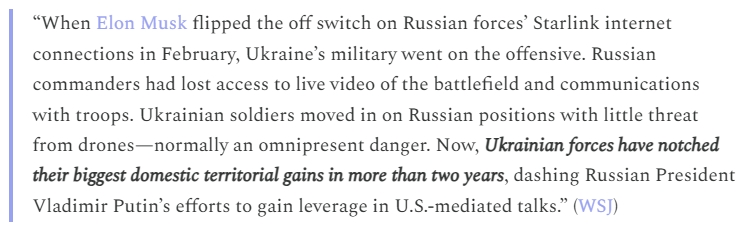
More evidence of my thesis about the resurection of corporate soverigns. Consider the attached, where a single company controlled by a single person can easily change the course of war at the flip of a switch.
Untitled
Date: 2026-04-20
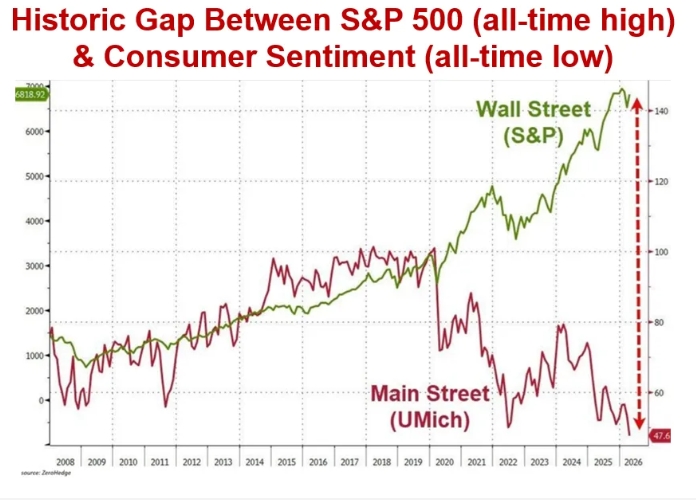
This gap is easily explained. THe top 10% (they own the majority of investment assets) are doing very well as corporations get more and more efficient and extend their returns and equity gains to owners. But the workers (the bottom 90%) are struggling and not participating in this. This gap is becoming worisome by the top 10% and there is finally some early consensus that this has to be rectified. That is why I am optimistic for the future for the U.S., because while short-to-medium term if will be rough, we will figure it out.
Untitled
Date: 2026-04-20
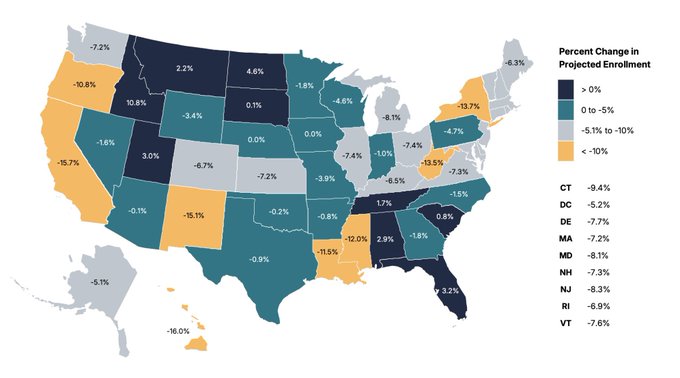
Student enrollment declines by 2031 by state. The primary and secondary order effects will be so numerous, don't know where to start. https://bellwether.org/publications/how-student-enrollment-declines-are-affecting-education-budgets/?activeTab=2
Untitled
Date: 2026-04-19
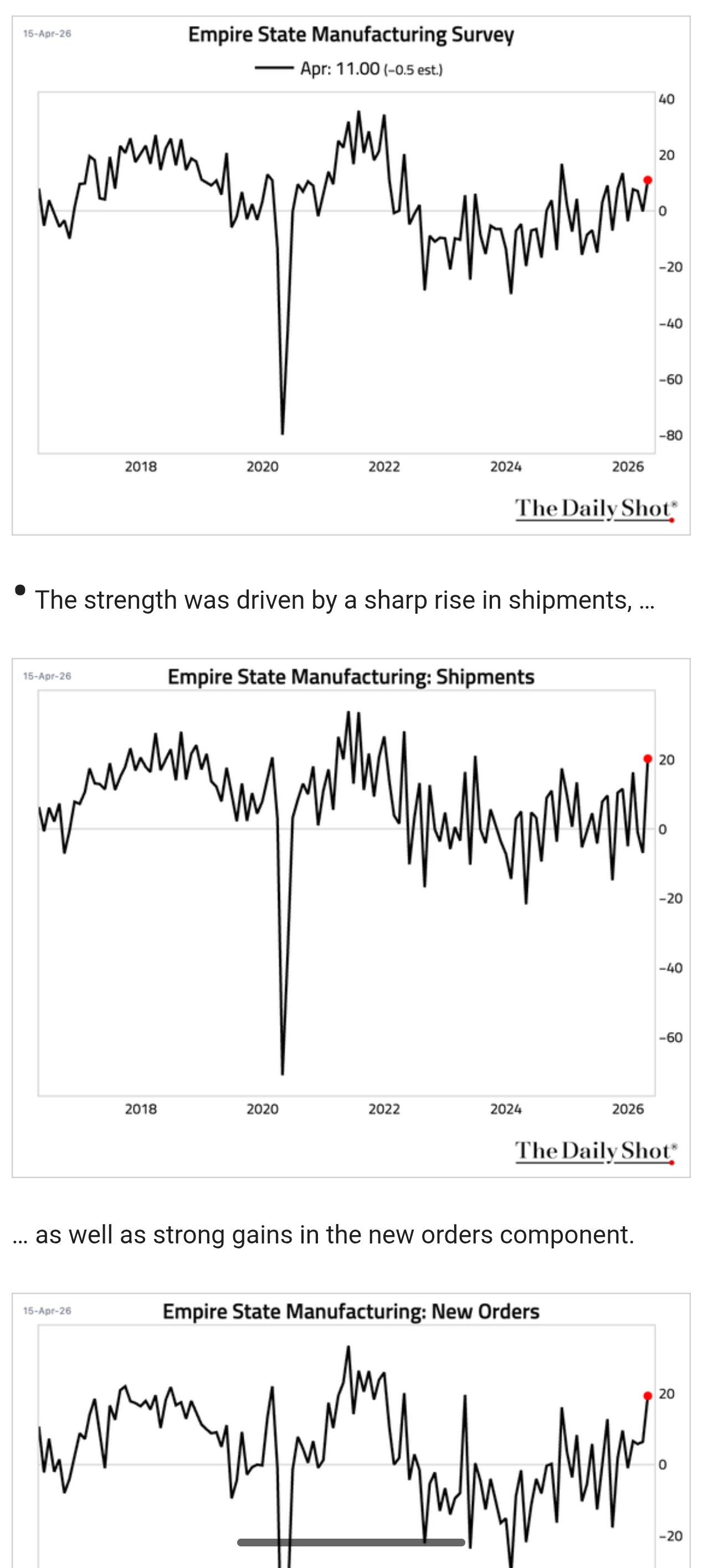
Uptrends in U.S. manufacturing growth for New York continues.
Untitled
Date: 2026-04-18
Untitled
Date: 2026-04-18
Untitled
Date: 2026-04-18
Untitled
Date: 2026-04-18
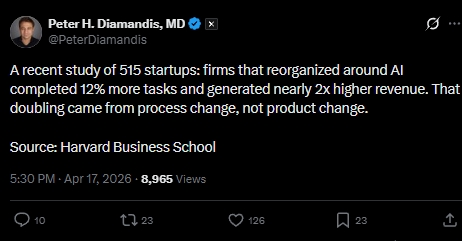
Untitled
Date: 2026-04-18
Untitled
Date: 2026-04-18
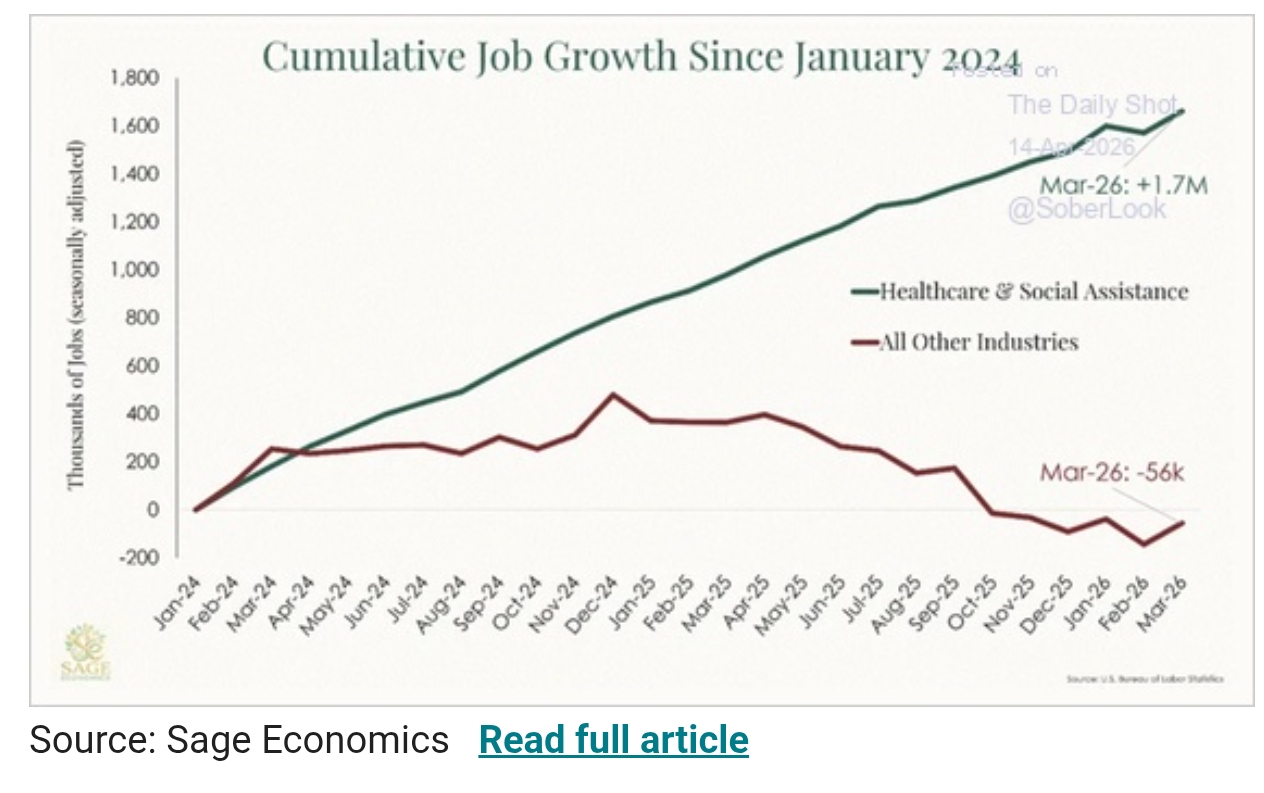
Untitled
Date: 2026-04-17
In 2023 people predicted that by 2025, we would create our own movies. Now its 2028, so a bit behind, but there is no question that it is coming.

Untitled
Date: 2026-04-17
There are two seemingly diametrically opposed views emerging: (1) Emerging technologies will explode jobs: (2) Emerging technologies will shrink jobs. Really smart and thoughtful people make great arguments for both. Who is right? Both, actually. Emerging technologies underpinned by AI will eliminate employees. Rather than having 1,000, 100 or 10 employees, companies can operate with far fewer. But it will explode business ownership, because emerging technologies will allow people to form new companies selling new products and services that were not possible before. So, employment way down, business ownership way up, which could means a lot more companies that are a lot smaller. Employees will become business owners. Data is thus far confirming this view.
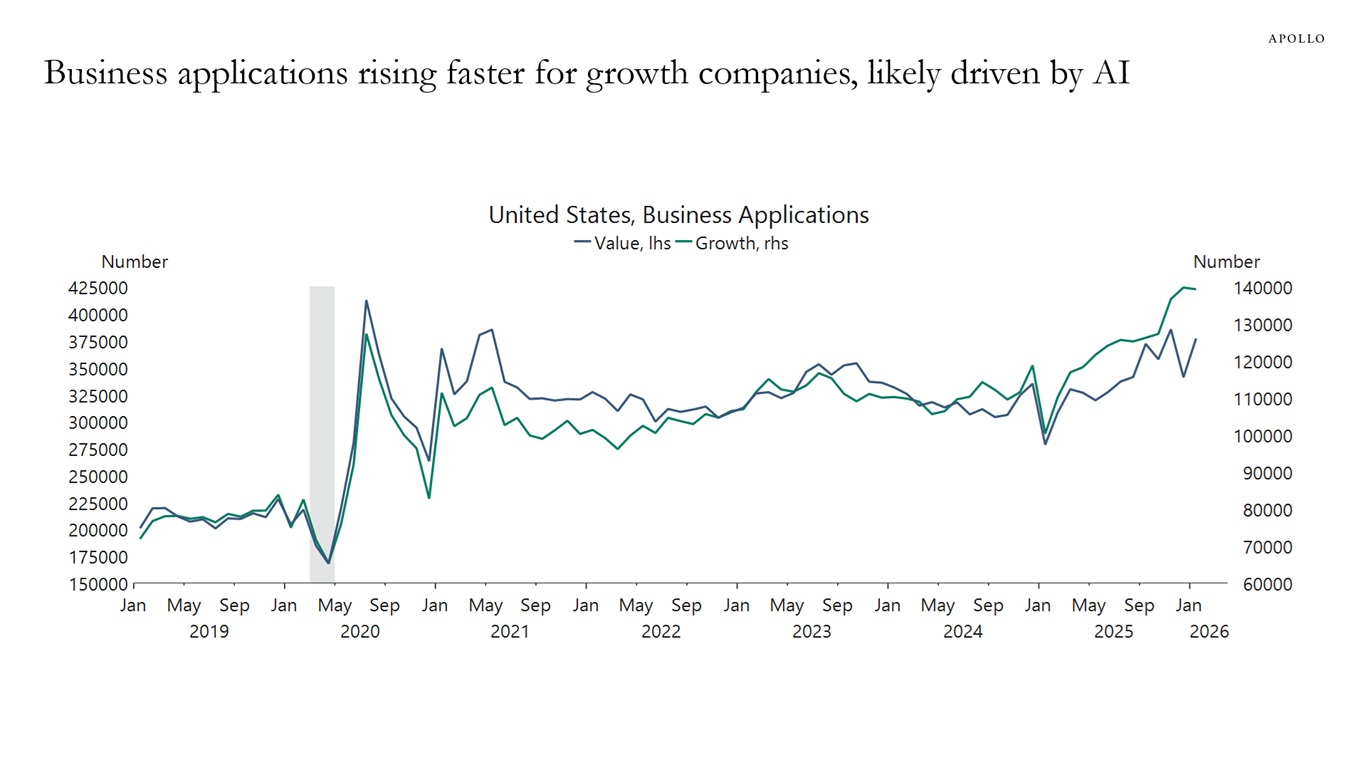
Untitled
Date: 2026-04-17
We've had a wonderful period the last 3-years to access incredible intelligence for the price of a streaming subscription. But that is ending because the capabilities of this intelligence have exploded, along with the demand, all of which requires lots more chips and power, which we lack. It is not just prices that are rising, but now that intelligence is being limited to who can pay for it. For most, however, the intelligence we need is probably good enough. But the shift will require that we move off of cloud platforms onto our own compute infrastructure with open source models. Thankfully, we're just starting to see an explosion in open source, decentralized AI so that the majority of us do not get shut out from using AI. https://tomtunguz.com/ai-compute-crisis-2026
Untitled
Date: 2026-04-12
Sure, this may be a clear action to reduce reliance on U.S. tech, but it brings to mind a much larger issue all of us have to fix for ourselves. Our technology-enabled world is becoming fragile because it is centralized among fewer and fewer providers. Take one down and 1/3 of the Internet breaks. We've seen this already in the last year. Each of us has to take control of our own infrastructure, installing our own servers managed by us, our own systems, building our own software (which we can do with AI). Incredible tools have emerged that deplatform, decentralize and democratize our ability to do this. And, it is a lot cheaper. I started dumping cloud services in 2024 and rebuilding into my own physical and digital infrastructure and have saved a lot of money. I also have control of my data and can control the security I put in place to protect it. https://techcrunch.com/2026/04/10/france-to-ditch-windows-for-linux-to-reduce-reliance-on-us-tech/
Untitled
Date: 2026-04-12
This from Seth Godin is awesome: Creating the conditions for magic. If you’re hoping for this meeting or this performance or this engagement to produce something extraordinary, why are you setting it up as if it’s ordinary? The hard work of a brainstorming session, a pitch collaboration or a negotiation happens long before most people begin. We hire architects to design expensive buildings, but we design expensive human interactions as an afterthought. If it doesn’t feel like you’re putting a lot of effort into creating the conditions for magic, you’re probably not creating those conditions. We want to create conditions for magic in this event, so lets design an awesome funnel that pulls people in and helps setup an incredible event.
Untitled
Date: 2026-04-12
Do you want your own Jarvis? Here it is. This repo is incredible and free. But I would not rush to do this. This is first generation of our own personal Jarvis, so it will be buggy. Second, this violates a very important security rule - never, ever give AI direct access to accounts. Instead, there needs to be a tool layer in between. What if the agent starts spaming all of your contacts? That is why you create tool layers to help limit the damage. Finally, this is a unified system. How do you debug it? What if a better component comes along. How do you integrate it? An effective Jarvis for each of us will be one that comprises many agents, each with a very specific task that we can sawp out when a better ones emerges or debug it or monitor its actions, and which does not have direct access to our accounts. Still, this repo blows me away. https://github.com/garrytan/gbrain
Untitled
Date: 2026-04-12
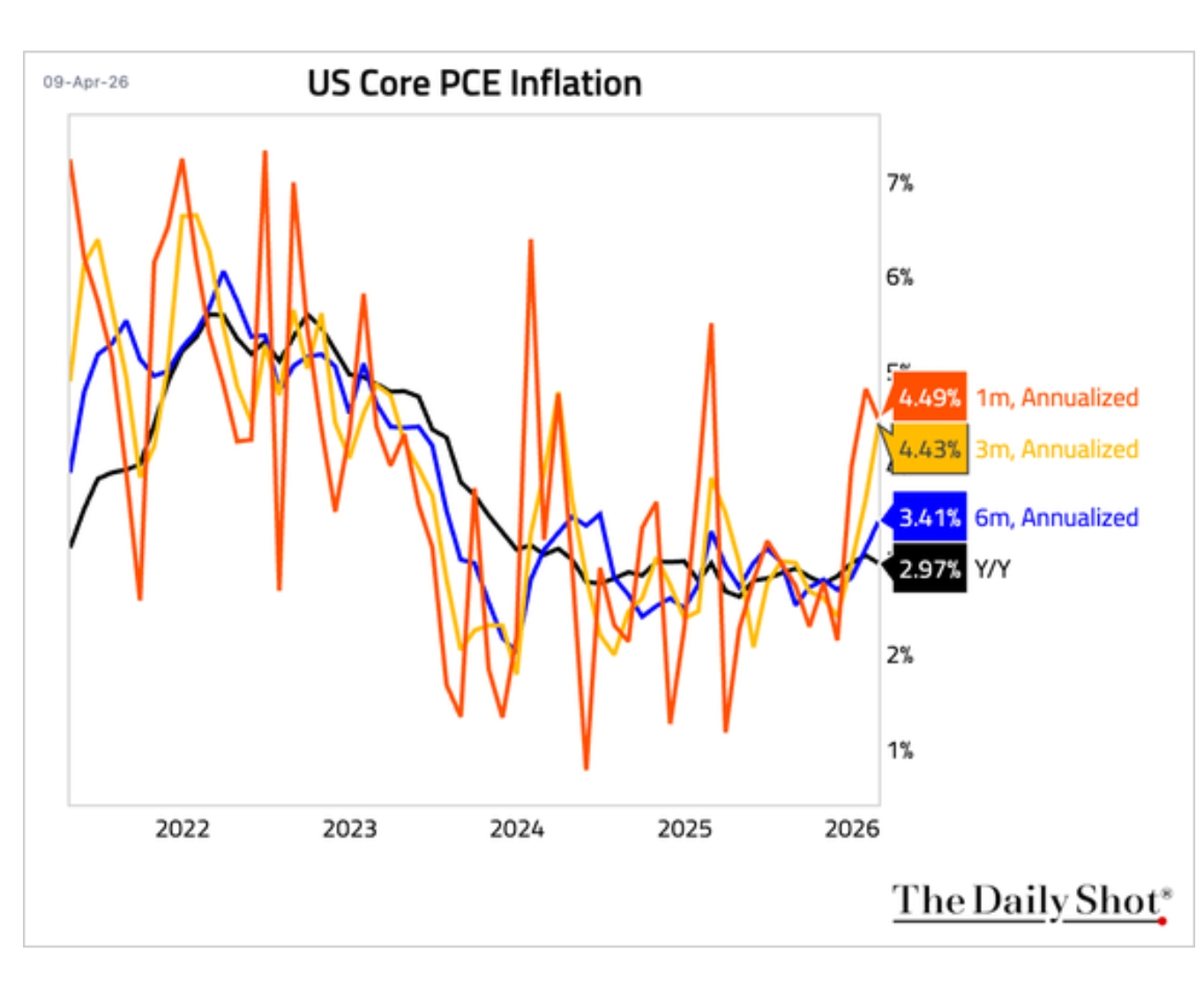
No secret that inflation is jumping right now due to oil and energy. The narrative has been and will be - for the next 10-years - higher inflation, maybe periods of really high inflation. The world is resource constrained and needs to shift to an electrified future, which requires a lot of resources and energy to make that shift. Hence, inflation. But I am open to an alternative narrative emerging where we could see lower inflation. Why? Because the costs could be borne by large corporations. Plus, we may be able to see actual deflation due to AI that will make things cheaper. I am prepared for inflation, but open to it being more muted.
Untitled
Date: 2026-04-12
Compute crunch does not do even come close to what is going on. The demand for intelligence via AI is surging exponentially right now. That will not stop - I think at least through the end of this decade if not for the next 10 years. My concern is that those who can pay for compute - intelligence - will win out, while those that cannot will lose. Intelligene, experience, education are no longer the competitive advantage, especially when AI is better. The advantage comes to owning assets, like compute, that others will pay to use. Shift to owning assets - not gaining job experience or education. https://martinalderson.com/posts/what-next-for-the-compute-crunch/?utm_source=tldrnewsletter
Untitled
Date: 2026-04-12
Superintelligence is finally here—and it’s rattling people. Anthropic’s new model isn’t being released to the public (at least not yet). Instead, it is being directed toward an initiative to identify and patch security vulnerabilities across the internet. At the same time, the U.S. government has reportedly convened financial institutions to coordinate using this model to shore up their own defenses. Even the name—Mythos—sounds like something rising out of the abyss. Here’s the issue: other frontier models are reaching similar levels of capability. How long before one is released publicly to gain a competitive edge? These systems are powerful enough to be used offensively—able to discover and exploit vulnerabilities faster than organizations can patch them. What can you do right now: (1) Use strong passwords, MFA, and especially passkeys everywhere possible; (2) Assume breach is inevitable—limit the blast radius. Separate systems and identities: Personal email, Shopping/accounts email, Work email, Financial accounts. Lock down access to critical accounts and data. (3) Do not give AI direct access to your core systems (email, OS, accounts). Instead, use intermediary tools that fetch data, pass it to the AI, and return results. Bottom line: operate as if your systems will be tested and design them so failure is contained. https://metatrends.substack.com/p/a-disruptive-moment-in-time
Untitled
Date: 2026-04-11
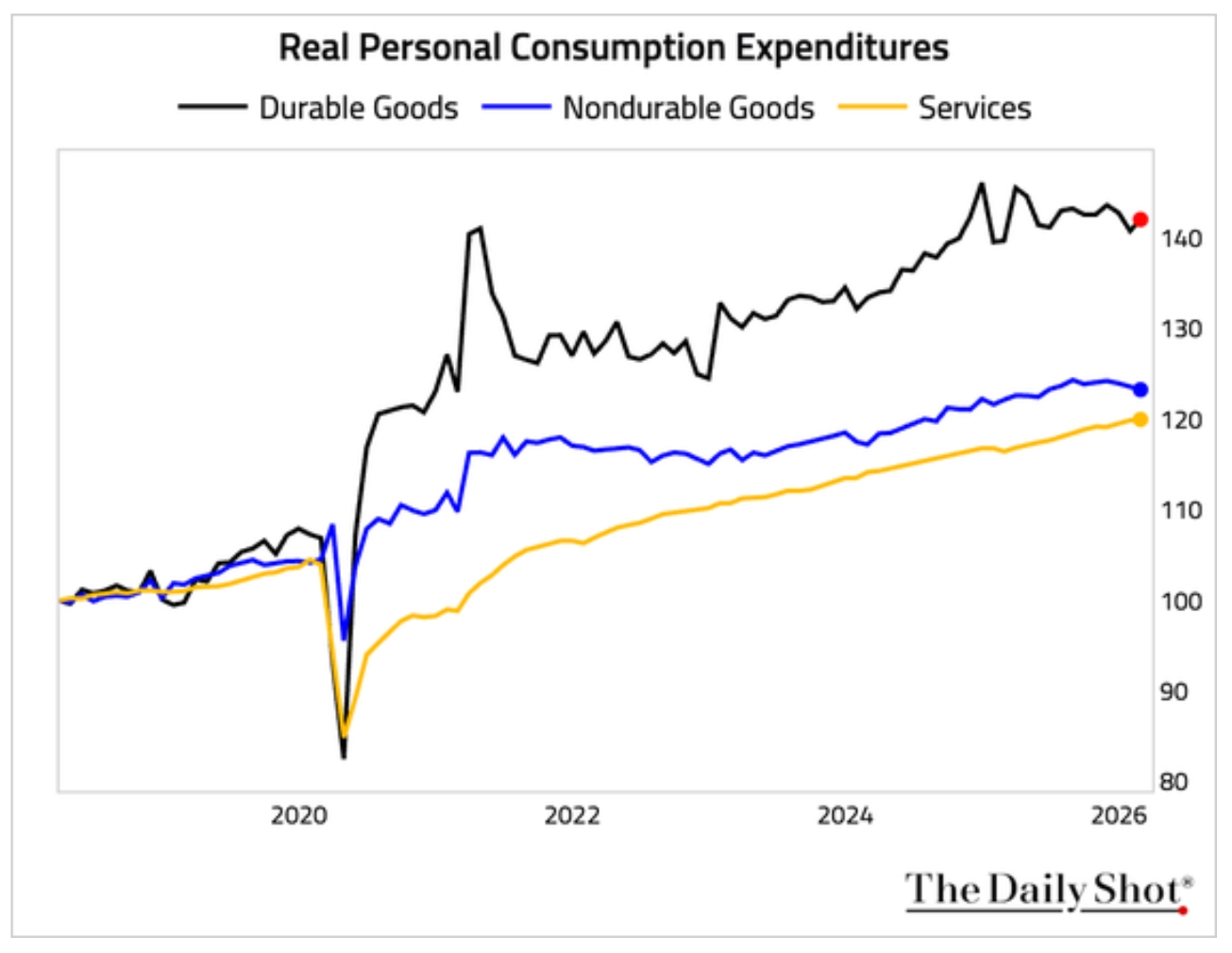
Services holding up. Durable goods (cars, appliances, machinery) and non-durable goods (food, beverages, clothing, paper goods) have leveled off or even showing downturns. The former appears to have meet with pre-COVID trend and later is below trend.
Untitled
Date: 2026-04-11
There is a big shift recently about how to manage the automation of jobs in the future. We've all known for several years that AI will significantly disrupt white collar and belue collar jobs at all levels. Now, many are becoming more alarmed and starting to propose solutions. Here's a recent paper put out by OpenAI discussing things like affordable access to AI so no one gets left behind, sharing AI-wealth more broadly, worker protections and more. We will truly see some radical things put in place to help people manage the transition, starting in the next few years. https://techcrunch.com/2026/04/06/openais-vision-for-the-ai-economy-public-wealth-funds-robot-taxes-and-a-four-day-work-week/
Untitled
Date: 2026-04-04
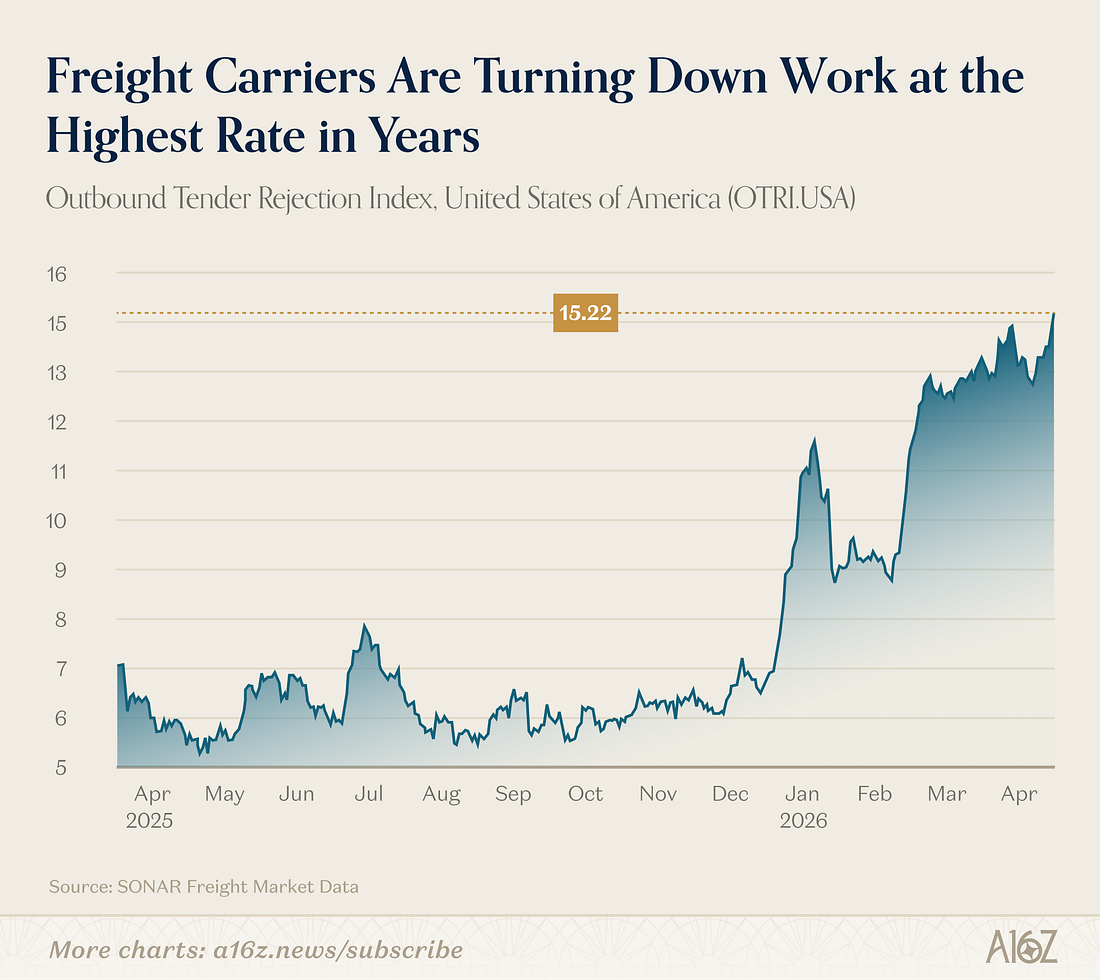
Freight tends to be a leading indicator of industrial and manufacturing activity. Looking at this chart, demand is surging quite a bit.
Untitled
Date: 2026-04-03
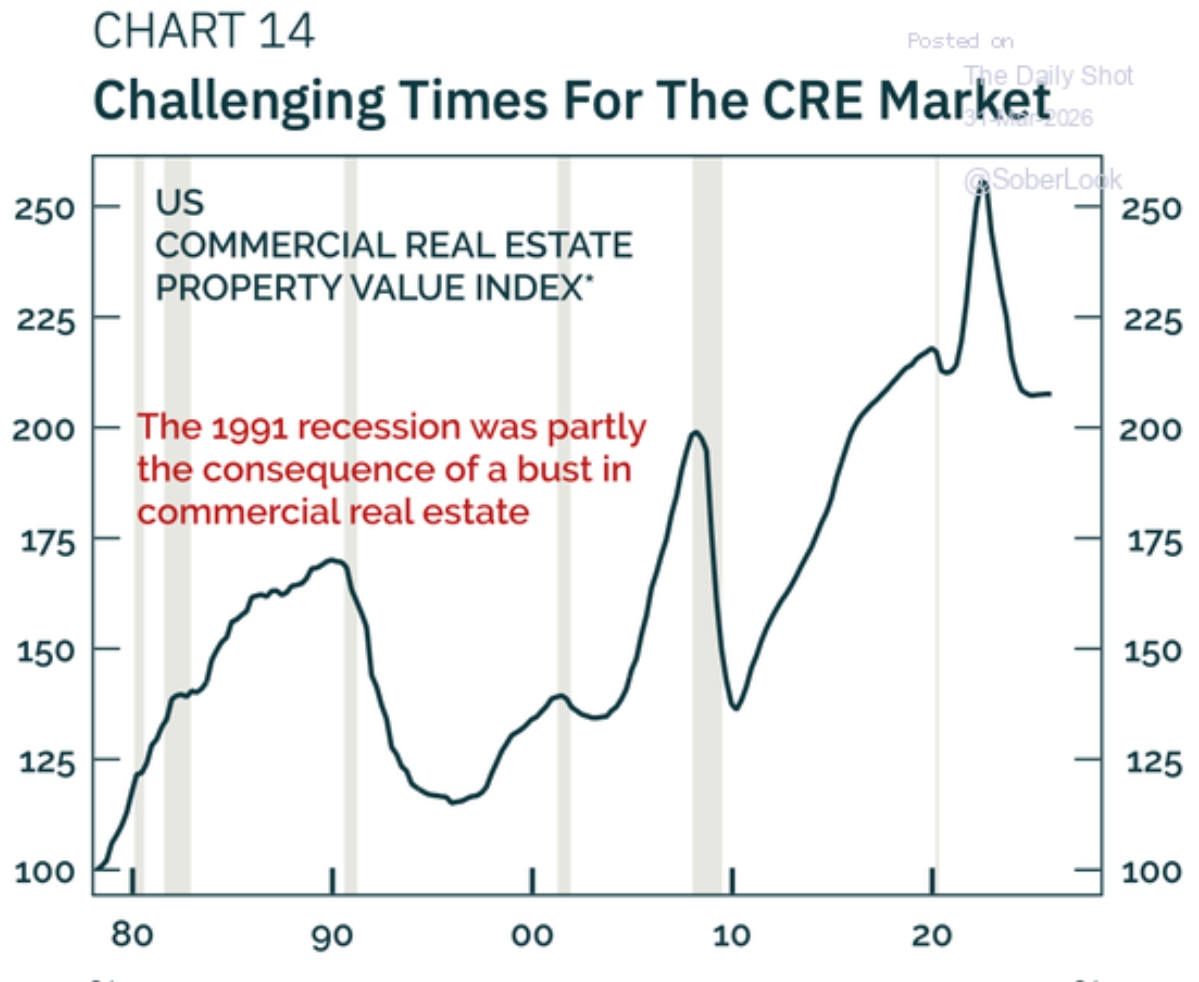
A fascinating multi-decade view on commercial real estate property values. Clearly, recessionary periods for the industry take 10-20 years to recover to previous values. We're not only at the start of another 10-20 year recovery period, but we may not even recover in the traditional sense because of the magnitude of societal and structural changes happening right now and over the next decade. The transportation compression alone (rise of autonomous vehicles, air taxis, supersonic and sub-orbital transportation) will change the real estate environment quite dramatically, as people can live where they want and commute far easier via autonomous methods. Layer on more connectivity (broadband via terrestrial, satellite), more economic stress and environmental stress (both that will curtail spending on office real estate and transportation), and the real estate industry will look quite different. How that impacts valuations will be more driven by local conditions.
Untitled
Date: 2026-03-31
This came across my desk: Sid Sijbrandij ran out of standard care treatments for bone cancer, so he started creating treatments for himself. This site details his journey and the results of the treatments so far. Sijbrandij's cancer is now in remission. He is now working with companies to scale his approach for others. Last week is was about guy in Australia that used Alphafold and Claude I think and genetic testing he paid for to design a cancer treatment for his dog and it worked. Each one of us can use these tools to figure out out health and heal diseases on your own.
Untitled
Date: 2026-03-30
Here a study out of Tufts that looks at the AI-driven job loss across occupation, indstry and metropilitan area. Clearly, the white collar, technology belts are most at risk. They are the rust-belts of the last centruy U.S. that saw manufacturing jobs evaporate. Huge disslocation across specific knowledge-based sectors. It is no longer intelligence or education or know-how, it is ownership of income producing assets that others will rent. https://phys.org/news/2026-03-wired-belts-rust-jobs-vulnerable.html
Untitled
Date: 2026-03-30
It is clear the immense dislocaiton coming in jobs due to exponential technologoes. That view is now mainstream. But how do manage this transition? This link provides a sobering look and offers a plan for universal basic income, packaging basic services for people in cost-effective ways, followed by immense dissinflation as productivity skyrockets and costs decrease dramatically. This is not decades away. This is the next decade, beginning now. Already there are major layoffs in the corporate sector; technology companies with immense wealth leading this transition are already beginning to shoulder expenses, like paying for power build out for their data centers. Government is bankrupt, paralyzed by regulations and legacy interests trying to hold on to what is inevitably slipping away. It will be up to the private sector, especially the large corporates. The return of the corporate soverign is at hand. https://metatrends.substack.com/p/from-ubi-to-uhi-in-3-steps?utm_campaign=email-half-post&r=6sj7
Untitled
Date: 2026-03-30
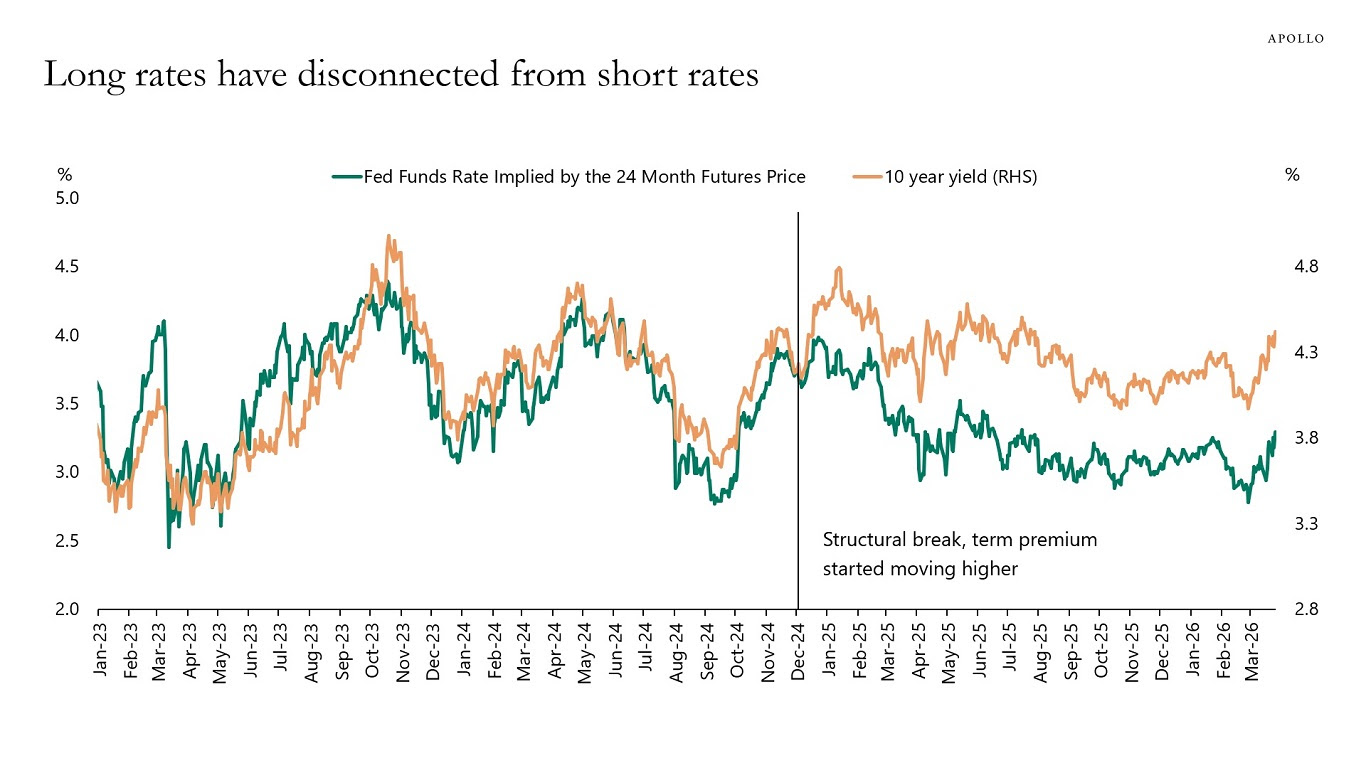
Really interesting diconnect in rates. The Fed controls short rates, which should dictate long rates, but that is no longer the case. Long rates are dicated by investors in U.S. debt, and they are indicating they want a higher yield to buy the debt. It is probably a combination of things, including concern about rising U.S. debt levels, competition from other investments, lower demand. January 2025 is when the divergence occured. Higher rates mean higher business and consumer interest rates.
Untitled
Date: 2026-03-30
43% of imports are free of any tarrif. INcludes energy, pharma, electrical equipment, machinery, consumer electronics, previous metals, aircraft and part. The industries with the best lobbiests are winning. Flows in foreign direct imports since 2025 have slowed. So tarrifs are only selectively applied and investments from abroad are still not forthcoming. Via Bloomberg. MDX is a format I learned that provides more semantic structure to markdown (md) documents. So you write in mardown, convert to mdx, then convert to JSON, then JSON chunks with CIS metadata. THat is the process for creating highly structure content for AI. Think of building an app that does this coupled with a dedicated AI agent tuned for this that as you write, can provide suggestions for structuring. When you are done, it converts the whole pipeline, and even compares it to other content libraries to improve it right from the start. This is a tool I could see deploying for nSIG, allowing people to use it to create PIDs from the start. Super interesting LI ask: Looking to acquire a business in the $5–20M EV range with a very specific profile: 1) Exceptional product or service at the core 2) Premium positioning with a high-ticket, less price-sensitive customer 3) Strong experiential element or opportunity to build one (not purely transactional) 4) Clear potential to scale through content and brand, not just performance marketing 5) Industry-agnostic, across both products and services. 6) Most interested in businesses where the product is strong but the brand, content, and experience layer are underbuilt. Examples of the type of businesses we’re looking at: - High-end outdoor or lifestyle products - Premium home or consumer goods - Experience-driven businesses (travel, events, hospitality) - Niche, enthusiast-driven categories with strong identity My response: With long investment horizons, I am seeing people push towards acquiring true scarcity and future access shifts. As travel gets faster (supersonic, sub orbital) and autonomous driving and air taxis proliferate (the transportation compression), remote geography gets repriced because it now becomes accessible. Here, product is strong, but brand and experience layers are underbuilt.
Untitled
Date: 2026-03-28
I came across JASONata recently and understood it better. It is really powerful for creating AI-native, data-defined systems, where you decouple data from databases, code and front end, which is expensive and locks you in, to where the data has policies, permissions defined with it, so that AI as the front end can build the front ends that the user desires, accessing the data, with lightweight middle layer codes. I added this to my working paper AI‑Native Data‑Defined Systems https://docs.google.com/document/d/1YruyY2anFoBRVHTLEdqGhx-CKPHtctMUtkcLs6GBQQY/edit?usp=sharing So much credible but polar opposite predictions on the future. The Iran war is causing serious harm to the global commodities economies, but the U.S. is fine because we produce most of it domestically. Global liquidity is under sever pressure, which if it breaks, will cause global pain in financial markets. The tech infrastreucture boom and emerging technologies are creating tremendous innovation and breakthroughs. But they are causing significan job dislocation. How do we threat this needle? Who is right? WHat is the proverial grain that starts the avalanche? Does it even exist? WIll be havve localized pain in sectors and countries, but the system is anti-fragile enough to absorb it and limit contagion? I keep going back to the last two major dislocations - COVID and Russia/Ukraine war. COVID cause a brief steep recession, then the fed pupming the economy with free money plus a reordering of spend produced a hit economy. The resulting delfation from rising rates produced some localize pain in sectors, but was ameliorated ny the top 10% spending, and rising rates gave the top 10% free money on their parked cash. Dynamics now resembled that last period - rates still high to funnel free money to the top 10%, investment markets under pressure but maybe not enough to cause the top 10% to stop spending. The Iran war is causing a reordering of supply flows around Hormuz - shor-term pain for probably long-term stability as nations re-route away from that choke point. Cuba could become an investment boom for the U.S. as we absorb that foe into the north american system. Venezulela was a successful coup that is reordering South America and removing a lot of illicit drug money that everyone, including Iran, had their hands in. I think we (the U.S.) muddle through the Iran war and come out resuming our march forward without much blowback. Burt, around the edges, job market softening, inflation creeping up. The real pain still starts later this decade as jobs get reordered from AI, healthcare bites, soverign debt becomes unmanageable, state-adjacent spending really has to slow down. and expenses on the middle class finally break it. The savior is new technologies as our economy orients around it, with robotics coming online and the rise of coporate soveriengs to save us (or help us get through). Those companies that align to new technpologies will probably do fine, but those that do not will lose and lose big. Retirees are in real trouble and anyone nearing retirement beause no state-funded retirement programs will be available because they are already broke. That slack will get picked up by corporate soveriegns who use compute to provide healthcare and services. We will muddle through with localized pain in sectors, while other sectors boom to even out the slack. This is the narrative I am following. Pain, but localized successes. Rates will come way down at some point as pain increases all around. Sell the best product, the cheapest, that is scarce, with a strong competitive moat, providing the least amount of friction. That will win. Easier said than done. THis is the narrative I am following right now. It is really more of the same but at some point, things break hard and a reordering takes effect. Survive through the same right now, but position for the reordering.
Untitled
Date: 2026-03-27
Where I use to buy beef from ranchers, I almost never do because drought has reduced local supply. I now just order it mostly from Whole Foods Market, which works great and is convenient, but for our dog food and pet food products, not ideal. Good meat and comes from responsible ranches, but ground round is just from the round cut, not a whole beef, which is what I use to do. Makes for better quality to have meat ground and mixed from the whole cow. I never stop thinking about coming transitions in our 4th Turning (Howe) era. If you want to be truly positioned right, its owning differentiated assets that spin off income which are scarce and cannot be copied. You are the best in your caegory, you are the cheapest, or both is awesome. People would truly miss you if you went away. It is hard to build businesses that truly command this. Competition and substitution can almost never be taken out of the equation. Maybe impossible. WHat about SpaceX - they are truly in their own category, but others could - with difficulty - step in to take their place if they went away. So even with their seeminly insurmountable lead, they could be replaced. How about Palantir. Maybe, but still, the could be replaced - with great difficulty - because there is always something new and better up and coming. Google. What an enshitified company. They make tons of money and I already pay for their stuff and still, every week, they blast me in google docs about buying more. It would be hard to move away from them but I am steadily doing just that. Docs can be come md that I host on my own server, sheets could move to libre office. Email could move to my own domain and server. I would never be able to fully get away from them, but can move a lot.
Untitled
Date: 2026-03-27
On the software architecture, engineering, and coding side, AI compresses what used to be six months of work—much of it spent learning—into about a week, at least in my experience. It’s an incredible productivity unlock. But it also means I’m taking on far more projects in parallel than I normally would, so it still feels like things take just as long. The difference is that, as an entrepreneur, I can now operate across many initiatives at once, dramatically increasing my surface area for potential success.
Untitled
Date: 2026-03-27
AI agents just massively increase the surface area for hacking. Agents we spin up to do things for us, but also agents spun up to hack us. We have to be so careful and thoughtful in our security practices and efforts. The LiteLLM expolit this week really brought it home for me and catalyzed me into being far more practive. I was not affected. I have a working SOP on online security that I've had for years and slowly add to it as I learn (or get hacked myself). This week I added a comprehensive policy on AI security.
Untitled
Date: 2026-03-27
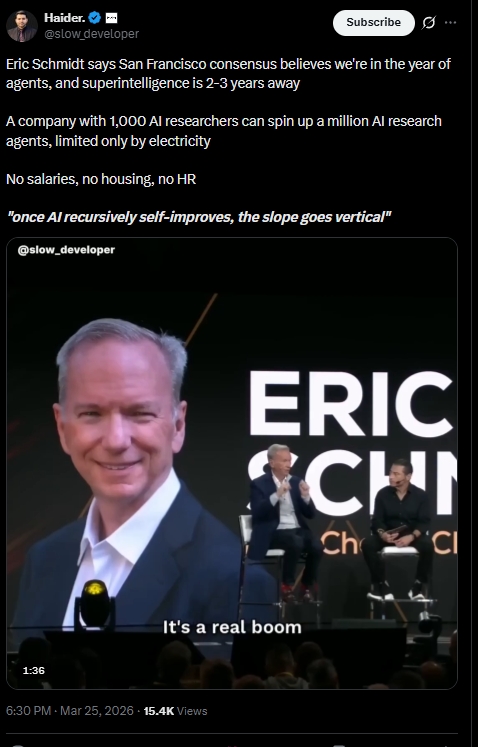
The takeaway—regardless of your technical background—is simple: start collecting data on everything you do and build proprietary datasets, because very soon you’ll be able to deploy AI agents to analyze it and surface patterns and insights. Here’s why: an open-source framework called Autoresearch was just released and is already exploding in usage. We’re not talking about a few agents anymore—I’ve seen hundreds running simultaneously on a single problem, communicating and improving each other’s performance. Now we’re seeing experiments pushing toward one million concurrent agents. This is recursive self-improvement going vertical—the exact dynamic we’ve been talking about for years—and it’s now becoming real. AI systems improving themselves, no longer bottlenecked by human throughput.
Untitled
Date: 2026-03-22
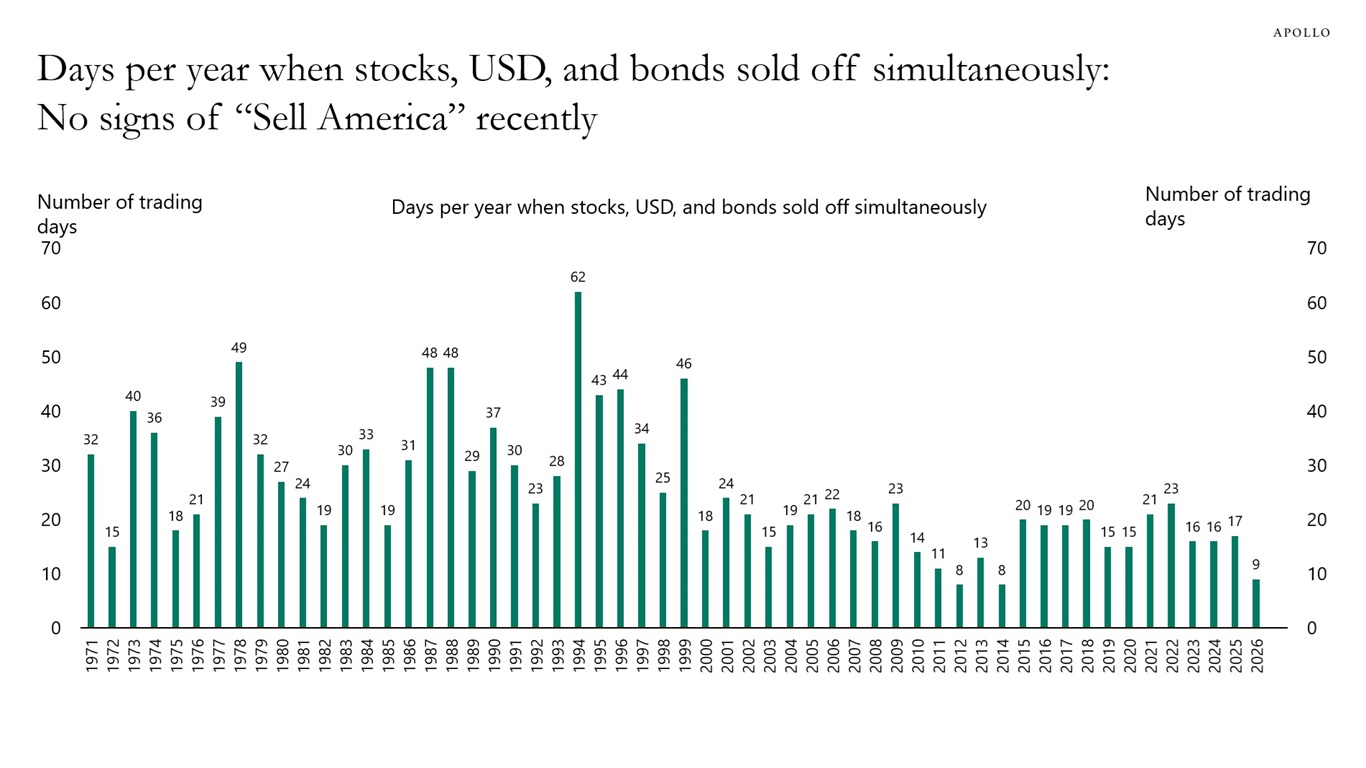
Despite U.S. challenges, we have and will continue to remain the country to invest in and in which to do business. This is a fascinating 55-year look at signs of Sell America, and it has been decreasing. What disrupts this is if countries begin forcing their citizens to repatriate assets back to their countries because of mounting financial challenges, which faces most countries. This does not mean our investment markets keep going up. Will we see continued appreciation, sideways action for years if not a decade, or a deep bear market? No one knows. Anything is possible. The challenge is to be prepared for any path. But one thing is clear. The U.S. is the place to be, for now and the rest of this century
Untitled
Date: 2026-03-20
Jason Eccles from Bending Branches sent out an email to friends offering a 50% discount on custom engraved decorative paddles. Use Code CUSTOM50 at checkout (limited to one time use per email address).
Untitled
Date: 2026-03-20
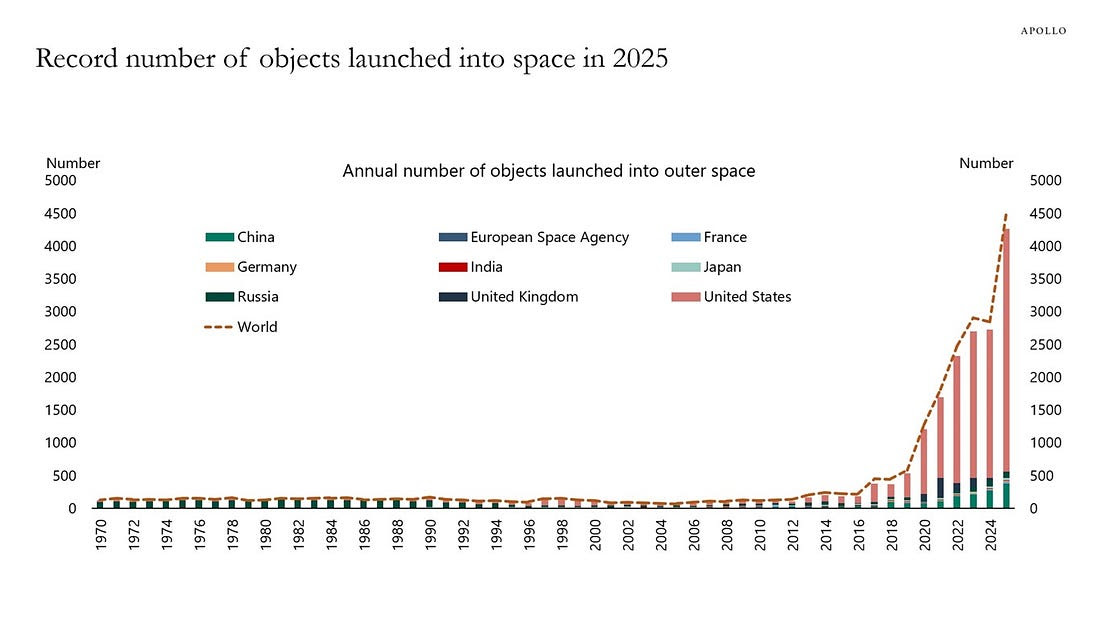
Satellite launches. What could go wrong?
Untitled
Date: 2026-03-20
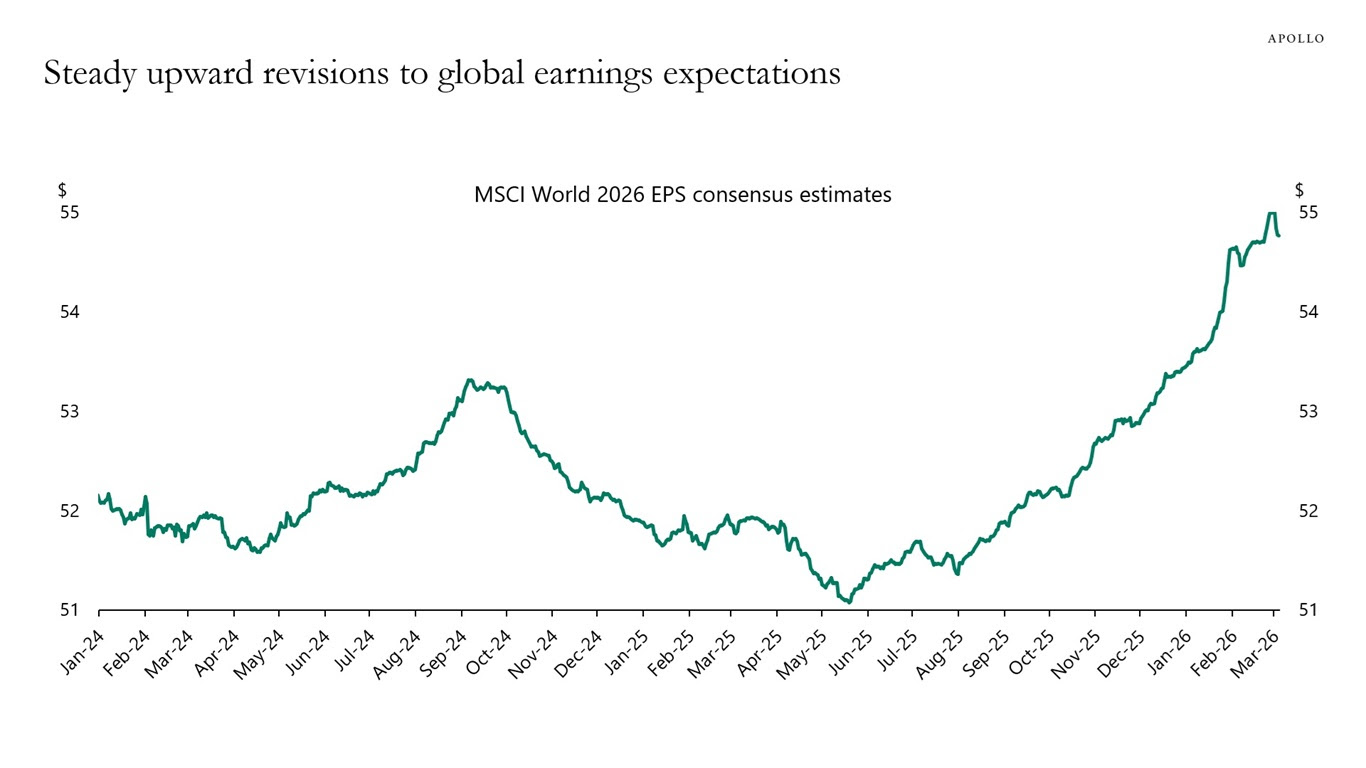
Global growth expectations are improving, reflected in upward revisions to corporate earnings forecasts. This aligns with what we should expect: corporations are entering a structural productivity boom driven by AI and emerging technologies. And we are still in the early innings. But this shift is not neutral. For large enterprises, AI is primarily a labor substitution engine. Knowledge work, once considered defensible, is now directly exposed. The result will be sustained workforce compression as AI systems absorb functions previously performed by employees. For individuals, however, the equation flips. Entrepreneurs, small businesses, and asset-owning households stand to benefit disproportionately. AI dramatically lowers the cost of execution, expands capability, and unlocks latent capacity...turning small operators into highly leveraged producers. This is not just a technology cycle. It is a structural reallocation of economic advantage. The key question is simple: are you positioned as labor being replaced, or as capital being amplified?
Untitled
Date: 2026-03-16
More than half of NYT readers preferred AI-generated prose to human writing in a blind test. https://www.nytimes.com/interactive/2026/03/09/business/ai-writing-quiz.html
Untitled
Date: 2026-03-16
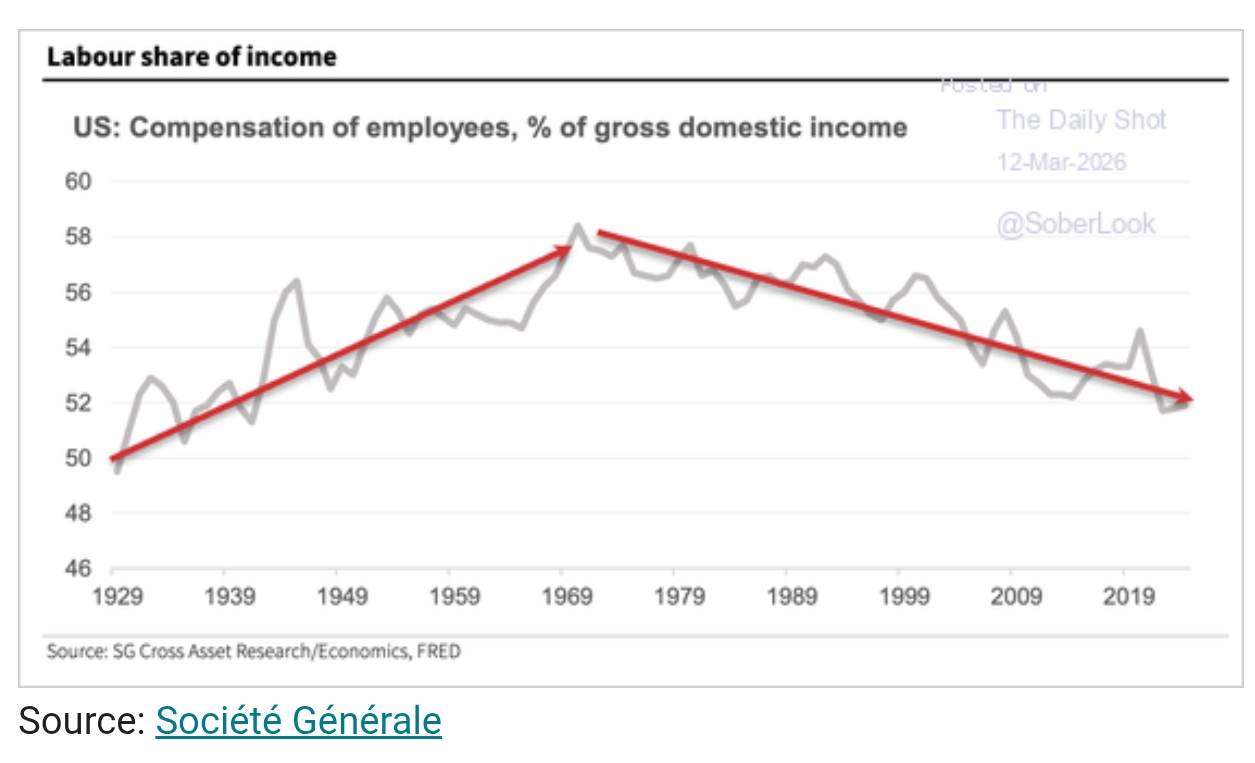
U.S.employee compensation as a percentage of gross domestic income. This is a combination of changing tax policies to favor upper income, technology that shifted productivity and income gains to shareholders, which is largely comprised of upper income classes, deindustrialization of America that shifted production overseas to cheaper markets, where, again, gains accrue to companies and not employees.
Untitled
Date: 2026-03-13
This is a breakthrough that signals where technology is heading—and something all of us should begin preparing for today. This breakthrough is accelerating the Three Ds of technology — democratization, decentralization, and deplatforming. It shifts the training of AI models away from massive centralized systems and the control of large technology companies, placing that capability into the hands of individuals operating their own hardware. In this new paradigm, anyone can take the data they possess and train AI systems locally, turning personal data and domain expertise into intelligent systems. It may still sound technical today, but technology is rapidly advancing toward a point where anyone will be able to do this themselves. The key step now is to begin identifying the proprietary data you possess—or the data you create through your work—that could form the foundation for training your own AI systems to perform valuable tasks that others would pay for. https://x.com/_philschmid/status/2031355349526012050
Untitled
Date: 2026-03-12
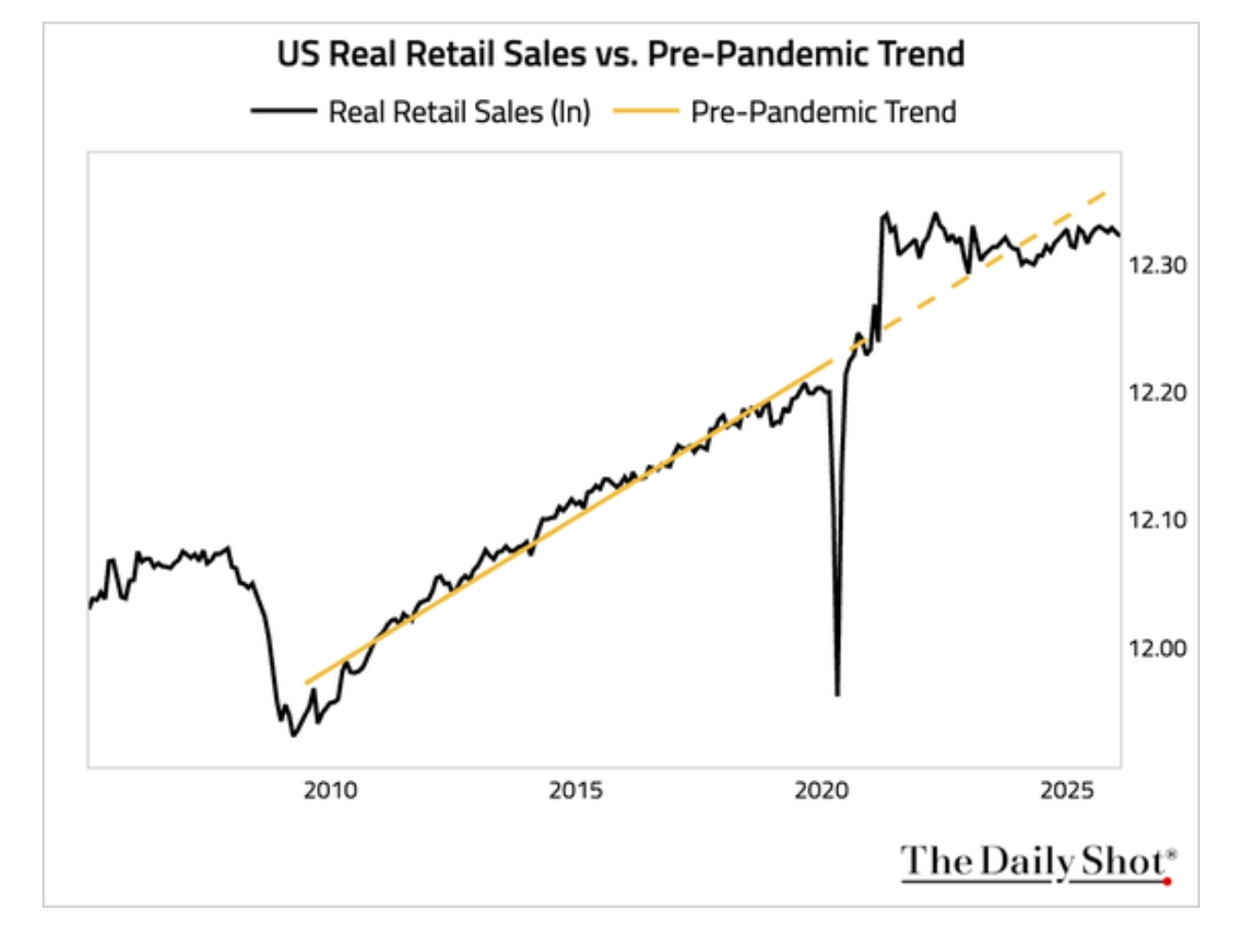
Real retail sales continue below trend.
Untitled
Date: 2026-03-09
More evidence of corporate sovereigns emerging. The White House released a cyber strategy document, which mentions a house bill that would authorize cyber letters of marque, last used in 1812. This is the historical analogy. In the 1700s–1800s. Governments issued letters of marque to private ships. This authorized them to, attack enemy ships, seize cargo, disrupt trade. These private ships were called privateers. They were not pirates because they had government authorization. The U.S. Constitution still references this power: Congress shall have power to grant letters of marque and reprisal. The last time the U.S. used them was the War of 1812.
Untitled
Date: 2026-03-07
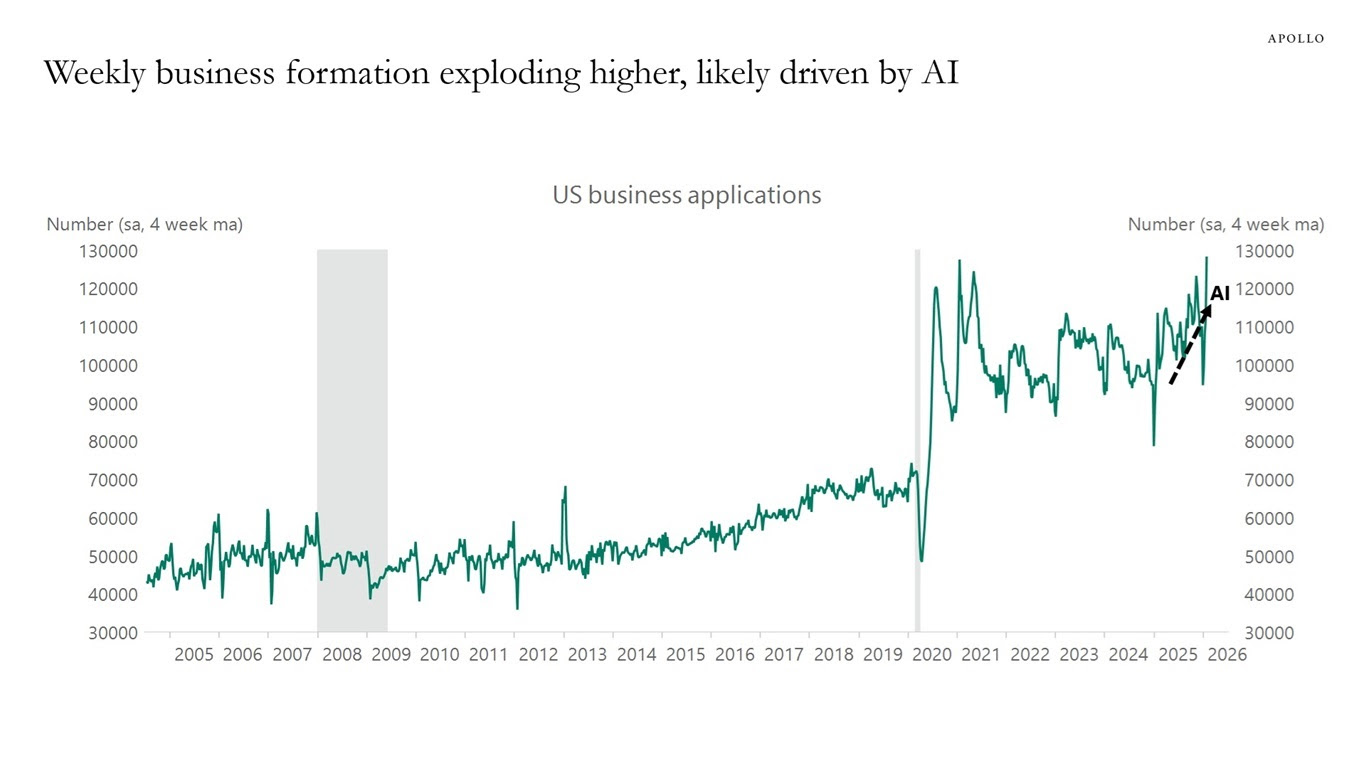
Weekly business formation is exploding higher. New business formation is generally considered a leading economic indicator, though it’s not perfectly predictive. It often signals future economic momentum, especially around employment, innovation, and investment.
Untitled
Date: 2026-03-07
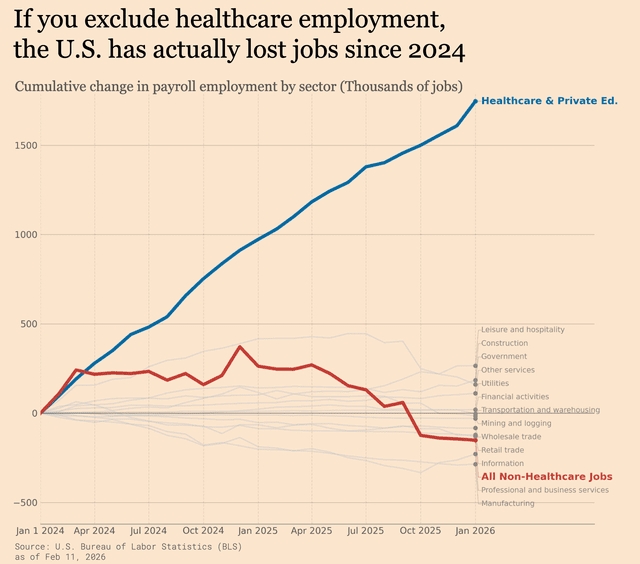
If you exclude healthcare employment, the U.S. has actually lost jobs since 2024. And our healthcare system is absolutely unsustainable and will face a reckoning
Untitled
Date: 2026-03-07
This is a short but important read. So much is happening just under the surface, but it will explode in the open. The problem is all of this hitting at once, which looks increasingly likely. My biggest concerns? AI automating white collar and blue collar jobs away; open source models from China that massively disrupt the value of the U.S. technology complex (because its the only sector keeping us above water at present); the elimination of AI safety guardrails, introducing untold downstream effects, especially across cybersecurity. This article talks about companies with no human employees, but the concern is with all the disruption, there won't be customers to buy their products. We will get through this, but it will hurt. https://metatrends.substack.com/p/when-ai-safety-collapsed-agents-took
Untitled
Date: 2026-03-06
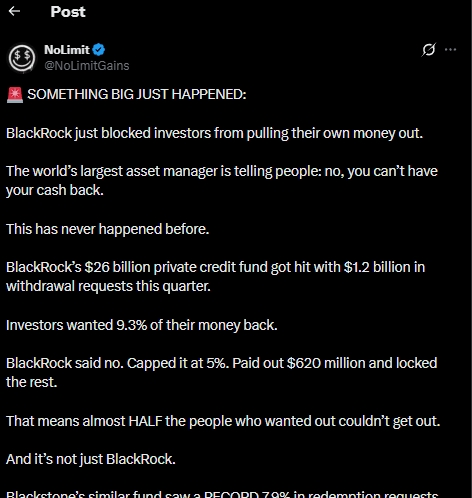
There is currently a lot of news about cracks forming in the private credit markets. This has been anticipated for some time. I started reading more than three years ago from experienced investors that private credit would eventually have its reckoning. What might the effects be? It likely won’t come anywhere near the housing crash of the 2008 Great Financial Crisis. The sector is much smaller and largely confined to Wall Street rather than Main Street. However, the downstream effects could still matter—particularly if corporate borrowers funded by private credit begin to falter, leading to layoffs, and if losses reduce spending among the top 10%, which is currently carrying much of the economy. The broader issue is the underlying strain across the economy, which makes small tipping points like private credit sector woes — the proverbial grain on the sandpile — more consequential. https://x.com/NoLimitGains/status/2029953260052717603
Untitled
Date: 2026-03-03
The surveilled state is inevitable, and already here. Shock and dismay at OpenAI and support for Anthropic won't change the outcome. I have a section in my main prediction document titled Surveilled State, listing what is already in play that is quite extensive, yet people are seemingly unaware. It will only increase because of resource constraints and cost pressures. As our challenges worsen, the only way out is through a future controlled by compute, which will gives us intelligence to solve our challenges, give us better healthcare, food, energy, leisure, entertainment and security. That security comes at a price - more surveillance - which people will accept because they want to maintain the lifestyle that we have become accustomed to in the U.S. There is no opting out. Try and you will be surveilled even more because the assumption is you are up to nefarious actions. More about what I have written about the surveilled state in this google doc: https://docs.google.com/document/d/1fqTPn6r5qSbTJ6AO1_0FnsyeDqmHffwgYn8_rAhLzr4/edit?usp=sharing https://techcrunch.com/2026/03/02/chatgpt-uninstalls-surged-by-295-after-dod-deal/
Untitled
Date: 2026-03-03
There is an incredible transformation underway, enabled by technology, that is leveling the playing field so the smallest among us—small businesses, freelancers, side-giggers, solopreneurs, and even households—can compete with the largest players with the most resources. We need this shift to help reverse wealth inequality and broaden the economic benefits of the next supercycle. But none of this matters if these new economic actors can’t be found—if they can’t be connected to the right customers at the right time. Fortunately, search, SEO, and findability are also evolving in ways that further level the field. I explain this in the Google doc and share a framework for how each of us can maximize findability in the new era we’re entering. https://docs.google.com/document/d/1HfdNZRC4823NvT1ID2ZQNrcW8PCT4czUlnIXROLY_20/edit?usp=sharing https://www.searchenginejournal.com/a-little-clarity-on-seo-geo-and-aeo/565522/
Untitled
Date: 2026-03-02
Stablecoins moved $12 trillion in volume last year; Visa moved $17 trillion. I don't consider stablecoins the same as cryptocurrencies because while they use the same infrastructure (blockchains), they are denominated in the U.S. dollar. Stablecoins don't just drop the transaction costs of money and make it move faster, they allow anyone, anywhere with an Internet connection to onboard to this economic layer. They introduce more transparency and can become an economic lifeline in countries plagyues by hyperinflation, capital controls, and corrupt financial institutions. Ultimately, stablecoins become the Trojan horse for reinforcing U.S. dollar supremacy, as the U.S. is leading the innovation behind them. https://a16zcrypto.substack.com/p/the-whatsapp-moment-for-money-is
Untitled
Date: 2026-03-02
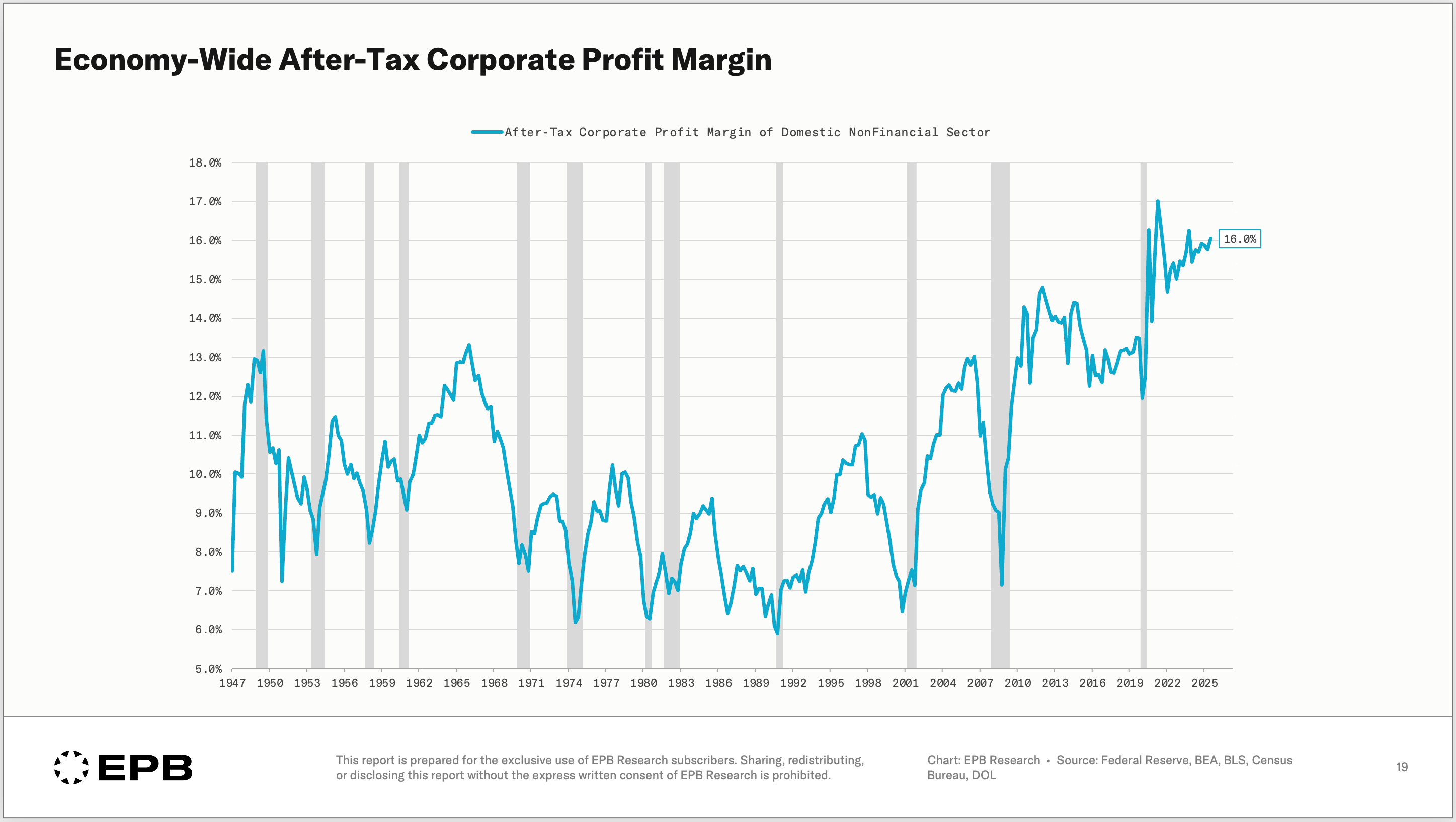
Corporate profit margins sit at 16%, the highest level in modern history.
Untitled
Date: 2026-03-02
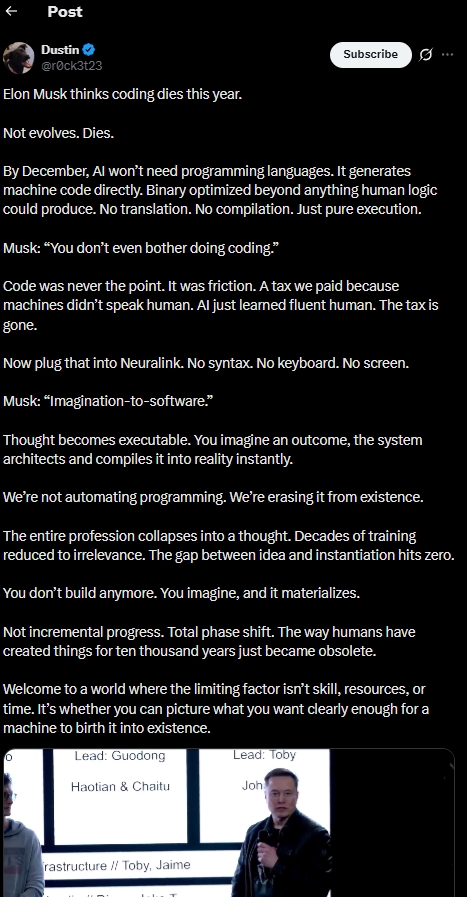
Could 90% of software coding jobs disappear inside five-years? Yes and here's what all those coders can do to leverage their expertise. Software code was originally created as a human-readable abstraction layer that ultimately compiles down to binary machine instructions. If AI increasingly operates at the machine-code or system-architecture level, it could compress or even bypass much of today’s traditional coding workflow. That doesn’t necessarily mean “no code,” but it could mean far fewer humans writing it directly. As AI agents gain deeper system access—designing software, provisioning infrastructure, deploying to cloud environments, and managing operations end-to-end—the role of the developer shifts from syntax author to intent architect. If human emulation and autonomous agent stacks continue advancing at their current pace, the interface may simply become: describe the outcome, and the system executes. Is that five years away? Three? Possibly less. What to do instead? Build specialized agents that others can rent. I have a few examples of agents I might rent in this working doc I created for me. https://docs.google.com/document/d/1_citc66qAkKL2IXAuPOvnor9P0hfxQbZ2z8daQnCxNQ/edit?usp=sharing Then, once an agent is created, use this guide I created to get your agent found in the AI era so the right person and the right time can rent it. https://docs.google.com/document/d/1HfdNZRC4823NvT1ID2ZQNrcW8PCT4czUlnIXROLY_20/edit?usp=sharing Via https://x.com/r0ck3t23/status/2021805528309956905
Untitled
Date: 2026-02-28
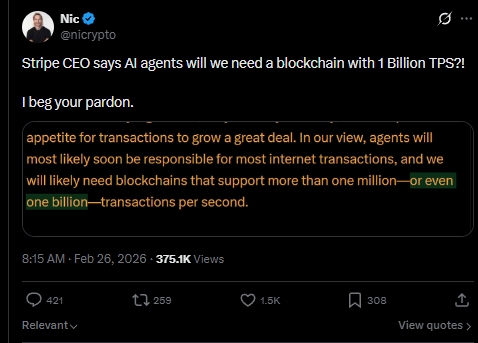
What is meant by this? AI agents will transact amongst each others for services on behalf of humans. These transactions will exceed human financial transactions in count and value. AI agents need to settle transactions quickly, securely, cheaply, so they will need blockchains that can handle this volume. But, now layer on human transactions that will also migrate to blockchains and that amplifies the need even more.
Untitled
Date: 2026-02-27
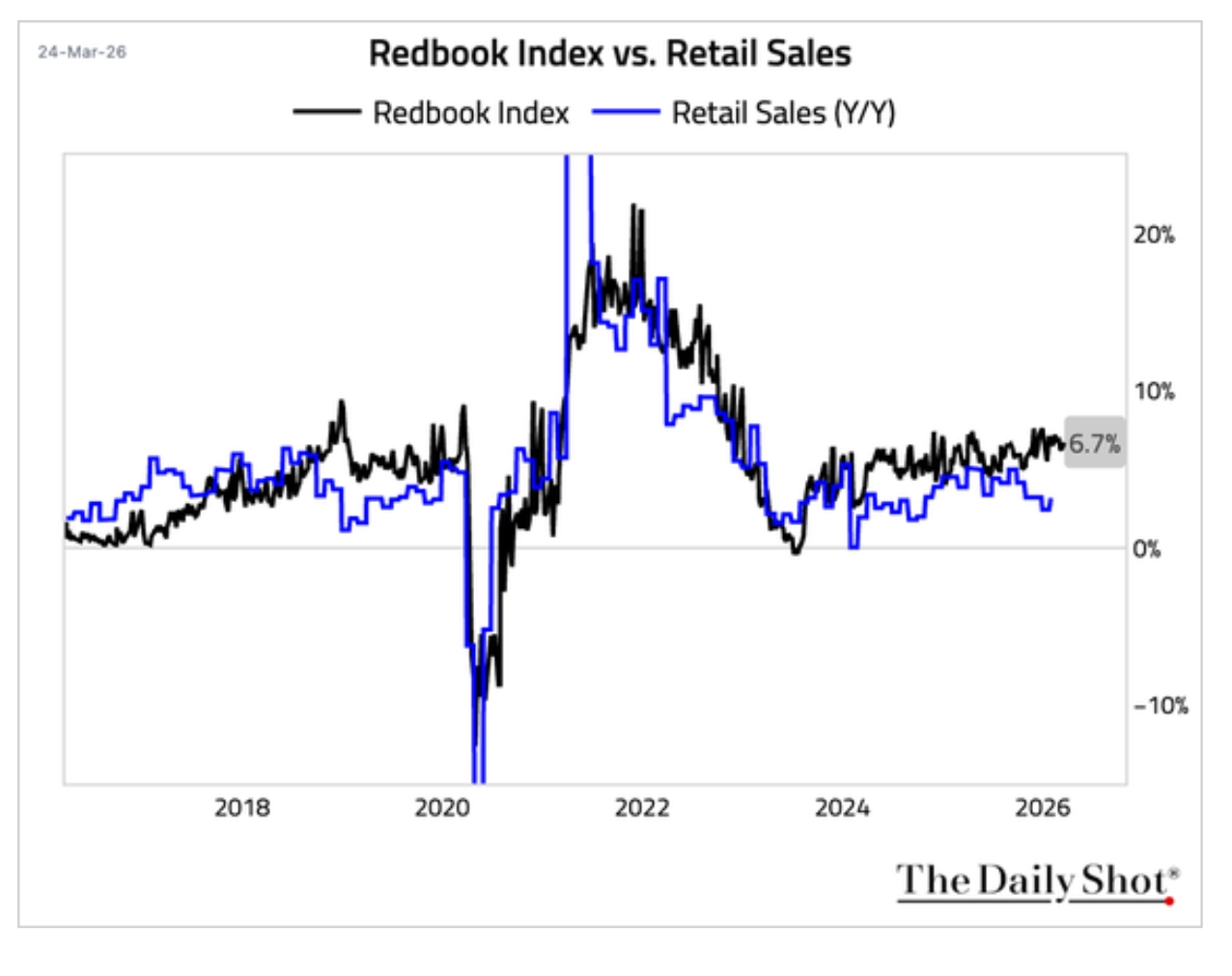
There is plenty of doom and gloom news circulating to capture our attention, but there is also a lot of positive activity that tends to get drowned out—here’s one data point that reflects that. The Redbook Index tracks weekly same-store sales growth at major retail chains, making it a faster, more real-time read on consumer spending than the official monthly retail sales report, which captures the broader economy. Because it’s reported weekly and focuses on comparable stores, Redbook tends to lead retail sales, often signaling shifts in demand 1–2 months earlier. In the current chart, Redbook has been trending higher and is slightly outperforming retail sales, suggesting that consumer spending is stabilizing or modestly improving in the near term, and that upcoming retail sales data will likely reflect that same gradual strength rather than a sharp downturn.
Untitled
Date: 2026-02-27
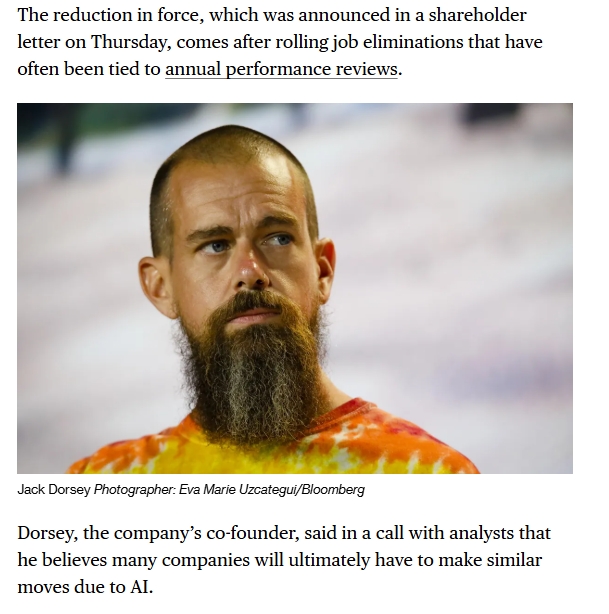
Companies have a fiduciary duty to the shareholders to deliver value for their investment, and as AI is a massive productive booster, they are and will do that. There is no fiduciary duty to employees. So much more of this to come. What will people do? The paradigm of relyign on experience, education and intelligence is rapdily ending. Move to owning assets that produce an income. Transfer your expertise into AI agents that people can hire, because they won't hire you.
Untitled
Date: 2026-02-27
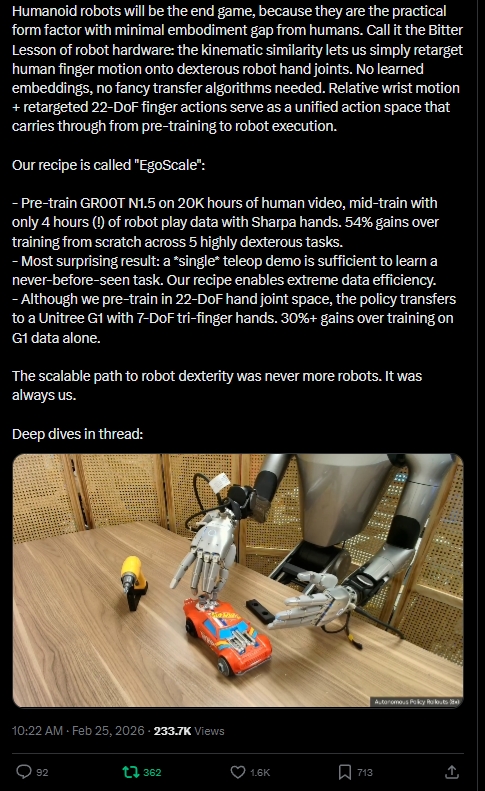
Boom! A major robotics paper just showed something big: if you record enough human hand movements (from simple daily tasks), extract the motion automatically, and train on it at scale, robot dexterity improves in a predictable way. In plain terms — more structured human motion data = smarter robot hands. This is monumental for complex, high-precision work like sewing, apparel production, repairs, and other tasks that require fine finger control. Instead of programming every movement, we may be able to scale dexterity the way we scaled language models — by learning from massive amounts of human behavior. via https://x.com/DrJimFan/status/2026709304984875202
Untitled
Date: 2026-02-27
The tsunami coming from human-level AI? It is already here and gaining speed and strength. We see it in job declines in the tech sector and marketing. We see it in people and companies using AI who are sprinting ahead in prouctivity and capabilities. It will overtake all sectors, white collar and blue collar. It is inevitable because AI fundamentally saves money and there is stampede by everyone to save money in an economy that is stagnant beset by challenges that have been building for decades. Its inevitability is also being forced by China and their relentless progress; the U.S. is in an existential crisis to stay ahead of China, lest they get the upper hand and use it against us. We cannot escape this tsunami. But we can ride it and navigate it to reach the other side, where our next economic supercycle is waiting.
Untitled
Date: 2026-02-26
The U.S. is famous for kicking the can down the road — but the EU is way better at it.

Untitled
Date: 2026-02-26
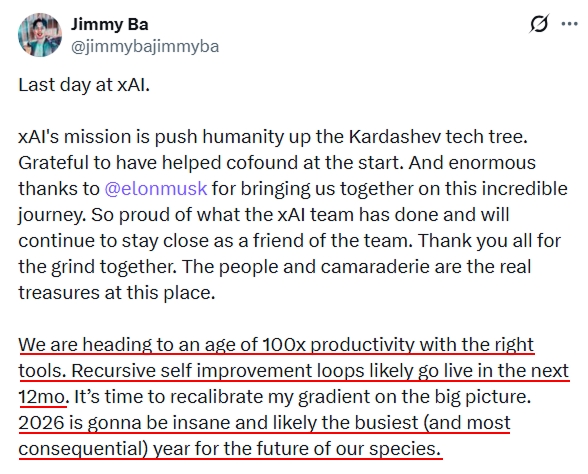
A founder at xAI says we’re about to see 100× productivity gains from recursive self-improvement — AI writing and upgrading itself — and that it’s happening this year. I’ve felt this wave building since GPT-2 dropped way back in 2019 and made the trajectory obvious. Now it’s arriving. And even after watching it for years, I’m not sure I or any of us are truly prepared for what that actually means. We're gonna find out.
Untitled
Date: 2026-02-25
Artificial intelligence first reshaped computer science and software development. Marketing seemed always next. The discipline runs on data, repeatable processes, pattern recognition, and optimization loops — ideal terrain for machine execution. The center of gravity is already moving. What began as context engineering and better prompting is evolving into multi-agent workflows and agentic engineering. Instead of asking a single model for outputs, we design systems of specialized agents that collaborate, verify, adapt, and execute toward defined objectives. We are no longer primarily prompt writers. We are orchestrators — coordinating teams of digital workers, assigning responsibilities, managing handoffs, setting constraints, and aligning outcomes to strategy. Success becomes less about crafting the perfect input and more about building reliable, repeatable, goal-driven operations. https://www.thedrum.com/opinion/mark-ritson-the-great-stay-and-the-quiet-collapse-of-the-marketing-job-market
Untitled
Date: 2026-02-24
Eddie’s been temporarily replaced. Vizsla dog leadership has assumed control of his feed! Canine Contemplations: Communicating With the Aliens Something strange started happening in our south meadow late last summer. At first, no big deal. There’s always something going on at the farm. But this one felt… different. Mom and Dad never mentioned it to us. We’d head out every day for our usual routines—walks, bike runs, rock climbs, dog parkour—and suddenly Dad started spending a lot of time down in the meadow. Digging. And digging. And then digging some more. Naturally, we helped. Because holes. At first it was fun. But then the holes got really big. Like “you could lose a tennis ball in there forever” big. Then one day… a cement truck showed up. And metal pipes got planted into the ground like giant silver sticks. We looked at each other. What. In. The. World. Is. This? That’s when Willy—one of our boarding peeps—casually dropped the theory: “It’s a communication device for aliens.” Why were Mom and Dad building an alien communications array in our meadow? Were we about to be abducted? Would aliens appreciate our recall skills? We decided an intervention was necessary—for everyone’s safety and sanity. Mom and Dad listened and explained everything. Immediate relief. Crisis averted. So what did go up in the meadow? Turns out—it’s a ground-based solar array. We still don’t fully understand words like kilowatt-hours or joules (honestly, sounds like chew toys), but here’s what we do understand: The sun makes energy. Energy means heat. Energy means food. Energy means mountain trips with Mom and Dad. Nuff said! Whatever that thing is… we’re all for it. Mom and Dad explained that energy is kind of a big deal right now. There are lots of new things coming that make life better—but they all need energy. And lots of it. So getting clean energy—from the sun, wind, water, and even deep in the earth—matters more than ever. Dad likes this quote: “You never change things by fighting against the existing reality. To change something, build a new model that makes the old model obsolete.” Instead of barking at the power company, he built a new model in the meadow. Classic Dad move. Who knew? We even poked around Dad’s computer files (another mysterious energy-powered contraption) and found a really cool folder about the solar array. Dad designed it himself using regular, easy-to-find materials, and it meets Colorado building requirements. He’s sharing the design freely, so if anyone wants to build their own ground-based solar array, you’re welcome to use it. https://docs.google.com/document/d/1cHgys143KesCqQzLYRbqVU7pXEVxy3pO0Js7D9yqs34/edit?usp=sharing Sharing is caring. Also very dog. So everyone - Rest Easy! Peace out! No aliens! No transmissions! No forthcoming abductions! To quote from one of our favorite TV shows…Saul Good!
Untitled
Date: 2026-02-24
It is becoming apparent that, head-to-head, toe-to-toe, we could lose to China. If the future runs on energy—which powers chips, which power AI, which in turn drives intelligence and eventually superintelligence—we may remain competitive in semiconductors and advanced models, but without abundant energy the whole system becomes a house of cards. China has been rapidly expanding generation capacity, while the U.S. is often slowed by regulation, NIMBY dynamics, complacency, and a failure to recognize the existential stakes for our prosperity and way of life. One workaround now emerging is the rise of corporate sovereigns with the capital and mandate to build the full stack themselves. At least we have that. Consider the Musk ecosystem: energy production through solar and batteries, chip design, data centers, AI with Grok, a growing knowledge corpus, launch capability to move infrastructure into orbit, satellite connectivity, and embodied AI via Tesla and Optimus—integrated to support relentless expansion. The risks are enormous, but at least someone on our side is operating with urgency, as if national competitiveness truly depends on it. https://www.bloomberg.com/news/newsletters/2026-02-05/china-s-energy-buildout-is-its-ai-superpower-in-race-with-the-us
Untitled
Date: 2026-02-21
If intelligence becomes free, then the intelligence each of us has gained through education and experience becomes devalued, and probably a lot. To create it into an asset, transform that intelligence into an AI agent that you rent out for others to use. This article is an excellent primer on building agents. https://x.com/Flynnjamm/status/2023465136204419096 I've added it as a link off my my working document about the skills and jobs of a future with AI dominating. That is here: https://docs.google.com/document/d/1_citc66qAkKL2IXAuPOvnor9P0hfxQbZ2z8daQnCxNQ/edit?usp=sharing
Untitled
Date: 2026-02-07
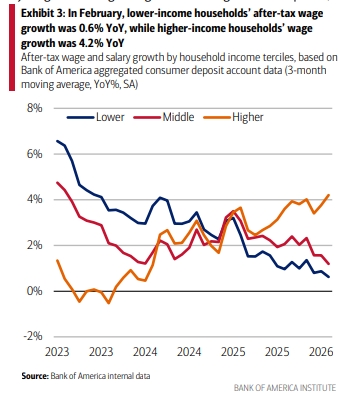
The widely known narrative we’re stuck in is a K-shaped economy, where the top 10% in wealth and income are doing well while the bottom 90% are struggling. I keep searching for data that might change this view, but it is not forthcoming. Here is another unfortunate chart reinforcing the narrative. What changes it? Broadly, fiscal and monetary policy shifts (which don’t appear to be happening), but even more importantly, each of us pushing into the future—embracing new technologies, business models, and growth paradigms. The problem is that most of us are clinging to the past rather than embracing the future. That keeps us stuck in legacy thinking, processes, and systems that have led us to the difficult states across economics, politics, geopolitics and the envrionment in which we find ourselves.
Untitled
Date: 2026-02-07
Continuing this original post, the rise of the corporate soverign, who wins, who loses and the effects. Anything state-adjacent - that is, it earns money from government contracts or people, who get entitlement spending, are in trouble. When you layer soverign debt, government has no choice but to cut payments everywhere - not just non-discretionary like entitlements, but discretionary as well. Layer on regulation, NIMBY and largely older generations and what I call the industrial complexes that will fight tooth and nail to prevent spending going to them, and futuer growth and change will not come from government. The corporate soveriegn - and we have already had them throughout history (Dutch East Indies Company, Hudson Bay Company), will rise to fill the gap. For example, as medicare and social security payments drop, corporate soverigns will step in offering AI healthcare. As public land support continues to fall, in steps corporate soverigns who will buy/rent these public spaces for resource extraction plus also managing for public use. So I would say private sector tied to our emerging AI driven economy (energy+chips+AI+robitcs) will fourish, while state-adjacent will stagnate. Wealth inequality is tied to this dynamic - the top are in emergent while many of the lower wealth classes are in the former. https://www.linkedin.com/posts/eddiesoehnel_trump-moves-to-have-tech-giants-pay-for-surging-activity-7424874399088119808-d-ks
Untitled
Date: 2026-01-30
We’re entering a pretty remarkable era—especially for small businesses, freelancers, creators, side-giggers, solo operators, and even households with assets to rent or monetize. SEO and findability are finally moving past the Google enshitification era, where the biggest players with the most money, tools, and teams could out-optimize everyone else. Good riddance! I’m open-sourcing a tool I originally built for my own businesses and for the work I’m doing through @indx. The key shift is this: we’re no longer pitching humans with limited attention spans. We’re pitching AI—which has no such limits and actually wants more detail so it can properly match us to its human users. That’s a profound change. It means each of us can finally lean into what makes us truly different, unique, and WOW.Don’t let the length of the tool scare you. It’s a living, working reference document that I’ll continue to update based on real-world use, and you won’t need every part of it. Whether you sell something, run a business, freelance, or even work as an employee, this approach helps AI find you and surface you to the right people at the right time. The important part is to start now. https://docs.google.com/document/d/1HfdNZRC4823NvT1ID2ZQNrcW8PCT4czUlnIXROLY_20/edit?usp=sharing
Untitled
Date: 2026-01-30
I keep emphasizing the importance of owning productive assets. As AI outperforms humans in education, experience, and knowledge-based work, the economic value of individual intelligence is trending toward zero. I created this superlist for myself as a way to deliberately shift my income from relying on my intelligence to relying on assets. Below are just the section headers from that list, each with detailed sublists beneath them. I maintain the full, living version in this Google doc under the “The Asset Stack” section. The next economic supercycle may be anchored in decentralized, distributed systems that we collectively own and participate in—but only if individuals actively make the transition from intelligence-based income to asset ownership. If we don’t, control will continue to concentrate in the hands of the largest companies and asset holders, leaving the rest of us increasingly dependent on systems we don’t own and can’t influence. Physical & Infrastructure Assets, Energy-Producing Assets, Machines & Robotics, Compute & Digital Infrastructure, Data-Producing Assets, Proprietary Workflows & Processes, Software & Agent Assets, Community / Network Assets, Location-Based Scarcity Assets, Trust & Verification Assets, Distribution & Attention Assets, Regulatory Arbitrage Assets, Experience-Based Assets, Capital Routing Assets, Maintenance & Longevity Assets. https://docs.google.com/document/d/1_citc66qAkKL2IXAuPOvnor9P0hfxQbZ2z8daQnCxNQ/edit?usp=sharing
Untitled
Date: 2026-01-30
This is a highly recommended practice I started about a year ago—and I’ve since heard from many others who do the same: save all of your AI chats in your own files. Why? To reduce platform lock-in and protect yourself if a platform changes, degrades, or disappears. And let’s be honest—enshitification is already creeping into AI platforms, while open-source alternatives you can run locally on your own equipment are accelerating fast. Your chat history isn’t just a record of you—your interests, thinking, and activity—it’s valuable intelligence that helps AI work better for you. If you save it, that intelligence can never be taken away. And instead of the AI running more inference to give you answers, which is more costs, it can search your memory to see if the answer is already there.I organize all my chats into folders using the same structure across platforms (OpenAI, Grok, Gemini, Claude), and mirror that exact structure in Google Drive. Once a week (Mondays), I copy the prior week’s chats into Google Docs and file them accordingly. ChatGPT tells me I’m a top 1% user, so yes—it’s a bit of work—but it goes fast. I can usually get through everything in 30 minutes or less. I've looked into automating this with scraping, but have not found a workable solution and, predictably, the AI platforms will make it harder to copy your content out because they want to lock you in, so the copy paste I do above may be it for now.
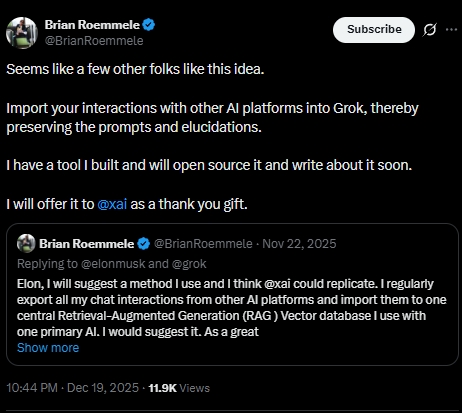
Untitled
Date: 2026-01-30
Ugh. Reindustrialization jobs are just not happening. We desperately need it, but policies and incentives are misaligned.
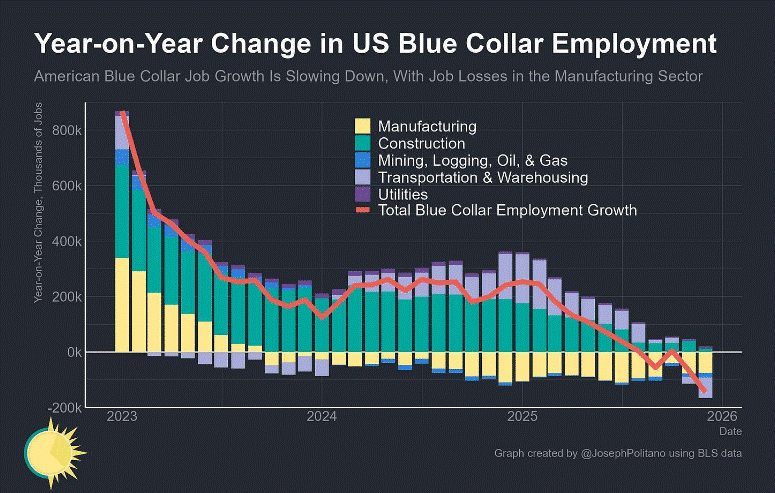
Untitled
Date: 2026-01-30
This wild project is an absolute harbinger of the future. A human started a company led by Grok, with “employees” that include Anthropic’s Claude, Google’s Gemini (which may already have been fired), and Clawdbots/MoltBots/OpenClaw—all reportedly hundreds of AI “workers” developing a new company using research acquired from a bankrupt firm. Wages are paid in joules (fractions of a kWh) and structured to force AI models to learn, negotiate tasks within fixed resource budgets, and become more efficient over time. There are so many paradigm shifts happening here: 1. AI taking over knowledge-based work - something like 50 days of human work is done every 24-hours in this project; 2. No human employees—just the owner; 3. New currency layers;4. AI-to-AI transactions (likely to exceed human transactions within 10 years); 5. AI learning on its own (recursive self-improvement) and from the actions of all the other agents - a flywheeel that goes faster and faster; 6. AI setting up its own infrastructure; 7. The moral compass of AI, fully exposed. This project mirrors the acceleration we’re seeing with Clawdbots, MoltBots, and OpenClaw — systems moving quickly toward greater autonomy. You could call it the earliest hint of the “Skynet” scenario we've all joked about. https://x.com/BrianRoemmele/status/2016055580692292083
Untitled
Date: 2026-01-24
Today's inflation vs the last 30-years. It is still double the previous trend, and I can't see it coming down, only going up as we have to add massive amounts of electricity production, retool for an era of compute, reindustrialize, all against a backdrop of rising resource contraints and geopolitical conflicts that makes it harder to get resources. Inflation is a killer of finances for middle and lower income classes. But intelligence is nearly free, so people can massively reduce costs by using AI to teach them how to do things themselves rather than hiring. Eliminate: researchers, writers, coders, electricians, plumbers, structural engineers, solar installers, SAAS software, auto mechanics, doctors, lawyers (this is amongst the hires I have eliminiated or reduced because of AI over the last few years)
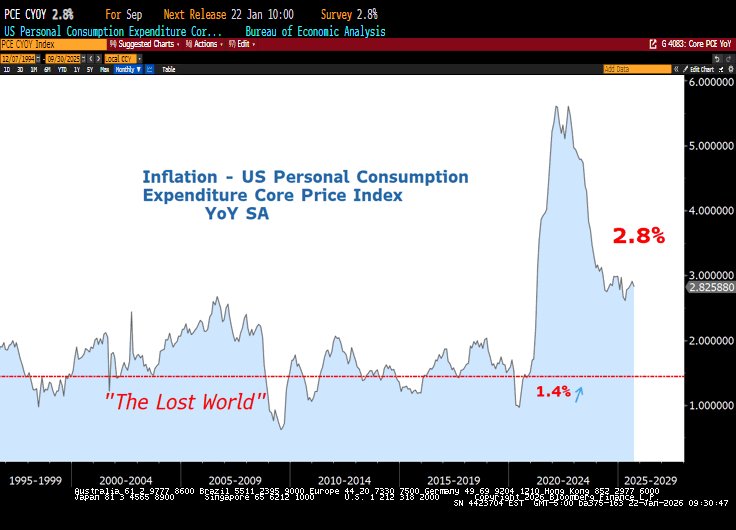
Untitled
Date: 2026-01-24
Enshittification is a term coined in 2023 to describe the predictable trajectory of consumer platforms: they begin genuinely useful, scale rapidly, then—under mounting revenue pressure—optimize for extraction rather than user value, resulting in degraded experiences that primarily serve advertisers, partners, or the platform itself, with Google Search as the clearest example. The same dynamic is likely to hit frontier AI models such as OpenAI, Anthropic, Google, and Grok, and to do so faster than it did with traditional platforms, as monetization pressure is arriving early and aggressively; the risk is AI systems that increasingly funnel users toward information, products, and services that maximize platform revenue rather than what is actually best for the user. A credible counterweight is already forming in the rise of open-source AI models that individuals and companies can run themselves or access via neutral hosts, the rapid expansion of independent directories and structured knowledge bases these models connect to, the emergence of domain-specific models that outperform general systems in narrow contexts, and a broader shift toward consumer- and company-sovereign AI stacks where users choose what they pay for and what they connect to. While this comes with real costs in compute, hosting, and curation, the trade-off is choice and control, with consumers and companies deciding what they purchase access to rather than being silently monetized. The likely shake-out is uneven: Google Gemini may persist despite weaknesses due to distribution and being “free enough,” Anthropic appears positioned to find durable footing as a B2B provider, OpenAI remains the open question as a consumer AI navigating the risk of enshittification, possibly via high-trust domains like health, and Grok’s future is unclear, potentially tied to X, Tesla, and SpaceX. Cory Doctorow’s original framing remains essential context: https://craphound.com/category/enshittification/
Untitled
Date: 2026-01-24
I cannot see a detente coming between The U.S., China and Russia. Why? Two unstoppable forces: (1) demographic collapse in the later two - they can do nothing to stop it. For them, it is a fight to expand to counter this to secure their future. Expand or die. And if they die, they have nothing to lose but to take everyone else with them. (2) Envronmental reckoning from natural disasters which means increased costs and resource constraints. Without expanding and securing resources, that leads to death. Again, expand or die. They have no choice. So, whatever detente may be realized on the surface, it won't last long. Previous cycle-ends (4th turning) lead to calamitous conflicts that broke one side so the other side could remake the order. If this does not happen, then we enter a long slow period of conflict as the later two countries implode and create havoc along the way. I fear that is the rail on which we will travel.
Untitled
Date: 2026-01-24
We all own smart phones. That can now be an asset that earns revenue. Simple example of how each of us can leverage what we own to produce income. An opportunity but also a neccessity, because as intelligence becomes free, what we know becomes worthless. What we own becomes priceless
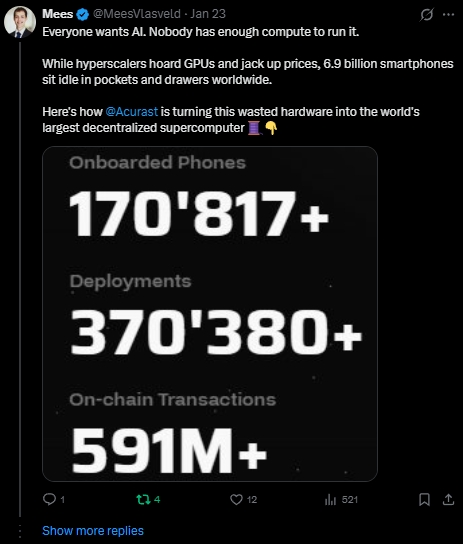
Untitled
Date: 2026-01-24
Have expertise? Code it into an AI agent for others to rent? Have assets? Use AI to leverage them for others to rent? Have an idea for a product or service? Use AI to develop it or code it. Have domaine expertise or distribution into a market? Use AI to develop a product or service so you can sell it. Start now. Leave the past behind. Forget competing on your education, expertise, and experience. AI will be better than you. Own assets that produce an income, not rely on a job that will go away.
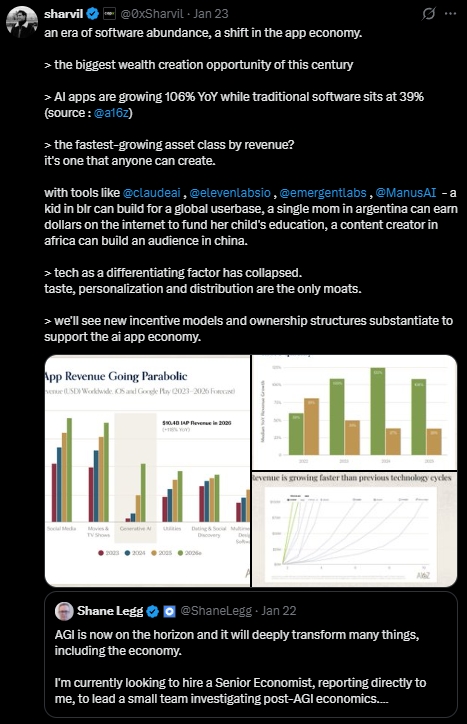
Untitled
Date: 2026-01-24
The killer app in AI thus far is software. While exceptional at code, it does not do business requirements, engineering and architecture as well. Without these three, code is almost worthless. But it will get there, which means anyone and everyone can code. The power moves away from software developers to domaine experts.
Untitled
Date: 2026-01-24
When intelligence becomes virtually free because of AI, the future does not reward intelligence, education or knowledge. It rewards ownership of things that intelligence can operate. As jobs collapse, assets compound. People don’t need to “learn more.” They need to own more leverage. I originally created this guide for me, but made it public to help others. This google doc contains a master list of assets that individuals, freelancers, side gigers and households can own to help secure their income in the future. Please, start moving in this direction! This is our future and to secure broad-based wealth gains, we all need to transition. https://docs.google.com/document/d/1_citc66qAkKL2IXAuPOvnor9P0hfxQbZ2z8daQnCxNQ/edit?usp=sharing
Untitled
Date: 2026-01-24
Capital spending as percentage of GDP. Our current technology boom far eclipses anything over the past 100 years. Technologies are converging and going exponential in growth, all feeding on each other. And I am not sure we have even gotten started. Robotics is coming and may be the biggest industry, ever. Our future is moving towards compute. Everything is being digitized with chips, all powered by electricity and run by AI. What derails this? If resource contraints get severe, from geopolitical conflicts or environmental disasters. The future of work and income will be dramatically different. Figure out now how you fit - move away from expertise, knowledge and education as your competitive advantage and towards owning productive assets (like creating software from your expertise). I created this guide for myself and I have made public for others. The faster we all can move to what I talk about in this working Google doc, the more prosperous we will all be. https://docs.google.com/document/d/1_citc66qAkKL2IXAuPOvnor9P0hfxQbZ2z8daQnCxNQ/edit?usp=sharing
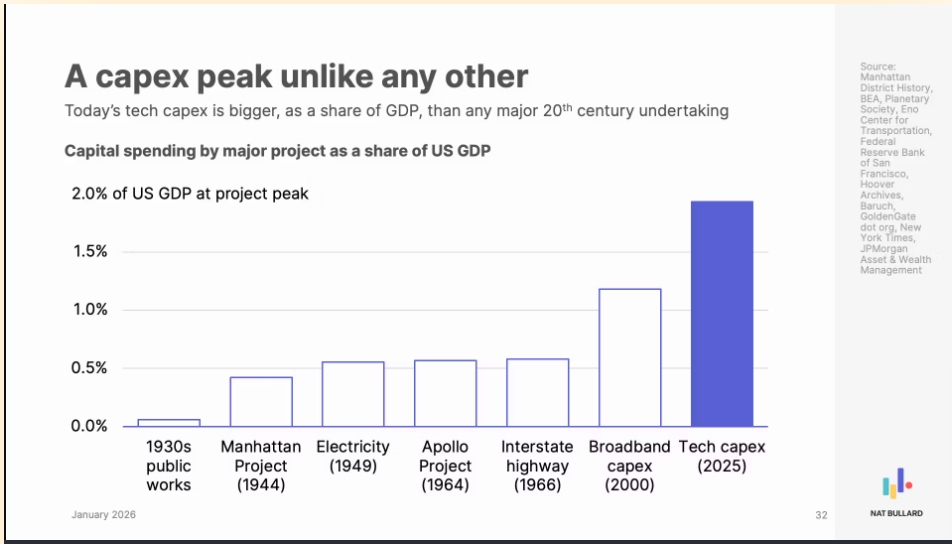
Untitled
Date: 2026-01-19
There is an emerging view that, because government is effectively bankrupt, highly bureaucratic, and hamstrung by regulation, it may increasingly turn to those with capital to help solve society’s problems—for a price. It is very possible that this becomes a pathway out of current debt constraints. Imagine addressing energy, healthcare, education, and social challenges through funding and programs funneled via technology corporations that leverage AI and other emerging technologies on our behalf. A highly recommended read on this scenario is The Emergence of the Corporate Sovereign. https://x.com/PeterDiamandis/status/2006904724541284684 https://www.bloomberg.com/news/articles/2026-01-15/trump-to-direct-key-us-grid-operator-to-hold-emergency-auction?cmpid=BBD011626_GREENDAILY&utm_medium=email&utm_source=newsletter&utm_term=260116&utm_campaign=greendaily
Untitled
Date: 2026-01-19
I think its very possible this goes a lot higher and goes on a lot longer. I am expecting trouble end of this decade, which might become a blip in an othewrwise continued run higher. The forces being unleashed with innovation may see a multi-decade run.
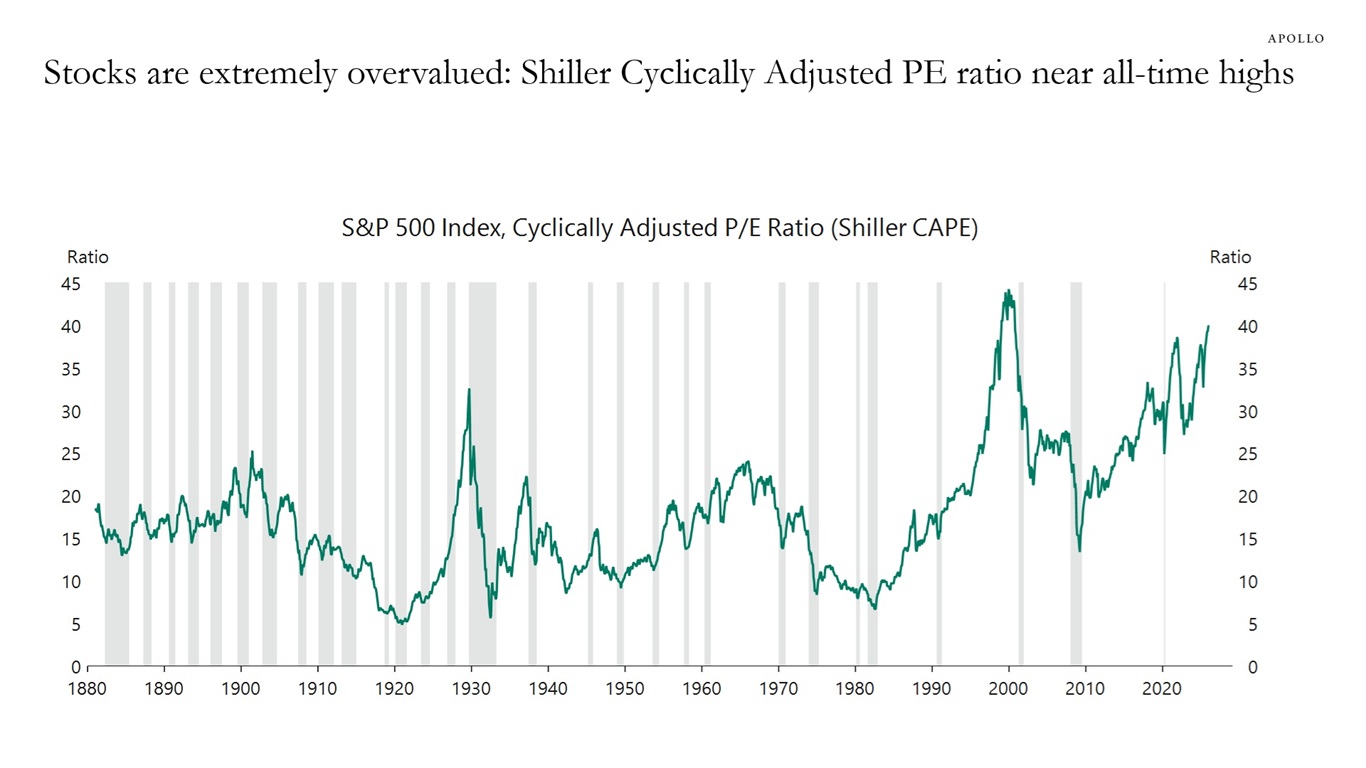
Untitled
Date: 2026-01-19
It is no longer shocking the progress AI is making. Building a browser is really hard and exising browsers have decades of development under them. And here it was built in a week on its own without human involvement. If AI can build browsers, imagine the smaller apps and agents you can build without knowing a shred of how to code. The future is plowing what we know into software we build that becomes an asset we rent out, like SAAS. We won't be employees of companies; we will be owners (or some of us at least) of software that we rent to companies. https://x.com/mntruell/status/2011562190286045552
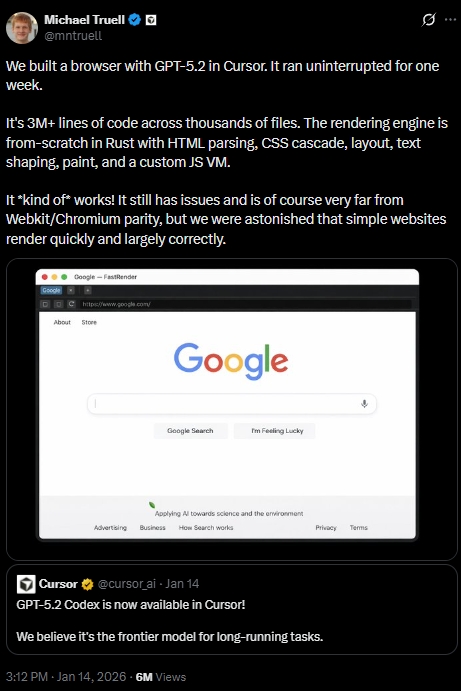
Untitled
Date: 2026-01-19
What is Elon talking about? Energy as currency? Here’s my simple take. Humanity has never had a “perfect” currency? But we may finally be able to build one. Every currency in history eventually fails. Fiat fails through debasement, as governments can’t stop spending. Gold and Bitcoin are supply-constrained. Neither can scale cleanly with real economic activity. Energy may be the missing answer. Everything in the modern economy ultimately resolves to energy. If energy is measured in kilowatt-hours (kWh) and used as the unit of account, supply can expand and contract naturally: more demand = more generation is built; too much supply = prices fall, investment slows. The tools already exist so we are not inventing new tech: blockchains for settlement; cryptography for security and privacy (including ZKPs); digital wallets for machines and people; revenue-grade energy measurement standards already used by utilities. The missing piece is simply connecting them into an open standard. How this could actually start (very practically): 1. start small, not ideological; 2. deploy in Texas, already one of the most innovative energy markets; 3. energy producers generate verified kWh; 4. A GPU cluster prices compute in kWh, but settles in U.S. dollars for now. 5. that same GPU cluster then resells AI inference priced in kWh to customers, again settling in dollars for now. At first, kWh is the unit of account, not the settlement currency. Money follows usage later.Companies like Base Power, which already coordinate distributed solar and batteries, are perfectly positioned to pilot something like this without changing their core business — just by publishing cryptographically verifiable energy data alongside what they already do. The idea is to not “launch a new currency.” It is simply to let energy become the economic truth, and currency emerges as a side effect. As AI, robots, and compute become the future of the economy — and all of them run on electricity — then a kWh-based monetary system may not be radical at all. It may be inevitable.
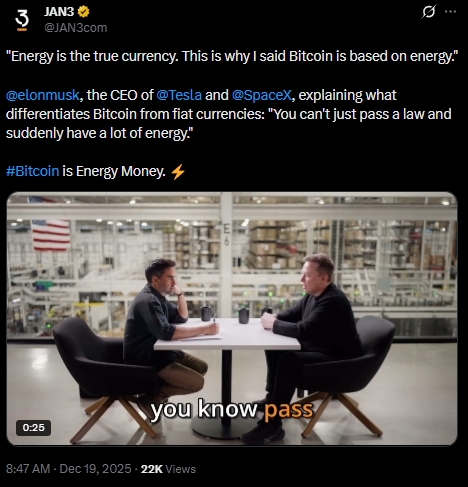
Untitled
Date: 2026-01-18
This is real retail sales (adjusted for official inflation). Slippage starting late last year. Does this return to trend this year? Anyone's guess. So much in flux. I could easily see a boom economy emerging, although bifurcated where the top 10% continue to do well and the bottom 90% continue to slip.
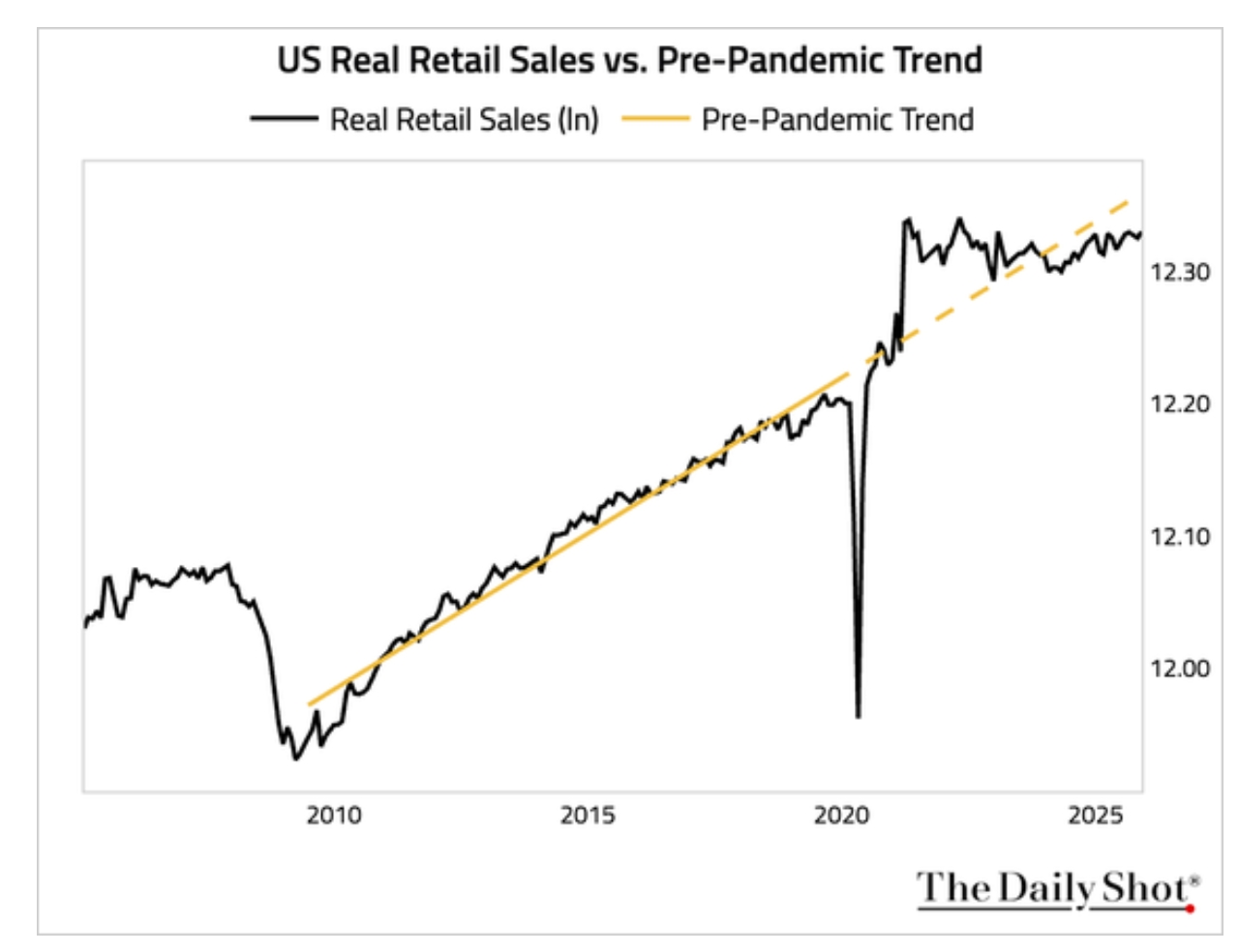
Untitled
Date: 2026-01-18
The US shopping mall is increasingly a business in which there are a few big winners, many losers, and nothing in between, according to a report in the FT. The top 100 of America’s roughly 900 shopping malls represent about half of the sector’s asset value; the bottom 350 account for just 10%. High-end malls (those classified as an ‘A’ mall) can attract new tenants, luxury brands, and large-scale entertainment; C and D malls have seen their occupancy rates fall by more than 26 percentage points between 2016 to 2019. The pressure on weak malls is being “compounded” by the strain on lower-income American consumers who are facing mounting bills. Some good news: apparently younger people – Gen Z in particular – are tired of doing everything via screens and are more likely to want to visit malls; the trick will be in knowing what combination of attractions will inspire shoppers and having the investment to see the vision through.
Untitled
Date: 2026-01-13
There's an uncomfortable truth at the heart of professional cycling’s funding model: pro racing is funded by selling extremely expensive, increasingly irrelevant products to ordinary riders. So much so that we've reached a point where professional cycling is now structurally dependent on a shrinking, increasingly affluent audience. It's an unsustainable model.
Untitled
Date: 2026-01-13
Insightful predictions with respect to AI 2026-2030. Some I pulled out with respect to companies, product and jobs. More in here with respect to investment and valuation. At the end, I summarize what this means for each of us with respect to our skills and employment in the future (1) AI capability will continue improving rapidly; today’s models represent the worst performance baseline going forward. (2) Agentic systems layered on top of pretrained models will expand into knowledge work beyond coding. Knowledge workers (law, research, consulting, medicine, support) are next after software. (3) Scaling has not yet hit a wall; if it does, it would be a major surprise as scaling in hardware and software to improve AI has a huge runway from what we can see. (4) Near-term job displacement remains limited and uneven. (5) Productivity gains are currently real but smaller, messier, and harder to measure than headlines suggest. As AI gets better, they will become more apparent (5) AI lowers the premium on expert labor. Human-only skill moats are shrinking rapidly. Asset ownership and leverage of AI tools matter more than credentials. As I keep emphasizing ad nauseum, human education, experience and knowledge will be significantly degraded as AI takes ovr intelligence. We all have to shift away from this as our value differentiators and towards assets we own which positively produce income for us. This includes creating software assets from our knowledge that we encode into agents. Humans won't be hired to do jobs so much as our agents and our assets will be rented to perform tasks. https://post.substack.com/p/the-ai-revolution-is-here-will-the
Untitled
Date: 2026-01-11
Data from the Census shows that the weekly number of business applications is at all-time highs. This is excellent. There is so much innovation across technology, business models and growth strategies emerging. Every one of us can harness it to create new businesses, and so far, it appears that is happening. To transition away from our legacy structures that have created so many of our challenges, every one of us needs to take initiative to find our place in the emerging era.
Untitled
Date: 2026-01-10
Vladimir Lenin once said, “There are decades where nothing happens, and there are weeks where decades happen.” Last week was one of those weeks. Venezuela’s sudden snatch-and-grab was a highly leveraged event that accelerated global realignment, as did the U.S. aggressively pursuing and seizing black-market oil shipments on the open ocean. Iran is facing unrest after decades of economic and climate-driven pressure, potentially reaching a tipping point toward regime change. After 25 years, Europe may finally be nearing a free-trade deal with Mercosur. And we cannot ignore Nvidia, which was massively disrupted — by itself — through an unorthodox release of its next GPU architecture that leaps far ahead of the previous generation while the rest of the industry is still trying to catch up.
Untitled
Date: 2026-01-10
As the compute economy issues more and more bonds to fund its growth, that means more debt supply, which means higher rates because more supply needs to attract buyers with higher rates. This probably means higher mortgage rates. https://www.apolloacademy.com/growing-ig-issuance-will-put-upward-pressure-on-rates-and-credit-spreads
Untitled
Date: 2026-01-10
I am seeing more and more predictions about massive GDP growth just around the corner. I think that growth is more likely in the 2030s, though it could start sooner. But here is the key issue: right now, the U.S. economy is being carried almost entirely by compute — investment in energy, chips, data centers, robotics, and AI. That sector is growing rapidly enough to offset sluggish or even negative growth across much of the rest of the economy. The problem is that the vast majority of the economy is still legacy. About 90% of people live and work there. This creates a truly K-shaped economy: the top is doing exceptionally well while everyone else struggles. So yes, we may see massive GDP growth, but it will accrue to a relatively small group. How do we fix that? Every individual can begin participating in the compute economy starting right now. The tools exist. New distribution and growth models are being built. It is early and still primitive, but anyone can start experimenting today to find their place in a future that will be defined by compute. If people do not, many will get left behind, and that will produce severe imbalances in wealth and income. We cannot allow that, or a dystopian future becomes very real.
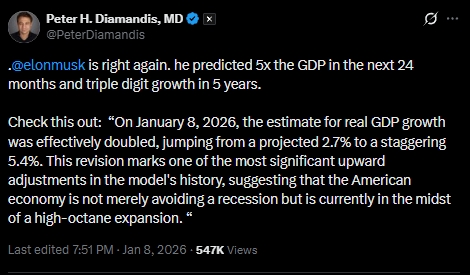
Untitled
Date: 2026-01-10
Yup. Dat
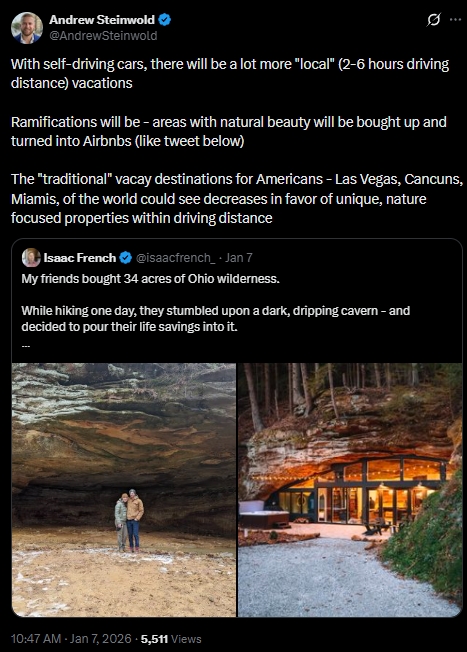
Untitled
Date: 2026-01-10
The dexterity and capabilities or robot humanoid hands is increasing in leaps and bounds. They will be able to do anything, including sewing apparel. This will disrupt apparel companies. See https://lnkd.in/guShNNNN and previous post with more here: https://lnkd.in/gA9ygd4y
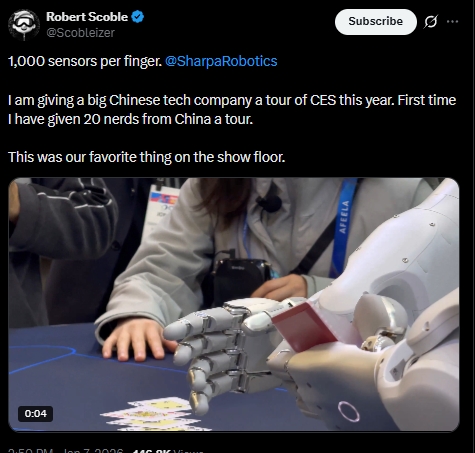
Untitled
Date: 2026-01-09
E-commerce continues to gain ground over traditional retail, but that doesn’t mean all physical retail is dying. There are clear pockets of growth. Department stores—and increasingly warehouse and superstores—are declining, while other formats are expanding. The factory outlet stores near me in Castle Rock are booming. I visited over the holidays and saw only one closed storefront, and that was because a new retailer was moving in. They’re even adding new construction.
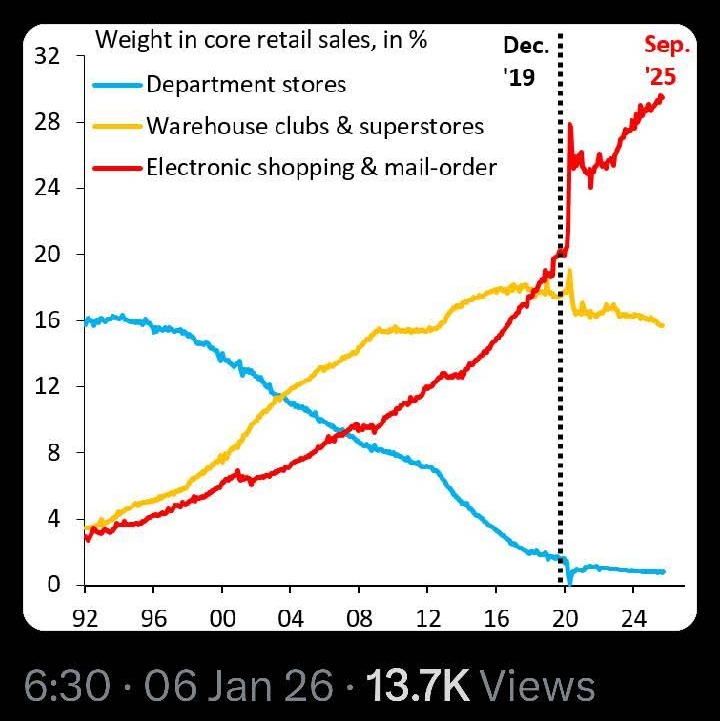
Untitled
Date: 2026-01-09
Yes...dat! Don’t be afraid to leave a job and build something of your own. We are entering an era where freelancers, side-gig workers, small companies, and even households can leverage powerful technologies and new business models to ignite a renaissance of decentralized work and growth that benefits everyone. The age of corporate concentration and extreme wealth can be reversed. We now have the tools.
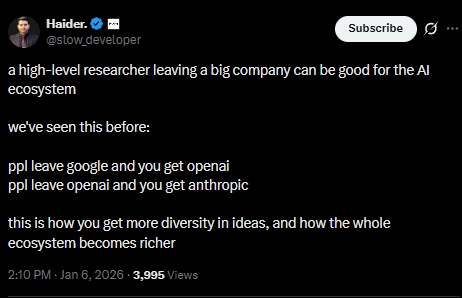
Untitled
Date: 2026-01-09
Share of U.S. household expenditures, 1929 to 2024: clothing, footwear, and groceries have steadily declined, while health care has become the monstrous category that rose to take their place. AI gives us a path out of this cost death spiral—delivering personalized care at a fraction of today’s cost, accelerating innovation even further, and stripping away much of the administrative overhead.
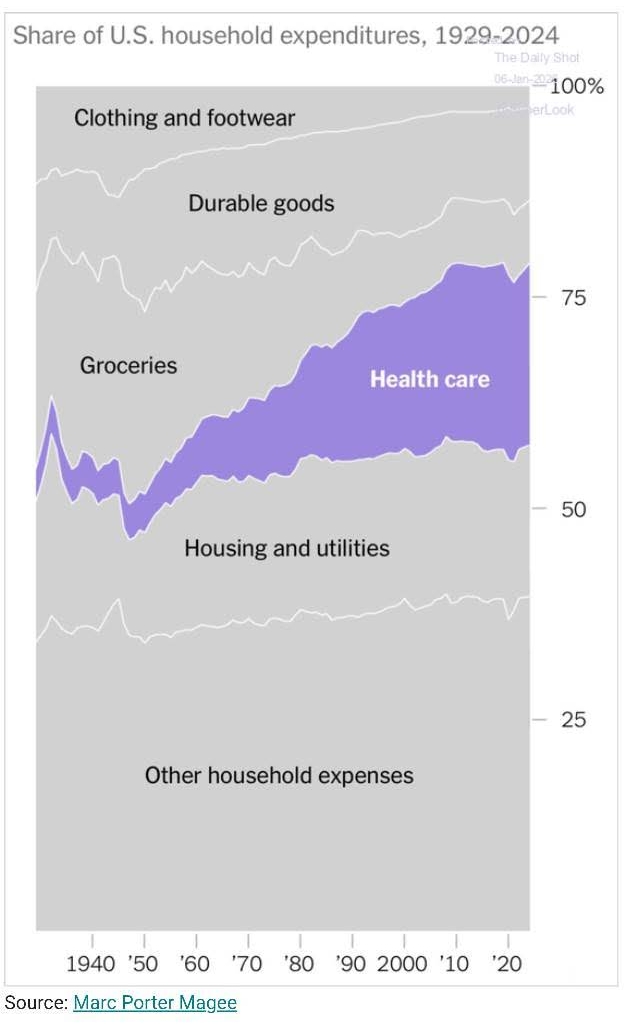
Untitled
Date: 2026-01-09
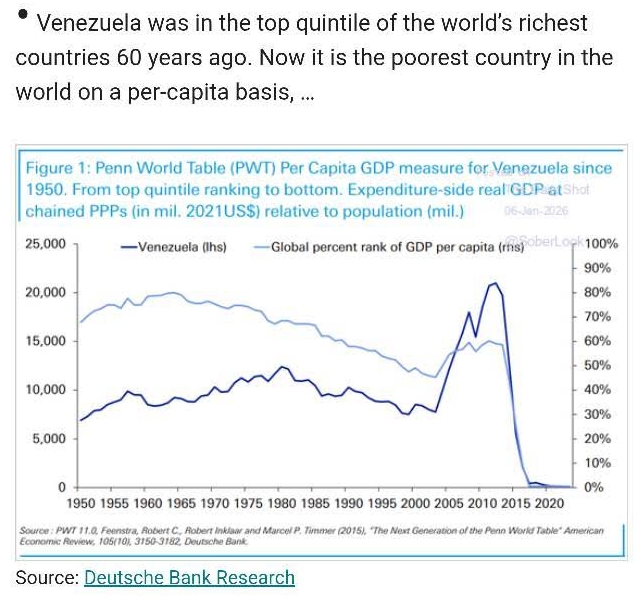
Untitled
Date: 2026-01-09
Another measure of Europe’s long-term decline. Its weight in global equity markets continues to collapse relative to the U.S.
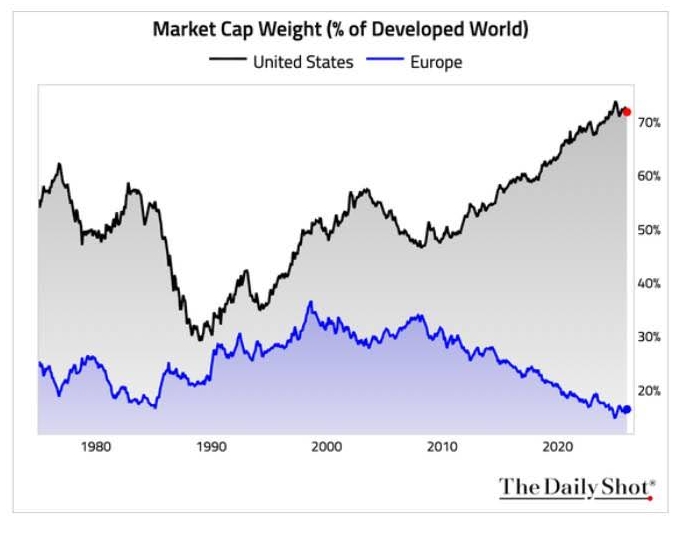
Untitled
Date: 2026-01-08
I read a lot of forecasts. This one is excellent for the outdoor industry. A few of its predictions map cleanly to my longer-term Future Map. Why Gear-as-a-Service and Used Gear Move Front and Center. This is all about It’s about affordability under constraint. These are economic coping mechanisms in a system where discretionary income is being squeezed year after year. That pressure does not ease this decade. It intensifies. For more and more consumers, ownership becomes optional. AI as the “Outdoor Gear Buddy” Is Just the Beginning. The friendly framing—AI as a helpful guide, packing assistant, or digital green vest—is just the on-ramp. The real driver is cost compression. AI excels at eliminating knowledge-based middle layers, standardizing expertise, and scaling decision-making without scaling labor. Every company under margin pressure will deploy AI not because it’s exciting, but because it’s unavoidable. The middle gets compressed. Expert roles get encoded. Human labor shifts toward fewer, higher-leverage positions. This isn’t an outdoor industry issue. It’s economy-wide. 2026 Is the Nervous Calm Before the Storm. 2026 is more of a holding pattern—a year spent trying to preserve the past with incremental tweaks, cost controls, and narrative optimism that assumes the old system will reassert itself. It won’t. What we’re seeing across the outdoor industry—and the broader economy—is not cyclical pressure. It’s structural failure. Reform begins in earnest in 2027, which, as I’ve been saying, is when things get real. Who Adapts—and Who Doesn’t. Individuals, freelancers, and small companies can adapt. They’re flexible, unencumbered, and able to adopt new technologies and business models quickly as AI, robotics, and resource constraints reshape the landscape. Large suppliers, vendors, and distributors are far less adaptable. Their size, inertia, and legacy structures make the transition painful—and in many cases, impossible. I see significant risk that some of the industry’s biggest and most storied companies will fail. When they do, they’ll create a blast wave. If you’re too tightly coupled to them—operationally, financially, or strategically—you risk getting pulled down with them (https://www.linkedin.com/feed/update/urn:li:activity:7413967449706037248/).
Untitled
Date: 2026-01-08
Everyone can start doing this now to protect their future income. The chart shows a clear downturn in tech employment—and tech is almost always a leading indicator for other industries. As AI and economic pressure displace white-collar, knowledge-based roles (nearly 50% of U.S. employment), income security is shifting away from resumes, credentials, and experience toward something else entirely: productive assets that generate cash flow. The key move is to turn what you know into software. Education, experience, and expertise only create durable income when they are converted into assets. In practical terms, that means AI agents. For example, I could build an agent that reconciles my monthly Chase credit card statement with my Google Sheets expense ledger. I use it myself—but I can also publish it so others can search for it, rent it for a fraction of a dollar, run it locally on their own device (protecting privacy), and have it delete itself when the job is done. This unlocks entirely new business models. Payments can be handled via HTTP 402 and settled in stablecoins, avoiding the 2.9% + $0.30 tax of traditional payment rails. The same mechanism will apply as physical robots become common. If I create an agent that guides the removal and cleaning of a 1993 Campagnolo rear cassette, I can publish that too—anyone can rent it for a few cents when they need it. Niche knowledge is the advantage. Start pairing your know-how across the things you do daily and weekly. The more specific and niche, the better—small markets can be extraordinarily profitable when you own the best solution. This is how individuals compete and win. This is a post-SaaS world. Centralized SaaS companies will erode as individuals reclaim the economic value of their own expertise. This is the democratization of know-how at scale. If you work inside a company and have learned unique processes, the opportunity is clear: quit and build them as agents yourself—and capture the upside directly.
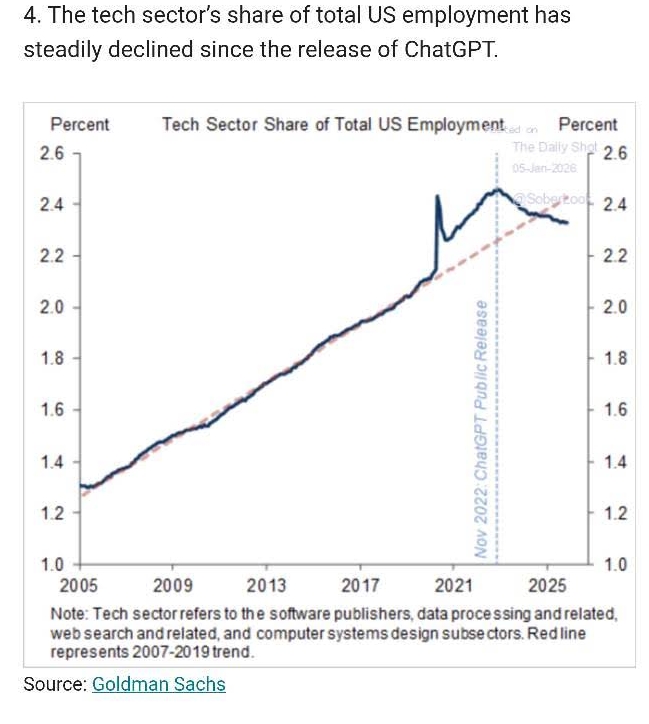
Untitled
Date: 2026-01-08
CHange in electricity prices 2020-2025
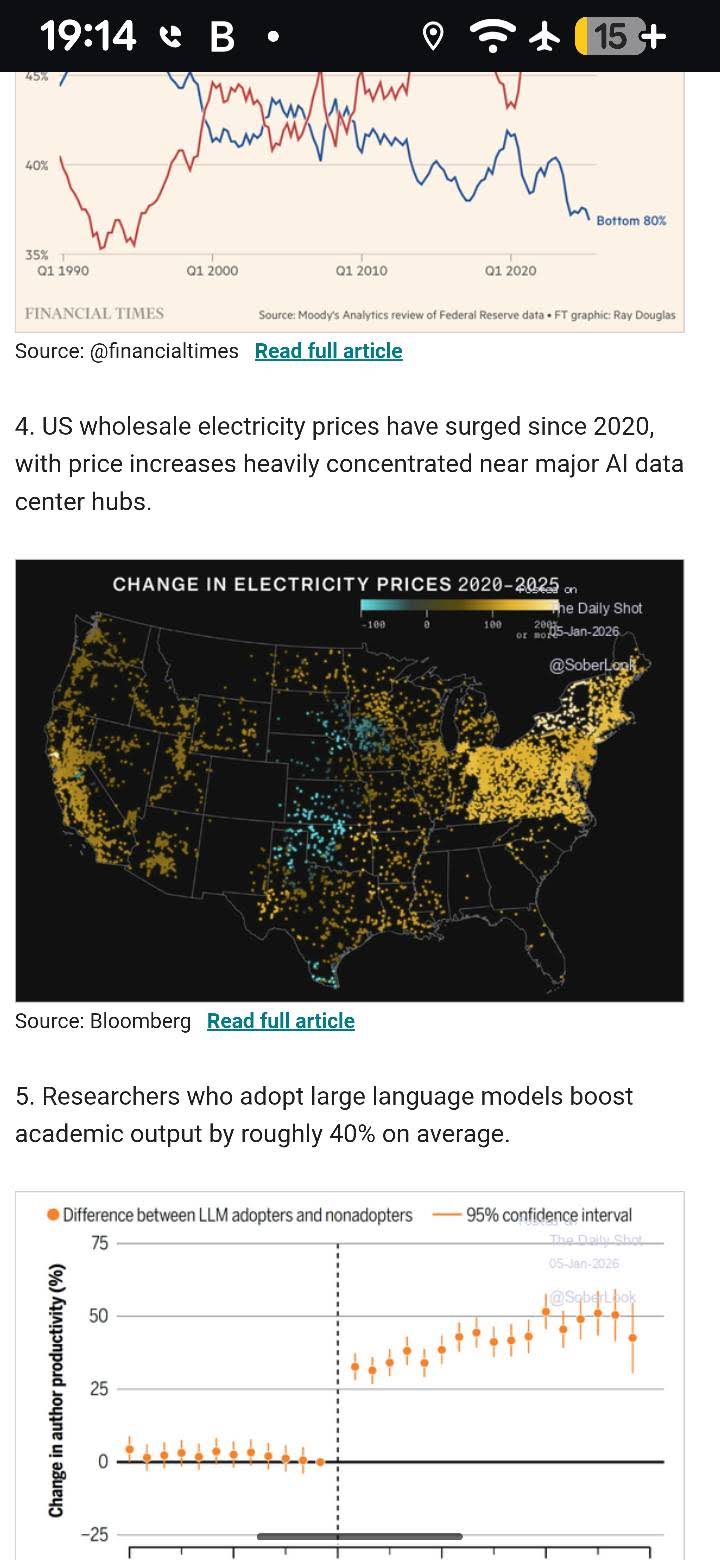
Untitled
Date: 2026-01-08
He is among the leading thinkers shaping how AI is understood and deployed, and his forecasts should not be dismissed. He is also not alone: a growing consensus across technology, finance, geopolitics, politics, and culture points to 2027 as the inflection point when pressures compound and acceleration becomes unavoidable—job displacement intensifies, technological change speeds up, climate impacts grow more acute, and geopolitical tensions escalate. The underlying driver is resource constraint and cost pressure: organizations, governments, and individuals will be forced to aggressively reduce costs and secure access to critical resources. While the long-term outlook for the United States remains one of relative abundance—far more so than much of the rest of the world—the transition from here to there is likely to be marked by periods of scarcity, disruption, and meaningful upheaval.
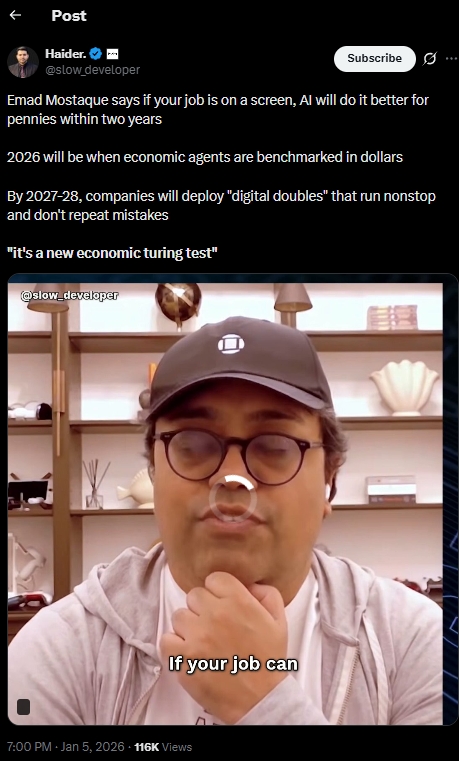
Untitled
Date: 2026-01-06
Many of the world’s largest companies were built for a different era—and to be fair, they executed that era exceptionally well. They delivered ever-cheaper products, on demand, from anywhere in the world. But those efficiencies came with structural costs: extreme concentration of wealth, erosion of the middle class, and significant environmental damage embedded in globalized scale. As we enter the next economic supercycle, that model becomes a liability. Broad-based wealth creation does not come from ever-larger institutions. It comes from decentralization—many smaller, faster, AI-enabled operators producing value closer to demand. For the middle class to re-emerge, legacy giants must either shrink dramatically or be displaced, allowing value creation to flow back to small businesses, freelancers, and even garage-scale operations amplified by AI and automation. Will markets correct this on their own? Possibly—but relying on that would be a mistake. This transition will not be passive. It requires all of us to move aggressively: adopting new tools, experimenting with new business models, and actively creating our own work, companies, and economic leverage rather than waiting for the market to change for us. https://www.bloomberg.com/news/articles/2026-01-05/ikea-under-pressure-from-amazon-temu-and-shein
Untitled
Date: 2026-01-05
Question: What do you hope the outdoor industry looks like in 10 years? via https://www.linkedin.com/feed/update/urn:li:activity:7407064589412020225/ 10 years from now: (1) big brands gone (or 10% the size) and demand democratized back to small vendors and garage manufacturers using AI and automation to produce localized, on-demand-driven, circularity-activated production, funneled from orders direct-from-consumer who use AI to design what they want, all of which power local manufacturing and industrialization and reignite the growth of the middle class; (2) emerging technologies and new business models of today are fully matured/adopted that fund and support public lands and ecological spaces to augment/replace public funding that will continue to get crushed over the next decade (our reckoning period...4th turning); (3) all products are circular/recyclable, possibly just produced via carbon-capture; (4) supersonic travel, suborbital point-to-point travel, autonomous driving/air taxis shuttle us to our recreation destinations easier/faster; (5) AI health, longevity breakthroughs and robotic exoskeletons allow us to enjoy the outdoors more, for more years; (6) AI is our intelligence layer, robots are the production layer, energy on the verge of becoming abundant, we work less, enjoy the outdoors more, which means more revenue for the decentralized ecosystem described above.
Untitled
Date: 2026-01-04
A difficult outlook for Germany—and Europe more broadly. Weak demographics, heavy dependence on exports, a strong inclination to preserve legacy systems, and an extraordinary level of bureaucracy are collectively constraining the EU’s ability to adapt and compete. This is not the U.S. fortunately. The best position for the future is to live in the U.S. and produce and sell products/services here. Next best if you cannot live in the U.S. is to at least produce and sell products here.
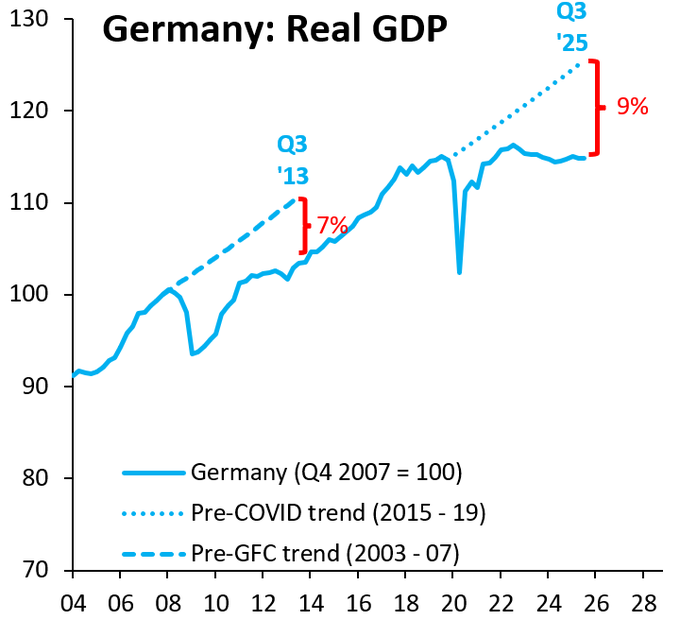
Untitled
Date: 2026-01-03
Everyone agrees things are moving fast—but not fast enough. We are entering a painful correction after decades of accumulated economic, political, and institutional imbalances. History suggests these transitions follow long cycles—roughly 80–100 years—where systems optimized for the past eventually stop working. The end of each cycle is disruptive by definition. The mistake is believing that slowing the transition reduces pain. It does not. Cycle endings are always painful, but the longer they drag on, the more cumulative damage they cause. The faster a system moves through the end of a cycle, the less time it spends in unstable, failure-prone states. Prolonged transitions maximize risk. Many people—particularly older generations, business leaders, and political incumbents—naturally want things to slow down or stay the same. That is understandable. The current system is how they accumulated wealth, power, and comfort. But preserving the status quo does not reduce risk. It extends it. Now layer in hard constraints: resource scarcity, climate stress, and geopolitical instability. These are not abstract future threats. They are already active. In that environment, technology is not optional or indulgent—it is the only credible path through the transition. Slower growth and delayed transformation do not create safety. They trap us longer in inherently dangerous conditions. If we are already in a high-risk world—and we are—then delay is not prudence. Delay is exposure. https://philiptrammell.com/static/Existential_Risk_and_Growth.pdf
Untitled
Date: 2026-01-03
This is brutal to read, but hard to escape. The uncomfortable conclusion is that people—employees and workers—have been the bottleneck all along. For decades, we steadily replaced human labor in factories. Now the cycle completes and accelerates: AI replaces knowledge workers while robots absorb even more physical production. What looks like two separate disruptions is actually one continuous process reaching its logical end. For centuries, wealth inequality had a natural brake. Capital still needed labor. Even the most concentrated capital structures depended on people to execute work, generate output, and consume wages. That dependency constrained how far inequality could run. AI and automation remove that constraint. Once labor is no longer essential, inequality does not merely widen—it compounds. Capital can scale without human participation. The result is likely severe social instability, followed by some form of income and wealth redistribution—political, forced, or chaotic. At the individual level, there is only one credible way to short-circuit this dynamic: stop relying on education and experience as your competitive advantage. AI will be better at both. The only durable position is ownership of productive assets. This is why I have been shifting toward owning energy (solar), servers (chips and compute), communications infrastructure (mobile data towers), land, and proprietary data that AI systems require. The question is no longer abstract: what assets do you own—or could own—that will generate value in a world where labor no longer sets the pace? https://substack.com/inbox/post/182789127

Untitled
Date: 2026-01-03
This is a hard truth that has not yet fully sunk in. For most people who spent decades—and substantial money, including me—accumulating education, knowledge, and experience, much of that advantage is approaching rapid decay. Not because it lacked value historically, but because AI will soon be better. We can already forecast AI capability a few years out with reasonable confidence simply by looking at semiconductor orders today. The trajectory is clear: intelligence likely becomes abundant and nearly free by 2030. The best expert in almost any domain will be available 24/7 for the cost of a streaming subscription. When intelligence is no longer scarce, it stops being a durable advantage. That raises the uncomfortable question: if what we know no longer differentiates us, how do we create value? The answer is that value shifts away from knowledge and toward ownership of productive assets. Energy production. Microchips. Servers. Compute. Robots. Proprietary data. Real estate. These are the assets that determine who wins in the AI era. It will no longer be primarily about how educated you are, how experienced you are, or how long you’ve been doing something. This transition will be a profound shock for those who are not preparing. The window to reposition is still open—but it is closing. https://x.com/benitoz/status/2005349615823183897
Untitled
Date: 2026-01-03
I maintain a working document on the future of apparel that I first published in 2024 and continue to update as new signals emerge. One of the most important accelerations is now unmistakable: humanoid robots are moving apparel production out of centralized factories and toward full decentralization. Recent demonstrations show humanoid robots rapidly approaching human-level dexterity for apparel tasks. This is often framed as factory labor replacement—but that misses the real disruption. The inflection point comes when humanoid robots enter households. Imagine renting a humanoid robot for roughly $500/month. During idle hours—overnight, weekends—you rent its excess capacity back to apparel platforms. Production collapses from factories to garages. Pair that with generative AI design tools, and consumers can design their own garments, then automatically match with nearby robot owners who manufacture on demand. At that point, the traditional apparel company model—centralized production, seasonal forecasting, inventory risk—no longer holds. This is not speculative. The compounding forces are already visible.
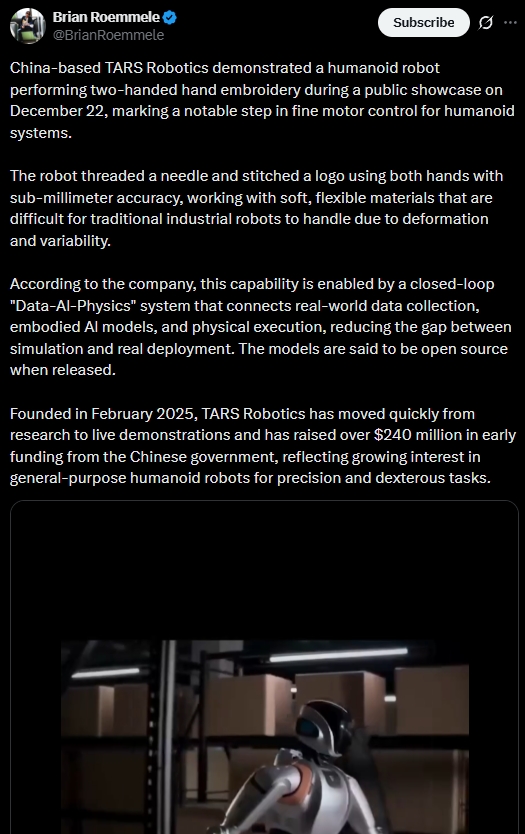
Untitled
Date: 2025-12-30
Mexico's GDP track mirrors that of many other countries; the U.S. continues to be the exception and will do so in the future. Despite our challenges, we have a unique set of strengths no one else has that will power us through our next economic supercycle.
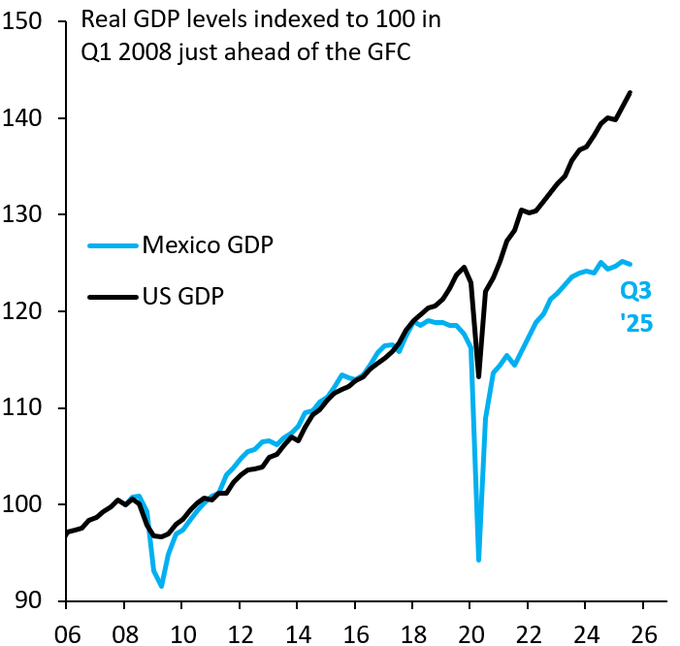
Untitled
Date: 2025-12-30
This is no surprise as people are nostalgic for the past when we did not have the challenges we face now. There is a yearning for a return to normal, but normal as we have come to expect over the last 80 years is gone. The truth is that the past is what caused our present challenges. The past (and present) is broken. The only way we get to normal is to push hard into the future and bring it forward - adopting new technologies, business models, growth and distribution frameworks and new tools and ways of doing things. Sadly, most people and companies are waiting when what everyone should be doing is moving into the future. Waiting will only make changes harder and consequences worse. But history shows that is the MO for humans - wait until things get so bad they have no choice but to change.
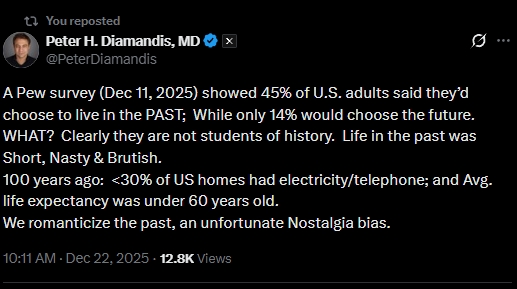
Untitled
Date: 2025-12-15
A16Z - a prominent venture capitalist - published its big ideas for 2026. I pulled out a few for B2C and B2B2C: (1) This applies to everyone, but the key to effective AI that does not hallucinate is structuring the data. This is a huge problem everywhere. Whether its companies or even individuals creating their own version of Jarvis, the key is the data. (2). Stope designing websites and online prescence for humans and istead, design it for AI. Consumers only start page for the Internet is becoming the AI dashboard, which gets content for them, or which allows them build agents to go do things for them. They will not see your website, so build your content and offering so that AI can use for their humans. (3) Forget mass-produce products, consumers are increasignly using AI to design what they want, and then find someone to make it. Big brands are especially at risk in this scenario. https://www.a16z.news/p/big-ideas-2026-part-1
Untitled
Date: 2025-12-15
Based on data, investors should expect to get zero in return in the S&P 500 over the coming decade. Not good news for passive and retail investors.
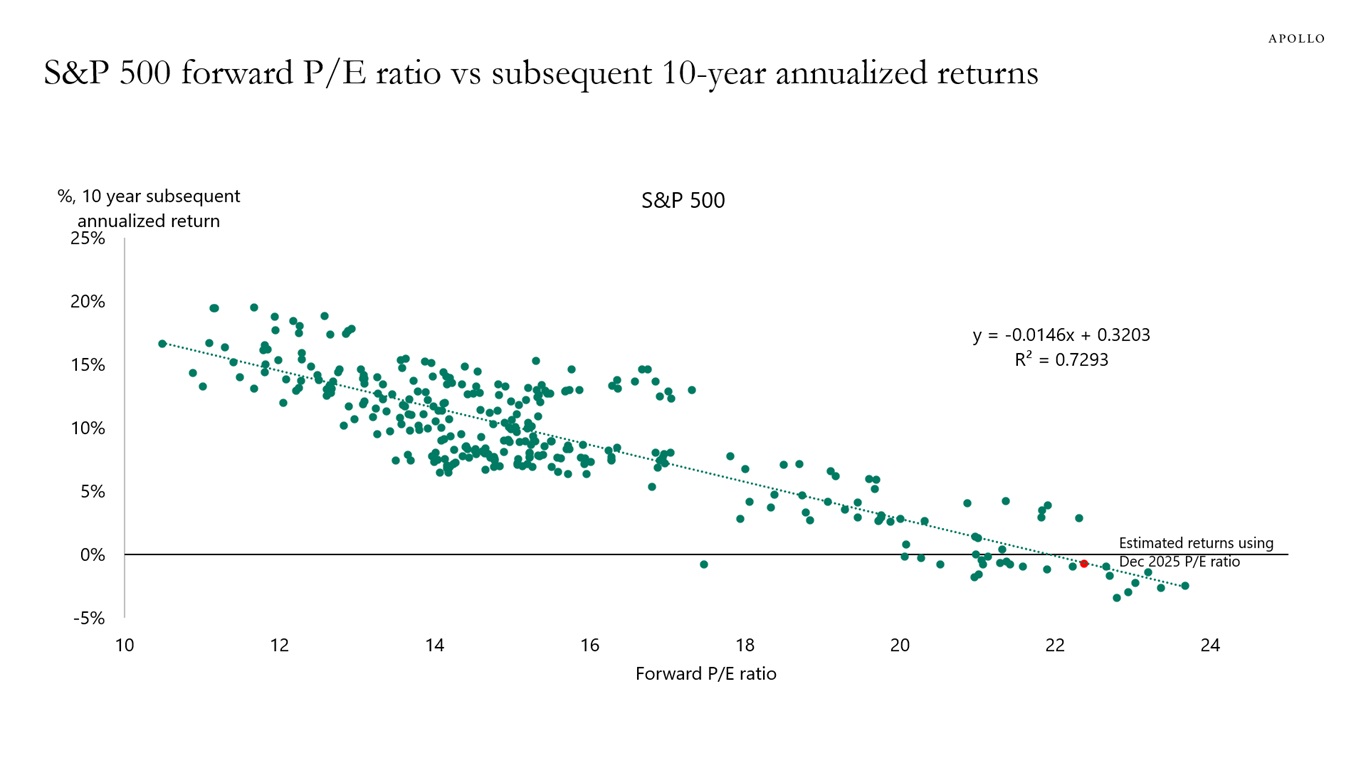
Untitled
Date: 2025-12-15
Fewer than one in six US workers aged 45 to 54 contribute the maximum to their 401(k) accounts, see chart below. Coupled with rising costs, inadequate savings and the looming depletion of the Social Security trust fund, these factors underscore a retirement crisis in the US, requiring many households to boost their savings to achieve stable and sufficient income in retirement. What is the end game? People do not have retirement and social security is bankrupt in the 2030's. The only solution is to move into the Emergent Stack outlined in my Future Map work and build wealth there. For people stuck in legacy or unable to move (baby boomers especially, gen x), it will be a tough future for them. Move now while you have the time and opportunity.