
49 KiB
CORE FRAMEWORK SECTION 6: MARKETING
Table of Contents
- Document Structure Rules
- Shared Files Folder
- Section Overview
- Marketing=Trust=Relationship
- Marketing framework
- How to organize the marketing framework - Business Organizer
- How to get marketing to pay for itself (so you can spend a lot on it)
- Test before you invest
- Steps to build marketing
- Deploy marketing
- Marketing Strategy vs Tactics vs Ideas
- Marketing channels
- Diagnose Marketing Failures
- Other
Document Structure Rules
See https://docs.google.com/document/d/109vex84XpU5FE-hYg4oFfU_NNXWqsuJxrtkdBVpzZtA/edit?usp=sharing
Shared Files Folder
Any files referenced will be in the shared folder: https://drive.google.com/drive/folders/0B23QMv-jQxTtY215c0pDcHdFZXc?resourcekey=0-fH3i1G05ZHgQOypRn6q79Q
Section Overview
The goal for the marketing section is not to tell you exactly what to do like in other sections, but organize marketing so you have a detailed framework to know what kind of marketing to create, why, when to deploy it, and where to deploy it. 👈👈 Marketing channels and ideas will always change, but having a framework to help understand when and how to use these channels and ideas should not change. That is what this section seeks to do.
Marketing is all about trying and testing. You won’t know what works until you test, and the more you test, the more you will learn and figure out what works. That is really the secret to marketing. 👈👈 If you have set up your systems properly (Section 2), then you should be in a position to try and test new things on a consistent basis. In my experience, trying a lot of things on a consistent basis this is what leads to success. 👈👈
Marketing=Trust=Relationship
When consumers buy and use your product, at some level, they place their trust in you and what you are delivering in the product.
Because consumers have so many product choices, purchasing decisions are coming down largely to trust. Even if you have defensible IP to thwart competitors, consumers always have substitute choices they can make instead of buying from you. See Section 3.
As you develop and deploy marketing (or create products), you need to keep in mind how you can create trust between you and your customer so they purchase from you and keep purchasing from you. How do you develop trust? It is delivering on your marketing promises, but also it is developing a relationship. Think about how you can use your marketing to build a relationship, not just the hard sell.
See this important article: “Attention”
Ultimately, no matter how big you become as a company, you want to strive for one-to-one marketing, because that builds relationship which can lead to trust, which leads to sales. This is easier as a small company, especially if you implement systems (See Section 2), but not impossible even as a big company and getting easier as technology advances.
Founding editor of Wired Magazine, Kevin Kelly formulated in 2008 the 1,000 true fans theory. His idea was that any artist, business, etc. could survive on having only 1,000 true fans and that “returns diminish as your fan base gets larger and larger.” In other words, you’re more likely to have success if you focus on gaining 1,000 true fans rather than tens of thousands, or even millions, of lukewarm fans.
Marketing is the generous act of showing up with a true story that helps people get to where they’d like to go. - Seth Godin
Marketing framework
Acquire vs. Retain
There are 2 broad categories for marketing: you are either acquiring new customers, or retaining existing ones. Acquire Within this marketing, I segment into two areas: Acquisition, where I use marketing channels to attract prospects to me; Conversion, where I am using landing pages, sales funnels, product packaging, events, one-on-one sales, or anything that is considered the last step before they decide to purchase. Also include any communication for abandoned carts, if I capture their contact information or cookie for retargeting. Within the above segments, I brainstorm and put in place all the appropriate marketing methods in which I can market to my prospects. Retain Within this marketing, I segment into the following areas, which are all the ways I can think of to use for retention marketing. See here: https://edsoehnel.com/retention-marketing-methods-for-consumer-product-companies/ Within the above segments, I brainstorm and put in place all the appropriate marketing methods in which I can market to my customers. I also keep 3-goals top of mind in my retention marketing: Ascend: I want to ascend buyers to purchase more products from me, so my retention marketing is about furthering that goal. Maintain: I want to maintain buyers, even if I cannot ascend them, by keeping in front of them so they will think of me when they want to make a purchase in my category Mine: I want to collect as much data as I can about my customers and maintain that in my customer database so that I can tailor my marketing to each one of them. The priority in all marketing activities should be to retain existing customers, because it is usually much cheaper to retain than try and acquire a new customers. In addition, if I constantly have to acquire new customers to replace the ones I cannot retain, then my business is really just a house of cards.
Hot vs. Warm vs. Cold Prospects
Hot prospects are usually ones that have purchased from you or are a strong referral for you. It usually takes much less selling to convert these Cold prospects do not know you, probably do not trust you (because they do not know you) and usually take more selling to convert. Warm is somewhere in between. Identifying hot vs warm vs cold gives me an idea for how much selling (more copy, more testimonials, more marketing, etc) to deploy. Basically, cold is much more challenging and may require lots more testing to get right, vs hot is no or little selling, so takes much less effort and testing to get right.
Direct Marketing vs. Brand Marketing vs. Grass Roots Marketing
This is covered in more detail in Section 1. These segments are more about the flavor of my ads and the type of copy that I will use. Direct marketing is very call to action oriented, demonstrating clear product superiority to attract and convert prospects (Example: we are the only product in this category with no GMO’s (genetically-modified organisms)). Brand marketing is relying on my reputation to attract and convert prospects (Example: in business since 2003, the brand you can trust). Grassroots marketing is relying on my identity or my position about my company versus the competition to attract and convert prospects (Example: we are against GMO’s and donate 1% of our profits to XYZ foundation) .
Paid vs. Owned vs. Earned Media
Paid media: you purchase it to place your ads or get in front of prospects (Example is Google search ads). Owned media: you own the media, so you do not have to pay to get in front of prospects (Example is your email list with past customers). Earned media: you do not own the media, but it is free to post, so you need to earn your prospects' purchase via your posts (Example is Facebook posts). Identifying my marketing by paid versus owned versus earned gives me an idea of costs.
Awareness vs. Engagement vs. Conversion
There are 3 general stages to a sale: Awareness: you market to prospects so they become aware of you. In this stage, you are trying to capture attention and get them to the next level with you, which for example, can be inducing them to your website so you can engage with them. In this stage, you are targeting your awareness activities and your marketing copy to appeal to your target market and to not appeal to those that are not in your target market, because they might just waste your time in the following stages and never become a buyer. You are trying to get across an awareness about the problem and solution to your target market so they will chose to engage with you. Engagement: you try to interact with them so that they go to the next stage; for example, they read and like your content, give you their email address for something in return, read your product marketing copy, or call you for more information so you can figure out their needs and how you fit. Conversion: you try to close them as a buyer by selling on the benefits of your product, overcoming their objections, consequences to them not acting now and giving them an easy path to complete the sale.
Active vs. Passive Media
Active media The prospect is seeking to purchase a product like what you offer. In this case, you want to be where consumers are searching to get their attention. An example is listing on Amazon and/or Google product listing. Active media advertisements can be more direct marketing driven where you sell harder, because the prospect is looking for that.
Passive media The prospect may or may not be seeking to purchase a product like what you offer. An example is Facebook ads. In this case, it may be more difficult to get the prospect’s attention. You have to be careful with passive media. If prospects are forced to see your ad or content, they will not care. With passive media advertising, you want to build a relationship with the buyer before trying for the hard sell. You do this with informative, entertaining and engaging content.
How to organize the marketing framework - Business Organizer
From the marketing framework listed above, now it is time to organize all the elements.
The marketing framework above is visually represented in the Business Organizer, which was first referenced in Section 2, but explanation on how to use is below. See the diagram here: https://edsoehnel.com/template-for-a-graphic-based-business-plan/
Marketing section
I organize the above elements of the marketing framework into the business organizer so I can visually see my marketing. The business organizer works left to right, from acquiring a customer all the way to retaining them. What I do is to list all the marketing channels appropriate for my business within the framework above. So, for acquisition, I want to know the channels I can use to attract hot, warm and cold prospects, in the context of active vs passive media, then organize my messaging and involvement with prospects based on whether I am trying to build awareness, engagement or convert them, and then label them (color coding) by paid vs owned vs earned media and tagging them with direct vs brand vs identity marketing. Same goes for retention. I want to know the channels I can use to retain my customers using the aforementioned categories. When I do it this way and put it in a visual diagram like the business organizer, I quickly get a sense for which marketing channels I should use and when. For example, would it not be smart to prioritize marketing to hot prospects that are already customers through media I own and crossell or upsell them on other products? Or, if they are not yet customers, then would I not want to try and prioritize marketing to hot or warm prospects first? Would I not want to prioritize marketing to prospects in active vs passive channels first? And, would I not want to design marketing copy where I am funneling prospects from awareness, to engagement, to conversion? See the Growth Stack workshop for more in a specific sequence for testing: https://edsoehnel.com/best-growth-approach-consumer-product-startups-product-launches/
Or, go back further to product development: would I not want to prioritize developing WOW products (Section 3) to get referral and word of mouth/reviews marketing (which are usually the cheapest forms of marketing)?
Brainstorming my marketing channels and putting in the visual business organizer helps me see what to do first, and why, and gives me a sense for how easy or hard it will be to sell using that channel, and what flavor of marketing might be most appropriate for that channel (direct, brand or identity, or a combination)?.
I also include a box of notes on the key customer segments in the retention area. This keeps them top of mind so that I make sure I am marketing to them on a consistent basis. I listed those segments that I market to to give you examples. I build into my calendars (See Section 2) when I want to specifically target these groups with offers.
The business organizer is my business plan
When I first brainstormed the business organizer, it was just to organize my marketing, as explained above. But, I expanded it to be a dynamic version of a written business plan that I can use everyday. Starting from left to right and top to bottom: I list out high level key and important aspects of my strategic fit (Section 1), which for me are my brand pillars (Section 1). I list out key aspects of my customers (Section 1 and Section 3) I list out key aspects of my products in context of what my customers want (Section 3) My marketing is already covered from Acquisition to Retention channels From the standpoint of a business, it is all about these elements - knowing your strategic fit, your brand pillars, customers, what they want, acquiring them and retaining them. Above and the red bars are discussed in Section 2.
How to get marketing to pay for itself (so you can spend a lot on it)
Copied from Section 4: the ultimate goal in any company is to acquire AND retain customers where costs to acquire and retain are less than expenses, which leads to profits.
Acquisition and retention are marketing activities, or costs.
But, there is a way to turn your marketing cost on its head and make it pay for itself. This method is a real secret to growing fast, at less cost, with top selling products. 👈👈 To employ this method, you need 3 things: WOW product - discussed in Section 3; Systems to collect - discussed in section 2 - and analyze your financial data so that you know your ROAS and ROI by product and by channel - discussed in Section 4. Use direct marketing, not brand or identity marketing, discussed earlier and in Section 1. When you have a WOW product, it captures attention, which makes it easier to use ads to interest people. Copied from Section 1: Direct (product) marketing is you appeal directly to individual customers through advertising that has calls to action to purchase your product. In this method, you have to demonstrate the superiority of your product to get them to act. 👈👈 The customer may not know you so you have to sell them on your product. This method tends to be cheaper to use to generate sales and has immediate response so you know if it is working or not, but relies on a truly superior product that captures attention.
Direct marketing ads have call to actions in them that provide an offer or inducement to get someone to take an action as a result of the ad. These call to action’s can be, for example, “Buy Now”, “Click Here”, or any other action oriented statements. But to get someone to respond to an ad right now, you have to have a WOW product with benefits that you can clearly and succinctly get across in the ad so that they respond to it. In the most classic sense, a direct marketing ad is a traditional infomercial, while a branding ad is a typical 30-second ad put out by big CPG companies. One is clearly telling you to do something now to get this amazing product and offer. The other is not. The advantage with a direct marketing ad is that, assuming you have the systems in place to collect and analyze the data, you can directly measure response (views, clicks, purchases, etc). With this data, you can then determine where your ROAS and ROI are based on the marketing spend.
Knowing this, you can then work on optimizing your entire process for acquiring a customer. See the Money Flow and Marketing Efficiency discussion in Section 4.
If you get enough of your process optimized such that you are acquiring customers with an ROAS of 6, for example, where your breakeven on your entire operation is a ROAS of 2.5, for example, then you are in a position where your marketing pays for itself. Then, the questions becomes, how can I spend more, because my process is working, and I know I will get my marketing costs back. It is not quite a simple as that, because as you spend more you will eventually have the law of diminishing returns kick in, reducing your ROAS, and you still have to optimize as you spend more. Whereas Brand and Identity marketing do not have traditional call to actions, so you have a much harder time measuring response to see if it is working. Then, the only way to measure response is months later asking, are your sales going up, by how much, and against how much marketing spend? You want immediate response to see if your marketing is working. If it is not, then you can optimize and make adjustments fast. But, direct response only works for products that capture people’s attention, which is why you really need to work on WOW products, because WOW products open you up to the ability to use direct marketing that, when optimized, might pay for itself, allowing you the potential to grow extremely fast. And when your marketing pays for itself, you can run a lot of it, which will get the attention of resellers. 👈👈
With direct marketing, you are very focused on metrics to guide your actions, and you want to use landing pages and sales funnels (covered later in this section).
But, consider drawbacks to WOW products that can go viral. Lots of data suggests most users who find products through viral posts don't become real customers. Steady growth beats viral moments. Find channels that bring in fewer but better users rather than chasing viral spikes that look good on paper.
Test before you invest
Since marketing is all about testing before investing, your best bet when deploying new marketing or launching a new products is to test from right to left in the business organizer. For example: Here is a general sequence I follow for testing and optimizing marketing: Test and scale in retention channels you own to existing customers who purchased most recently. Retention channels are channels where you own the customer because they have purchased from you before or you have some prior relationship with them (like maybe they subscribed to your email list) and have a direct way to market to them (via email, snail mail or retagreting). Prior customers always represent the best ones to test a new product because they have a prior relationship with you already and may be more likely to purchase from you again. If successful there, test and scale in retention channels to older customers who have not recently purchased (email or direct mail). If successful there, test and scale in active media acquisition channels where you have access to hot and warm prospects (google product listing ads, PPC, Amazon ads). Active media acquisition channels are where customers are looking to purchase. So, if they type a search for “buy organic BBQ sauce”, they are probably looking to purchase, so I define those channels that serve ads where they are looking as active media acquisition channels. Active channels can also include customers who landed on your website, but did not purchase, so they are targeting candidates. If successful there, test and scale in passive acquisition channels (Facebook, Instagram). Passive channels means you do not know if the customer is looking to purchase or not based on their activity or behavior. An example is Facebook; customers may not be looking to buy an organic BBQ sauce, so you can only infer based on demographic and psychographic data that they might be good targets. If successful there, test and scale in video in Youtube preroll. If successful there, test and scale video in cable/broadcast network TV ads (analog) on a targeted basis, then go national ($15K minimum needed to test). If successful there, test and scale in radio and print (analog) ($20 and $30 K respectively needed to test). Your testing should generally focus first on channels that cost the least where you can spend the least so you have low risk, but also have fast response so you know quickly if what you are doing is working or not. As you succeed and fine tune your messaging, you can scale your spend in those channels or possible go to other channels that are more expensive. An example is national TV, print or radio. Those are typically costly channels, so never start there, but test your copy (product names, headlines, taglines, keywords and marketing copy) in cheaper channels, like Google product listings, to get things working. Then, you might scale in that channel, and if successful, then try Youtube preroll ads, then try Hulu ads, then try national TV direct response ads buying remnant media. See: https://edsoehnel.com/testing-a-business-idea-no-product/
Steps to build marketing
Once the framework is brainstormed, next is to build the marketing to deploy in the channels brainstormed. Some of the work has already been done in Section 3. Take the information on the product from subsections Keywords & Search Phrases, through Value Propositions and Marketing. The following subsections are the main elements that I consider when building marketing. I have included notes and resources in these sections that are helpful to me.
Behavior and psychology
Review behavior and psychology from the following resources to get more direction in developing the creative and marketing copy: See “9 Essential Ways to Use Scarcity to Increase Sales” See “The Email Marketing Psychology Crash Course_ A Sumo-Sized Guide “ See “The Advanced Guide to Emotional Persuasion”. See “ 67 Ways to Increase Conversion with Cognitive Biases” See “18 Cognitive Biases You Can Use for Conversion Optimization” See “4 Truths About Human Nature Every Marketer Needs to Know Before Writing a Word of Copy” See “Want to Increase Your Average Order Value_ Frustrate Your Customers” See http://www.quicksprout.com/the-complete-guide-to-understand-customer-psychology/ See “39 Resources for Understanding the Science & Psychology Behind Great Marketing”. See “True Colors_ What Your Brand Colors Say About Your Business” See “The Psychology of Color in Marketing and Branding.pdf”
6 Factors that can increase motivation and action: Seeking Pleasure Avoiding Pain Seeking Hope Avoiding Fear Seeking Acceptance Avoiding Rejection 6 Factors that can decrease motivation and action: Time Money Physical Effort Brain Cycles - attention Social Deviance Non-routine If they do not have to make the purchase now, they may not. So, how do you motivate them to make the purchase now? What will they lose if they do not purchase now?
Brand identity
Brand identity is represented in company name, brand name, product names, color panels and logos
Brand identity flows from Section 1’s brand pillars, the research in Section 3 and the work done in this section up to now.
You need to be creative to come up with an identity that flows from your brand pillars
This flows into your website, packaging and any other marketing materials.
Make sure with whatever you come up with is not infringing on someone else’s intellectual property (copyrights, wordmarks, logos) by doing an IP search at USPTO.gov for the U.S. market, or your respective countries patents and trademarks office. See: https://edsoehnel.com/filing-for-a-federal-wordmark-for-a-cpg/
Marketing creative & copy
See “The Ultimate Guide to No-Pain Copywriting (or, Every Copywriting Formula Ever)” excellent guide - get it here 👈👈 See backlinko_headline_template See “Landing_Page_Template” See “3 Advanced Tactics We Used to Increase Product Page Conversion Rates” See “Big Daddy List of 200+ Negative Keywords for AdWords & AdCenter PPC”. See “How to Write the Perfect Blog Post Title (+2,900 Buzzwords!)” See 49 Headline Formulas to Skyrocket Conversions (And Where to Use Them)” See “The-Conversion-Marketers-Guide-To-LandingPage-Copywriting” Pattern Interrupt Concept for creating ads: See DotCom Secrets Book, page 45, http://amzn.to/2gmNpVf See “Copywriting formulas (don't write from scratch!)” See “Empathy in marketing and big blocks o cheese”. See “Turbo-Charge Your Marketing With These 355+ Power Words”. See “277-Action-Words-that-Drive-High-Impact-Writing-Download” - in shared tools folder. See: “Learn from the Best_ 6 Skills All Great Writers Have (and How to Learn Them)” See “3 Professional Copywriters on What It Takes to Write Landing Page Copy that Converts”. See “Everything You’ve Been Told About Copywriting is Complete Nonsense”. See “A No-Fail Process For Writing Landing Page Copy That Converts” Simple and straightforward copy works. That means ~14 words for ad post text, and another ~18 for the link description See “The Ultimate Content Marketing Checklist_ 40 Questions to Ask Yourself before Publishing Your Next Blog Post.pdf” See “The Ultimate Copy Checklist_ 51 Questions to Optimize Every Element” See “The Big List of 189 Words That Convert.pdf” See “Marketing Titles for Best Content Marketing_ 10-Point Checklist”. Packaging mistakes: http://edsoehnel.com/what-are-the-biggest-mistakes-in-cpg-package-design-how-do-you-avoid-them/ See “8 Principles of Packaging Design” See “Color in Packaging” ScriptFunnels.com writes copy for you http://viooly.org/login - copy check for cause marketing General rule of thumb: the 40/40/20 rule in direct marketing: 40% of your marketing efforts is targeting the right customers, 40% is giving the right offer, and 20% is having the right creative. See https://edsoehnel.com/newsletter-versus-magazine-and-marketing-power-words/ Storytelling Try to use storytelling in your creative and copy, because stories are what truly engage people. See “How To Create The Perfect Story” See “Master the power of Storytelling your Ads” See “How to Tell Stories With Facebook and Instagram Carousel Ads _ Social Media Examiner”. If you plan to personally engage in marketing using yourself, then find your style and voice by watching others and adopting those things you like and might work for you. Start practicing your style and voice by publishing content for others to see. Keep adjusting your style and voice as you learn what works for you and what you like that others are doing. You need to practice to get better. Just start doing it and learn as you go. There are 2 journeys in a story that you want to get across: You see the desire to where you want to get to and the conflict (journey of accomplishment); Second journey is journey of transformation that you may not see on the surface - you are becoming a different person. The hero in the story accomplishes both, but the real journey is that of transformation. This is key to developing a story that engages people. Controversy, information, innovation: if you can have a story with any one of these three, but preferably all three, then that makes for a killer story/backstory to interest people. This gets them excited and is the sweet spot in storytelling.
Value propositions
See section 3, Brand Positioning for a resource how to drill down to developing value propositions
From your product positioning, create value propositions, which communicate to your customers how your product will meet their needs better than the alternatives
If need be, introduce something new by framing it in the context of something that’s already known, then you reduce confusion.
See “How To Write An Effective And Unique Value Proposition”
Pricing
Pricing from a financial context is discussed in Section 4 Pricing from a marketing standpoint is here. I always determine my pricing from a marketing standpoint first and then work on the financial side. If I cannot make the financial side work, then I have to go back to figure out how I can tweak my product features, benefits and outcomes (Section 3) to get to a price that satisfies my financial picture. Pricing can also vary based on your customer acquisition goals. You might use flexibility in pricing a product by itself so that if you acquire a customer (and their contact information because you sell direct). While the pricing may not cover your costs or may not cover your costs such that they leave you with your target net income, you might be able to cross-sell them other products either in your funnel checkout, or later as you try to build customer lifetime value through repeat purchasing. This will be a way to make back what you lost or fell short on in the initial purchase.
See: https://edsoehnel.com/how-will-competing-on-price-as-a-small-cpg-work/
Review the SRP Pricing Model in Section 4 for notes on pricing by channel and avoiding conflict.
See “9 Pricing Strategies to Explode Your Revenue (Backed by Psychology)” See “Six Advantages of Hyperbolic Discounting” See “What converts better_ $100, $99, or $97_.pdf” See “10 Pricing Strategies That Can Drastically Improve Sales”
Landing Pages, Funnels, Conversion Rate Optimization (CRO), SEO, UX/UI
Resources See “Retail after the website” with data and concepts around successful modern commerce (2022) See “How to use Google Trends to Find Sizzling Hot Topic Ideas” https://www.youtube.com/watch?v=wJxwrsBloho See “75 Tactics_ The Complete List of Content Marketing Strategies [2019]” See “70+ Shopping Cart Abandonment Statistics—and Tactics to Help You Overhaul Your Online Shopping Experience” See “Ecommerce Facebook Ads_ $1,000,000 Ad Spend, 4X ROI (Hint_ Puppies) - Sumo” This article talks about using a top-of-funnel leading indicator for ROAS which is Cost Per Add-To-Cart (CPATC) See “Google Search Console: The Definitive Guide: See “Ecommerce SEO: How To Increase Traffic To Your Store” See”Top 20 A/B Ecommerce Test Ideas” See “The Ultimate Blueprint for Creating a Super Persuasive Testimonial” See “34 Landing Page Trends To Look For In 2017” See “7 Lessons Learned from 7 'Free Plus Shipping' Funnels in One Year”. See “98% Of Your Paid Ads Are A Colossal Waste of Money” See “3 Ways to Increase Conversions by Increasing Contextual Relevance” See “8 Psychological Triggers to Optimize Your Pricing Page” Customer Value Optimization_ How to Build an Unstoppable Business” See “Growth Hacking Quick Wins” See “A_B Testing For Beginners_ 70 Resources to Get You Started” See “How to Make your Landing Page More Persuasive Using Buying Modalities” See “6 Web Design Tips Based on Brain Science” See “39 Factors_ Website Credibility Checklist” http://www.aminstitute.com/headline/ Use this to analyze headlines Complete CRO list: http://backlinko.com/conversion-rate-optimization See “Funnel Tracking Template” gSheets file to track multiple funnels See: https://edsoehnel.com/minimum-statistically-significant-sample-size-direct-mail-campaign/ See https://eddiesoehnel.com/website-supplement-funnel/
General Notes This is more top level items to keep in mind:
Design the site based on traffic sources. See here as example: 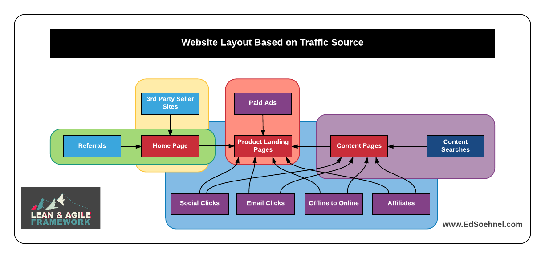 The boxes indicate where that traffic is landing. Third party sites are e-commerce sites like Amazon where traffic might come to the home page, but much less likely. Ideally, you want to use popups and other in-page advertisements and incentives to drive traffic from content to landing pages, if you use content as a way to acquire customers.
I keep this above graphic for my businesses copied into the Business Organizer under the marketing zone.
As aesthetically oriented humans, we're psychologically wired to trust beautiful people, and the same goes for websites. Our offline behavior and inclinations translate to our online existence. Websites that are more attractive and include more trimmings create a greater feeling of trustworthiness and professionalism in consumers. Periodically search for bait, lead magnets, trials, trip wires, self-liquidating offers to stay current on latest that is working. Rule of thumb pricing: Trial=$1; Tripwire-$10; SLO=$37 Use photos of people’s faces in your marketing to help establish trust. When ordering your navigation (or any lists within your copy), put the important stuff at the beginning and end. The reader's’ attention and retention are lowest in the middle. As visitors scan the page, the first and the last items are most likely to stay in short-term memory. Also, don’t include too many items. Short term memory can only hold around seven items. If your navigation includes more than seven links, break it up into smaller groups. People read from left to right in an "F" pattern People tend to do what other people are doing. So giving evidence that others have selected you makes choosing your company seem like a good choice. The goal is to make any decision other than using your company seem outside the norm. Add supportive messages: Testimonials from clients or reviews from customers Social media widgets showing the size of your following Endorsements from relevant influencers “As seen in…” logos of media where your company has been mentioned Trust seals, including association memberships, security certificates, and awards Copy that works well for “low literacy” users works well for everyone. It’s not about dumbing it down; it’s about using simple language that everyone can understand. Even PhDs prefer to read at an 8th grade level Pick an “action color” for all of your links, buttons, and rollover effects. Make it a color that’s distinct from the brand colors used throughout the design (these are the “passive colors”). Use the action color nowhere else but in the clickable items. Headlines and images can quickly spark emotions. Research shows that emotional headlines get shared more. The three types of emotions that get shared the most: anxiety, anger, and inspiration. We are not thinking machines that feel, we are feeling machines that think Have 1 goal for your landing page: all elements point to that goal. One call to action Make everything about value customer gets, not features and do not talk about you. Use images because we process them faster than text. Use images that demonstrate value, not the product - show end result of what customer will feel from using product. All statements and claims need 3rd party verification or from neutral experts. List sources and scientific studies Address and phone number in microcopy Guarantee The call to action (CTA) above and below the fold With funnels, break down the decision making that your customers make into small steps and use funnels to help guide them into making the decisions we desire. Funnels work because you can design them around behavior. Search Clickbank for funnels to research so you can model them; top leaderboards do min of $300,000 per year Make your own funnels swipe list. I keep one in evernote. Always force people into funnel to get anything from you, including free products, so you have opportunity to sell them on a cheap product to get them to say yes, and get their address. Barrier, yes, but you want to force people and weed out those that are not really that interested. For A/B testing, collect at least 500 clicks to your ads and reach at least 10 000 impressions before drawing any conclusions. Significant calculator here: http://getdatadriven.com/ab-significance-test Be careful of small sample sizes and extrapolating success from there. If you have low traffic or low budget to get low traffic in testing, then you need to be very thoughtful about experimentation and design. Only when you have lots of traffic can you come up with ideas and test them fast: Lesson here is to test for big improvements, not small ones. Unless you have the traffic, small changes won't make a big difference. Test further down the funnel because that is where you will get bigger results from smaller changes. But only do this when you have traffic. Without traffic, optimizing further down the funnel will not make a difference. When you employ direct marketing to an existing list (email, retargeting, snail mail), be careful not to always be selling. Consider for every direct marketing message, the other three messages are branding or informational/helpful. Do not abuse your list too much. So, if I send 4 emails to my list per month, only 1 is a direct pitch for my product, the other 3 are informational. Considering the rule of 7 in brand marketing (you need at least 7 impressions before the prospect will purchase), maybe it might be 1 to 7. Offer expedited shipping in the funnel as upsell Create ads people want to see. Build ads around content that is helpful, entertaining, inspiring. A huge secret to success in marketing is scarcity. How can you use that in your messaging to increase product value and motivate action to purchase?
Deploy marketing
Once you build your marketing for the channels you want, then you deploy
Analytics
But before you deploy your marketing, you want to make sure you have the analytics in place to capture data so you can analyze it and make decisions.
This row repeats the opening row in Section 2: Data and information is power...it is everything in business success. 👈👈 This section is not just about technology, but using the technology to get you the data you need to make decisions As already stated in section 1, It is well-know that whatever gets measured, tracked and reported is more likely to improve. 👈👈
It is hard to list out a the analytics side of a business because it depends on many factors specific to that business. I recommend you review Section 2: Dashboard, for more about the Metrics and KPI’s I collect. If you have setup the systems I use in Section 2, you will know the data you can collect and as you spend time with it and think about it, you will learn how to use it in your business. I recommend you map out your data flows so you know what you have and what you might want to do with it. See Section 2: Database, and click on the database file, which contains a link to mapping data flows for my businesses. Since The Lean & Agile Framework focuses on direct-to-consumer sales online, you will want to setup Google Analytics, Google Webmaster tools and Bing Webmaster Tools. Also look at Google Tag Manager to see if that will help you. Really understand how to make use of these tools. Use outside consultants or contractors as needed to help you set everything up and use these tools. That is what I have done. See Section 2: Contractors & HR for resources.
Use UTM’s (Urchin Tracking Module) for all your links so you can track them. I have a simple formula in Google sheets to create them and use this file to maintain consistency across my channels where I use them. See this file: https://docs.google.com/spreadsheets/d/1jwI0T7gn78Yk6zoWQdRytCycw2Xv2KYMIYdvUCe7bKQ/edit?usp=sharing
In addition to my metrics file, I keep a spreadsheet tab that tracks all of my marketing campaigns and my marketing ideas. See this file: https://docs.google.com/spreadsheets/d/1jwI0T7gn78Yk6zoWQdRytCycw2Xv2KYMIYdvUCe7bKQ/edit?usp=sharing
| Resources: See “Ecommerce Analytics Tracking_ 69-Point Guide To Drive Performance” = good detailed article on how to use Google analytics with ecommerce (shopping cart has to be hooked up to GA). See “Funnel Tracking Template” gSheets file to track multiple funnels Setup Google Search Console: use Fiverr gig to do that. URLs to help manage: https://www.quicksprout.com/2016/12/16/a-step-by-step-guide-to-using-google-search-console-like-a-boss/ and https://www.quicksprout.com/2016/06/15/the-ultimate-guide-to-using-google-search-console-as-a-powerful-seo-tool/ See “$9 Marketing Stack_ A Step-by-Step Guide” See “How to Setup Google Analytics and Segment Your Data”. What is your stick point? See: See”Stick_Point” 2015 See “An example of setting up a Marketing Dashboard with actionable KPIs - Smart Insights Digital Marketing Advice” See “16 Startup Metrics Andreessen Horowitz” . See “16 More Startup Metrics Andreessen Horowitz” See “How 3 Simple Google Analytics Reports Will Increase Your Search Engine Traffic” See “Google Analytics 102_ How To Set Up Goals, Segments & Events in Google Analytics” Tools to track conversions thru funnels from traffic sources with divergent sources: Improvely, Click Magick For A/B testing, collect at least 500 clicks to your ads and reach at least 10 000 impressions before drawing any conclusions. Significant calculator here: http://getdatadriven.com/ab-significance-test See: The 8 Google Analytics Features Every Site MUST Have Enabled https://blog.kissmetrics.com/8-google-analytics-features/ Consider setting up a raw data profile in Google Analytics that you never touch and they a working data profile so that if something goes wrong with it, you always have the raw profile to fall back on. Or create test profiles when customizing GA first before moving to your working data profile. Research attribution - which marketing campaign and channel do you attribute a sale, since in reality, most companies are using multiple channels to market? There is no clear and cut answer, so you need to research it for yourself to see what will work best for you and what data you can collect to make the attribution. . | |
Targeting
Target to behaviors, and be careful of targeting to interests, because interests can be old and prospects may not update them (like in Facebook profile)
Marketing Strategy vs Tactics vs Ideas
Up till now, we have been working through marketing strategy, which is big picture. Tactics are specific efforts and ideas are the creative. That is how I try to look at marketing. For example: Strategy: create content and post to social to build follower base; Tactic: boost posts with a view/share rate of 1% or more;
Tactics and ideas are constantly changing. I keep my own list of ideas in the same file where I track my campaigns and my UTM’s. Where possible, I will include tactics that are universal in the Marketing Channels and Tactics file: https://docs.google.com/document/d/1XhHVl5gXsFH2aTihejBoam5Z0R43IvY6-Uk82mAqzzY/edit?usp=sharing
Marketing channels
Specific marketing channels are constantly changing. I keep track of the ones I may want to use in the business organizer diagram. I do Google searches to find helpful guides to come up to speed on using them. I keep a high level basic list in my Marketing Channels and Tactics file: https://docs.google.com/document/d/1XhHVl5gXsFH2aTihejBoam5Z0R43IvY6-Uk82mAqzzY/edit?usp=sharing One thing to ask yourself always when considering channels: what is the least crowded channel? Consider using it over a crowded channel where everyone else is on
Consider that with the proliferation of products (whether physical or digital), and the increasing automation in creating content (by AI systems), which means a lot of content can be created quickly, this means a very crowded field to capture attention. In this environment, channel becomes more important, which is why you want to find less crowded channels from which to capture attention.
Diagnose Marketing Failures
This graphic is based originally on the Circles of Marketing by Seth Godin. I re-worked it as seen below and included a few other items. The goal of this graphic is to organize marketing such that if a product/service is not selling or selling below expectations, then the company may need to move one box in to remedy the problem, and keep moving in until the weakness is discovered and fixed. For example, if advertising, PR and hype/spin are not motivating sales, then move one block in and ask if the right distributors, resellers, channels are being used, the target market, community or tribe is correctly identified and the story resonates. The thinking is that each block builds upon the other, which I would agree with and why I like this approach. This graphic makes it more simple and straightforward to think about marketing and diagnose problems. If you flip this approach and start from the inside and move out, it helps a company address weaknesses and deficiencies before moving out to the next block. 
Other
See “Social Amplification Engine Process”
See: The Ultimate Slide Deck Collection to Help You Excel As a Growth Hacker - nice summary of technical skills that you might need for some aspects of your marketing.
It is not a bad idea to also review the best book I have read about sales, because it has relevance to marketing tactics. See The Science of Selling
Brand Stack 