added
This commit is contained in:
 eddiesoehnel committed
commit
6a34982699
245 files changed
+9080
No files matched your search
@@ -0,0 +1,33 @@
|
||||
# Are you in alignment with your investors?
|
||||
|
||||
Source: <https://eddiesoehnel.com/alignment-with-your-investors/>
|
||||
|
||||
Tags: accelerators, acquisition, angels, equity, incubators, investors, IPO, Private Equity, Venture Capital
|
||||
|
||||

|
||||
|
||||
I want to cover fundraising and investors, and even if you do not plan to raise money, this discussion has important implications for giving equity to cofounders, employees, advisors, consultants or partners.
|
||||
|
||||
Investors invest to get a return on their investment, and the predominant way in which they get a return is when their investment is acquired or goes public. But, even in the world of investor-funded startups, both of these options is rare.
|
||||
|
||||
it is even rarer for the company to pay the investor back through dividends on profits.
|
||||
|
||||
Unless the investment is structured as debt, their chances of getting paid back are small and investors rarely want debt or dividends because the returns are too low. They want 10X return on their investments.
|
||||
|
||||
So, how does an investor maximize their chances of an acquisition or IPO? By having their investment take big risks in pushing for fast growth and a “swing-for-the-fences mentality.
|
||||
|
||||
And for professional investors who invest for a living, this is fine because they can spread their investment dollars across many startups, with the expectation that in general, 1 out of 10 investments will hit it big to more than make for any losses or missed expectations on the other 9.
|
||||
|
||||
Now, as an entrepreneur, you cannot diversify across 10 investments. Possibly years of your work and savings is invested in your startup. So if you take money that causes you to accelerate your growth rate, all of a sudden, those investment dollars might be adding huge risk to your investment. Instead of those dollars giving you breathing room to grow, they may actually be pushing you closer or even over the edge of failure.
|
||||
|
||||
So, you really need to know what you are in for when you take on investment.
|
||||
|
||||
Investment can be very good, but at the right time, when you have proven that your product and your marketing works. At that point, investment dollars can be good to help you scale, because you have taken out a lot of the risk.
|
||||
|
||||
But when you take on investment too early, and go on a growth path without proof of product and marketing, you end up spending a lot of money fast. And if you end up being wrong, the investor may not give you more money, and instead, just invest in your competitor who has chosen a different growth strategy. I know…this happened to me twice and is how I ended up crashing and burning on those two startups.
|
||||
|
||||
So, first, before you take anyone else’s money (family, friends, accelerators or venture capitalists), prove your product sells and your marketing works.
|
||||
|
||||
If you do not take on investment, but still give equity to cofounders, employees, advisors, consultants or partners, you need to make sure you and they are on the same page so that everyone’s expectations are aligned.
|
||||
|
||||
Don’t let them push you towards fast growth and a “swing-for-the-fences mentality until you prove your product and marketing works. And, they need to understand that you might prefer a profitable company and pay them back via dividends, rather than trying to grow towards an acquisition or IPO, which as I said earlier, is rare.
|
||||
@@ -0,0 +1,9 @@
|
||||
# Develop your price for a CPG or consumer product
|
||||
|
||||
Source: <https://eddiesoehnel.com/develop-your-retail-price-for-a-cpg-or-consumer-product/>
|
||||
|
||||
Tags: None listed
|
||||
|
||||
Article unavailable.
|
||||
|
||||
Article content unavailable. The live URL redirects to the site’s missing-page notice, and the supplied WordPress backup contains no matching article.
|
||||
@@ -0,0 +1,15 @@
|
||||
# Equity Capitalization Model
|
||||
|
||||
Source: <https://eddiesoehnel.com/equity-capitalization-model/>
|
||||
|
||||
Tags: equity capitalization model
|
||||
|
||||

|
||||
|
||||
If you ever plan to take on investment or bring on co-founders, employees, advisors, consultants or partners and you want to share equity with any of these stakeholders, you need to have a capitalization schedule.
|
||||
|
||||
The cap schedule helps you plan out how the equity in your company gets distributed, to whom, when and at what valuation. It is not something you can take to the bank now, and whatever you come up with now will surely change, but you want to think about it now so that you can plan your valuation properly.
|
||||
|
||||
Please read the notes I have embedded in cells so you learn how to use it.
|
||||
|
||||
[Click here to download the spreadsheet for this post.](https://eddiesoehnel.com/EquityCapModel)
|
||||
@@ -0,0 +1,15 @@
|
||||
# Finance
|
||||
|
||||
Source: <https://eddiesoehnel.com/startup-roadmap/finance/>
|
||||
|
||||
Tags: None listed
|
||||
|
||||
Retrieved from the supplied WordPress backup.
|
||||
|
||||
# Finance
|
||||
|
||||
### Pricing, cost of goods sold (COGS), accounting, budgeting, forecasting, fundraising and all things finance-related.
|
||||
|
||||
[Embedded Google document](https://docs.google.com/document/d/133JrJUZaCQUp-Oo_t8C9eIwo8itR75N4EP14-jCWccM/pub?embedded=true)
|
||||
|
||||
## Questions, Feedback?
|
||||
+23
@@ -0,0 +1,23 @@
|
||||
# How can I get better margins for my products in my e-commerce business?
|
||||
|
||||
Source: <https://eddiesoehnel.com/how-can-i-get-better-margins-for-my-products-in-my-e-commerce-business/>
|
||||
|
||||
Tags: Average order value, cart funnel, COGS, cross-sell, customer acquisition, downsell, e-commerce, funnel, Margins, upsell, woocommerce
|
||||
|
||||

|
||||
|
||||
This is a [Quora](https://www.quora.com/How-can-I-get-better-margins-for-my-products-in-my-e-commerce-business) question I was asked to answer.
|
||||
|
||||
By margins I am going to assume net margin, which is net income.
|
||||
|
||||
Think of the flow of money in a consumer goods business as a way to help you improve margins. I have a spreadsheet model accompanying this graphic [here](https://eddiesoehnel.com/flow-money-consumer-product-company/).
|
||||
|
||||

|
||||
|
||||
In the first box – activity you do to acquire customers – you potentially improve margins by optimizing your media creative and media spend to acquire customers as cheap as possible. Ideally, you target the right customers who will buy from you again because on average, a repeat customer costs 7x less to maintain than acquire a new customer.
|
||||
|
||||
In the second box- activity happening on your website – you potentially improve margins by optimizing your landing pages and checkout funnel, minimizing cart abandons and adding in cross-sells and upsells and downsells to maximize your order value. I built a nice logic/rules-based funnel for Woocommerce that, once installed (you will need a developer), allows you to create your own cross/up/downsells rather than have to work through a developer. Grab it here along with documentation via my [Github account](https://github.com/edsoehnel).
|
||||
|
||||
The third box – which is your operations – you potentially improve margins by focusing on cheaper COGS, more efficient operations (logistics, warehousing, administration, etc).
|
||||
|
||||
If your question referred to better margins on your COGS or products you purchase to resell, that I suppose is more a factor of volume – the more gives you better economies of scale, and maybe proximity of supplier – the closer they are to you then less cost in logistics.
|
||||
+37
@@ -0,0 +1,37 @@
|
||||
# How cost of goods sold (COGS) impacts a CPG company selling to retail
|
||||
|
||||
Source: <https://eddiesoehnel.com/how-cogs-impacts-a-cpg-company-selling-to-retail/>
|
||||
|
||||
Tags: COGS, retail
|
||||
|
||||

|
||||
|
||||
I work predominantly with small consumer companies, especially startups and a commonality I see among them is that their COGS is really high, and how COGS impacts a CPG company selling to retail is significant.
|
||||
|
||||
COGS includes raw materials, manufacturing, assembly and freight. This “Landed Cost” is the total cost of making the product and having it boxed up in a warehouse ready to ship to a retailer. It does not include packaging development costs, which are a marketing expense, and does not include the costs to ship from the warehouse to the retailer, which is an operating expense.
|
||||
|
||||
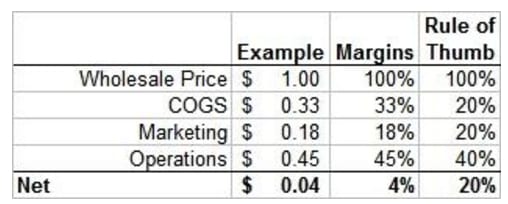
Take a look at this basic example:
|
||||
|
||||
[](https://eddiesoehnel.com/wp-content/uploads/2012/01/cogs_1.jpg)
|
||||
|
||||
The rule of thumb margins are for an established ongoing CPG business. The example includes an actual business, where wholesale price is the cost to the retailer and the gross revenue to the CPG company. Net includes the earnings before interest and taxes (EBIT).
|
||||
|
||||
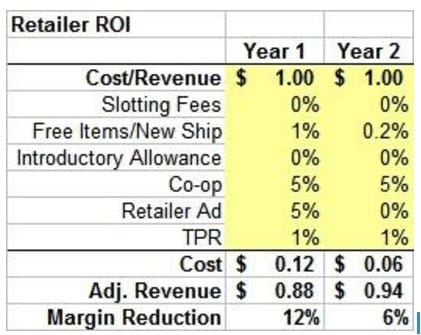
In this next table, we’re doing an ROI analysis of the year 1 and year 2 sales (projected) to a specific retailer, based on the terms they are offering. The fees are converted as a percentage of total projected sales and represent a true cost. As you can see, we don’t earn $1.00 on revenue, but it’s actually $.88 and .$94, respectively in years 1 and 2, for sales to that retailer.
|
||||
|
||||
[](https://eddiesoehnel.com/wp-content/uploads/2012/01/cogs_2.jpg)
|
||||
|
||||
Finally, in this last table, we pop in our revised adjusted revenue to see how it impacts net, especially if we hold our other expense buckets the same.
|
||||
|
||||
[](https://eddiesoehnel.com/wp-content/uploads/2012/01/cogs_3.jpg)
|
||||
|
||||
This is a very simplified example used for illustrative purposes only, so don’t use this for real. The reason is if your retailer fees change, it also changes your operating costs, which might also change your marketing costs. You have to do an ROI retailer analysis in the context of how it impacts your financials on a holistic level. The lesson here and the point of this article is that COGS really impacts your financials.
|
||||
|
||||
A few recommendations with respect to COGS:
|
||||
|
||||
1. It’s OK to have a higher COGS when you are a start-up, but you must have a path towards reducing those costs. The lower the better, but shoot for 30%, which is very hard to achieve in the organic/natural food space unless you are doing some real volume.
|
||||
2. Raise your cost to retailers. That’s really hard to do, unless you can demonstrate rising raw material costs, because the retailer will likely pass that on to consumers and that will likely hurt sales. Its better to start out with as high a cost as possible to the retailer. Conduct thorough category/competitor research and develop your product so that it has high value to your consumers. This gives you room to charge a higher price.
|
||||
3. You could reduce your pack size, but not drop the cost and suggested retail price by an equal amount. In essence, you are fooling the consumer. Consumers are generally adept at price shenanigans and this will hurt your brand.
|
||||
|
||||
Based on these recommendations, it’s clearly better to understand where and how you will reduce your COGS over time and make sure that you lead into the retailer with the right price and pack size.
|
||||
|
||||
[Click here to download the worksheet for this post](https://eddiesoehnel.com/COGSImpactRetail).
|
||||
@@ -0,0 +1,25 @@
|
||||
# How do you calculate the ROI for channel sales?
|
||||
|
||||
Source: <https://eddiesoehnel.com/how-do-you-calculate-the-roi-for-channel-sales/>
|
||||
|
||||
Tags: channel sales, Investment, net profit margin, operating costs, payback period, ROI
|
||||
|
||||

|
||||
|
||||
This was a [Quora](https://www.quora.com/How-do-you-calculate-the-ROI-for-channel-sales) question I was asked to answer.
|
||||
|
||||
I’ve not personally thought of or used ROI for channel sales, but I suppose you could.
|
||||
|
||||
To be clear, when I think of channel sales in context of what I do, which is consumer products, I think of the retail channel, or a subset of retail might be the grocery channel, or the mass channel.
|
||||
|
||||
I think of ROI as a fixed investment with a return marked by a defined period of time. So if you purchase an asset and later sell it, you would calculate your ROI.
|
||||
|
||||
Selling into channels is not something you get in and out of. You set it up, which are defined by costs, which are an investment, then you operate, which are your operating costs.
|
||||
|
||||
When looking at the investment costs, I am more interested in payback period…the costs associated with setting up the channel compared against the profits and how long that takes to earn back the initial investment. These are investment costs that get paid back from profits and are separate from operating costs.
|
||||
|
||||
When accounting for operating costs, the metric I am most interested in is net profit margin for operating in that channel. Take all direct and indirect costs against revenue to determine the profitability of that channel.
|
||||
|
||||
This metric is most useful because you can compare against channels. It is not ROI in the classic sense as I defined above. but operates in the same way in that you can see your return for a given time period and can compare it across different channels.
|
||||
|
||||
I have a simple spreadsheet explaining this [here](https://docs.google.com/spreadsheets/d/1eMPgXBXtGQpW64ZjadYkxgxnuaAim80_N6XP_2Arb1w/edit?usp=sharing).
|
||||
+29
@@ -0,0 +1,29 @@
|
||||
# How to use margins and benchmarks in financial statements for a CPG or consumer product business
|
||||
|
||||
Source: <https://eddiesoehnel.com/how-to-use-margins-and-benchmarks-in-financial-statement-for-a-cpg-or-consumer-product-business/>
|
||||
|
||||
Tags: COGS, Finance, Margins, Marketing, retail price, Wholesale Price
|
||||
|
||||

|
||||
|
||||
This post demonstrates how to use margins and benchmarks in financial statements for a CPG or consumer product business.
|
||||
|
||||
### Margins Defined
|
||||
|
||||
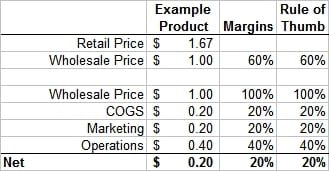
By margins, I mean an expense line item that is relative to net profit, expressed in percentage. Figure 1 is a basic example with the key margins to which we will pay attention.
|
||||
|
||||
*Figure 1 – Margins in a Product Business*
|
||||
|
||||
[](https://eddiesoehnel.com/wp-content/uploads/2011/05/Margins_Figure_1-1.jpg) [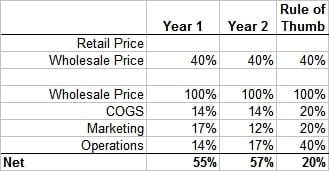](https://eddiesoehnel.com/wp-content/uploads/2011/05/Margins_Figure_2-1.jpg)
|
||||
|
||||
In this example, I made numbers equal to the rules of thumb. In general, wholesale price to a retailer is 60% of shelf-price. This will vary across retail channels, but on average, it’s 60%. The wholesale price is the gross revenue to the manufacturer, whereas the retail price is the gross revenue to the retailer. The retailer pockets the difference between retail price and wholesale price. COGS, marketing and operations rule of thumbs are 20%, 20% and 40%, respectively. Again, these vary across industry and company, but if you don’t know them for your industry, these benchmarks are a good place to start.
|
||||
|
||||
### Example of a Pre-Launch Phase Company
|
||||
|
||||
Figure 2 is one example of a product business in the pre-launch phase. A detailed set of financial projections are working behind the scenes to arrive at these margins. Investment costs are separated out, [as explained in more detail here](https://eddiesoehnel.com/separate-investment-costs-from-your-operating-costs-in-the-profit-and-loss-statement/ "Separate investment costs from your operating costs in the profit and loss statement").
|
||||
|
||||
*Figure 2 – Product business in pre-launch phase*
|
||||
|
||||
[](https://eddiesoehnel.com/wp-content/uploads/2011/05/Margins_Figure_2-1.jpg)
|
||||
|
||||
The expense margins are lower than average, especially the operations number and marketing in year 2. We have to ask: Are the expense and/or revenue assumptions wrong? Is the spreadsheet not making accurate calculations? are there advantages that the business is able to leverage to reduce the expenses? Or, is this the norm for the industry? In this specific case, the business is projecting its ability to leverage certain advantages to reduce costs and the industry tends to have lower expense margins and a much higher net. This could be a great business with room to make errors in the expenses because there is lots of margin to play with.
|
||||
+33
@@ -0,0 +1,33 @@
|
||||
# I am currently working on the development of an e-commerce that sells healthy dry food. What are the typical margins?
|
||||
|
||||
Source: <https://eddiesoehnel.com/currently-working-development-e-commerce-sells-healthy-dry-food-typical-margins/>
|
||||
|
||||
Tags: COGS, direct marketing, direct-to-consumer, Margins, net profit, Profit and Loss, ROAS, SRP
|
||||
|
||||

|
||||
|
||||
*Question: I am currently working on the development of an e-commerce that sells healthy dry food. What are the typical margins?**I’m launching a webshop with healthy products, nutritional supplements and natural cosmetics from different distributors.**What is the typical gross margin for this kind of products? What percentage of my budget should I allocate to marketing? What is the average basket and the purchase frequency?*
|
||||
|
||||
My answer is below.
|
||||
|
||||
I can only speak from the perspective of being the manufacturer/brand/vendor producing and selling products like what you have described direct to consumer via my website (or through my call center). I don’t have experience as a 3rd party e-commerce business. But, I think many of the metrics will be the same, so here’s what has worked for me.
|
||||
|
||||
My goal is to set my anchor prices on products so that my net profit is at least 30%, if I sold 1 unit. Think of your profit and loss statement one each product. Back into the anchor prices assuming 30% net income and 36% operating costs, which leaves 44% left over for COGS. Or, in your case, 44% paid to the vendors to purchase product from them so you can resell it. In general, try to get that number down closer to 30-40%, or less, if possible.
|
||||
|
||||
If 30% is my net profit goal based on my anchor price – my top most price on a single unit – then think of offering generous volume discounts to attract high average order values. I shoot to maintain at least a 15% – preferably 20% – net profit margin when I do volume discounting.
|
||||
|
||||
In general, $75 or greater average order value from each customer seems to be a bit of a magic number for making the direct online operation work. Offer volume discounts upsells, cross-sells, or down-sells in your order process to get above that figure. Any less and you may not be able to pay for all your operating and marketing costs to acquire customers. You might make it up over time through repurchases, but that puts extra pressure on you. Try to adjust your average order value so that you can at least pay for acquiring that customer on the first purchase.
|
||||
|
||||
A 30% or more repurchase rate from initial purchase within 3-months is another good metric to exceed.
|
||||
|
||||
I don’t think of allocating a percentage of my budget to marketing. I use direct marketing (also called direct response marketing) to acquire customers and my goal is to optimize my entire marketing and operation so that my marketing pays for itself through the sales.
|
||||
|
||||
A general breakeven rule of thumb is an ROAS of 2, or gross sales minus cancels/declines/returns, divided by marketing/advertising spend. If your ROAS is hitting 2 or more, in general, your operation will be at breakeven. So you optimize marketing to get you a higher ROAS – say 3, 4 or higher – I have done as high as 7.
|
||||
|
||||
It often takes time to optimize, so I may be spending low dollars on marketing to start, but it is returning less than 2 ROAS. As I optimize and it gets above 2, I then spend more and more and keep going up.
|
||||
|
||||
When you think of it this way, it’s less about allocating percent to marketing, but more about how much more can I spend because I have optimized and I know the marketing is working and will pay for itself with sales coming in.
|
||||
|
||||
But, if I look back, and I have optimized my marketing to a strong ROAS, my P&L generally shows around a 20% marketing spend.
|
||||
|
||||
I try to build my operation around the above-mentioned metrics, and if I am successful, will give me a strong, profitable and generally sustainable business.
|
||||
@@ -0,0 +1,96 @@
|
||||
# Key viability metrics for a startup CPG company
|
||||
|
||||
Source: <https://eddiesoehnel.com/viability-metrics-for-a-startup-cpg-company/>
|
||||
|
||||
Tags: CPG, metrics, retail, startup
|
||||
|
||||

|
||||
|
||||
When I look at CPG opportunities, my goal is to know the following:
|
||||
|
||||
1. Is this product/idea differentiated in the marketplace and how easy is it for the competition to copy/replicate that differentiation?
|
||||
2. Does the team know what they are doing to grow the opportunity?
|
||||
3. What’s the plan to get the opportunity to 20% EBIDTA?
|
||||
|
||||
To accomplish the above, I need the following metrics for a startup CPG, in this order, with the basis at the product unit level that the end consumer would purchase:
|
||||
|
||||
1. Current sales in units/door/week by channel;
|
||||
2. SRP – suggested retail price of the item by channel;
|
||||
3. Repurchase rate;
|
||||
4. Retailer margin (%);
|
||||
5. Wholesale revenue;
|
||||
6. Returns;
|
||||
7. COGS;
|
||||
8. Gross margin (wholesale revenue – COGS);
|
||||
9. Tradespend;
|
||||
10. Marketing costs;
|
||||
11. Sales costs, incl. broker fees;
|
||||
12. Logistics and retailer penalties;
|
||||
13. All other operating costs;
|
||||
14. Net;
|
||||
15. Cash investment.
|
||||
|
||||
The above is structured like a basic P&L. The metrics are less important because in most cases, they will not be to where they should be. What’s more important is the qualitative discussions on each metric to help me get to my 3 goals listed above. With the above metrics and a 30-minute discussion, I can usually know if this is a good opportunity for me.
|
||||
|
||||
Sales/Units/Door/Week and SRP by channel
|
||||
|
||||
This is a core metric to understand how the product is performing in the marketplace. It will be different for each product category, but a good metric for many grocery categories is 1 unit/door/week. If this is average, does this product exceed that or is it below that? If so, why? If above, is it a unique product different enough from the competition? If above, is the company doing some kind of in-store or external marketing that is driving sales? If below, why? Is the company’s marketing not effective? Is it a commodity product getting lost in the clutter of all other commodity products? Is SRP too high, too low? Why?
|
||||
|
||||
These are exactly the kinds of questions category buyers ask in determining whether to take on new products, expand existing ones into more stores, or discontinue them out in favor of another product. Even if a product is meeting sales threshold does not mean it won’t get discontinued. Another better product could come along or one with better marketing. The company needs to know its category and competitors and trends very well to try to position against this.
|
||||
|
||||
When I say “by channel” above, I mean I want to know SRP and margins by channel – grocery, drug, mass, club, etc.. Even if the company is not selling in these channels, what would SRP be in those channels, against the retailer margin? Eventually, I would want to see them sell to the other channels to get more growth. This is important to know now because setting SRP relative to margin and EBIDTA has to be done in the context of looking at other channels, because even though it might work in one channel, it will break in other channels, so you want to get that right from the start.
|
||||
|
||||
Repurchase Rate
|
||||
|
||||
This metric can only be derived with accuracy if the company has a direct-to-consumer (D2C) component (i.e.: sell via their website). And it is very important to know because if the company has a low repurchase rate – and I assume if in grocery stores it’s a consummable product, so there should be repeat purchasing – then the company has a structural problem and eventually it will fail when it runs out of new consumers. Having a D2C component is very important to know information like this. I look at repurchase rate in context of 12-months from initial purchase. Another similar metric is customer lifetime value, but I limit to 12-months.
|
||||
|
||||
If only in retail, the best way to gauge this number is through specialty or smaller chains that the company has been selling in for a while. If succeeding, then you might infer that there is a good repurchase rate. However, the caveat there is that the product is not in an impulse-buy store location, like the checkstand area. If so, then be careful.
|
||||
|
||||
Retailer Margin (%).
|
||||
|
||||
For grocery, the target is 35% – the difference between wholesale and SRP, or the retailers markup. Is it higher or lower than this and why? If lower, then to expand to other chains, it will have to go higher, meaning it eats into EBITDA. If higher, why? Is it because it’s a new product and the category buyer wanted more margin because of the risk? Or, is it because the company is not marketing or not marketing well to support sales, so the category buyer wants more margin?
|
||||
|
||||
Returns
|
||||
|
||||
Usually will be 1-4% for small companies in smaller retailers. It should not be higher than that. If so, why? Dig in to understand what is going on.
|
||||
|
||||
COGS
|
||||
|
||||
For smaller CPG’s in food, selling organic, this figure is easily in the 50-70% range. The key to ask is not necessarily where it is now, but can the company get it down over time with increased volume? They should be able to get it to the 30-40% range – closer to 40 if an organic product. Again, this is for consummables.
|
||||
|
||||
Tradespend
|
||||
|
||||
On average, for all CPG consummables, its 13.5%. If higher why, if lower, why? What is the company doing to warrant it being higher or lower? It’s almost always higher the first year in a retail chain, then goes down. What are the specific factors in tradespend that is causing this number to be what it is? Experienced CPG people will know how to negotiate this number down over time. Does this company know how to do this? Note: diving into this area will really tell you if the company knows what they are doing or not, in my experience.
|
||||
|
||||
Marketing Costs
|
||||
|
||||
This goes with tradespend, because in-store marketing is in tradespend. But external marketing (what the company does independent of the retailer) is everything else. For small companies, marketing should really be direct response drive, in my opinion. By DR marketing, your marketing has to drive sales and you have to be able to measure it to see if its working. You can’t just throw dollars at brand marketing like large CPG companies because you will run out of money before they have an effect, in my experience. With DR marketing, you need to know how many dollars are spent and what sales that brings in – simple equation called MER (marketing efficiency ratio). A ratio of 2 or more is what you want, but it takes time to get there to optimize marketing. A CPG company that knows how to do this can leverage it into retail growth very well.
|
||||
|
||||
Sales costs, incl. broker fees
|
||||
|
||||
Broker fees is what I really want to get at. Goal is to get to 5% with no monthly upfront payment. Hard to do for smaller companies, but that is the goal.
|
||||
|
||||
In the natural channel it will be 8-15% with a $500-800 monthly payment to good brokers. Over time, you can get the monthly payment to go away and with volume, get the % down.
|
||||
|
||||
I care less about the costs now and more about who the brokers are, what are they doing and are they good ones (I can usually tell by knowing how the brokers work by asking the company questions about them). Good brokers are key to growing in retail. You want relationships with good ones.
|
||||
|
||||
Logistics and retailer penalties
|
||||
|
||||
Goal is to get to 5-7%, or even lower if possible. If higher, why? This is another area that by digging in, will tell me if the company really knows what they are doing on an operating level. Companies with less experience or with weak operations will have higher logistics and retailer penalties. This area can kill a company if not under control. This area might not be a problem now, but its a sleeper land mine because it could become a problem if internal processes and systems are inadequate.
|
||||
|
||||
All other operating costs
|
||||
|
||||
I usually don’t dive into any other cost areas. The above is what I really need to get to my 3 goals.
|
||||
|
||||
Net
|
||||
|
||||
What is the EBITDA? Goal is 20%. Now, let me say that 20% is my goal. It does not necessarily mean that is the goal of other companies. I like 20% because it gives me room for error, because there will always be error. In general, if its less than 10%, that’s a problem, because errors will eat into that fast. If not at 20%, then what is going on above to impact this? Based on the above discussion, I would be able to understand better what is needed to get to 20% EBITDA and if the company has the expertise to make it happen. However, I see opportunities all the time that will never get to 20%. Does not make them bad ones, just maybe not ones I would consider.
|
||||
Put the above into a simple excel model and as you play with all the variables, you will see its impact on EBIDTA.
|
||||
|
||||
Cash Investment
|
||||
|
||||
What will my cash investment do for the company to get it towards 20% EBITDA? Or, if it’s at 20% now, what will my investment do for growth? If my investment won’t get it there, will the company need more investment? If so, can they raise money from other investors besides me? Do they have a differentiated opportunity and a good team that would be attractive to other investors?
|
||||
|
||||
Growing CPG companies, especially those in retail, even at positive EBITDA, often need more and more cash to growth. So, even if goal EBIDTA is reached, growth still means more cash will be needed. Can they get it?
|
||||
|
||||
What’s the exit? How do I get my money back? Because growing CPG companies, especially in retail, need cash to fund growth, don’t expect your investment to come from EBITDA distributions to investors, at least any day soon. And selling a company is really hard and very few are able to do that.
|
||||
+119
@@ -0,0 +1,119 @@
|
||||
# Marketing campaign goal metrics model: a simplified version of the most important financial model for any consumer product company
|
||||
|
||||
Source: <https://eddiesoehnel.com/marketing-campaign-goal-metrics-model-a-simplified-version-of-the-most-important-financial-model-for-any-consumer-product-company/>
|
||||
|
||||
Tags: Average order value, clickthroughs, COGS, CPC, Excel, google sheets, kpi, Marketing, net profit margin, reseller, retailer, ROAS
|
||||
|
||||

|
||||
|
||||
### The ultimate goal in any company…
|
||||
|
||||
…is to acquire AND retain customers where costs to acquire and retain are less than expenses, which leads to profits.
|
||||
|
||||
Boiled down to this single statement, then the most important variable in the finances is the marketing spend.
|
||||
|
||||
Even if your other expenses are high or way out of whack or your conversion is terrible and you can profitably acquire and retain customers, then those other expenses matter a lot less.
|
||||
|
||||
So, how do we know how well our marketing is working? We use the model in this post, which is a high level marketing campaign model that aggregates all the detailed costs into a few key components.
|
||||
|
||||
This model is probably the most important model in my arsenal and the one I use the most. It flows like a profit and loss statement with key ratios to help me quickly see how I am doing in a particular marketing or sales campaign.
|
||||
|
||||
Actually, this model is a more simplified version that I use, but for a very high level view, this one works great and useful to explain in this post.
|
||||
|
||||
How it works is rather simple. Let’s dive in.
|
||||
|
||||
### Marketing campaign goal metrics model
|
||||
|
||||
[Embedded resource](https://docs.google.com/spreadsheets/d/e/2PACX-1vSN3B5LUtLtS5hWX6VbWMvb6T6hweBbRX-GtFNxrEfQOnjFXq8LJCsVVF6B200w-WmC19pt72W2IX2n/pubhtml?widget=true&headers=false)
|
||||
|
||||
To download the spreadsheet used in this post, please scroll to the end.
|
||||
|
||||
Marketing Goals
|
||||
|
||||
This variable I set as my gross income that I want. Actually, it might be the last thing I set because I generally start with my net income and net margin goals and work backwards by putting in the variable that will get me there.
|
||||
|
||||
Excel’s or Sheet’s goal seek and goal seeker, respectively, are useful here, or you can interpolate by hand.
|
||||
|
||||
COGS (Cost of goods sold)
|
||||
|
||||
I always try to determine my COGS based on a given revenue range and a particular marketing channel and convert to a percentage of revenue, which makes it easy for the model to use when the other variables change.
|
||||
|
||||
Marketing
|
||||
|
||||
The key here is to understand your costs for a given channel and product that you are promoting in the marketing campaign.
|
||||
|
||||
This is very important because marketing costs can vary dramatically for different channels and products.
|
||||
|
||||
Don’t mix them together.
|
||||
|
||||
This means you want to have a really good accounting general ledger and system to be able to track expenses down to the product and the channel.
|
||||
|
||||
I always like to look at my marketing fixed costs because they can vary quite dramatically by channel and product, so they go in this line item.
|
||||
|
||||
But the one variable in this whole model that I will constantly adjust based on my ad spend is the ad spend line item.
|
||||
|
||||
I highlighted it in blue because when I set all other variables, I find this one will continue to change the most.
|
||||
|
||||
Operations
|
||||
|
||||
This is all other costs for the business, and I mean all other fixed costs. Just lump them all into this variable.
|
||||
|
||||
There will be other variable costs, like product returns, but I generally just try to lump them into this line item based on the revenue range to keep the model simple.
|
||||
|
||||
Other P&L line items of net and profit margin are pretty simple to understand.
|
||||
|
||||
I always try to start with my goal net profit margin, then work backwards from there to fill in all other variables in the model.
|
||||
|
||||
My net profit margin goal is usually 30%.
|
||||
|
||||
ROAS
|
||||
|
||||
Return on ad spend is important because it helps me compare one campaign to the next.
|
||||
|
||||
Do comparison only for each marketing campaign within a specific channel and by product. Don’t use it to compare across different products and channels because it is not an apples-to-apples comparison.
|
||||
|
||||
In general, I look to be in a range for ROAS:
|
||||
|
||||
- 2-4 is generally the range for breakeven for a consumer product business. If I am above that and at or below my breakeven net income, then I may need to try and work on getting my operating costs down to get it in line.
|
||||
- 7 or above for a profitable business via digital marketing usually means I have a great performing campaign. That number is 3 or more for an analog marketing campaign.
|
||||
|
||||
Traffic
|
||||
|
||||
My traffic line items specifically break down the performance for each step in my funnel through purchase.
|
||||
|
||||
Those performance ratios should be in line with my category.
|
||||
|
||||
My goal is to improve those ratios by playing with my funnel and each step in it to get better conversion.
|
||||
|
||||
Average Order Value
|
||||
|
||||
And finally, I have my average order value, which rolls up to revenue.
|
||||
|
||||
### Key things to focus on
|
||||
|
||||
There is a lot going on in this simple model with all the variables you can input, but to keep it simple, here are the key things to focus on:
|
||||
|
||||
1. Ad spend: the goal is to drive this one down, which means finding a marketing channel where the costs are cheaper over other channels (you have good marketing arbitrage).
|
||||
2. Traffic: improve these numbers by working on your funnel to get customers to convert better in each step.
|
||||
3. COGS and Operations: reduce these costs so that those savings flow to your net.
|
||||
4. Average Order Value: get this number up so that fewer customers will do the job for you, which then means your traffic numbers do not need to perform as well.
|
||||
|
||||
This model can technically be used anywhere, even with reseller or retailers. The ad spend is any cost you pay to acquire customers.
|
||||
|
||||
For a reseller or retailer, that is not just the tradespend but also the margin you give to them to resell your product. Margin you give up is an acquisition cost, so I consider it a marketing expense.
|
||||
|
||||
When you look at it this way, the 65% margin that a retailer in a specialty channel is charging to resell your product becomes a huge expense.
|
||||
|
||||
But that is the way you want to look at it because if you can acquire customers for less in other channels (and you usually can), then you might want to focus efforts there.
|
||||
|
||||
Paying that 65% margin usually only starts to make sense when you can sell a lot of volume to get economies of scale, which takes time and cash to get to that point.
|
||||
|
||||
### Summary
|
||||
|
||||
This model rolls up key performance indicator (KPI’s) for a consumer product company.
|
||||
|
||||
Sure, there are [many others](https://eddiesoehnel.com/top-kpis-cpg-companies/) you will want to track, and maybe [one super metric](https://eddiesoehnel.com/north-star-metric/), but they all roll into the ones in this simple model.
|
||||
|
||||
As long as you have [robust and thorough data and accounting tracking systems](https://eddiesoehnel.com/technology-infrastructure-for-consumer-product-companies/) in place, then it becomes quite easy to use this model to figure out what is working in your business.
|
||||
|
||||
[Click here to download the spreadsheet model for this post.](https://eddiesoehnel.com/MarketingCampaignGoalMetricsModel)
|
||||
+30
@@ -0,0 +1,30 @@
|
||||
# One method for determining channel margins when you are not able to talk with industry insiders
|
||||
|
||||
Source: <https://eddiesoehnel.com/one-method-for-determining-channel-margins-when-you-are-not-able-to-talk-with-industry-insiders/>
|
||||
|
||||
Tags: COGS, consumer electronics, distributor, importer, Margin, markup, MSRP, reseller, retailer, SRP
|
||||
|
||||

|
||||
|
||||
This post answers this question I received on Quora:
|
||||
|
||||
*Does the manufacturer of robotic kits for kids have a potential to enter markets overseas by offering a 50% discount on MSRP to importers? Will the importer have enough space to markup the price before CE retailers markups his own purchasing price?*
|
||||
|
||||
The answer is unknown without direct knowledge of the margins amongst the various intermediaries (importers, distributors, retailers/resellers) involved in the sale of products in your category.
|
||||
|
||||
It is hard to pin down using general industry rules of thumb because margins on consumer electronic products varies quite substantially not just between categories, but within categories, between channels and retailers and possible also based on the maturity of the product in the category.
|
||||
|
||||
The best way to get this information is two fold:
|
||||
|
||||
Talk directly with importers/distributors and retailers/resellers to understand their margin requirements.
|
||||
|
||||
If this is not possible, then I would back into this number through the following sequence:
|
||||
|
||||
1. Determine the MSRP of your product. This would be equal to the revenue that the end retailer/reseller makes on the sale of your product to the end consumer;
|
||||
2. Research your specific category within the consumer electronics industry from financial statements by publicly traded consumer electronics retailers. Determine their COGS, which is what they pay the importer/distributor;
|
||||
3. Assume 20% margin to the importer/distributor (this is a rule of thumb and may not be correct for your category), which lets you back into determining your wholesale cost of the product to the importer/distributor (your revenue);
|
||||
4. Assemble your P&L for the product, including COGS and all applicable operating expenses and net income. Assume a reasonable but standard net income percentage for companies like you in your category.
|
||||
|
||||
The goal with this exercise is to determine if you can manufacturer and sell your product at your wholesale cost with all of your P&L variables factored in for that product, based on your industry net income average, which then rolls up to the importer/distributor price, which then then rolls up to the retailer price, factoring in their COGS.
|
||||
|
||||
Build this sequence into a model and you will then be able to determine what margin you can deliver on your product.
|
||||
+31
@@ -0,0 +1,31 @@
|
||||
# Revenue strategies in the early days of your consumer product startup
|
||||
|
||||
Source: <https://eddiesoehnel.com/revenue-strategies-consumer-product-startup/>
|
||||
|
||||
Tags: AOV, MSRP, retention marketing, SRP
|
||||
|
||||

|
||||
|
||||
In the early days of your startup, there are three revenue generating strategies that you want to try and adopt into your business.
|
||||
|
||||
First, try to maximize the price of your product to get as much revenue a possible from a single customer.
|
||||
|
||||
As an example, if your goal is $1000 in gross sales a week, at $100 per product, that is only 10 customers, compared to a $25 product, which is 40 customers.
|
||||
|
||||
It is a lot easier to take care of 10 customers than 40 customers, in terms of processing orders, managing inventory, managing customer service and any returns. You want to make it as easy as possible on yourself when you are starting out and having larger backend operations that add greater costs and complexity don’t help.
|
||||
|
||||
The ideal is to get your MSRP or SRP above $100 but below $1000; any higher and it may require personal selling to close a sale, which will add more work for you.
|
||||
|
||||
Second, try and maximize your order value. That is, try to get that customer to put as much in their cart as possible.
|
||||
|
||||
As a general rule, when selling direct to a customer, you want your average order value to be greater than $100 to really make things work in your business. If your product retails for less than $100, violating the first rule above, then maybe you can make up for it here through incentives to maximize the cart value.
|
||||
|
||||
Third, you want to maximize the revenue from each customer over time. This means you want to work hard to retain customers and keep them as repeat buyers, because it is a lot cheaper and easier to keep a customer than find a new one.
|
||||
|
||||
As a general rule, try to have 30% or more of your customers give you repeat orders. If it is less, then there may be something wrong with what you are selling that is turning customers off, and you need to find out why.
|
||||
|
||||
So, when you are starting out, sell a product or products that have higher price points, try to incentivize your customers to place big orders with you, and do everything you can to retain customers and keep them buying from you.
|
||||
|
||||
If all you can do is one, that is fine, but if you can incorporate two or all three, then that will help you out immensely in the earlier days of your startup.
|
||||
|
||||
As you grow, get sales, cash flow and profits, then you might be able to better afford to have lower priced products or lower average order values.
|
||||
+29
@@ -0,0 +1,29 @@
|
||||
# Separate investment costs from your operating costs in the profit and loss statement
|
||||
|
||||
Source: <https://eddiesoehnel.com/separate-investment-costs-from-your-operating-costs-in-the-profit-and-loss-statement/>
|
||||
|
||||
Tags: COGS, Cost of goods sold, Finance, Investment, Profit and Loss
|
||||
|
||||

|
||||
|
||||
This article talks about how to separate investment costs from your operating costs in the profit and loss statement so that you have good numbers from which to make meaningful analysis.
|
||||
|
||||
### P&L Cost Buckets
|
||||
|
||||
In my P&L, I like to group operating costs into the following buckets: COGS, marketing, and operations. There are many expense line items under these buckets, but they roll up into each of the categories.
|
||||
|
||||
Below my P&L are my investment costs, which I separate into corporate investments and product investments. Investment costs are one-time expenses or paid over a short-period of time and do not recur. On the corporate side, they include costs with setting up legal entities, trademark filings, systems and office setup. These costs occur at the start-up stage or at key growth stages of a company.
|
||||
|
||||
Product investment costs are associated with R&D, development, customer testing, marketing and packaging development, copyright and trademark filings and any other costs to get a product ready for launch. If there are re-branding efforts after the product is launched (like new packaging), they would be grouped under product investment costs.
|
||||
|
||||
There will always be questions on whether some expenses belong in the operating or the investment buckets. For example, website development costs can be ongoing due to the addition of functionality and enhancements in our fast-changing technology environment. So, would they be considered an operating or investment cost? You’ll have to make that decision on your own, but my rule is to group minor changes as part of my operating costs and the addition of functionality or major layout/re-branding efforts to be grouped under investment costs.
|
||||
|
||||
Another example is personnel costs. The salaries you pay your people to develop a product, packaging and marketing is probably the largest investment expense. How do you decide what of their salary is investment expense and what is operations expense? I don’t like to generalize in answering this question by just taking some percentage and allocating towards investment and operations. I try to be more exact and take into account the time they spend in investment vs. operations activities. I need to be able to analyze my business with good data and its very easy to get bad data when you generalize.
|
||||
|
||||
### Analysis
|
||||
|
||||
I separate my costs as outlined above for 3 key reasons:
|
||||
|
||||
1. Investment costs skew analysis of operating results and distort the true health of the business. If they are mixed in with operations, then it will be harder to determine how the core functions of the business are performing. You want to have a clean set of accounting numbers void of investment costs to do your margin analysis on your operations.
|
||||
2. Payback period. The purpose of healthy and sustainable profits in a product business are to help pay back your investment, fund future investment and provide free cash flow that is returned to the shareholders. Looking at your investment costs separate from operations makes this it much easier to determine how long it will take the business to pay back that investment with the profits.
|
||||
3. Investment costs remain transparent. Separating them from operations allows you to look at your investment costs in a clean and transparent way.
|
||||
+9
@@ -0,0 +1,9 @@
|
||||
# Startup fundraising: my thoughts on the process and tips on your fundraising pitch deck
|
||||
|
||||
Source: <https://eddiesoehnel.com/startup-fundraising-tips-on-your-fundraising-pitch-deck/>
|
||||
|
||||
Tags: Fundraising, investors, pitch deck
|
||||
|
||||

|
||||
|
||||
[Embedded resource](https://docs.google.com/document/d/e/2PACX-1vR6pANuMCAOSstwmsAT6GVj5DJE9bKxqwdUzxWlsQFNcUeNVD7drVcdArXDeQHRtd63tC35Qq3YyWAb/pub?embedded=true)
|
||||
+17
@@ -0,0 +1,17 @@
|
||||
# The Flow of Money in a Consumer Product Company (infographic)
|
||||
|
||||
Source: <https://eddiesoehnel.com/flow-money-consumer-product-company/>
|
||||
|
||||
Tags: abandons, AOV, Average order value, CLTV, COGS, cost per click, cost per order, CPC, crossell, downsell, gross margin, Profit and Loss, return on ad spend, ROAS, ROI, ROIMI, sales funnel, upsell
|
||||
|
||||

|
||||
|
||||
The best way to think about this is a profit and loss statement, starting with revenue at the top and net income at the bottom.
|
||||
|
||||
A customer flows from the top, acquired through marketing spend, and everything in between to deliver that product to them, with profit left over, and all the key metrics that matter in this flow.
|
||||
|
||||
You can think of selling to resellers using this same flow, except you will not have to collect and review all the same metrics as you do when selling direct-to-consumer. I organize my financial models and way of thinking based on this flow.
|
||||
|
||||
[Click here to download the spreadsheet for this post.](https://eddiesoehnel.com/FlowofMoney)
|
||||
|
||||
[Embedded resource](https://www.lucidchart.com/documents/embeddedchart/ac5ebb3b-d97b-490e-a04e-5db3b884ef11)
|
||||
@@ -0,0 +1,37 @@
|
||||
# The North Star Metric
|
||||
|
||||
Source: <https://eddiesoehnel.com/north-star-metric/>
|
||||
|
||||
Tags: kpi, north star metric, super metric
|
||||
|
||||

|
||||
|
||||
There’s something called the North Star Metric, which one can also refer to as a super metric or a super KPI (key performance indicator).
|
||||
|
||||
I found it to be best described in this one sentence, [pulled from this post:](http://edsoehnel.us2.list-manage2.com/track/click?u=b0d432e4c7e4ba05821cfae69&id=11c63fb5c2&e=380e33e966)
|
||||
|
||||
*The North Star Metric is the single metric that best captures the core value that your product delivers to customers.*
|
||||
|
||||
I think the best place to discover your North Star Metric is to focus on the final best outcome your product provides to the customer and to quantify and measure that outcome.
|
||||
|
||||
For example, if the product is a weight loss supplement, then the outcome could be pounds lost while taking the supplement.
|
||||
|
||||
If the customer experiences pounds lost, then that may lead to repurchase, which you can track via repurchase rates, which leads to high customer lifetime value, which you can track (assuming you sell direct and have implemented systems to track this data).
|
||||
|
||||
High customer lifetime value means you have more efficient marketing because you are not spending to acquire a customer for every one you lose, which leads to higher profitability
|
||||
|
||||
So, in this example, if you can track how many pounds your customer’s lose from using your product, that could be The North Star metric. If you can track on a weekly basis, then that can serve to align the entire business to keep this number up, because that leads to repeat purchasing…more efficient marketing…more profits.
|
||||
|
||||
But tracking the outcome may not be feasible. It is not realistic for every customer to tell you on a weekly basis how much weight they lost taking your product. So, move backwards from there to track earlier metrics in this process, like product repurchase rates or customer lifetime value. If I had to choose, I think these two metrics are probably the best North Star metrics for consumer product companies.
|
||||
|
||||
I think my best North Star Metric for my business is repeat purchasing rate, which averages 50% for me.
|
||||
|
||||
But I am uncomfortable just using this one metric because averages end up hiding real insight into my business and could be masking underlying problems.
|
||||
|
||||
What is better is to look at repeat purchasing rate by things like specific product, by cohort (for example, which channel I used to acquire a particular set of customers) or segment (for example, my VIP customers versus my regular customers).
|
||||
|
||||
Another possible North Star Metric is customer lifetime value, which for me averages $260 across my entire customer base.
|
||||
|
||||
But again, the averages could mask underlying problems. I am most concerned with raising this number among my VIP customers, so for me, tracking customer lifetime value for my VIP customers is a better North Starmetric.
|
||||
|
||||
So, in sum the North Star Metric is potentially useful to align the entire company, but probably should not be relied upon on its own because averages can mask problems.
|
||||
+26
@@ -0,0 +1,26 @@
|
||||
# What are Honest Co.’s gross margins (and some rules of thumb for figuring this out)
|
||||
|
||||
Source: <https://eddiesoehnel.com/what-are-honest-co-s-gross-margins-and-some-rules-of-thumb-for-figuring-this-out/>
|
||||
|
||||
Tags: COGS, Finance, gross margin, Honest Company, Marketing
|
||||
|
||||

|
||||
|
||||
This is a [Quora](https://www.quora.com/What-are-Honest-Co-%E2%80%99s-gross-margins) questions I was asked. Here is my answer
|
||||
|
||||
I did a quick search in my industry source and did not find anything that specific.
|
||||
|
||||
Here are some quick metrics to make a guess:
|
||||
|
||||
- As of 2016, they are north of $300 mm in sales;
|
||||
- Unprofitable;
|
||||
- Raised $220 mm to date from 10-investors;
|
||||
- Direct-to-consumer sales and no retail to date.
|
||||
|
||||
Based on the type of marketing they are doing (all brand, from what I can tell), I assume their marketing costs are running at least 25% of revenue, and operations costs at 40% (based on their size).
|
||||
|
||||
That leaves 35%, and if they are not profitable, then I assume their COGS is at least 35%.
|
||||
|
||||
Given that they sell organic products, I would peg their COGS at 40%, so gross margin is 60%.
|
||||
|
||||
In my experience, I have not see pure organic companies with COGS below 40%.
|
||||
@@ -0,0 +1,25 @@
|
||||
# What are good margins and markup for a food business?
|
||||
|
||||
Source: <https://eddiesoehnel.com/good-margins-markup-food-business/>
|
||||
|
||||
Tags: Margin, markup
|
||||
|
||||

|
||||
|
||||
Markup depends on the retail channel in which you sell.
|
||||
|
||||
Specialty/natural channels run 50-65%, drug is 45%, grocery is 35%, mass is 30%, and club is 14%.
|
||||
|
||||
If you sell direct to consumers, then the anchor price on a single unit of your product would equal that specialty/natural channel price.
|
||||
|
||||
In my experience and opinion, your EBIT (earnings before interest and taxes) should be 30%+ if you sell direct to consumer. This is your most profitable channel – selling direct to consumers.
|
||||
|
||||
For retail, you should strive for a 20%+ EBIT.
|
||||
|
||||
For cost of goods sold (COGS), you should strive for 40% or lower, which is not necessarily possible when you are a startup or doing smaller volume. I see COGS in the 40%-70% range for startups and small food companies.
|
||||
|
||||
The above profitability and COGS margins assume you are selling at volume, not at startup. You likely won’t have EBIT at 30% or 20% for direct and retail, respectively, and COGS at 40% or lower when you are a startup or running small volume, but you want to make sure you can get to these metrics as you scale.
|
||||
|
||||
In reality, especially if you are selling an organic or natural product, it can be difficulty even at volume to hit the 30% and 20% EBIT metrics, but to be sustainable, you really need to shoot for these metrics.
|
||||
|
||||
If your forecasting reveals that you may not be able to hit these metrics at volume, then go back to R&D to redevelop the product with more value that will allow you to charge the price that will give you the profitability you need to be sustainable.
|
||||
+31
@@ -0,0 +1,31 @@
|
||||
# What are some barriers of entry to running a successful eCommerce business?
|
||||
|
||||
Source: <https://eddiesoehnel.com/what-are-some-barriers-of-entry-to-running-a-successful-ecommerce-business/>
|
||||
|
||||
Tags: Average order value, Customer Lifetime Value, customer retention, Profit and Loss
|
||||
|
||||

|
||||
|
||||
This is a [Quora](https://www.quora.com/What-are-some-barriers-of-entry-to-running-a-successful-eCommerce-business/answer/Ed-Soehnel) question I was asked and my answer is as follows.
|
||||
|
||||
My sense is that a minimum qualification for “successful” is profitable on an EBITDA basis (net profit or earnings before interest and taxes, depreciation and amortization) such that your profits will pay back your original investment in a defined time frame.
|
||||
|
||||
Defined time frame is different for everyone, but could be 3, 5, or 7 years or some other time frame you require for payback on your original investment.
|
||||
|
||||
If we take that minimum definition for “successful”, I think the biggest barrier for new entrants is not knowing the right set of metrics that will get you to success.
|
||||
|
||||
It usually takes trial and error and general testing to learn what those metrics should be for your business. Even if you have direct experience in your specific industry, each company is different so the metrics will be different.
|
||||
|
||||
A big metric includes average order value, which as a general rule should be north of $75, because anything less and you will not be able to pay your operating costs.
|
||||
|
||||
But, that is greatly affected by may other big factors, principally the acquisition cost of each customer and the customer lifetime value of that customer.
|
||||
|
||||
If you have optimized marketing where your customer acquisition costs are low, you might do just fine with a lower average order value.
|
||||
|
||||
And if you can retain your customers so that you can count on repeat purchasing, then in general your marketing costs will be much less because it costs, on average, 7x less to retain a customer than acquire a new one.
|
||||
|
||||
Knowing these and many other metrics in your business takes time and that is often the enemy of ecommerce startups, because the more time they spend to learn this, the more cash they burn, not only reducing available cash, but also increasing the payback period on the original investment.
|
||||
|
||||
To reduce the complexity of these and other metrics,[I have an infographic on the flow of money in a consumer product company](https://eddiesoehnel.com/flow-money-consumer-product-company/) organized into a profit and loss statement and how the main metrics fit together.
|
||||
|
||||
You can use this to model your ecommerce business and see how the metrics fit within the context of profit and loss.
|
||||
@@ -0,0 +1,19 @@
|
||||
# What are the profit margins on plastic storage containers?
|
||||
|
||||
Source: <https://eddiesoehnel.com/profit-margins-plastic-storage-containers/>
|
||||
|
||||
Tags: None listed
|
||||
|
||||

|
||||
|
||||
This is a [Quora](https://www.quora.com/unanswered/What-are-the-profit-margins-on-plastic-storage-containers) question. This is my answer.
|
||||
|
||||
The general goal in consumer products is 20% EBITDA (earnings before interest and taxes) profit margins.
|
||||
|
||||
But these are commodity products and the category is probably competitive, so it’s possible EBITDA is less, may 10%-15%.
|
||||
|
||||
Cost of Good Sold (COGS) on a product like this is probably 15% – that is raw materials+manufacturing+packaging+shipping to warehouse.
|
||||
|
||||
Retailer margin (markup from wholesale) depends on the channel – anywhere from 14% to around 50%.
|
||||
|
||||
So, when you break it all down, the costs are all in marketing, sales and distribution. Prices probably are not that high because this is a commodity product and many competitors, thus less ability for one to charge higher prices.
|
||||
@@ -0,0 +1,43 @@
|
||||
# What are the top KPIs for CPG companies?
|
||||
|
||||
Source: <https://eddiesoehnel.com/top-kpis-cpg-companies/>
|
||||
|
||||
Tags: kpi, metrics
|
||||
|
||||

|
||||
|
||||
The KPIs for CPG depend on the channels sold.
|
||||
|
||||
If sold direct-to-consumer, the top metrics I track include:
|
||||
|
||||
1. Marketing spend;
|
||||
2. Message engagement rates (email, social views, social shares, hashtags, etc);
|
||||
3. Click throughs;
|
||||
4. Conversions;
|
||||
5. Average Order Value;
|
||||
6. Cost per click;
|
||||
7. Cost per visitor;
|
||||
8. Cost per order;
|
||||
9. Cart abandon rate;
|
||||
10. Cancels/Declines/Returns rates;
|
||||
11. Return on advertising spend (ROAS) or marketing efficiency ratio (MER);
|
||||
12. Lifetime value, calculated at least over 12-months, but can be also much sooner depending upon the product repurchase cycle.
|
||||
13. ROI
|
||||
|
||||
If sold in retail, the top metrics I track include:
|
||||
|
||||
1. Units/door/week sold per retailer;
|
||||
2. Sales order change from 52-weeks prior;
|
||||
3. Weeks of inventory on hand that I have;
|
||||
4. Weeks of inventory on hand that the retail account has;
|
||||
5. Retailer weeks of inventory target number;
|
||||
6. Value of outstanding purchase orders;
|
||||
7. Product returns
|
||||
8. Retailer ROI and tradespend and penalties
|
||||
9. PO delivery on-time rate
|
||||
10. Out of stock percentage
|
||||
11. Logistics costs to revenue ratio
|
||||
|
||||
My background is consumer product and CPG startups through low 9-figures in revenue, so I cannot speak to the top metrics tracked for larger CPG’s. I would think they track the above plus additional ones.
|
||||
|
||||
[Click here to download the spreadsheet for this post](https://eddiesoehnel.com/FlowofMoney).
|
||||
@@ -0,0 +1,17 @@
|
||||
# What is the ROI average for e-commerce sites?
|
||||
|
||||
Source: <https://eddiesoehnel.com/what-is-the-roi-average-for-e-commerce-sites/>
|
||||
|
||||
Tags: e-commerce, EBITDA, payback period, revenue-to-funding, ROI
|
||||
|
||||

|
||||
|
||||
This is a [Quora](https://www.quora.com/What-is-the-ROI-average-for-e-commerce-sites) question I was asked to answer.
|
||||
|
||||
I don’t look at ROI in terms of consumer products or ecommerce because that number is not as meaningful due to its wide range across categories, channels and geography.
|
||||
|
||||
EBITDA, net profit margin, payback period, and revenue-to-funding are metrics I prefer.
|
||||
|
||||
Based on that, here’s is some data I have.
|
||||
|
||||

|
||||
+31
@@ -0,0 +1,31 @@
|
||||
# What is the cost to revenue ratio of an e-commerce infrastructure in the retail industry?
|
||||
|
||||
Source: <https://eddiesoehnel.com/what-is-the-cost-to-revenue-ratio-of-an-e-commerce-infrastructure-in-the-retail-industry/>
|
||||
|
||||
Tags: COGS, EBITDA, net profit margin, Profit and Loss
|
||||
|
||||

|
||||
|
||||
This is a [Quora](https://www.quora.com/What-is-the-cost-to-revenue-ratio-of-an-e-commerce-infrastructure-in-the-retail-industry/answer/Ed-Soehnel) question I was asked and my answer is as follows.
|
||||
|
||||
For my P&L’s, I break cost up into 3-main buckets:
|
||||
|
||||
- COGS (cost of goods sold)
|
||||
- Marketing
|
||||
- Operations
|
||||
|
||||
I compute COGS based on landed costs, which includes the complete costs to produce a product so that it is sitting in your warehouse (or your 3rd party logistics partner’s warehouse), ready to ship to an end customer or a wholesaler/reseller. Any cost forward of that would be bucketed into operations, below.
|
||||
|
||||
COGS will vary greatly by product category. For organic food items, figure 40% when you are producing at volume for economies of scale. If you are just starting out, it could be higher, as much as 70% because you cannot spread those costs out over greater production volume. Durable goods or soft goods or any non-food/consumable item is also all over the place. I have seen as high as 30% to as low as 3%.
|
||||
|
||||
Marketing costs are also all over the place, too, from 2% for marketing to repeat buyers, and up from there, depending on the channel and many other factors.
|
||||
|
||||
As a rule I try to keep marketing costs below 25%. More than that and the marketing is probably not efficiently bringing in new customers, so you have to work on marketing optimization, which I cover how to do in this [free workshop here](https://eddiesoehnel.com/best-growth-approach-consumer-product-startups-product-launches/).
|
||||
|
||||
That leaves operations. My rule of thumb for ecommerce is 35% which works for me based on how I setup my ecommerce operations. But, that can vary greatly. If you have no other number to go off of (like past experience), then start with 35%.
|
||||
|
||||
For selling via retail, I use 50%.
|
||||
|
||||
Subtracting the three will give you net profit margin (earnings before interest, taxes, depreciation and amortization – EBITDA).
|
||||
|
||||
I have various spreadsheet downloads related to this question on my [downloads page here](https://eddiesoehnel.com/content/download/).
|
||||
@@ -0,0 +1,29 @@
|
||||
# When will competing on price as a small CPG work?
|
||||
|
||||
Source: <https://eddiesoehnel.com/how-will-competing-on-price-as-a-small-cpg-work/>
|
||||
|
||||
Tags: brand pillars, cheap, perception, price, startup, value
|
||||
|
||||

|
||||
|
||||
If you are a startup or small company, it’s common wisdom to not compete on price. If price is all that differentiates products in the same category, then customers will buy from the lowest-priced competitor. This means that competitors will constantly be pricing their products lower and lower to win business to where eventually, no competitor has any profits. Or, the competitor with the most efficiencies who can eek out a profit will end up the winner, putting the rest out of business.
|
||||
|
||||
So, if you are a startup or small company, when is competing on price as a small CPG OK? By competing on price, I mean that it becomes one of the brand pillars on which you build your entire company and use heavily in your promotion.
|
||||
|
||||
**I think it’s OK to be competing on price if you can defend this position against competitors now and well into the future, without cheapening your product and giving a good explanation to your customers about why you are the lowest price.**
|
||||
|
||||
Let’s unpack that statement.
|
||||
|
||||
1. Defend your position. This simply means that you are able to prevent your competitors from matching your price so that you stay the lowest-priced competitor.
|
||||
|
||||
One defense is through intellectual property patent(s), where, for example, you have a patent on a manufacturing process that allows you to more efficiently make your product, thus allowing you to earn the same profit margins as your competitors, but with lower prices. Or you have a patent on a product that is better than alternative products and can also be sold for less.
|
||||
|
||||
Another defense might be in your supply, where you are able to more cheaply source raw materials than your competitors. Or, you own your supply chain, where you cut out intermediaries, thus lowering costs. Or, you are purchasing locally, reducing the transportation miles required to get the raw supply to you.
|
||||
|
||||
A third defense might be distribution, where you sell direct-to-consumer, cutting out distributors, retailers and other resellers entirely.
|
||||
|
||||
2. Don’t cheapen your product. You don’t want to use inferior materials or processes to produce your product such that it will not meet your customer’s expectations. “Expectations” is the key word, here.
|
||||
|
||||
3. Give customers a good explanation about why you are the lowest price. Low prices can mean lower quality. You don’t want to communicate that your product quality is lower because of price. Thus, I think it’s important to be very proactive and transparent in telling consumers why you are the lowest in price. Maybe it’s because you source locally, sell direct-to-consumer, or have a patent on a manufacturing process that allows you to produce more efficiently. Whatever it is, it is critical that you get this across so as not diminish the perception that your lower price means your products won’t meet expectations.
|
||||
|
||||
Satisfy the above three and you have a good shot at competing on price and really winning big because price is a very powerful way to gain customers and marketshare.
|
||||
+22
@@ -0,0 +1,22 @@
|
||||
# A 50% average email open rate and some other email marketing benchmarks – here’s some things that work for me
|
||||
|
||||
Source: <https://eddiesoehnel.com/50-average-email-open-heres-things-work/>
|
||||
|
||||
Tags: clickthrough, Email, Email Marketing, email marketing benchmarks
|
||||
|
||||

|
||||
|
||||
Here are some quick email marketing benchmarks for my dog category business:
|
||||
|
||||
- The email open rate averages 50%;
|
||||
- The clickthrough rate averages 10%;
|
||||
- In the last 12 months, about 1/6 of my list has not opened any of my emails.
|
||||
|
||||
Overall, I am pretty pleased with my list performance, it’s open rate and engagements.
|
||||
|
||||
Some things that help:
|
||||
|
||||
1. Don’t send emails very often – one to two times a month for us;
|
||||
2. Make them especially entertaining – use fun content with lots of images and video;
|
||||
3. Always send a copy of the email a few days after the first email to those that did not open it – that usually gets me another 5-10% open rates;
|
||||
4. Try to use headlines that increase response.
|
||||
+17
@@ -0,0 +1,17 @@
|
||||
# A few notes on how I build my list of emails for marketing with high quality prospects
|
||||
|
||||
Source: <https://eddiesoehnel.com/list-of-emails-for-marketing/>
|
||||
|
||||
Tags: auotresponders, build my list of emails, email list, Email Marketing, sales funnel, trip wire
|
||||
|
||||

|
||||
|
||||
It’s common practice to throw up a free download as a way to build an email list ail list bait to lure subscribers to your list.
|
||||
|
||||
I typically do not build my list of emails for marketing that way because I want to maintain a high quality list with people that are potentially serious about becoming customers. As a result, I do not use free downloads as bait. In fact, I do not promote my list at all in the overt, in your face ways like popups. Instead, I subtly offer the availability of my list in a discrete ad in my posts, with the subscription form at the footer of the page.
|
||||
|
||||
Once I get a prospect on my list, I have a series of autoresponders with mostly helpful content that ties back to what I sell. In those emails, I offer free access to content or additional downloads, but I don’t just serve it up. Instead, I am funneling clicks to an actual product that is for sale on my website, but which I have discounted to $0.
|
||||
|
||||
The customer can get that product for free, but they must go through my checkout process. In this way, I am getting a physical address for snail mail campaigns, and have the option to use their address to obtain demographic data that I get from third party providers. I am also forcing them into my sales funnel, so I can attempt to upsell them on a paid product or two. I might start with a really cheap product like a trip wire.
|
||||
|
||||
Does all this reduce my list signup and people taking my free content? Of course, but with these strategies, I know I get more high quality leads.
|
||||
+10
@@ -0,0 +1,10 @@
|
||||
# Design your website layout based on the expected traffic sources (diagram)
|
||||
|
||||
Source: <https://eddiesoehnel.com/design-website-layout-based-expected-traffic-sources/>
|
||||
|
||||
Tags: website
|
||||
|
||||

|
||||
|
||||
|
||||
[Embedded resource](https://www.lucidchart.com/documents/embeddedchart/dff395f1-6f21-4afc-9221-e3ac61b8a55d)
|
||||
+41
@@ -0,0 +1,41 @@
|
||||
# Do I spend the $50,000 on this TV commercial or not? Analyzing a TV commercial opportunity with simple metrics
|
||||
|
||||
Source: <https://eddiesoehnel.com/analyzing-a-tv-commercial/>
|
||||
|
||||
Tags: AOV, Average order value, Branding, CLTV, Customer Lifetime Value, Direct Response, ROI, TV
|
||||
|
||||

|
||||
|
||||
This is a question from a business acquaintance:
|
||||
|
||||
*I’ve been approached by a network and their TV show about featuring our line in a commercial as part of an episode.*
|
||||
|
||||
*The rub is that they want a $50k “scheduling fee” from us in order to do the segment.*
|
||||
|
||||
*This would be a big bet for us, about 6-9 months of marketing budget and I’m trying to figure out if it’s worth entertaining.*
|
||||
|
||||
*The show will air twice nationally in the same time slot and our segment would be 5-6 minutes long featuring our products and telling a story about why people should care about the ingredients in their products (and highlighting our brand as a gold standard).*
|
||||
|
||||
*They also provided me with the attached deck which breaks down their viewership.*
|
||||
|
||||
*Overall, I’m trying to figure out if it’s worth it (or even potentially worth it) and you’re the only person I’ve met that’s done anything like this.*
|
||||
|
||||
This is my answer on analyzing a TV commercial:
|
||||
|
||||
My take is that as a small company, this kind of spend must yield measurable results in sales dollars. Branding value is hard to measure, especially when you are a small company. If you were in 30K+ retail outlets and doing 30mm a year in sales, then certainly, opportunities like this might represent great branding value. So, that said, I put on my direct marketing lens to see what kind of metrics I need to at least breakeven on my $50K spend.
|
||||
|
||||
This model should give you more guidance on how I would look at it (see file: MEDIA SPOT ROI). To quickly explain, back into the 50K spend through the various response metrics that might be reasonable for your product category and your target customer. You can play with the input values yourself. In the end, this model tells you how many people need to be watching to get the response (i.e. orders).
|
||||
|
||||
I did not spend much time on the attachment you sent, but zeroed in on the viewership, which is $300K. With the metrics I am using in the attached model, you will get nowhere near that to get your money back.
|
||||
|
||||
But again, I don’t know your AOV (average order value) or CLTV customer lifetime value) or conversion metrics.
|
||||
|
||||
AOV is one order…not including follow-on orders… and CLTV is the value of your customer over time. In direct response analog media, I almost always use AOV and try to maximize that, rather than try to entice a new customer with an entry-level offer and hope to make more from them over time.
|
||||
|
||||
I’ve done analysis both ways with TV buyers and maximizing the AOV from a first time customer offers much better ROI.
|
||||
|
||||
For digital direct respons marketing, capturing an email address for long-term CLTV may make more sense, so in that case, maximizing AOV is not as important.
|
||||
|
||||
Based on this quick analysis, I think you should pass on this opportunity.
|
||||
|
||||
[Click here to download the worksheet for this post](https://eddiesoehnel.com/MediaSpotROI).
|
||||
+72
@@ -0,0 +1,72 @@
|
||||
# Format for consumer product feedback surveys and how it can correct for problems with getting accurate and reliable data
|
||||
|
||||
Source: <https://eddiesoehnel.com/format-for-consumer-product-feedback-surveys/>
|
||||
|
||||
Tags: customer interviews, customer research, market research, primary research
|
||||
|
||||

|
||||
|
||||
Here is a format for consumer product feedback surveys that I use. I take consumer product feedback surveys with a big grain of salt, for [reasons listed here](https://eddiesoehnel.com/ditch-customer-surveys-instead/).
|
||||
|
||||
But they have been useful for me when I follow the format below.
|
||||
|
||||
## Interview Format
|
||||
|
||||
Could be a voice call, in-person/video or over email.
|
||||
|
||||
## Interview Process
|
||||
|
||||
### Describe the product’s outcome
|
||||
|
||||
Do not go in depth on what the product is, why its better, etc. A short sentence on the outcome for using the product. For example, we all know what a diaper is, so, your description is a diaper for infants. If we did not know what a diaper was, then we would briefly describe what it does, which in this case, a product to capture potty accident by infants worn along or underneath clothing.
|
||||
|
||||
### Ask what the consumer does now to solve this problem or to get the outcome you described
|
||||
|
||||
In our example, what do you use to capture potty accidents now. Which products and brands do you purchase, or if you do not buy a product, what are you doing now to solve this problem? Does the product use changed based on circumstance? For example, maybe the consumer uses one type of brand of diaper during the day and a different one at night. Ask why.
|
||||
|
||||
### What channels do you respond to for advertisements
|
||||
|
||||
This is a generic question, but could get more specific. Do they click on ads in social feeds, when doing keyword searches, banner ads, followup with a radio or TV ad, store shelf, word of mouth? Those are general categories to ask, but get as specific as you can. Ask the customer if they have ever responded to ad ad or word of mouth for the current products they use, if they use them. Why did they respond? What caused them specifically to respond (what did the ad say, or what are the product features and benefits)?
|
||||
|
||||
### Describe the outcome and benefits of your product in terms of measureable and noticeable statements.
|
||||
|
||||
For example, my product has the following benefits over existing choices:
|
||||
|
||||
- Potty train in ½ the time;
|
||||
- Cut your sleepless nights in half due from having to get up to change diapers;
|
||||
- Save $800 in potty training;
|
||||
- Save 1/4 dumpster full of diapers.
|
||||
|
||||
These statements are short, hard hitting, and the customer gets them fast.
|
||||
|
||||
They also focus on very key benefits that most everyone is mindful of, including time, cost and frustration/convenience.
|
||||
|
||||
Many people have environmental concerns top of mind but I have found when it comes to parting with their money, they are much less likely to be concerned about this if it means paying more over a competitor’s products.
|
||||
|
||||
You always want to try and link your product to the things consumers tend to be most mindful of for this category. In our example, it is the above four ones mentioned, but for the most part, time, cost, frustration/convenience are pretty much top of mind for consumers no matter what they buy.
|
||||
|
||||
Next, ask the customer to rank the statements above in terms of importance to them in purchasing this product.
|
||||
|
||||
And, that concludes the interview.
|
||||
|
||||
## Interview Process Summary
|
||||
|
||||
The above is designed to keep everything simple, fast, easy to understand.
|
||||
|
||||
Do not go into detail, or exaggerate. Keep to the facts.
|
||||
|
||||
If you start going into too much detail, then your enthusiasm for your product will likely infect the customer and they will exaggerate as well, or they will not want to disappoint you by bursting your bubble, so they will tell you what you want to hear, not what you should hear.
|
||||
|
||||
Notice the format, and what is duplicates. It is plain old marketing.
|
||||
|
||||
The customer sees an ad about the product and its benefits, in a certain ad channel, where they click or respond, which takes them to a product landing page (or if in-store, they pick up the packaging to look at it), which gives them more details and the product benefits, and if they see the benefits they want, they purchase.
|
||||
|
||||
We are duplicating that process in this interview format to help us gather information about how best to market this product.
|
||||
|
||||
Notice we learn what channels the consumer uses now and where they might respond, some potential data on competitors and why the customer buys those products, and what is important to the customer in order for them to purchase this product.
|
||||
|
||||
You can use this process for any qualifying customers, which are ones that might be likely or have a need for your product. In our example, it would be new parents or parents with kids in diapers.
|
||||
|
||||
It is best to find people you do not know, but if all you have to go on is people you know, it might be better than nothing, but be careful because they might be more reserved in what they say to not hurt your feelings and protect their relationship with you.
|
||||
|
||||
I always leave pricing out of this process because pricing is a function of other things that the customer does not have much knowledge of, like competitor pricing and how your product benefits stack up against competitors. After you do all your primary research (like interviews above) and secondary research (like competitive analysis), then you can sit down to figure out pricing.
|
||||
+19
@@ -0,0 +1,19 @@
|
||||
# How Facebook’s Reactions Is a Huge Step Forward in Marketing
|
||||
|
||||
Source: <https://eddiesoehnel.com/facebooks-reactions-huge-step-forward-marketing/>
|
||||
|
||||
Tags: emotions, Facebook, neuromarketing
|
||||
|
||||

|
||||
|
||||
Here’s why I think Facebook’s Reactions is so impactful.
|
||||
|
||||
Marketing is ultimately about the marketer having an emotional impact on the customer, or buyer. We humans purchase and make decisions based on emotions much more than on logic.
|
||||
|
||||
The ability for subscribers to now categorize a Facebook post by emotion let’s Facebook know more about what kind of content drives people emotionally. They can use that data to adjust their algorithms so that each of us is shown more content that we might respond to emotionally, thus keeping us on Facebook longer or causing us to visit more often.
|
||||
|
||||
But it has its limitation. We humans have many biases and are influenced constantly by our emotions. This rolls over into our decisions, so in many respects, we can’t completely trust what we label with a reaction because that can change based on other things going on in our lives and what we are feeling at the moment.
|
||||
|
||||
But this is a step towards neuromarketing, which has really jumped onto my radar in the last few months. It is now not only possible, but also looks scientifically sound to be able to analyze people’s facial reactions and let artificial intelligence truly measure how engaged a consumer is with what they are seeing. Rather than trusting what someone says, you can look deeper at how they truly feel about what they are seeing to get a much more accurate picture of their engagement.
|
||||
|
||||
But that jump – instead of us labeling content with our reactions – to letting Facebook analyze our facial reactions is certainly possible with today’s technology, but requires that Facebook see our facial reactions. That is pretty invasive, I agree, but I am sure Facebook and marketers will figure out how to do that.
|
||||
+86
@@ -0,0 +1,86 @@
|
||||
# How I use my customer data to help me retain my customers and maximize customer lifetime value
|
||||
|
||||
Source: <https://eddiesoehnel.com/how-i-use-my-customer-data-to-help-me-retain-my-customers-and-maximize-customer-lifetime-value/>
|
||||
|
||||
Tags: customer loyalty, customer retention, database marketing
|
||||
|
||||

|
||||
|
||||
In general, I have found that it is at least five times cheaper to retain a customer than acquire a new one. But often that multiple is higher.
|
||||
|
||||
I know this because I maintain detailed customer transaction records and track my marketing campaign activities, costs and conversions.
|
||||
|
||||
As a result, I work hard on my customer retention strategies.
|
||||
|
||||
The methods I can think of available to contact customers for retention marketing are as follows:
|
||||
|
||||
1. Transactional communication, such as sending purchase receipts or communicating about a purchase. I customize my receipts to include additional content to drive interest in my products and brand.
|
||||
2. List email by communicating through my customer email list to those that subscribe to my list.
|
||||
3. Social posts to my social channels.
|
||||
4. Social retargeting by creating custom audience files from my customer database and using them in social and pay per click advertisements.
|
||||
5. Direct mail communication through postal or other delivery services.
|
||||
6. Logistics/shipping by including items like flyers and coupons in direct-to-consumer product shipments.
|
||||
7. Product packaging by including call-to-action statements on the product labels to drive a response from a customer.
|
||||
8. Loyalty programs to reward customers for repeat business and referrals to new business.
|
||||
9. Physical contact through events or other meetings with customers.
|
||||
10. Personalization of my website for each customer when they return for site visits.
|
||||
|
||||
I have more discussion about the above methods [in this post](https://eddiesoehnel.com/retention-marketing-methods-for-consumer-product-companies/).
|
||||
|
||||
Taking the above methods in context, one way I work on customer retention is to reward repeat purchases with free products.
|
||||
|
||||
Here is what I do on a weekly basis to make this happen:
|
||||
|
||||
1. Monday is the day each week where I run prior weeks metrics. I track a wide variety of metrics that I consolidate into one spreadsheet dashboard. You can use any day of the week, but I like to use Mondays to analyze prior week’s results.
|
||||
2. One of those metric pulls originates from my customer database. I have a large report which I call the Core Marketing Report, a fairly sizeable data dump that I can filter and sort in an infinite number of ways to analyze customer data and create direct marketing campaigns.
|
||||
3. I filter the report based on purchases the prior week and omit everything else.
|
||||
4. That filtered data then gets exported in CSV format and opened in Google Sheets. You can use Excel, but I prefer to use Sheets because it is much easier to share files with others and access on any device.
|
||||
5. I further cut this report down by eliminating a bunch of columns of data that I do not need for this activity. The columns of data remaining include the following:
|
||||
1. Customer name: I split first, middle and last in my database but in this report, I concatenate into one column;
|
||||
2. Address: their full contact information is concatenated into one column;
|
||||
3. First Contact Date: when they first became a customer;
|
||||
4. Total Spent Payments (Sum): total they have spent with me since their first purchase;
|
||||
5. Payments (prev. 12 Mos): here I am looking for recency vs total spent payments to see how active they have been in the last 12-months;
|
||||
6. Products Sold: this lists in one cell all the products they have purchased with me;
|
||||
7. Payment Dates: this list all their payment dates in one cell;
|
||||
8. Last Payment Date: this lists the date of last payment received on a purchase;
|
||||
9. Primary Email Address: their email address;
|
||||
10. Referral Source Name: how they were referred to me (this data can be hard to collect, but for my pet company, I have managed to get about 75% of our customers to tell me this so I know how my marketing is performing);
|
||||
11. Campaigns: what specific marketing campaigns I have used to target them. For example, if I do social retargeting, snail mail or specific segmented email campaigns, I create the targeted list first from a data pull in my database and also tie those campaigns to the customer;
|
||||
12. Prior Gifts: this is a list of products or other offerings I have previously offered to a customer to thank them for their business.
|
||||
|
||||
From the above data, I can easily see of the customers that purchased last week and the additional activity they have with my business.
|
||||
|
||||
Accounting for what prior loyalty gifts I have given (point 13 in the list above), I then tailor specific additional giveaways.
|
||||
|
||||
Depending on the size of the list and what I am giving away, sometimes those additional giveaways come in the form of emails that I create and send in bulk, or if the list is smaller or the giveaways more customized, I use semi-customize emails to each customer.
|
||||
|
||||
I prefer semi-customized emails because it is much more personalized, but sometimes the list size gets too big and becomes too time-consuming so I have to resort to using my bulk email distribution software.
|
||||
|
||||
Now, if a customer I am sending a free giveaway has opted out of my email list, then it kinda become a bit of a gray area if I can email them again.
|
||||
|
||||
Technically I probably cannot because my loyalty emails are not about their transaction (see Transactional emails above).
|
||||
|
||||
But I have not yet run into a problem where a customers gets irked with me for emailing them when they have opted out. They are already a repeat buyer so they probably want to hear from me and I am sending something free.
|
||||
|
||||
I could also just use snail mail to communicate with them but that raises costs. Since it has never been a problem for me, I will continue to use email.
|
||||
|
||||
So, what are my giveaways? Mostly free digital premium content that I already have for sale or which I specifically create for customer loyalty. I am a big fan of content marketing and create a lot of content, which can be mixed and matched in different ways to create unique offerings for customers. Using content and digital products keeps my hard costs low.
|
||||
|
||||
But not always. For really good customers I will surprise them with free product. For my pet company in particular, since I mostly sell locally and have events for customers, I often giveaway free product when I see them in person. This cuts down on my shipping and processing costs to send them something for free.
|
||||
|
||||
I also note what I offered to each customer in my database so that in the future, I do not offer the same thing, which would show in the Prior Gifts column in the above report. Or I might still offer the same thing if it is a physical product. But if it is a digital product, then I will not offer it again.
|
||||
|
||||
Once I am done with this activity, I save the above report so I have a record of what I did in a particular week. I also share this report with others in my business for other tasks that need to happen as a result of this data and using Google Sheets is the easiest way to do that.
|
||||
|
||||
Providing personalized giveaways weekly has been very successful for me. Customers love it and appreciate that I take the time to think of them and send them value-added offerings. This has resulted in more purchases and customer referrals.
|
||||
|
||||
What I am doing is using technology and a little effort to offer one-to-one personalization, but doing it with some scale, versus one-to-many that is the norm. And quite frankly, most of us have become smart and numb to these supposed personalized offers coming from companies because we know that is not the case.
|
||||
|
||||
So what is required to do the above?
|
||||
|
||||
You need to sell direct-to-consumer, of course, and you need a database to capture all customer data, transactional data, and any other data you have that you want to add to your customer database. The free Google sheets app is used for the exported CSV files.
|
||||
|
||||
If you are a small consumer product company you may think it is not feasible to have a customer database due to technology costs and complexities, but that is no longer the case. Technology has and continues to advance such that even the smallest company can make use of fairly sophisticated enterprise-level database marketing technology for extremely low cost.
|
||||
|
||||
And with this technology you can do things like I have outlined here to help with customer loyalty to retain customers and maximize customer lifetime value.
|
||||
@@ -0,0 +1,19 @@
|
||||
# How can I thrive in online marketing in textile / fabric?
|
||||
|
||||
Source: <https://eddiesoehnel.com/how-can-i-thrive-in-online-marketing-in-textile-fabric/>
|
||||
|
||||
Tags: Alexa, competitors, digital marketing, Follower.net, Similarweb
|
||||
|
||||

|
||||
|
||||
This is a [Quora](https://www.quora.com/unanswered/I-started-to-work-as-an-Online-Marketing-manager-in-a-Fabric-company-How-can-I-thrieve-in-online-marketing-in-textile-fabric?__snids__=1574518349) question I was asked. Here is my answer.
|
||||
|
||||
Since I do not know who your customer is, I will give you a more general answer that may help you regardless if you sell products to other manufacturers, wholesale for retail sale, direct-to-consumer, or all of the above.
|
||||
|
||||
I would search for my direct and substitute competitors and audit their online marketing. You want to focus on the ones that are doing well in their online marketing efforts. SimilarWeb and Alexa will give you traffic counts and SimilarWeb and Follower.net are good for ad research. Competitors with higher traffic counts are probably doing more sales. You will also understand through this research what other sites are driving traffic to your competitors, and what kind of paid advertising they are doing, if any.
|
||||
|
||||
Next, analyze your competitors eCommerce pages, the marketing copy on these pages, pricing, promotions and any other relevant activities they are doing to promote sales on their site.
|
||||
|
||||
With the information collected above, you want to model what these successful competitors are doing. If they are doing paid advertising, you can find their ads and you might want to model them. If they are advertising on specific websites, you might want to do that. If they have good marketing copy, promotions or any other details on their eCommerce site that appears to be working for them, you want to model that and apply to your business.
|
||||
|
||||
The goal is not necessarily to try and reinvent the wheel, but figure out what is already working in the marketplace and model it to apply in your own marketing efforts. In this process, you will also learn a lot about online marketing and build your education from there.
|
||||
+49
@@ -0,0 +1,49 @@
|
||||
# How do you find customers who will pay the highest price for your products?
|
||||
|
||||
Source: <https://eddiesoehnel.com/how-do-you-find-customers-who-will-pay-the-highest-price-for-your-products/>
|
||||
|
||||
Tags: club, Drug, DTC, Grocery, look-a-like, mass, retail minimum allowable pricinv, retargeting, specialty
|
||||
|
||||

|
||||
|
||||
This is a [Quora](https://www.quora.com/How-do-you-find-customers-who-will-pay-the-highest-price-for-your-products/answer/Ed-Soehnel) question I was asked to answer.
|
||||
|
||||
Here’s how I would go about finding customers who will pay the highest price for my products.
|
||||
|
||||
### Direct-to-consumer (DTC)
|
||||
|
||||
The first thing I would do is create high quality products that customers will rave about.
|
||||
|
||||
I would create a highly polished brand that looks good and presents well via my website, with ample social and brand reputation marks through third party certifications and verification and consumer testimonials.
|
||||
|
||||
I would also have excellent customer service.
|
||||
|
||||
When I build in these main elements into my products and company, I am giving consumers more confidence and comfort in doing business with me, which can allow me to charge a premium in pricing.
|
||||
|
||||
Apple is probably the best brand that exemplifies this, which allows them to charge prices that gives them incredible profit margins.
|
||||
|
||||
### Offline Reseller
|
||||
|
||||
When selling through offline resellers, I want to pick them carefully because there is a hierarchy of reseller channels and the types of customers they attract. In the U.S., they are as follows:
|
||||
|
||||
- The dollar and discount/mass channels (Dollar General and Wal Mart, respectively), are not going to be the best channels to attract customers who can and usually willing to pay extra. They are the channels with the most price sensitive consumers.
|
||||
- Next up are mainline mass channels like grocery, Costco and Target. Although Costco could be considered a retailer that attracts high end buyers.
|
||||
- Next is drug stores
|
||||
- Finally, I have my specialty channels with high end retailers/resellers. In food, for example, that would be Whole Foods Market.
|
||||
|
||||
So, I would not want to sell my product in the lower end channels and focus on the high end channels, otherwise I would cannibalize my sales in favor of the low-end channels.
|
||||
|
||||
### Online Resellers
|
||||
|
||||
Just like selling offline, there is a hierarchy in online resellers and I would only pick those that attract high end customers.
|
||||
|
||||
### Marketing
|
||||
|
||||
For marketing, I would focus on the following to attract high end customers:
|
||||
|
||||
- Retargeting look-a-like audiences that match to my high end customers only.
|
||||
- Display or native advertising through other website that attract my high end customers.
|
||||
|
||||
The big takeaway from all the recommendations above is to make sure that I am not selling my product everywhere at different prices, because consumers, whether they are high end who can better afford my products or not, will always default to buying from where ever the price is cheapest.
|
||||
|
||||
The places where I might resell my product I want to enforce my pricing through what is called MAP (minimum allowable pricing) agreements.
|
||||
+21
@@ -0,0 +1,21 @@
|
||||
# How much of a role does the packaging of a product play in its sales?
|
||||
|
||||
Source: <https://eddiesoehnel.com/how-much-of-a-role-does-the-packaging-of-a-product-play-in-its-sales/>
|
||||
|
||||
Tags: packaging
|
||||
|
||||

|
||||
|
||||
This is a [Quora](https://www.quora.com/How-much-of-a-role-does-the-packaging-of-a-product-play-in-its-sales/answer/Ed-Soehnel) question I was asked to answer. My answer is as follows.
|
||||
|
||||
From a functional perspective, yes. But that I think everyone knows that. If you are talking about protecting the product such that when the user opens the packaging, it is what they expect, of course your packaging is important.
|
||||
|
||||
But if you are asking from a design perspective for marketing purposes, in general, packaging plays a huge role.
|
||||
|
||||
But the more important question is how good does it have to be. Designing packaging and the packaging itself can be expensive, so if you are just starting out, what should you do?
|
||||
|
||||
If you have an exceptional product that captures attention that people talk about and buy over and over again, then the product sells itself and you probably do not need to worry about the packaging as much.
|
||||
|
||||
But if your product is not “WOW!” like I listed above, and while still a good product, does not capture attention as well, then your packaging design probably has to be better to capture attention.
|
||||
|
||||
But even if you have “WOW!” product, and you can afford it, I would try to have great packaging that captures attention. But if you cannot afford it to start, then focus on making a great product that people will buy over and over again and tell others about.
|
||||
+51
@@ -0,0 +1,51 @@
|
||||
# How relevant is TV as an advertising medium for FMCG/CPG marketers (brand managers)?
|
||||
|
||||
Source: <https://eddiesoehnel.com/how-relevant-is-tv-as-an-advertising-medium-for-fmcg-cpg-marketers/>
|
||||
|
||||
Tags: analog marketing, Breakeven, digital advertising, digital marketing, funnel, pay-tv, print, radio, ROAS, TV
|
||||
|
||||

|
||||
|
||||
This is a [Quora question](https://www.quora.com/How-relevant-is-TV-as-an-advertising-medium-for-FMCG-CPG-marketers-brand-managers-in-2018/answer/Ed-Soehnel) I was asked to answer.
|
||||
|
||||
Absolutely yes, but I need to qualify my answer with more details to back that up.
|
||||
|
||||
First, my focus is building consumer product startups, not managing large brands. So, I really have no clue if brand advertising is relevant or not because I have almost no experience doing it.
|
||||
|
||||
Second, to effectively use TV as a startup, you need a “WOW” product that captures attention.
|
||||
|
||||
Third, you need to use direct response advertising, not traditional brand advertising.
|
||||
|
||||
Direct response simple puts a call to action in the ad to get a customer to respond immediately.
|
||||
|
||||
Whereas brand advertising relies more on impressions to stay top of mind with a consumer.
|
||||
|
||||
With direct response, you are in a position to capture metrics fairly quickly on whether your ad is working or not, whereas with brand advertising, it typically takes months of spend to see if you start to get sales lift.
|
||||
|
||||
So, brand advertising can work, but you better have the cash and the time to wait out your spend before you start to see sales lift.
|
||||
|
||||
That is traditionally a luxury available only to large brands, not startups or low 8 to 9 figure companies.
|
||||
|
||||
So, if you are a consumer product startup, with a WOW product that captures attention, is analog advertising relevant? (note: I define national and pay TV, along with radio and print as analog advertising, versus digital advertising which is online.)
|
||||
|
||||
Absolutely.
|
||||
|
||||
But the trick is to optimize campaigns so that you have as high of a return on ad spend as possible (ROAS – gross sales divided by advertising spend).
|
||||
|
||||
To do this, you never want to lead with analog advertising out the gate. You want to use digital first to find out what works in your messaging – keywords, headlines, taglines, copy, landing pages and your conversion funnel (website and call center, if you do that).
|
||||
|
||||
It is cheap and fast to test a multitude of messages using digital and as you gain success and find out what works, you build your ad spend online first.
|
||||
|
||||
When you start to show strong ROAS via digital, and you can successfully ramp your spend across digital and you still have strong ROAS, then you can think about adapting the same messaging for analog.
|
||||
|
||||
Analog is far more expensive to test versus digital. You can start with as low as a few dollars a day for digital, but to test with analog, you need into the 5-figures to effectively test, not including creative development. You are much better off using digital to test your creative than analog.
|
||||
|
||||
What are some benchmark ROAS? For digital, it should be a few whole numbers above your breakeven ROAS. So, if your ROAS breakeven is 3, then you probably want to see a ROAS in digital of at least 5 (but really, 7+ is better).
|
||||
|
||||
In general, direct response analog traditionally does not have as strong a ROAS as digital, so if you roll out with analog, you might never get above a 4, which is why you test on digital first to confirm if your messaging can deliver a ratio of 7 or more.
|
||||
|
||||
I find that when you adhere to the above – WOW product, direct response advertising, with an optimized campaign delivering a positive ROAS, then nothing beats TV.
|
||||
|
||||
In this case, you can be a super small brand with a low 7-figure budget, but you can spend a lot in marketing – punching way above your weight – and achieve incredibly fast growth.
|
||||
|
||||
But you have to work up to it to find out if it will be relevant for your company.
|
||||
@@ -0,0 +1,13 @@
|
||||
# How to build your website supplement sales funnel
|
||||
|
||||
Source: <https://eddiesoehnel.com/website-supplement-funnel/>
|
||||
|
||||
Tags: funnels
|
||||
|
||||

|
||||
|
||||
See this video to learn about the elements, flow, and metrics for a good website supplement sales funnel.
|
||||
|
||||
[YouTube video player 1](https://www.youtube.com/embed/AqW4_xp9RMA?wmode=transparent&autoplay=0)
|
||||
|
||||
[Click here to download the spreadsheet for this post](https://eddiesoehnel.com/WebsiteSupplementFunnelDowload).
|
||||
@@ -0,0 +1,23 @@
|
||||
# How to know you are pushing the edge with your marketing
|
||||
|
||||
Source: <https://eddiesoehnel.com/know-pushing-edge-marketing/>
|
||||
|
||||
Tags: Email Marketing, email marketing benchmarks
|
||||
|
||||

|
||||
|
||||
This landed in my inbox recently.
|
||||
|
||||
A disgruntled email subscriber was not happy…and you can tell because they have multiple misspellings in their response…a possible clear sign of frustration.
|
||||
|
||||
I don’t get these very often and wish I did. People will just unsubscribe and that is the end of it. But this is valuable feedback because it means you are pushing the envelope to some degree. And in marketing, you have to push the envelope and take risks.
|
||||
|
||||
I like to provide serious value to people in list emails through content, but you betcha I am going to push the marketing of my products along with it.
|
||||
|
||||
And most people are willing to put up with marketing if you give them good content along with it.
|
||||
|
||||
In general, I try to follow the 3-to-1 rule…three pieces of value for every one hard sell. I don’t know if that is a rule somewhere, but it is roughly my rule that I follow and seems to work for me.
|
||||
|
||||
I tend to have a 4-to-1 or even higher ratio for those subscribers who are valuable customers (I segment emails based on detailed customer data). I want to keep them and they keep buying from me, so no need to push marketing hard on them.
|
||||
|
||||
But for subscribers who never buy or have very low customer lifetime value, I tend to push the marketing more with a 2-to-1 ratio . Some people will just never buy, and ideally I may not even want those people on my list or in my marketing sphere (my email list, database, social follows, retargeting lists, etc) because they end up wasting time and resources.
|
||||
+93
@@ -0,0 +1,93 @@
|
||||
# How to supercharge growth in a CPG or consumer product start-up
|
||||
|
||||
Source: <https://eddiesoehnel.com/how-to-supercharge-growth-in-a-cpg-or-consumer-product-start-up/>
|
||||
|
||||
Tags: cash flow, Direct Response, infomercial, ROI, start-up, TV
|
||||
|
||||

|
||||
|
||||
For this post, I will be discussing a not-so-well known way to supercharge growth in a CPG or consumer product startup, which I had the opportunity to use in a few different start-ups with great success.
|
||||
|
||||
### **Which set of results would you rather have?**
|
||||
|
||||
[](https://eddiesoehnel.com/wp-content/uploads/2012/06/2012_07_Quarterly_Email-1.jpg)
|
||||
|
||||
Exhibit B is looking a heck of a lot better, isn’t it? In fact, its multiples better across all metrics except investment. Sure, it required more investment, and that might be a problem. But, if you are raising the money, going from one to two million is not a big stretch.
|
||||
|
||||
The sources of these results come from two different companies in very similar product categories, both of whom were raising follow-on rounds from investors. How could one company do so much better than the other, especially when they had similar products? The answer is analog (TV, radio, national print) direct response marketing. DR marketing can provide leverage to grow a brand that manifests through free marketing dollars. Would you like free TV or radio advertising for your product? Yes, there is a catch (actually several), but read on.
|
||||
|
||||
### **Direct Response Defined**
|
||||
|
||||
This type of advertising is defined by a call to action, asking the buyer to do something right now, which is to purchase the product or get more information by calling an 800 number or going online. There are long-form ads that are up to 30 minutes long, while short-form infomercials are 15, 30, 60 or 120 seconds long.
|
||||
|
||||
Most TV ads are branding vehicles that create exposure between the brand and the consumer so that the consumer will purchase the product at retail. Branding ads don’t include a call to action asking the consumer to purchase. DR ads sell direct to the consumer. Many companies use them because they do not have a retail presence.
|
||||
|
||||
DR ads are driven by metrics, where response rates at all levels through the sales process are measured and captured in order to help the marketer determine where they need to optimize and tweak to make improvements. The only metric that cannot be 100% accurately measured is knowing on which network (TV, radio, or print vehicle) a prospect saw the ad that caused them to go to the website.
|
||||
|
||||
### **Where’s The Leverage**
|
||||
|
||||
Here’s where the leverage in free marketing comes in. Since the vast majority of consumer product sales occur in brick and mortar stores, the end goal for most consumer products is to sell on shelf. But to do that, you want brand awareness so that consumers will purchase in-store.
|
||||
|
||||
DR ads can be used to build the brand awareness, but since they are designed with a call to action to purchase now, the revenue derived will pay for the marketing. Further, the revenue derived from selling a product on shelf has no marketing cost behind it because it’s being paid by the DR operation. It’s that simple.
|
||||
|
||||
But aren’t you cannibalizing your DR business with your retail business, or vice versa? No. At least not until much later. At some point, when you reach tens of thousands in retail locations and have built a national brand that people recognize and see in retail, your DR ROI’s will start to drop and the business may no longer prove profitable. But at that point, you’ve built your brand and are selling in retail, so you don’t really care.
|
||||
|
||||
You will still want to run analog advertising to reinforce and continue promoting the brand, but at this point, you would switch to standard 15 or 30 second branding ads and close down the back-end operations of your DR business (customer call center, shipping, returns processing, etc).
|
||||
|
||||
Or, better yet, come up with a next product that you can advertise with DR and start all over again. This gives you the benefit of continuing to use analog media to promote your brand while using the DR to pay for the marketing.
|
||||
|
||||
### **Catch 1 – Optimization takes time and never really stops**
|
||||
|
||||
You don’t just create an ad and throw it up. DR ads are driven entirely by metrics and the goal is to optimize the ad by maximizing the revenue against the media spend. Optimization comes through a variety of things, including:
|
||||
|
||||
- Tweaking the ad creative or the offer presented in the call to action to maximize calls and website visits;
|
||||
- Selecting the right networks to run the ad that will maximize the number of calls and website visits;
|
||||
- Selecting the right day parts (time of day when the ad is run);
|
||||
- Training the sales agents through a customized script so that they maximize the opportunity to close a sale;
|
||||
- …and many more.
|
||||
|
||||
The catch is that optimization often requires testing over some period of time, which means you will have to spend media dollars that may not provide sufficient ROI until you get it right. You might never get it right, requiring that you re-shoot a new ad and try again or cut your losses and throw in the towel. While your optimization might get you to a good ROI, you will never stop your optimization efforts because you want to keep tweaking things to see where you can find incremental improvements.
|
||||
|
||||
Your main goal is to be able to reach some weekly media spend that will, at a minimum, give your ad the reach and the frequency that will build brand awareness and move product off the shelf, while also allowing the revenue from the ad to pay for the media spend and operating expenses (COGS, personnel, S&H, etc.) to run the DR business. Is that weekly media spend $25k, $50K, or $100K? It all depends on a great many factors – you will only know through testing.
|
||||
|
||||
Optimization also takes management focus. You want to dedicate 20-30 man-hours hours per week on the DR business, where you outsource everything but serve the role as QB. Regardless of whether you are spending $25K per week or $200K per week, management time will still generally be in the 20-30 hour range to effectively manage the business and stay on top of the metrics.
|
||||
|
||||
### **Catch 2 – Investment and Cash Flow**
|
||||
|
||||
Traditionally, short-form ads have cost $25K and up to produce, and adding in the expenses to set up the operation, you may be in the hole for a good $50K before you start spending on media. Long form ads can cost $150K and up to create. While this is the way it is usually done, I always start much cheaper than that and only spend the money to create professional ads when they prove out.
|
||||
|
||||
Another catch is that you generally have to pre-pay three times your weekly media spend in buying ad time. This is a cash flow intensive business. Plus, there is a lag on your product returns, which is why you really need a good 3-months testing to factor those into your ROI.
|
||||
|
||||
When you first start out, you are spending a low amounts of cash to minimize losses while you optimize. If you optimize in the right direction and your ROI improves, then you start upping your media spend while you continue to optimize. At some point, you start to see diminishing returns on your media spend, where greater spend results in lower ROI.
|
||||
|
||||
If you want to maximize profitability, you hold your media spend at this level just before you start to experience diminishing returns. If your goal is to maximize your brand building efforts and move product off the shelf, then you spend until your DR business gets to break-even. At this level, your marketing is paying for itself and the profits come through retail sales.
|
||||
|
||||
Another thing about DR is that there is real risk of losing your investment. You can do all the right things to prepare – doing the market research, hiring the right partners and really staying on top of your metrics – and still fail. You just will never really know if your ad and product hit their target until you try. But, there are cheap ways to test before you invest, which is what I do before I spend a lot to develop ads and the backend to support the operations.
|
||||
|
||||
### **Eligible Products**
|
||||
|
||||
[](https://eddiesoehnel.com/wp-content/uploads/2012/06/2012_06_Scireport-1.jpg)
|
||||
|
||||
Not every product will work for DR. In general, products that solve a clear and pressing pain or need, versus ones that create delight, are much more apt to succeed. It’s best if the products have features and benefits that are magnitudes better than what is already available in the marketplace. Think revolutionary benefits versus evolutionary benefits – it is much harder to get a customer to differentiate in their mind if the differences are not dramatic. You are hoping to appeal to a potential customer’s impulse buying behavior. If they see something with dramatic benefits, they are more likely to purchase in the short-term rather than think about it over a longer period of time and decide against a purchase.
|
||||
|
||||
### **Pricing, Margins & Configurations**
|
||||
|
||||
Pricing for a product can be all over the place: for short form ads, 10-$40, with upsells thrown in to get the average order value; long-form range from $30 to $200, with many products spreading the cost out in multiple payments over several months.
|
||||
|
||||
Product margins sold via DR can be better than retail, but not always because it depends on your goals. If you want to achieve brand recognition, you might drop the price and maximize media spend to breakeven, relying on the retail business to bring in the profits. If you are not in retail or have limited presence, then you would want to find the optimal balance between maximum product price, maximum media spend and net profits.
|
||||
|
||||
The industry looks at a multiple of sales to media spend as a common benchmark for performance. Assuming all your variables are optimized, you want around a multiple of 2 to achieve break-even. Star performers achieve multiples of 3 and higher and sometimes a lot higher.
|
||||
|
||||
Product configurations will likely need to be different from those sold at retail, so as to minimize channel conflict, with large quantities/packaging sold via DR and smaller quantities/packaging sold at retail. In general, your goal is to maximize the amount that you get on the first order; don’t assume that you can sell a customer on a small purchase now with the goal that they will like the product and come back for more.
|
||||
|
||||
### **Retail Channel**
|
||||
|
||||
One final element about DR is the retail channel. DR ads are a mass market promotional vehicle, not a grass-roots or guerrilla-style marketing vehicle. As a result, any company growing in retail that wants to use DR will probably have to focus on traditional mass market retailers and not on specialty or niche market retailers.
|
||||
|
||||
For example in food, the specialty/niche markets are natural/organic retailers, such as Whole Foods and Trader Joe’s. Mass market retailers are Walmart and mainline grocery stores like Kroger.
|
||||
|
||||
That might sound counter-intuitive, as start-ups and small consumer product companies think first to establish their reputation in niche markets and among early adopters before expanding to mass. But if you use DR, you won’t be maximizing your brand building efforts through the media if you are not in mainline retail. And, if you are advertising on analog and it is working, mainline retailers are much more likely to bring you in. Focus on mass market first, then go into specialty/niche later.
|
||||
|
||||
### **Summary**
|
||||
|
||||
DR ads really do work and it’s my recommendation for any consumer product company to take a hard look at using this marketing strategy. It won’t work for every product, but the brand building potential may be worth the effort to develop a product or tweak an existing one for a DR ad.
|
||||
+84
@@ -0,0 +1,84 @@
|
||||
# How to use autoresponder sequences for all your marketing and sales
|
||||
|
||||
Source: <https://eddiesoehnel.com/use-autoresponder-sequences-marketing-sales/>
|
||||
|
||||
Tags: Asian, autoresponder, chatbot, funnel, Korean, Mandarin, sales funnel, Social
|
||||
|
||||

|
||||
|
||||
Autoresponders are traditionally thought of in terms of email; you get a subscriber to your list and a series of emails goes out to them.
|
||||
|
||||
Or, a customer buys a product so they get a series of emails, either general emails because you also put them on your list, or specific emails related to their purchase, or both.
|
||||
|
||||
But, autoresponders can also be thought of in terms of other mediums, like text and chat messages that go out in sequence.
|
||||
|
||||
### **I like to think of autoresponders sequences for any customer contact, like from someone I meet or hear from via voice or email for the first time. What is the sequence that I want to deliver to them after that first meeting/email/call?**
|
||||
|
||||
My general goal with an autoresponder sequence is to help me develop and deepen the relationship. In particular, I want to create some sort of emotional connection between my customer and me and my company. Emotional connection helps in creating a long-term customer.
|
||||
|
||||
But, I don’t want my autoresponder sequence to be too long. Short, simple and to the point.
|
||||
|
||||
### **What is ideal length of an autoresponder sequence?**
|
||||
|
||||
Everyone has their own opinion, but for me, I think it is somewhere between 3 and 7 individual messages in an autoresponder sequence.
|
||||
|
||||
Don’t use 4, because in Asian cultures, it’s pronunciation in Mandarin and Korean sounds similar to the word of death.
|
||||
|
||||
As a rule we humans prefer even numbers to odd, [but 7 seems to buck that trend](https://eddiesoehnel.com/gr6h).
|
||||
|
||||
I have gone as high as 12, but after 7, I have noticed a big drop off in open/response rates.
|
||||
|
||||
So, between 3 and 7, but not 4.
|
||||
|
||||
### Next is content
|
||||
|
||||
In general, the earlier part of my communications in the sequence are to try and create a connection between me and the recipient. I try to give them a little of my personal backstory about me, my work, or my personal life, as long as that backstory has relevance, or context, to how they originally came to meet me, email me, call me or subscribe to get my communications.
|
||||
|
||||
That relevance is usually the storyline that goes something like:
|
||||
|
||||
1. I use to have this problem…
|
||||
2. then I came to an epiphany…
|
||||
3. created the solution…
|
||||
4. and here is how it helped me.
|
||||
|
||||
In this way, I am trying to tie my backstory to my current recipient, so they too can get my solution to help them out.
|
||||
|
||||
But the backstory is also to help me be more open, authentic and down to earth with the recipient. I want them to know more about who is the person behind the product/company, because that is one of the greatest advantages for small companies, which is to personalize their business.
|
||||
|
||||
Later in the sequence, I try to give them real value through content that can help them. If I can get them to identify with me through my backstory and be truly helped by giving them something, then that sets up the future much better so that they are more likely to open and respond to my communications.
|
||||
|
||||
### For one-to-many sequences, like to new email subscribers, I also find that telling them how many emails they will get in this opening sequence.
|
||||
|
||||
This helps people know there is an end to your sequence, otherwise, they might unsubscribe before the sequence ends because they think they are going to get something from you everyday…forever. Knowing there is an end means that people are more likely to stick to the end of your sequence. My unsubscribe rates have gone down considerably doing it this way.
|
||||
|
||||
See here for the current autoresponder sequence I am using with my dog business:
|
||||
|
||||
- [Email 1](https://eddiesoehnel.com/9yem)
|
||||
- [Email 2](https://eddiesoehnel.com/30ka)
|
||||
- [Email 3](https://eddiesoehnel.com/ejec)
|
||||
- [Email 4](https://eddiesoehnel.com/1jjr)
|
||||
- [Email 5](https://eddiesoehnel.com/51t3)
|
||||
- [Email 6](https://eddiesoehnel.com/xzmd)
|
||||
- [Email 7](https://eddiesoehnel.com/iqyb)
|
||||
|
||||
I also adapted this sequence for social media subscribers. I auto-post a weekly message to Facebook for new subscribers, [which drives them to this page](https://eddiesoehnel.com/lodsocialfollowwelcome).
|
||||
|
||||
Here is the originating Facebook post:
|
||||
|
||||
[](https://eddiesoehnel.com/wp-content/uploads/2017/08/ba4a2d48-e03c-4345-a81f-00ab4b4fe801.jpg)
|
||||
|
||||
At present, I average a 63% open rate and 21% clickthough rate with my email sequence.
|
||||
|
||||
### But I also want to use sequences to help screen out people.
|
||||
|
||||
Maybe someone signed up for my list, but in the course of the sequence, they decide they do not like me or want my content, in which case they unsubscribe, which is good, because ultimately, I can’t be everything to everyone. Best to get those people to remove themselves early on.
|
||||
|
||||
An autoresponder sequence is really just personal selling that is programmed into a sequence and delivered through a variety of mediums, like email, text, instant messaging, direct mail, and voice.
|
||||
|
||||
This sequence can be adjusted and modified based on the audience, delivered in a one-to-many fashion, like to your email list, or customized and delivered one-on-one to each specific person if the opportunity for personal selling arises.
|
||||
|
||||
The goal is to think through your own sequence and then set it up across your communication mediums that you want to use.
|
||||
|
||||
And your sequence does not have to be email, email, email…email; but can be something like, email, email, personal call, snail mail, email…
|
||||
|
||||
Be creative and use sequences and delivery mediums to help you stand out and capture attention.
|
||||
@@ -0,0 +1,17 @@
|
||||
# Marketing for a small farm
|
||||
|
||||
Source: <https://eddiesoehnel.com/marketing-small-farm/>
|
||||
|
||||
Tags: farm, Marketing
|
||||
|
||||

|
||||
|
||||
A great article on marketing for a small farm from [Riva Richmond](http://www.forbes.com/sites/thestoryexchange/people/rivarichmond/#f8e0170562d6) on [Forbes](http://www.forbes.com/sites/thestoryexchange/2016/04/04/heather-sandford-has-a-strategy-to-bring-home-the-bacon/2/#2079aa9d4cdf).
|
||||
|
||||
I love small farms and buy all our meat direct from ones that meet our standards for quality product and humane treatment of animals. We certainly need more small farms that produce quality products in humane ways. Here’s a comment I left on ways this farm can grow, based on my experience:
|
||||
|
||||
1. Wholesale may likely be the least profitable channel and the hardest one to control the brand impression and quality. Try to compel consumer’s to become direct customers through engaging packaging that drives them to the farm’s website, or co-branding opportunities at restaurants.
|
||||
2. Online could be the most profitable channel, if products are priced right. I try to set higher anchor prices on single units and then offer generous discounts on volume purchases. Shoot for 30% net profit margin on single units and 20% on volume purchases. That may be really hard with their products, but maybe possible by adjusting the branding and finding ways to increase value without cost.
|
||||
3. With online, you also own the customer and have direct communication to them through email or snail mail. Another reason why online can work so well.
|
||||
4. I would think there is a sweet spot in sales/profitability, but how big is too big when you loose that small farm perception that is important to many consumers? On the front end, optimize product pricing (Suggested Retail Prices), drive incentives to purchase through the online or direct channel that is most profitable; and on the back end, optimize operations, which it sounds like they are doing and seeing success, and then drive towards that sweet spot without getting too big.
|
||||
5. A few online tactical marketing ideas: (a) [Follow.net](http://Follow.net), [MixRank](http://MixRank.com), [Ahrefs](http://ahrefs.com) – some good sites for understanding competitor ad strategies. There is traffic already for your product category, you just want to direct that traffic to you, so look at what others in your category are already doing and model their ad strategy; (b) you might want to play with landing pages and sales funnels for where your ads drive consumers back – they might be a better way to sell than just an e-commerce page. My preferred tool is ClickFunnels, but others also on the market
|
||||
@@ -0,0 +1,15 @@
|
||||
# Marketing
|
||||
|
||||
Source: <https://eddiesoehnel.com/startup-roadmap/marketing/>
|
||||
|
||||
Tags: None listed
|
||||
|
||||
Retrieved from the supplied WordPress backup.
|
||||
|
||||
# Marketing
|
||||
|
||||
### Organize the marketing of your product.
|
||||
|
||||
[Embedded Google document](https://docs.google.com/document/d/1ckYUER0X7R-p5AXmfAeW7_tyBWl_rhuSR3Ie6jt5jPg/pub?embedded=true)
|
||||
|
||||
## Questions, Feedback?
|
||||
@@ -0,0 +1,60 @@
|
||||
# My ecommerce sales funnel results
|
||||
|
||||
Source: <https://eddiesoehnel.com/ecommerce-sales-funnel-results/>
|
||||
|
||||
Tags: attribution, crossell, crossells, downsell, downsells, ecommerce, ecommerce sales funnel, infrastructure, PHP, upsell, upsells, woocommerce, wordpress
|
||||
|
||||
## Background on my ecommerce sales funnel
|
||||
|
||||
Ecommerce sales funnels are designed to guide a consumer through the purchase process and present them with value-added offers that compliment their existing purchase before they checkout.
|
||||
|
||||
I architected and had developers build my ecommerce sales funnel. Rather than use an existing solution, I went this route because of the following:
|
||||
|
||||
1. I could not find a customizable ecommerce cart to turn into a sales funnel;
|
||||
2. Which fits with WordPress;
|
||||
3. That can accomodate a multi-product ecommerce setup;
|
||||
4. That is “smart” and can be personalized based on what the customer has or does not have in their cart;
|
||||
5. Whose data from the sale can be sent to an external database;
|
||||
6. All done cost-effectively (there are enterprise-level systems I have used that can do this, but they are far too expensive for startups or small consumer product companies);
|
||||
7. And, once built, allows me to change the funnel sequences and build the upsell/crossell/downsell pages on my own without having to engage with my developer every time. This is a huge requirement because in the past, every time I wanted to change anything in my sales funnel, I would have to engage with my developer, which added cost and time. By having the ability to do it all myself, I save money and can do things quickly myself.
|
||||
|
||||
I designed the flow and requirements, summarized in the diagram below, and had developer’s code this into Woocommerce.
|
||||
|
||||
[](https://eddiesoehnel.com/wp-content/uploads/2018/01/ecommerce_sales_funnel.jpg)
|
||||
|
||||
## What makes my ecommerce sales funnel “smart”?
|
||||
|
||||
What makes this ecommerce sales funnel smart is the rules engine I had built. It works as follows:
|
||||
|
||||
1. Based on what the customer has or does not have in the cart, the cartsell pages will show through guidance with a rules engine.
|
||||
2. The cartsell pages are upsells, crossells and downsells; they are just single wordpress pages.
|
||||
3. For example, full priced items can be shown in the product catalog page, which is the start of the ecommerce sales funnel and cart checkout process. The product catalog page also has a dynamically updating cart to show the customer what is in their cart based on what is added from the product catalog page.
|
||||
4. If the customer selects to purchase them, then cartsell pages on those products will not be shown. If the customer does not have the full price item in their cart, a cartsell page with an offer for a discount can be show to entice the customer to purchase.
|
||||
5. Based on what the customer accepts or does not accept in the cartsell pages, the rules engine can be further customized to change the cartsell page flow.
|
||||
6. Each cartsell page is a dedicated landing page promoting a product or offer.
|
||||
7. I build my cartsell pages and group them under a parent page (like the shop page) and also order them to keep them organized and together in the pages view in WordPress.
|
||||
8. There is a priority list so that if a cart contains more than 1 product that has a rules sequence attached to it, then the rules sequence for the highest level priority product will be shown first.
|
||||
|
||||
Following checkout, I use the Zapier plugin to send the customer information and purchase data to an external relational database, which is my central warehouse for all my customer transactions, marketing and CRM data.
|
||||
|
||||
The rules engine is a single PHP page. To keep it lightweight, I did not build a front-end to it. Once it was built and initial rule sequences built in, if I want to add a sequence, I just copy and paste a section of the code with the sequence I want and change the page ID’s. This allows me to add, delete or adjust sequences based on the models already created on my own without having to engage with my developer. I can read PHP code, so it is not that hard once I grab the sequence I want.
|
||||
|
||||
For example, one rule sequence contains three upsells, and one downsell. If I want to create a new rules sequence with this 3-1 format, I just copy it from an existing rules sequence, paste it in the PHP document in the location I want and comment as needed to keep it organized. Then, I change the wordpress page ID numbers in this copied sequence to match how I want the sequence to go.
|
||||
|
||||
Eazy peazy.
|
||||
|
||||
## The results
|
||||
|
||||
After a year of having the ecommerce sales funnel operational, on average, 13% of customers that enter the ecommerce cart add an upsell, crossell or downsell to their cart.
|
||||
|
||||
That is an across the board average.
|
||||
|
||||
Some products have higher averages and some have lower.
|
||||
|
||||
But I think my overall upsell/crossell/downsell results is much better because I have noticed that some customers which do not accept either in the checkout flow end up making a purchase of one of the upsell/crossell/downsell products later on.
|
||||
|
||||
I can’t necessarily attribute that follow-on purchase to the original upsell/crossell/downsell display in the sales funnel because I am marketing many of my upsell/crossell/downsell products across different channels to the customer (website, email, snail mail, events).
|
||||
|
||||
But the ecommerce sales funnel is just another channel to advertise upsell/crossell/downsell products, even if they do not accept it at the time of checkout.
|
||||
|
||||
My ecommerce sales funnel is in operation in my [pet category company here](https://thelightofdog.com).
|
||||
+30
@@ -0,0 +1,30 @@
|
||||
# One way for testing a business idea even if you do not have a product to sell
|
||||
|
||||
Source: <https://eddiesoehnel.com/testing-a-business-idea-no-product/>
|
||||
|
||||
Tags: A/B testing, conversion, landing page, MER, ROAS
|
||||
|
||||

|
||||
|
||||
I had a pre-launch startup in the pet category contact me with a product idea and a website created around the idea. They were trying to raise money from investors for a seed round to produce a small number of units to sell.
|
||||
|
||||
I personally did not think much of the idea, but what I think does not matter. What did the market think?
|
||||
|
||||
The company had a lot of secondary research about the problem but no primary research to indicate that their solution would solve the problem in a way that would interest consumers to purchase.
|
||||
|
||||
This is a problem for them, especially if they are trying to raise money for an idea that has no primary market data to indicate it will succeed. And, this was not an experienced team, but first-timers in the startup world, so that was another big strike against their prospects.
|
||||
|
||||
My suggestion for testing a business idea with no product was to understand what the market thought of their idea. Here is how:
|
||||
|
||||
1. Setup a landing page with basic copy and product images through a unique, actionable URL;
|
||||
2. Create a call-to-action to get people to sign up to receive emails when the product launches;
|
||||
3. Buy some traffic and run it to that page and do some basic A/B testing to improve email signup conversions;
|
||||
4. Take your ad clicks and divide by signups to get conversion rate. Assume 20% of signups buy the product. With these assumptions plus your ad cost, you can arrive at some assumptions about interest.
|
||||
|
||||
Responders who sign up for emails are certainly not purchases, but they are still people who care enough about what you have to give their email address. That means something.
|
||||
|
||||
The only good thing I saw going for this company – besides a lot of secondary research to indicate the problem – was that the SRP for the unit was pretty high. This means that with less traffic, they can still drive good revenue, versus a lower priced product where they need a lot of traffic to drive top line revenue.
|
||||
|
||||
[See this quick and easy conversion model with some assumptions I threw in](https://docs.google.com/spreadsheets/d/1xO7eTEKTf4VV9BicLMvHXIIuVlPQz4cXFSFlzbdKh9c/edit?usp=sharing), but replace some of these variables with actual results. If you start to see ROAS results that are 4+, then you might have an interesting idea that might increase investor interest.
|
||||
|
||||
If you do not, no matter what kind of A/B testing you do, then you might want to go back to the drawing board to come up with a better idea.
|
||||
+118
@@ -0,0 +1,118 @@
|
||||
# Product reviews: we need them to sell, but we have to sell first to get them…what is a startup to do?
|
||||
|
||||
Source: <https://eddiesoehnel.com/product-reviews-need-sell-sell-first-get-startup/>
|
||||
|
||||
Tags: authenticity, Branding, customer reviews, FOMO, scarcity, transparency, woocommerce, word of mouth, wordpress
|
||||
|
||||

|
||||
|
||||
It’s the classic chicken or the egg…which came first. We need product reviews to sell, but how do we get them if we have not sold? Unfortunately, product reviews have been completely distorted in the marketplace from their original intent:
|
||||
|
||||
- The review has nothing to do with using it to improve products or offerings, which is what review are suppose to do, but instead, just to stoke sales.
|
||||
- Because reviews help sell, companies have resorted to offering bribes to customers to give positive reviews, which taints reviews, which leads to their becoming unreliable.
|
||||
- Negative reviews are leading to lawsuits against the consumers that wrote them.
|
||||
- We consumers are sick of giving reviews, yet are still pestered unbelievable for a review after we buy a product.
|
||||
|
||||
How do we get out of this mess?
|
||||
|
||||
I don’t know, but the question I want to answer is: **How do us startups get honest public validation for our products to help us sell?**
|
||||
|
||||
Here are my thoughts.
|
||||
|
||||
### Asking for product reviews
|
||||
|
||||
Yes, do this, and play with offering incentives to give reviews, but be careful.
|
||||
|
||||
Don’t give a direct incentive via product discount or free product, which is too much of a bribe, but instead, offer a different product that compliments your main offering will help the customer. That way, they get something that they probably would not pay money to receive, so it is less of a direct bribe via a discount or free product, which I think may be going too far.
|
||||
|
||||
Think about building 100 true fans. This is an adaptation of the 1000 true fans approach, because 1000 is a lot for a startup, but if you can genuinely get 100 that love you, your products, believe in you, and have a connection with you, then ask them for genuine reviews to be posted. I think this approach is fine, because you are asking from people that are true believers and users of your products.
|
||||
|
||||
But also ask for reviews not for the end goal of publishing them, but to genuinely get feedback to improve. Get back to using reviews for what they were intended for.
|
||||
|
||||
I built an object in my customer database just for tracking reviews. It tells me who I have asked for reviews, the reviews they submitted, and who has not received a review request. I have to manually update the database object with this information.
|
||||
|
||||
When I send my reviews, I do it from my personal email rather than automated response through my system connected to my ecommerce cart that can also be setup to send reviews.
|
||||
|
||||
### Social likes/Follows/Upvotes
|
||||
|
||||
This is an indirect public validation that while not product specific, can help with sales. But this also probably means having social accounts with good content that will cause people to want to like/follow/upvote your company.
|
||||
|
||||
And if you can give people incentives to also post using your product, that can help significantly, but again, it is like a review and people have to take action.
|
||||
|
||||
### Website validation engine
|
||||
|
||||
This is a term I came up with to describe software I have thought about building, but it appears there are companies popping up already doing this.
|
||||
|
||||
In essence, it is a rolling sidebar popup that displays information about the recent sales of your products, so that a prospect can see that there are others buying on your website already. Check out UseFomo.com as an example.
|
||||
|
||||
I really like this because at the end of the day, it is about selling products, and if others are buying, especially repeat purchasing, then that is what we want to tell the world about, because that is all the validation we really need.
|
||||
|
||||
### Word of mouth
|
||||
|
||||
This is a product review, but posted to our social circles and to people we know. That also is the best product review because it is far more trusted than a public review posted on a product page.
|
||||
|
||||
I actively ask my customers for referrals, whether it is in my marketing emails, transaction emails, snail mail marketing and any other method I use to remarket to my customers.
|
||||
|
||||
If they like your product and like you, then ask them and keep asking them for referrals. It really works.
|
||||
|
||||
I am playing with ways for my products to be shared or sampled out by my customers. This is another indirect form of word of mouth marketing.
|
||||
|
||||
### WOW Products
|
||||
|
||||
I harp on this constantly, that startups need WOW products that CAPTURE ATTENTION QUICKLY. If we really focused on WOW, revolutionary products, then we would care a lot less about asking for reviews because we have such strong repeat customer purchases and word of mouth marketing that they would not be needed.
|
||||
|
||||
And it does not have to necessarily be a WOW product, but could be some element of your company that is wow, like:
|
||||
|
||||
- customer service (think Zappos);
|
||||
- environmental stewardship (think Patagonia);
|
||||
- breathtaking media (think Redbull).
|
||||
|
||||
And if you have such WOW products, then customers may be compelled and really happy to give a public review, and that is the best way to get a review. Don’t ask for it, just deliver such WOW that they will do it for you.
|
||||
|
||||
### Authenticity
|
||||
|
||||
Consumers want to know who they are buying from, and startups can shine in this area by being honest, transparent and authentic about who they are, what is in their product’s, how they are produced, and what their company stands for.
|
||||
|
||||
Creating these elements through content on your website, online and even in offline advertising helps create an emotional connection between you and your customer. That connection is what can help creates sales, repeat sales and loyalty.
|
||||
|
||||
### Money back guarantee
|
||||
|
||||
If you really believe in your product, then offer an insane money back guarantee that is heads and shoulders above your entire industry.
|
||||
|
||||
We did that in a past company: standard return policy was 30-days; we went a full year, no questions asked guarantee. That completely took the risk out of the buying equation for the customer.
|
||||
|
||||
### Content
|
||||
|
||||
Write detailed product descriptions, with lots of high quality copy to really help people get to know your products. Put your complete supply chain history of the ingredients and production online for people to see what is in your products, where it is coming from, and how it was produced.
|
||||
|
||||
Write great content around your product that helps elevate you as an authority in your industry and helps your customers get to know you.
|
||||
|
||||
I like content marketing and use it for my businesses extensively. This is one of the main reasons why my websites are built on WordPress, because it is a content management platform at its core. But the platform has become far more versatile than just content management. Use it in conjunction with WooCommerce to have an excellent direct-to-consumer sales platform that is very scalable. That is what I do.
|
||||
|
||||
### Public Relations
|
||||
|
||||
There’s the old way of sending out press releases that does not work, or the new way, as captured in this awesome instructional video that everyone should watch. These methods explained in this video are cheap and easy for any of us to replicate for our own businesses.
|
||||
|
||||
### Scarcity
|
||||
|
||||
Amazon does this, and a website validation engine can probably also do this. Post available inventory, especially when it is low, because scarcity instills the fear of missing out (FOMO), so people are more apt to make a purchase or stock up.
|
||||
|
||||
But you have to be genuine about this. If there are multiple ways to purchase your product, then someone can just go to another website or reseller. But if you genuinely restrict supply and create scarcity in your product, then that can really help.
|
||||
|
||||
I have seen this work really well for me and I am trying to figure out ways to do more of it.
|
||||
|
||||
### Longevity
|
||||
|
||||
Make products and packaging that sticks around.
|
||||
|
||||
For example, one of my products is in a nice 32-ounce glass reusable jar. I could go with cheap plastic that most of my competitors use, but that sucks for the environment.
|
||||
|
||||
My glass jar is reusable, which means it might stick around after the product inside is all gone and repurposed by the customer for some other use. This increases the chance for more brand impressions because they will still see my label on it (they are not easy to wash off).
|
||||
|
||||
### Events
|
||||
|
||||
Invite your customers to events you put on. This is another form of social validation that inspires camaraderie among a customer base, repeat purchasing and word of mouth, plus a great way to get post event reviews (assuming people had a good time).
|
||||
|
||||
I think this is hard for small companies; easy for a company like Apple. See here as an example for how a small company does it with their customer base.
|
||||
|
||||
I have been experimenting with this the last few years with little success. I think I can make it successful for my company in the future, but I need to build my company, product line and some additional capabilities to do it the way I want.
|
||||
@@ -0,0 +1,19 @@
|
||||
# Recent spikes in email marketing click through rate
|
||||
|
||||
Source: <https://eddiesoehnel.com/recent-spikes-email-marketing-click-rate/>
|
||||
|
||||
Tags: Email Marketing
|
||||
|
||||

|
||||
|
||||
My last two emails sent to my list saw spikes in click through rates on one link in each email.
|
||||
|
||||
Both links led to entertainment-based content with a short video.
|
||||
|
||||
On seeing this, I reviewed all the performance stats on emails sent to my list in the last year and did not see anything near those email marketing click through rates. Those spikes were at least double the email marketing click through rate I have seen in other emails.
|
||||
|
||||
I have not done much entertainment-based short video in the past, so these results means I will be trying to do more.
|
||||
|
||||
While video can be time consuming, neither one of these took long at all to assemble.
|
||||
|
||||
In fact, for one of the videos I used the Snapchat app on my phone to cobble together a bunch of short clips.
|
||||
+28
@@ -0,0 +1,28 @@
|
||||
# Retail e-commerce data and what it means for your consumer product company
|
||||
|
||||
Source: <https://eddiesoehnel.com/retail-e-commerce-data-means-consumer-product-company/>
|
||||
|
||||
Tags: e-commerce, retail
|
||||
|
||||
|
||||
|
||||
[YouTube video player 1](https://www.youtube.com/embed/Ed665gTmt9s?wmode=transparent&autoplay=0)
|
||||
|
||||
Retail e-commerce increased 14.6% from 2014 to 2015, and accounts for only 7.3% of total retail sales.
|
||||
|
||||
Total retail sales increased 1.4% from 2014 to 2015, which means brick/mortar sales increased less than 1.4 when you take out the e-commerce share%, which means brick/mortar actually shrunk relative to inflation (inflation running in the 4% range, according to [Shadowstats](http://www.shadowstats.com/)).
|
||||
|
||||
Map of same day delivery service in major metropolitan areas offered by Amazon.
|
||||
|
||||
Some quick conclusions:
|
||||
|
||||
- Regardless if whether you sell in brick/mortar, you need a strategy and infrastructure to sell online to take advantage of the growth;
|
||||
- You want to position for same day delivery as this segment grows (another reason why you need a strategy and infrastructure for online sales)
|
||||
- If you move or grow in brick/mortar, you are likely replacing someone else, which makes it very competitive;
|
||||
- Brick/mortar still commands the majority of retail sales, so you want to be here, but realize it will take time and likely reduced profitability relative to online in the short-term to make this channel work.
|
||||
|
||||
See data points below:
|
||||
|
||||
[U.S. Dept. of Commerce E-commerce Sales Data – 2015](https://drive.google.com/file/d/0B23QMv-jQxTtc2J3emprenVybjA/view?usp=sharing)
|
||||
|
||||
[](https://eddiesoehnel.com/wp-content/uploads/2016/04/2016_Amazon_Same_Day_Delivery_Map.jpg)
|
||||
+77
@@ -0,0 +1,77 @@
|
||||
# Retention marketing methods for consumer product companies
|
||||
|
||||
Source: <https://eddiesoehnel.com/retention-marketing-methods-for-consumer-product-companies/>
|
||||
|
||||
Tags: direct mail, email list, retention marketing, trans
|
||||
|
||||

|
||||
|
||||
I am a big believer in retention marketing because it works.
|
||||
|
||||
Retention marketing is marketing you do to customers you have acquired through past purchases.
|
||||
|
||||
It is also far cheaper to retain customers than to acquire new ones – [like 5 to 25 times cheaper, depending upon your industry](https://hbr.org/2014/10/the-value-of-keeping-the-right-customers). My personal experience is that it is about 7x cheaper to retain than to acquire.
|
||||
|
||||
I built out my internal systems so that I can do pretty effective and sophisticated retention marketing. I won’t go into detail on those systems but you can get an idea of the [technology infrastructure I use](https://eddiesoehnel.com/technology-infrastructure-for-consumer-product-companies/) to help me do retention marketing.
|
||||
|
||||
What I want to do in this post is list out the specific methods that can be employed for retention marketing and what I do with respect to these methods.
|
||||
|
||||
### Transactional
|
||||
|
||||
When they purchase, you email them a receipt. But transactional communication can also include shipping information, review emails and customer service emails.
|
||||
|
||||
I customize my transactional receipts to cross-sell them on my other products and services. I also try to advertise the availability of any other helpful free offerings, like a link to a recent blog post.
|
||||
|
||||
My review emails are requests for product reviews, but I also include images and links to my product and service groupings, in an effort to do some cr0ss-selling.
|
||||
|
||||
I love selling digital products with lifetime access. This gives me an excuse to email the customers of these products one or two times per year with information about any updates I have made to them and to remind them that they have lifetime access. In the email, I also include images and links to my product and service grouping in an effort to do some cross-selling.
|
||||
|
||||
### Email List
|
||||
|
||||
I automatically put all new customers on my email list, which is the best way for me to do retention marketing. I do general email blasts as well as targeted email blasts based on segments that I create using my customer database.
|
||||
|
||||
### Social Channels
|
||||
|
||||
I post content regularly to my social channels for my subscribers there to see.
|
||||
|
||||
### Community
|
||||
|
||||
I have an online forum or community through my social channels where members can join and participate and I actively participate in it, manage it, and showcase member posts, either on the community, or elsewhere in my advertising.
|
||||
|
||||
### Retargeting
|
||||
|
||||
I consistently retarget my customer base especially on Facebook, mostly with [branding-related content, but sometimes with direct marketing content](https://eddiesoehnel.com/consumer-product-growth-strategies/). Retagreting can also be done on other social and advertising channels. I find the branding-related content works better. Usually, that content is new posts that I will boost or a link to a recent list email that I sent. This is just another way to help stay top of mind with my customers.
|
||||
|
||||
### Direct mail
|
||||
|
||||
To keep costs low, I use targeted direct mail based on segments I create using my customer database. I usually am only sending direct mail pieces to my best customers to keep them engaged. Content is usually around invite to events or to reward them with free product or samples.
|
||||
|
||||
### Logistics and shipping
|
||||
|
||||
This is more related to transactional, but I make it a separate category to distinguish it from digital communication. In this method, I am customizing the shipment to the purchaser, which usually means inserting specific content pieces into the shipment. I like to put in additional helpful information about the product purchased and how to use it as well as marketing information.
|
||||
|
||||
### Product packaging
|
||||
|
||||
One thing I have been trying for awhile without much success is to include specific calls to action on the label of the product itself. I usually put a special URL to drive them to a landing page for something helpful or free. My primary reason for doing this is to see if I can siphon off purchasers at retail to instead become direct buyers from me and not the resellers/retailers.
|
||||
|
||||
### Loyalty programs
|
||||
|
||||
I have not directly used loyalty programs in my businesses, but this is a way to do retention marketing. I sort of indirectly do loyalty marketing through the special offers and perks I give to my best customers.
|
||||
|
||||
### Physical contact
|
||||
|
||||
Anyway I can meet my customers, I will do that. If my business is local, I try to hold events and invite my customers. The more one-on-one interaction I have with them, the higher potential there is to create a bond with them through the personal interaction.
|
||||
|
||||
### Personalization
|
||||
|
||||
This generally means to personalize my website so that each customer is served specific content for them, but you can think of personalization in direct mail and physical contact channels. For a website, personalization takes more advanced back end heavy lifting of the website to be able to recognize customers and customize content based on predefined rules and data about the customer.
|
||||
|
||||
Personalization also encompasses products, where customers can get a product tailored to their needs
|
||||
|
||||
### Crowdsourcing
|
||||
|
||||
Ask your customers to help you design products and services. Involve them in the process which is not just a way to connect with them and retain them, but also a way to help design products and services that your customers will buy.
|
||||
|
||||
Those are the methods I can think of and use.
|
||||
|
||||
Another important element to retention marketing is data collection. As much as possible, you want to be able to track how the above activities work for you. To do that you want to pay special attention to setting up your infrastructure so that all your activities and results flow into your database.
|
||||
+95
@@ -0,0 +1,95 @@
|
||||
# Review of Internet Trends 2017 Report in context of consumer products
|
||||
|
||||
Source: <https://eddiesoehnel.com/review-internet-trends-2017-report/>
|
||||
|
||||
Tags: ad blocking, analog marketing, conversion, customer service, digital marketing, marketing arbitrage, mobile, online video advertising, retail
|
||||
|
||||
|
||||
|
||||
I reviewed [this year’s report](http://www.kpcb.com/internet-trends) and extracted pieces of data important to consumer product brands selling to consumers direct or through resellers. Here they are.
|
||||
|
||||
---
|
||||
|
||||
Global internet users = 3.4 bil at 10% per year growth. The market to sell online continues to grow, especially in developing and frontier markets, so digital products can be sold globally, versus physical products that can be more difficult to sell cross-border. Try to include digital products in your product lineup.
|
||||
|
||||
---
|
||||
|
||||
US internet use/engagements: 4% growth per year. For the U.S. market, attention is going towards digital, so you need to be there in a big way.
|
||||
|
||||
---
|
||||
|
||||
5.6 hours per day on Internet – 60% of that on phone. Optimize entire digital presence for a mobile device, which is easy with current web platform technologies.
|
||||
|
||||
---
|
||||
|
||||
Mobile advertising is where growth is happening -desktop has declined.
|
||||
|
||||
---
|
||||
|
||||
Looks like opportunity in ad spend is on mobile, not on Internet, TV, radio or print, based on usage
|
||||
|
||||
---
|
||||
|
||||
Internet ad spend will surpass TV within 6-months. So, TV might become the better opportunity because more available inventory that will come down in price (marketing arbitrage).
|
||||
|
||||
---
|
||||
|
||||
Google and Facebook command 85% and rising share of internet advertising growth. Opportunity might lie in other networks where marketing arbitrage is better.
|
||||
|
||||
---
|
||||
|
||||
Ad blocking on US desktop is 18%, where mobile is 1% – still does not seem a big problem, but why you need to focus on organic content, not paid or ads, especially if this trend continues. This is what I do for organic content marketing:
|
||||
|
||||
- email list;
|
||||
- snail mail/direct mail;
|
||||
- transactional emails;
|
||||
- customize email signatures;
|
||||
- events;
|
||||
- attract social followers;
|
||||
- product packaging;
|
||||
- product shipments to consumers (customize shipping box, add in other marketing materials to the packaging);
|
||||
- 3rd party marketplaces
|
||||
- product listing ads
|
||||
- content/SEO;
|
||||
- word of mouth
|
||||
- get credible reviews.
|
||||
|
||||
---
|
||||
|
||||
26% of Facebook users that clicked an ad made a purchase. This is a stunning conversion rate to me (and wonder if it is correct). I think it will go down as ad fatigue on Facebook sets in, but now is time to take advantage of it.
|
||||
|
||||
---
|
||||
|
||||
Online video advertising: mobile app reward is only one with which consumers have strong positive attitude towards. All others – social click to play, skippable pre roll, popups, banners – have strong negative attitudes. You may not want to use them as much.
|
||||
|
||||
---
|
||||
|
||||
Interesting idea here for retail locations or if you are doing location-based selling (events, popup stores).
|
||||
|
||||
|
||||
|
||||
---
|
||||
|
||||
I would add voice to the statement below as well. But if images, then use lots with your products showing different ways to use or in different settings, maybe with text in the image (but not more than 20% of area is text because of ad restrictions on some platforms).
|
||||
|
||||
|
||||
|
||||
---
|
||||
|
||||
Demand for instant customer service response makes it hard for small, niche companies to compete.
|
||||
|
||||
---
|
||||
|
||||
Retail is not dead, just changing. Old stalwarts are being disrupted. Internet only brands/companies going to retail offering new experiences and leveraging online/offline.
|
||||
|
||||
---
|
||||
|
||||
This slide surprised me. Analog use is not going down, but digital is going up, which means we are just spending more time looking at screens.
|
||||
|
||||
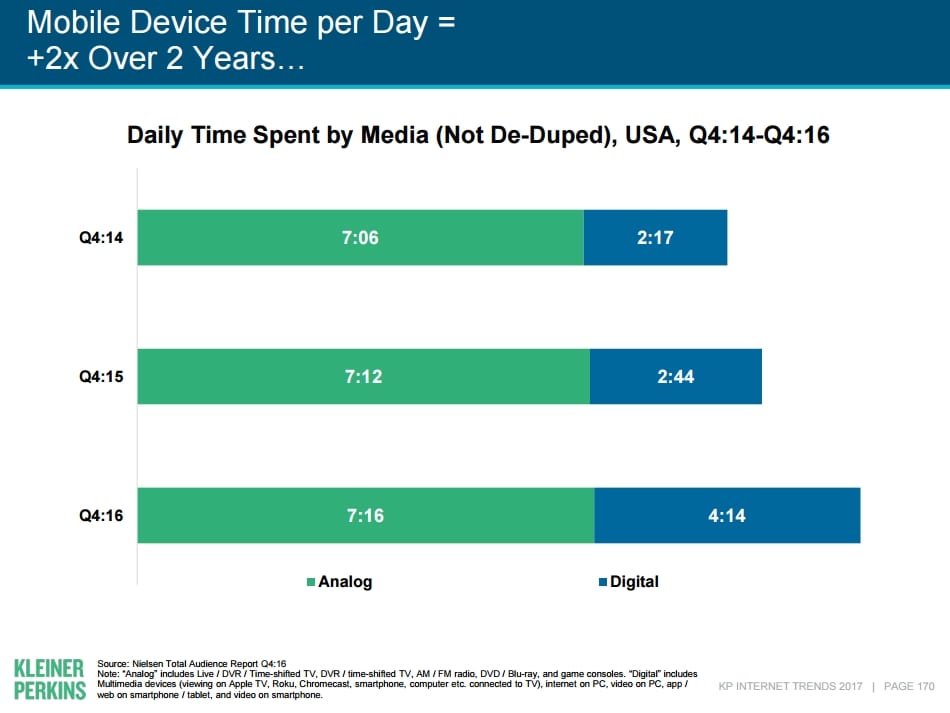
|
||||
|
||||
---
|
||||
|
||||
I found this slide interesting, and it appears that AR/VR will not keep to this trend.
|
||||
|
||||
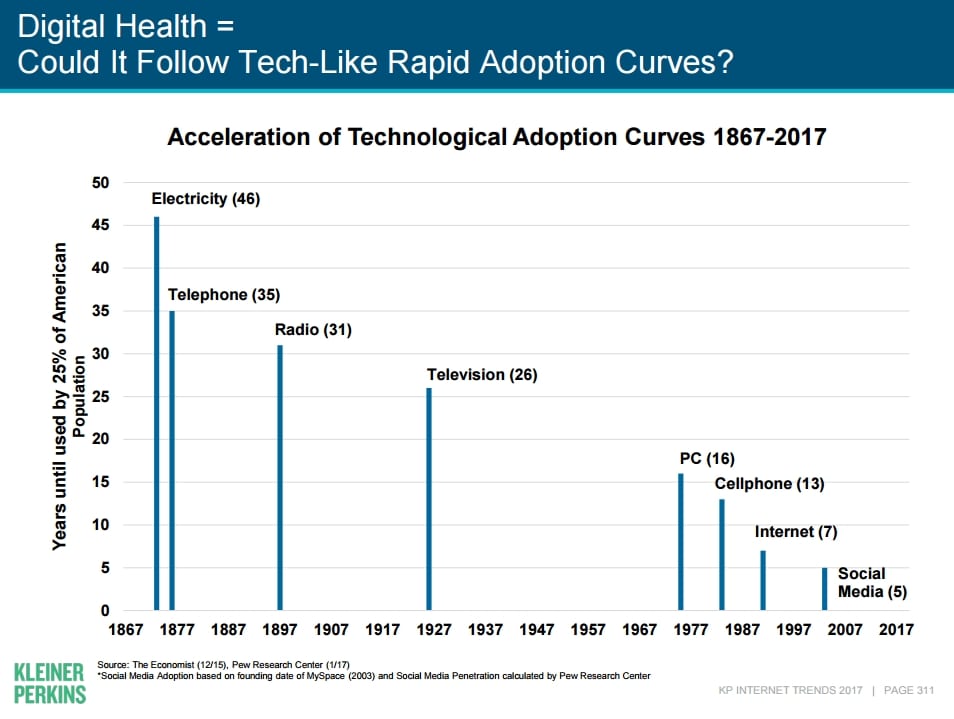
|
||||
+19
@@ -0,0 +1,19 @@
|
||||
# Simple model to determine success of product sampling in e-commerce
|
||||
|
||||
Source: <https://eddiesoehnel.com/simple-model-to-determine-success-of-product-sampling-in-e-commerce/>
|
||||
|
||||
Tags: AOV, Average order value, Breakeven, Customer Acquisition Costs, ROAS, Spreadsheet
|
||||
|
||||

|
||||
|
||||
Here is a simple model to determine success of product sampling in e-commerce.
|
||||
|
||||
I was presented with some quick performance metrics on an e-commerce product sampling campaign for a supplement startup, which included the cost of the sample plus shipping ($.70), the average order value ($39) and the response rate at 20%.
|
||||
|
||||
That got my wheels turning and I quickly determined that this campaign could be a winner.
|
||||
|
||||
How? I made some assumptions, including that the average breakeven return on ad spend (ROAS) for a consumer product company is 2. So if 10 samples were sent at $7 total cost, and 2 orders were placed that is $78 dollars in revenue, which gives a ROAS of more than 11. That is fantastic, but I am missing another variable.
|
||||
|
||||
The unknown that I was not given was the cost to acquire a customer to send them a sample. That would need to be added in to get a sold ROAS number.
|
||||
|
||||
[Here is the model](https://docs.google.com/spreadsheets/d/1_CC9rUoueS_oxIu1jGCxWmLWOEsdz1MHQEZnMrypADU/edit?usp=sharing) I put together that gives a quick analysis and helps me do some what-ifs when the variable that changes is the cost to acquire a customer to send them a sample.
|
||||
@@ -0,0 +1,21 @@
|
||||
# The importance of packaging for a CPG product
|
||||
|
||||
Source: <https://eddiesoehnel.com/the-importance-of-packaging-for-a-cpg-product/>
|
||||
|
||||
Tags: CPG, packaging, retail
|
||||
|
||||

|
||||
|
||||
The importance of packaging for a CPG product is significant. Here’s why:
|
||||
|
||||
- A study done by Proctor and Gamble 25 years ago indicated that consumers pushing a shopping cart down the aisle of a supermarket look at packaging for 1/6th of a second before they decide to stop and look.
|
||||
- According to the Food Marketing Institute, if a customer picks up a package, even if they are not familiar with the product, there is a 71% chance they will put it in the shopping cart.
|
||||
- A study conducted by Goldman Sachs in the 1990s indicated that for shoppers who shop with a shopping list, >60% of the content of the shopping cart were impulse purchases, thus the importance of packaging to appeal to that impulse.
|
||||
|
||||
I think since the great recession of 2008, these last two statistics are not as high, as every indication is that people at all levels of society have changed their behaviors to reflect the economy. But, packaging is still critical because it conveys and confirms our expectation of satisfaction, even if we can’t fully elucidate our expectations. The product has to have an interesting enough presentation to cut through the noise and clutter and appeal to the customer.
|
||||
|
||||
You can improve packaging over time, but it has to be incremental improvements, not revolutionary improvements. If the packaging is incompetent from the start, there will be no second chance. If you are in retail distribution, to continue the baseball analogy, “Strike one. You’re out.”
|
||||
|
||||
Moreover, how happy do you think retailers will be, if any of them are stocking the product, when you announce “all new packaging”? Retailers will want you to pick up the old packaged product at your expense. Also, category managers usually look carefully at the packaging of any new products presented to them and if the packaging is unclear, the use of the product is ambiguous and benefits are not screaming headlines, your chances of getting retail distribution shrink significantly.
|
||||
|
||||
Try to get the major stuff with your packaging right the first time, which is color and key differentiating features about what your product delivers over the competition. Make it crystal clear for the consumer…don’t make them think. Packaging flows from the overall brand strategy.
|
||||
@@ -0,0 +1,31 @@
|
||||
# The two biggest hurdles for successful marketing
|
||||
|
||||
Source: <https://eddiesoehnel.com/the-two-biggest-hurdles-for-successful-marketing/>
|
||||
|
||||
Tags: direct marketing, Marketing, trust
|
||||
|
||||

|
||||
|
||||
I recently worked on a direct marketing campaign with mediocre results. I saw a 7.5% response, which in direct marketing would be considered very successful, but I was hoping for something north of 20%, considering the free offer provided. I don’t have any historical data indicating that I should have gotten 20%; it’s just the number I put in my head that I thought I needed to generate the ROI I wanted on this campaign.
|
||||
|
||||
Next time, I am pretty sure I can improve on that number by modifying the creative, sweetening the free offer a bit and making the landing page easier to navigate.
|
||||
|
||||
So, what’s wrong with this picture? I was pretty obsessed with the response and ROI of THIS campaign. That’s not a bad thing. I mean, marketing has to give an acceptable ROI, right?
|
||||
|
||||
I think what’s wrong with this picture is that I am forgetting about The two biggest hurdles for successful marketing: patience and trust.
|
||||
|
||||
With patience, it really takes time and consistent delivery of a message before a consumer responds. I think this is the case for most products. Some have such a nice “WOW” factor to them that the consumer will respond quickly. But in general, most products take consistent messaging to generate a response.
|
||||
|
||||
What do I mean by trust? Well, I think that trust is the scarcest thing available to companies. Consumers have become leery and cynical towards companies and business in general. They don’t trust that they will do what they say or deliver on their promises. You can’t blame them. Look at the exaggerated claims that companies make about their products and services, and then never deliver. Or, how about the difficulty in returning a product or getting helpful customer service.
|
||||
|
||||
It’s not just company-consumer trust; its business-to-business trust, too. Companies don’t trust sales people who come calling, selling them the latest and greatest. Companies don’t trust consultants and other business service providers. This has evolved, I think, because of competition: to be heard and get your marketing or sales message through all the clutter, you have to make more and more exaggerated claims about your products and services.
|
||||
|
||||
To really succeed, marketing requires patience that your message will resonate and get through.
|
||||
|
||||
Patience means consistently marketing so that customers can see that you are around for the long-haul.
|
||||
|
||||
This leads to trust, which will cause them to buy your products, and if they are good products, buy them again and again.
|
||||
|
||||
As this cycle continues, consumers will develop more and more trust in you, your company, your messaging and your products. That’s how you get good ROI on your marketing.
|
||||
|
||||
So, the lesson here is that this was just one campaign, and I will want to stick with doing many more of the same campaign in the future so that I can slowly build my target market’s trust that I am here, I’m not going away, and I’ve got real value to offer in my products.
|
||||
+11
@@ -0,0 +1,11 @@
|
||||
# Tools for product developers – the hackers – to also become marketers – the hustlers
|
||||
|
||||
Source: <https://eddiesoehnel.com/tools-product-developers-hackers-also-become-marketers-hustlers/>
|
||||
|
||||
Tags: None listed
|
||||
|
||||

|
||||
|
||||
How power to market and sell consumer products is shifting to the hackers. If you’re a hustler – the marketer, which I am – you might want to become a hacker – the product developer – because the world of marketing needs fewer hustlers. Learn more about some of my core marketing tools for hackers to also become hustlers.
|
||||
|
||||
[YouTube video player 1](https://www.youtube.com/embed/2h9lY_1YUtw?wmode=transparent&autoplay=0)
|
||||
+36
@@ -0,0 +1,36 @@
|
||||
# What are the biggest mistakes in CPG package design? How do you avoid them?
|
||||
|
||||
Source: <https://eddiesoehnel.com/what-are-the-biggest-mistakes-in-cpg-package-design-how-do-you-avoid-them/>
|
||||
|
||||
Tags: CPG, packaging, retail
|
||||
|
||||

|
||||
|
||||
I was asked this question on CPG package design on [Quora](https://www.quora.com/Consumer-Packaged-Goods-CPG/What-are-the-biggest-mistakes-in-CPG-package-design-How-do-you-avoid-them?__snids__=118381146&__nsrc__=4). My response is below.
|
||||
|
||||
I think the biggest mistake is not grabbing consumer’s attention. There are so many products on shelf that it’s easy to get lost and not get any attention. This is especially the case if there is limited or no out-of-store marketing to create brand awareness. Consider the following:
|
||||
|
||||
- A study done by Proctor and Gamble 25 years ago indicated that consumers pushing a shopping cart down the aisle of a supermarket look at packaging for 1/6th of a second before they decide to stop and look.
|
||||
- According to the Food Marketing Institute, if a customer picks up a package, even if they are not familiar with the product, there is a 71% chance they will put it in the shopping cart.
|
||||
- A study conducted by Goldman Sachs in the 1990s indicated that for shoppers who shop with a shopping list, >60% of the content of the shopping cart were impulse purchases, thus the importance of packaging to appeal to that impulse.
|
||||
|
||||
Based on this, its important to get it right with your packaging. First, start with some background research:
|
||||
|
||||
1. Have a thorough understanding of your brand – who you are, what you do and how that benefits your target market. Take the time to figure this out as early as possible in the life of your company, and certainly before you are ready to scale.
|
||||
2. Know the value your products provide and how they are differentiated from your competitors.
|
||||
3. Know the market, customer dynamics and trends of your category(s) where you sell.
|
||||
4. Know the purchase drivers that your customers use to make purchase decisions in the category(s) you occupy.
|
||||
5. What is your suggested retail price (SRP) and why? A higher price may mean that your brand and packaging should reflect that higher price – i.e, be more upscale.
|
||||
6. Know your competitors packaging well. Consider setting up a shelf in your office that is the same height and depth as that found in retail so you can place all your competitor’s product on it to compare and contrast.
|
||||
7. Besides knowing your competitors and their packaging, take the time to go through the whole store to see what other kinds of packaging are being used and what might fit with your brand. What grabs your attention and why? This will help give you ideas.
|
||||
|
||||
From your research and analysis above, consider the following to create great packaging:
|
||||
|
||||
1. Use the data from the above questions to help figure out how to appeal to your target market and what holes you fill in your category. Consider using two-axis competitor maps to help you arrive at this.
|
||||
2. Develop words and statements that differentiate you and appeal to your customer’s purchase drivers.
|
||||
3. Develop the form factor, size, graphics, and colors, along with your words and statements, that will allow you to be distinctive, differentiated, clear, concise and hard-hitting. How can you use design elements and text to grab attention in 1/6 of a second against the sea of competitors already on shelf? Try to be different, but not so different that customers will get confused about what your product is and what it does.
|
||||
4. Be careful about putting too much information on the front of your packaging. Keep it simple. Put the most pertinent info that will differentiate, hits at purchase drivers and gets consumers to pick up the packaging.
|
||||
5. Use graphics people who are experienced in packaging design. Use appropriate legal and regulatory experts to review packaging and any claims you use. Proof carefully with many eyes, and do it again, and again.
|
||||
6. Get consumer feedback.
|
||||
7. Take your time. Don’t rush this. When creating new products, allow plenty of time in your project plan to get the packaging done right and give you time to think about it and get appropriate feedback
|
||||
8. Finally, try to do all this before you scale, if you are an early-stage company. That’s not suggesting you never touch your packaging again. On the contrary, you want to keep it fresh and relevant, which requires periodic updating. But if you are a small company with limited resources (cash and time), its best to get it right early on so that you can run for a while without having to touch it again.
|
||||
+25
@@ -0,0 +1,25 @@
|
||||
# What is a good marketing start to sell goods in a luxury segment?
|
||||
|
||||
Source: <https://eddiesoehnel.com/what-is-a-good-marketing-start-to-sell-goods-in-a-luxury-segment/>
|
||||
|
||||
Tags: Brand, content marketing, direct marketing, events, grass roots, luxury, scarcity, SEO, sponsorships
|
||||
|
||||

|
||||
|
||||
This is a [Quora](https://www.quora.com/unanswered/What-is-a-good-marketing-start-to-sell-goods-in-a-luxury-segment) question to sell goods in a luxury segment I was asked to answer. My answer is as follows.
|
||||
|
||||
Are you selling your own products that you created and own to consumers, or are you reselling other luxury products via a wholesale basis? I think the answer depends on which avenue you are pursuing.
|
||||
|
||||
When I review my marketing framework, I think the first to consider is the pain/needs that your product(s) satisfy. Luxury products are much more likely to appeal to the pain/needs of a prospect’s ego and image of themselves. So appealing to this takes a carefully crafted and polished brand via products, packaging, logo/color schemes, and website.
|
||||
|
||||
Next is to consider the type of marketing – [direct marketing, brand marketing or grass roots marketing](https://eddiesoehnel.com/consumer-product-growth-strategies/). I don’t think it is direct marketing at all, but brand marketing through a carefully crafted image. But I feel like you could also incorporate grass roots marketing and stand for something that might help set you apart.
|
||||
|
||||
Next, consider which marketing channels might work best based on the above. When I review my list, I think it is marketing through influencers and association with events that already have a luxury appeal. Luxury is so much about image so you want to try and tie your product to an existing person, event or other product that is already about luxury.
|
||||
|
||||
Consider using scarcity to increase appeal and the image of luxury. If everyone can purchase it, then it diminishes the appeal.
|
||||
|
||||
If you are reselling luxury products, I think it comes down to picking the right luxury products and targeting your marketing properly with effective creative the conveys luxury.
|
||||
|
||||
For digital marketing channels as a reseller, I would use organic SEO and social paid ads and content marketing to boost organic SEO.
|
||||
|
||||
For analog marketing (offline), maybe events and sponsorships.
|
||||
@@ -0,0 +1,25 @@
|
||||
# What is an effective way of creating a brand?
|
||||
|
||||
Source: <https://eddiesoehnel.com/what-is-an-effective-way-of-creating-a-brand/>
|
||||
|
||||
Tags: Brand
|
||||
|
||||

|
||||
|
||||
*I want to create a premium accessories brand. Our products will be hand made from the highest quality materials. I have already created the designs of the products, but I wanted to hear about the different ways of creating a brand and standing out?*
|
||||
|
||||
This is a [Quora](https://www.quora.com/What-is-an-effective-way-of-creating-a-brand) question I was asked and here is my answer.
|
||||
|
||||
I think you mean creating a marketing image.
|
||||
|
||||
A brand happens over time. As you sell products that deliver on a customer’s needs/wants, you gain a level of trust in the marketplace that leads to continued sales and a positive reputation, so that when a customer thinks of your brand, they have positive feelings about it,
|
||||
|
||||
You create an effective marketing image (logos, color pallets, designs, etc) by researching the competition so that in a side-by-side comparison to them, you would clearly “pop” against their logo, color pallet and designs.
|
||||
|
||||
You also research your target market and create buyer personas so that you better understand who your customer is and what type of marketing image they might best respond to.
|
||||
|
||||
But an effective image is not just logos and colors ad designs, but a professional looking website that is responsive across all devices, great customer service, and fast shipping, to name a few.
|
||||
|
||||
For example. If your products are premium, then you may be attracting a type of customer that looks for environmentally friendly production practices and packaging, so you have to deliver on that to create a premium brand.
|
||||
|
||||
A brand is really the sum of all the interactions a customer has with your company, both positive and negative, so you need to be comprehensive in all your interactions with your customer to build a good brand.
|
||||
+21
@@ -0,0 +1,21 @@
|
||||
# What is the advertising to sales ratio investors will look for in a direct to consumer e-commerce startup?
|
||||
|
||||
Source: <https://eddiesoehnel.com/what-is-the-advertising-to-sales-ratio-investors-will-look-for-in-a-direct-to-consumer-e-commerce-startup/>
|
||||
|
||||
Tags: Advertising, P&L, Profit and Loss, return on ad spend, ROAS, Sales
|
||||
|
||||

|
||||
|
||||
This is a [Quora question](https://www.quora.com/What-is-the-advertising-to-sales-ratio-investors-will-look-for-in-a-direct-to-consumer-e-commerce-startup/answer/Ed-Soehnel) I was asked to answer.
|
||||
|
||||
Do you mean the return on ad spend ratio (ROAS)?
|
||||
|
||||
I have never heard of “advertising to sales” ratio, but it probably means the same thing (revenue or sales divided by advertising spend…not to include media development costs or technology costs, just the costs to advertise the media).
|
||||
|
||||
Investors look at many things, but a strong ROAS is a way to capture their attention so that they may be more willing to take a deeper dive.
|
||||
|
||||
For consumer product companies, a ROAS of around 2 is breakeven on the profit and loss. If you can reliable demonstrate a consistent ROAS of 4 or more over the last 3-months with increasing media spend into the 5 figures, that might help capture attention.
|
||||
|
||||
But the higher the better. If you can show a 6 or more, then that should really capture attention. But you need to show consistency in achieving this ratio over time with higher spends (5 figures).
|
||||
|
||||
I have written more posts with ROAS and downloadable models using this ratio, [here](https://eddiesoehnel.com/?s=roas)
|
||||
+15
@@ -0,0 +1,15 @@
|
||||
# What is the minimum statistically significant sample size for a direct mail campaign?
|
||||
|
||||
Source: <https://eddiesoehnel.com/minimum-statistically-significant-sample-size-direct-mail-campaign/>
|
||||
|
||||
Tags: direct mail, sample size, statistics
|
||||
|
||||

|
||||
|
||||
This is a [Quora](https://www.quora.com/What-is-the-minimum-statistically-significant-sample-size-for-a-direct-mail-campaign/answer/Ed-Soehnel) question I was asked and here is my answer.
|
||||
|
||||
That will depend on additional data.
|
||||
|
||||
Do a search for a [sample size calculator](https://www.google.com/search?aqs=chrome.0.69i59j69i60l3j0l2.3560j0j7&ie=UTF-8&oq=sample+size+calculator&q=sample+size+calculator&rlz=1C1CHFX_enUS754US754&sourceid=chrome) and you will probably see a lot of options where you can plug in your assumptions to give you the minimum sample size needed.
|
||||
|
||||
Optimizely has a quick and easy one, [here](https://www.optimizely.com/sample-size-calculator/), as does Survey Monkey, [here](https://www.surveymonkey.com/mp/sample-size-calculator/).
|
||||
+35
@@ -0,0 +1,35 @@
|
||||
# What is the most important attribute of successful startup product marketers?
|
||||
|
||||
Source: <https://eddiesoehnel.com/what-is-the-most-important-attribute-of-successful-startup-product-marketers/>
|
||||
|
||||
Tags: analytics, conversion, data-driven marketing, funnel, Spreadsheet
|
||||
|
||||

|
||||
|
||||
This is a [Quora](https://www.quora.com/What-is-the-most-important-attribute-of-successful-startup-product-marketers) question I was asked. My answer is as follows.
|
||||
|
||||
In short, understanding marketing and sales conversion metrics and analyzing in spreadsheets
|
||||
|
||||
## Why Is This Important?
|
||||
|
||||
A startup requires developing products, producing them, creating marketing copy and creative, all in context of a support structure with people, systems, suppliers/contractors, etc.
|
||||
|
||||
All of that leads to employing the efforts to market and sell a product to earn revenue. This is the tip of the speer for the entire company. And knowing what works in the tip of the speer comes down to metrics: making sure you setup systems to collect them, and processes to effectively analyze them and take action in a timely manner.
|
||||
|
||||
In this way, you will know what is working and what is not and where to take action to correct: (top of the funnel, middle of the funnel, bottom of the funnel, returns, customer service, failure/misalignments in product/market fit, wrong marketing copy/creative, and more).
|
||||
|
||||
When you have a process that collects all this data and analyzes (in real-time, or as best as possible), you can then zero your efforts where fixes need to be made.
|
||||
|
||||
The big ones first and then the small fixes so you optimize your entire company that will drive top line and bottom line revenue.
|
||||
|
||||
A successful product marketer is the tip of the speer and informs the rest of the company, not just tactically, but strategically. And this means knowing the numbers: how to collect, analyze, interpret, all in spreadsheets, and be able to act quickly on them.
|
||||
|
||||
But that is only part of the equation. Marketing and sales requires constant testing and trying new things. You can have the best and fastest process to analyze and interpret results in real-time, but if you cannot steer the company to act on them quickly, and design the company such that it can support the product marketer to try a lot of different things, cheaply and quickly, then marketing metrics won’t help that much.
|
||||
|
||||
A successful product marketer, then, is not just understanding the numbers, but having a company that will let them try a lot of things quickly and cheaply to see what works and does not.
|
||||
|
||||
## Tools To Help
|
||||
|
||||
- This process might help understand the [flow of money](https://eddiesoehnel.com/flow-money-consumer-product-company/) and different metrics to capture for visibility into marketing and sales performance.
|
||||
- See this page and scroll down to [Diagnose Marketing Failures](https://eddiesoehnel.com/startup-roadmap/marketing/) to help understand at a more strategic level where to fix things if they are not working.
|
||||
- To dive more into systems, processes and spreadsheets related to marketing and sales, see my [finance page](https://eddiesoehnel.com/startup-roadmap/finance/), which links to many template models I have used.
|
||||
@@ -0,0 +1,25 @@
|
||||
# When old is new in marketing
|
||||
|
||||
Source: <https://eddiesoehnel.com/when-old-is-new-in-marketing/>
|
||||
|
||||
Tags: direct mail, Innovation, Marketing
|
||||
|
||||

|
||||
|
||||
Marketing is constantly evolving with new channels and vehicles to reach consumers. Technology is pretty much driving and ensuring that. But sometimes, what’s old and that which no one seemingly pays attention to works the best.
|
||||
|
||||
I’ve been working with a company over the last few years that operates in a pretty crowded and competitive space. Two years ago, we were looking at ways to reach our market and decided to give direct mail a try. It was not a traditional marketing method used in the industry, which is why we thought it might be an opportunity to break through the marketing clutter to reach potential customers.
|
||||
|
||||
Since then, revenue has increased a good 20% from direct mail alone! The business recently decided to increase its direct mail outbound reach by 100%.
|
||||
|
||||
Clearly, direct mail ain’t new. But clearly, its working for this business. I think the main reason its working is because direct mail is not traditionally used in this companies industry. As a result, this allows the company to capture mind share from potential customers without interference from competitors using the same method.
|
||||
|
||||
What the company did is borrow a marketing vehicle used on so many other industries and adapted it to its own. What is old became new for this company and its industry.
|
||||
|
||||
This is a great example for teaching us a number of things:
|
||||
|
||||
1. Look to other industries to see what it is being done successfully and adapt to your own;
|
||||
2. Look at old ways of marketing that are not being used in your industry;
|
||||
3. Don’t get mired in the “that’s the way we’ve always done it” thinking;
|
||||
4. Don’t get mired in the “that’s the way everyone else is doing it” thinking.
|
||||
5. Innovation is not just about what’s new or never been done before, but how to tweak something that is unique to your marketplace.
|
||||
+37
@@ -0,0 +1,37 @@
|
||||
# Who You Need To Help You Run A Direct Response TV, Radio, or Print Business
|
||||
|
||||
Source: <https://eddiesoehnel.com/who-you-need-to-help-you-run-a-direct-response-tv-radio-or-printdio-business/>
|
||||
|
||||
Tags: Direct Response, Outsourcing
|
||||
|
||||

|
||||
|
||||
This is a nuts and bolts post on operations for a DR TV/Radio/Print business for a consumer product. It includes the pieces you need to setup and manage in order to run such a business, whether it is part of a business or is the business. Think of these components as your team on the field and you’re the quarterback. If you are a start-up or small company, all of these components, unless otherwise noted, should be outsourced to a qualified provider. This article assumes you are producing product already and want to market it via direct response.
|
||||
|
||||
1. The spot producer. For a TV spot, whether it’s a long-form 30 minute or short-form 30, 60 or 120 second, you will need a producer to create the ad. You’ll pay for a TV spot, but in my experience, the radio spot is produced by the partner who will also buy and place your media. You will need pitch-person(s), which you will pay for in addition to what you pay the spot producer, unless you have your own spokesperson, like your company founder. Ideally, you will want your media buyer involved in helping you select and guide the producer. Once your spot is complete and in production (on air), you may use your producer from time to time to make changes and refine your spot or to modify its length for ad time (for example, taking a 120 second spot and creating at 60 second spot).
|
||||
|
||||
2. The media buyer. This entity purchases and places media for you, selecting the networks and time slots based on the likely demographic profile of your target customer and the profitability ratio that you desire. They will also try to get you approved on networks that might initially not accept your spot based on content and/or claims (such as dieting products). They will constantly refine their buys based on past results to help get you to your profitability target or improve upon it. They will do the nitty-gritty analysis of media performance for both call centers and web, taking into account product cancels, declines and returns from customers who responded from a specific network. They are a key partner that you will work with on an almost daily basis and ideally, should have input into many of the operational pieces of this business, especially spot production and call center selection and script.
|
||||
|
||||
3. In-bound order call center. This is a dedicated company that answers the phone and takes orders. It could be a live agent or automated agent (known as interactive voice response – IVR). They create the call center agent script with your guidance and direction that agents use to help guide them in closing the sale and taking the order. You will work with them at least weekly to improve on the myriad of metrics that you watch on their performance and you will participate on a monthly basis to train agents.
|
||||
|
||||
4. Overflow in-bound call center. If you use live agents and start small in your media buys, you will have low call center volume. It may not make economic sense to use a large call center, so use a small one instead. However, if you get higher than anticipated call volume, you will need an overflow call center. Your regular in-bound call center should be able to help you select one, unless they already contract with certain ones to handle their overflow.
|
||||
|
||||
5. 3rd Party product upsells. This is a component of the in-bound call center. After the sale has closed on your product and its associated upsells, and if you chose to have the agents try to sell the customers again, the agent will introduce 3rd party products to upsell the customer, of which you will derive a portion of the revenue (but you will also pay for the minutes the agent spends on the phone for these 3rd party upsells). You will work weekly with the call center to analyze these metrics and their impact on your revenue and profitability.
|
||||
|
||||
6. Outbound call center on phone and web in-completes. This may or may not be a part of the call center company you use. There are customers that call in or visit your website and do not order. They may leave some contact information sufficient for an agent to call back or their contact information is gleaned from phone records. In either case, an agent will call back within 24-hours to try to close the sale.
|
||||
|
||||
7. Outbound snail mail phone and web in-completes. You might want to use a 3rd party company that will send postcards via U.S. mail to phone or web in-completes as another method to try to close the sale.
|
||||
|
||||
8. Website. If you outsource your website, you will work weekly with your provider to optimize your site for sales conversion and search engines (SEO). If you use and outsource online marketing, these are additional components to manage.
|
||||
|
||||
9. Warehouse. This provider can also be known as a pick and pack warehouse, order fulfillment center or a third-party logistics (3PL or TPL). Orders flow in and they process the order, from banking (charging credit cards, depositing checks), packing and mailing. This includes processing product returns and charge-backs. They will also assemble your product, if it comes from manufacturing in pieces or parts or if you have different configurations of the product. They should have a robust IT back-end not only for accounting purposes, but also so you can gather and analyze key metrics that help run your business.
|
||||
|
||||
10. Customer service. This is most likely a part of the warehouse, or probably should be, since customer service does everything, including not just taking orders, but solving customer problems, processing returns and everything in between. If you use social marketing, you may have customer inquiries from this channel that you will need to route in a timely manner to customer service so they can be handled appropriately. Customer service should have a robust IT back-end that gathers customer inquiry data that is useful for product feedback, marketing and operations optimization.
|
||||
|
||||
11. Outbound email after purchase. Ideally, your warehouse/customer service provider can handle this. This is not just emails sent to customers to confirm order, charge of your credit card and shipment of the product, but can be, for example, additional emails you create that are sent to your customer at future specified time periods to help them get the most out of the product.
|
||||
|
||||
12. Legal. You will need legal to review ads. Also, If you sell a digital product on the web (DVD, book, game, etc), expect to have pirate websites try to dupe customers into purchasing your product(s) for less than what is sold on your website. Ideally, you will establish your own internal process for addressing these sites as they pop up (sending cease and desist letters to them and their hosting companies, contacting search engines, etc) and have legal assistance available if more immediate action is needed against violators that are impacting your sales and/or brand in a significant way. It is likely that you will have Better Business Bureau (BBB) complaints filed against you, so you will need to establish a process for handling them, whether its internal or through a contract provide, which is ideally your customer service center. If your sales volume is small, you could handle in-house but as it grows, it is recommended that you outsource this function.
|
||||
|
||||
13. Customer feedback and research. This is a proactive component where you initiate contact with past customers to obtain feedback to improve your product(s) or your order taking and customer service processes. It is best for you to handle this in-house, especially if you are making direct-to-customer calls or emails to gather deep qualitative data. For surveys, use outside applications and services to handle.
|
||||
|
||||
This list may seem daunting, but it’s not as bad as it seems, if you use providers that are in the DR business. Some of these components are not required out of the gate and optional, like third-party upsells, outbound on phone and web incomplete, and outbound snail mail postcard. If you are a start-up and testing your product in DR, you might not want to go through the effort and expense to set up these components, but over time, realize that you might be missing on valuable ways to increase revenue and profitability if you do not use them. Once you are setup and past the initial operating phase, assume 20-30 hours a week in man-hours to run.
|
||||
@@ -0,0 +1,59 @@
|
||||
# Why am I not getting online sales?
|
||||
|
||||
Source: <https://eddiesoehnel.com/why-am-i-not-getting-online-sales/>
|
||||
|
||||
Tags: online sales
|
||||
|
||||

|
||||
|
||||
I get this question fairly consistently.
|
||||
|
||||
And it could be any of a number of issues.
|
||||
|
||||
But the biggest ones I see come down to the following areas:
|
||||
|
||||
## Product
|
||||
|
||||
Have you created a “WOW” product that is easily differentiated from the competition that causes customers to make repeat purchases and tell their friends about? Products like these sell themselves.
|
||||
|
||||
## Customer
|
||||
|
||||
Do you know exactly and intimately who your ideal customer is, and their wants/desires and needs/pain? Does your product satisfy them perfectly?
|
||||
|
||||
In my experience, many problems in sales stem from the above two. Fix those two and everything else becomes easier. Don’t fix them, and doing anything else to fix online sales problems almost won’t matter.
|
||||
|
||||
## Pricing
|
||||
|
||||
Is your product priced based on the features, benefits and outcomes it delivers such that customers are happy to pay it? Goes back to “WOW”. Create something truly amazing and they price is less of barrier to sales
|
||||
|
||||
## Website
|
||||
|
||||
Is your website built properly to maximize sales?
|
||||
|
||||
## Copy
|
||||
|
||||
Do you have effective marketing copy in your ads, website and packaging to sell your product?
|
||||
|
||||
In my experience, copy is as important as product and customer. Writing good copy is hard and time consuming and can be expensive if you hire a copywriter, but absolutely worth it.
|
||||
|
||||
## Targeting
|
||||
|
||||
Are you targeting your ad buys correctly to your ideal customer?
|
||||
|
||||
Now, take the above list and reverse the order.
|
||||
|
||||
You get a path from marketing to customer purchase/repurchase:
|
||||
|
||||
- Ideal customer sees your marketing;
|
||||
- Clicks to your product landing page;
|
||||
- Reads the copy;
|
||||
- Looks at the price;
|
||||
- Makes a purchase;
|
||||
- Gets the product;
|
||||
- Uses it;
|
||||
- Loves it!
|
||||
- Repurchases;
|
||||
- Gives you a great review;
|
||||
- Tells others about it.
|
||||
|
||||
So, where is the problem with your online sales? Start with where it falls apart the most in this flow and fix that. Then move to the next biggest point of failure.
|
||||
@@ -0,0 +1,17 @@
|
||||
# Why do businesses redesign their product packaging?
|
||||
|
||||
Source: <https://eddiesoehnel.com/why-do-businesses-redesign-their-product-packaging/>
|
||||
|
||||
Tags: Branding, packaging, reputation, trust
|
||||
|
||||

|
||||
|
||||
This is a [Quora](https://www.quora.com/Why-do-businesses-redesign-their-product-packaging) question I was asked to answer.
|
||||
|
||||
There are a few reasons:
|
||||
|
||||
1. Help differentiate the brand better against competitors. You want to capture attention so you use packaging to do that, and if you look like everyone else, then it is hard to do that. Take a walk down a retail aisle and notice which packaging grabs your attention. A brand may start with a certain look that works but as competitors either change their packaging or new ones enter the category, then the brand may start to get lost. Thus, updates help refresh the brand to capture attention.
|
||||
2. Make the brand look new again, which can capture customer’s attention. Sometimes with the launch of new products or different sizes, this helps capture attention as well.
|
||||
3. New packaging that is better. It might be more environmentally friendly, or do a better job of preserving/protecting the product.
|
||||
4. Increase the trust/reputation factor. Maybe a brand has lost trust or reputation among consumers. It could have been a product recall, some other major PR gaffe or the brand is of lesser quality than new competitors. As a result, new packaging might accompany a new brand look or marketing campaign to help reverse its declining image.
|
||||
5. Update the brand to current design schemes. Maybe the brand’s look and feel is from an older era and updating to current design standards will improve its image in the eyes of consumers.
|
||||
+9
@@ -0,0 +1,9 @@
|
||||
# Why sell the sizzle and fake it till you make it is a really bad way to grow
|
||||
|
||||
Source: <https://eddiesoehnel.com/sell-sizzle-fake-till-make-really-bad-way-grow/>
|
||||
|
||||
Tags: None listed
|
||||
|
||||

|
||||
|
||||
[YouTube video player 1](https://www.youtube.com/embed/V0acLldhjO8?wmode=transparent&autoplay=0)
|
||||
@@ -0,0 +1,27 @@
|
||||
# “Newsletter” versus “Magazine” and marketing power words
|
||||
|
||||
Source: <https://eddiesoehnel.com/newsletter-versus-magazine-and-marketing-power-words/>
|
||||
|
||||
Tags: copy, copywriting, creative, magazine, Newsletter, power words
|
||||
|
||||

|
||||
|
||||
I want to do a quick post here on marketing in words and the power of words.
|
||||
|
||||
For my pet business we’ve had a newsletter a monthly newsletter for a long time.
|
||||
|
||||
It’s both in digital version and in print version.
|
||||
|
||||
We’ve always named it newsletter and it goes out once a month. But over time, we’ve really improved it. We’ve put processes in place to add a lot more content. And it’s kind of been getting bigger and bigger, which is good. We’ve got good feedback on it. We’ve got generally good click through and read metrics, and people comment about it to us.
|
||||
|
||||
So, it’s really become less of a newsletter and more like a magazine, because it goes out once a month. There’s a lot of content in it now. So we’re really want to call it what it is, which is a “magazine” versus a “newsletter”.
|
||||
|
||||
We’ve also noticed that “newsletter” is used widely. It’s used everywhere. It does not really carry much weight or impact like it might have in the past.
|
||||
|
||||
Because a lot of emails can be very short and be called a newsletter or they can be like ours with a lot of content that is also called a newsletter, so we think that magazine actually is the best way to migrate in what we call it. I think we are calling it what it really is. And it’s a more powerful marketing word. So, I’m always trying to think of words and their meaning in terms of marketing impact.
|
||||
|
||||
I do research on words and see what the marketplace is thinking about it and how it’s used. So I try to incorporate words that will make for more powerful marketing impact.
|
||||
|
||||
There is one resource that I have in Section Six – Marketing of of my Lean and Agile Framework. I’ve got a whole bunch of resources but one in particular is 355 power words from marketing.
|
||||
|
||||
So, I am making that available as a PDF download. Download it here: <https://eddiesoehnel.com/355MarketingPowerWords>
|
||||
@@ -0,0 +1,11 @@
|
||||
# Characteristics of blockbuster products
|
||||
|
||||
Source: <https://eddiesoehnel.com/characteristics-blockbuster-products/>
|
||||
|
||||
Tags: blockbuster products, Distribution, intellectual property, patent
|
||||
|
||||

|
||||
|
||||
Have 1, 2 or all 3 of these characteristics in your product to potentially get a blockbuster on your hands.
|
||||
|
||||
[YouTube video player 1](https://www.youtube.com/embed/wruzrbNiKRY?wmode=transparent&autoplay=0)
|
||||
+18
@@ -0,0 +1,18 @@
|
||||
# Early stage research steps for selling an online training product
|
||||
|
||||
Source: <https://eddiesoehnel.com/early-stage-research-steps-selling-online-training-product/>
|
||||
|
||||
Tags: Clickbank, keywords, online training product
|
||||
|
||||

|
||||
|
||||
[YouTube video player 1](https://www.youtube.com/embed/OjetqzAZuRw?wmode=transparent&autoplay=0)
|
||||
|
||||
Tips in this video:
|
||||
|
||||
1. The best source I have found for learning internet marketing of information products is [Russell Brunson](http://www.russellbrunson.com/hi);
|
||||
2. Get bearings by finding out the current best-selling competitors on the market – try [Clickbank](https://www.clickbank.com/):
|
||||
3. Check them out at a high level to get idea of their pricing, offering and landing page setup so you know what you will need to do (model what is working);
|
||||
4. Do keyword search to find out what customers are doing to find these products – use SimilarWeb and Follower.net;
|
||||
5. The initial focus is to sell the product will probably be on targeting niche markets – keywords with range of 50 to 500 searches/month. Expand to bigger markets later on.
|
||||
6. Next step is a detailed review of top competitors profiled, including purchasing their products, documenting their sales pages and process, and dissecting their product offering. The goal is to model their sales approach (because it is working) and at least match and hopefully exceed their offering.
|
||||
+11
@@ -0,0 +1,11 @@
|
||||
# How we plan to position this product in a stagnant market in the home outdoor segment
|
||||
|
||||
Source: <https://eddiesoehnel.com/plan-position-product-stagnant-market/>
|
||||
|
||||
Tags: product positioning
|
||||
|
||||

|
||||
|
||||
Our research summary and plan for how to position a product in a stagnant market. Download the research summary and plan from the link provided at the end of the video.
|
||||
|
||||
[YouTube video player 1](https://www.youtube.com/embed/ti3HVVnyAwU?wmode=transparent&autoplay=0)
|
||||
+19
@@ -0,0 +1,19 @@
|
||||
# Is it better to start with a low manufacture suggested retail price in CPG and increase them later on, or start high and lower them?
|
||||
|
||||
Source: <https://eddiesoehnel.com/is-it-better-to-start-with-a-low-manufacture-suggested-retail-price-and-increase-them-later-on-or-start-high-and-lower-them/>
|
||||
|
||||
Tags: price
|
||||
|
||||

|
||||
|
||||
*Is it better to start with a low manufacture suggested retail price in CPG and increase them later on, or start high and lower them?*
|
||||
|
||||
This was a question posted to Quora that I answered, which I have re-copied below:
|
||||
|
||||
I know consumer products, so can only answer from that perspective:
|
||||
|
||||
1. Do your research against competitors and the category to find the price range. If you plan to go to retail, you do in-store research and your online price is then dependent on your retail price. If you will sell online, research your competitors and category as you would for retail, but you might find a much wider price range.
|
||||
2. Research the product size/unit count. There is generally an optimal size that allows for sufficient shelf turnover/product movement and maximizes your revenue. You do that by looking at what is on-shelf already. If your product size is too large, then consumers may not need to purchases as often, leading to slow shelf movement and possibly product spoilage.
|
||||
3. If your product benefits/features are considered to offer premium value to the consumer, then you might lead with a higher price for the category. If not, then you might have a lower price for the category.
|
||||
4. Always try to price higher, because it’s a lot easier to come down in price. Also, you will need every margin point you can squeeze out of your product, especially if you are a start-up or small consumer product company. Without the benefits of leveraging your fixed costs and your COGS over a larger volume of products produced, you will barely eek out a profit, if that. Additionally, price higher so that you can cover yourself from having to make any price increases for the next few years, if possible. That way, you have more breathing room to absorb raw material price hikes, instead of passing along to consumers, which would likely affect sales.
|
||||
5. If you are selling online only, then you have wider latitude to test your price. This week’s buyer is probably different from next week’s buyer, so you have less to worry about in distorting your brand (unless you are already an established consumer brand). In this case, test to get your optimal price/volume that you want, and re-test occasionally. I tested a product once from a low of $20 to a high of $80, while also altering the benefits/value/quantity that I communicated to the end buyer, just to see which set worked the best. Or, if you have direct marketing resources, either because you have a list of past customers or you have purchased a list of prospects, you can test with much less brand distortion effects.
|
||||
+39
@@ -0,0 +1,39 @@
|
||||
# I’m considering on starting a drop ship ecommerce online site. What are the best products to offer?
|
||||
|
||||
Source: <https://eddiesoehnel.com/im-considering-on-starting-a-drop-ship-ecommerce-online-site-what-are-the-best-products-to-offer/>
|
||||
|
||||
Tags: AOV, Average order value, CLTV, Customer Lifetime Value, dropship, manufacturers suggested retail price, MSRP, suggested retail price
|
||||
|
||||

|
||||
|
||||
This is a [Quora](https://www.quora.com/Im-considering-on-starting-a-dropship-e-commerce-online-site-What-are-the-best-products-to-offer/answer/Ed-Soehnel) question I was asked to answer. My response is below.
|
||||
|
||||
There are a ton of free resources online about drop ship ecommerce. One is [Drop Ship Lifestyle](https://www.dropshiplifestyle.com/).
|
||||
|
||||
Finding the best products is the million dollar question. But you find these products using many tools and processes to help, one of which I will outline below.
|
||||
|
||||
I am copying this directly from a piece I have available here: [The best growth approach for consumer product startups and product launches](https://basecampinqb8r.com/)
|
||||
|
||||
***Development #3: MSRP/AOV/CLTV – How to get insanely profitable products without having to sell a lot***
|
||||
|
||||
[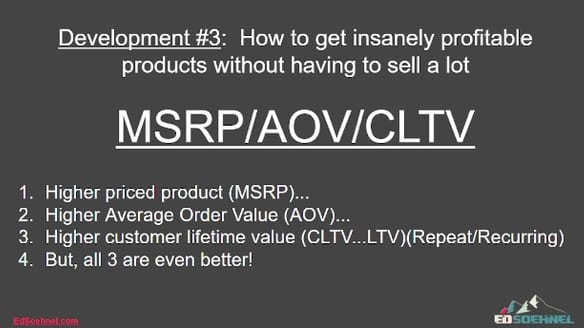](https://eddiesoehnel.com/wp-content/uploads/2018/08/msrp_1.jpg)
|
||||
|
||||
*When you have higher priced products, or higher average order values (either because the customer buys more of your product or adds other products to the cart when they buy from you), or repeat purchasing that raises your customer lifetime value, then your backend operations become a lot easier to manage because it’s fewer orders, less inventory to manage, fewer customers, with fewer customer service issues, and you can spend more taking care of fewer customers.*
|
||||
|
||||
*Ideal is to get your MSRP or AOV above $100 but below $1000 (any higher and it may require personal selling to close a sale). Minimum should be around $100.*
|
||||
|
||||
*Aim for at least a 30% repurchase rate from new customers. If you cannot get that, it makes it harder because you have to constantly find customers to replace ones you are losing, and that may indicate something wrong with your offering because you cannot keep customers.*
|
||||
|
||||
*I use offering to general mean not just product, but customer service, and anything else about your business where you are touching your customers. For some reason, they are not choosing to buy from you again, and you need to find out why.*
|
||||
|
||||
*Maybe you have products that are priced much less and you cannot hit this range, and that is OK after you have revenue, profits and cash flow, but when starting out, try to get these figures up as much as possible.*
|
||||
|
||||
*You may not be able to do all 3, but do the best you can, or if you cannot do any at all, then go back to product development to come up with a product(s) that can get you in this range.*
|
||||
|
||||
*As you grow, get sales, cash flow and profits, then you might be able to better afford to have lower prices products, but not when you are starting out.*
|
||||
|
||||
[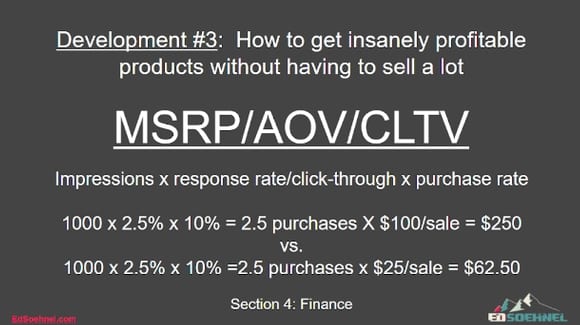](https://eddiesoehnel.com/wp-content/uploads/2018/08/msrp_2.jpg)
|
||||
|
||||
*This simple example demonstrates same front end conversion, but with a lower priced product, revenue dramatically goes down. You will need 4x the customers to get the same revenue.*
|
||||
|
||||
*If you want to understand more about this particular equation and how it fits into context of the money flow in your business, [please see this post](https://eddiesoehnel.com/flow-money-consumer-product-company/) and the download associated with it.*
|
||||
+11
@@ -0,0 +1,11 @@
|
||||
# Market research plan for developing a home outdoor accessories product
|
||||
|
||||
Source: <https://eddiesoehnel.com/market-research-plan-developing-home-outdoor-accessories-product/>
|
||||
|
||||
Tags: market research
|
||||
|
||||
|
||||
|
||||
My market research plan for developing a home outdoor accessories product.
|
||||
|
||||
[YouTube video player 1](https://www.youtube.com/embed/H2u7P5-iqVI?wmode=transparent&autoplay=0)
|
||||
@@ -0,0 +1,17 @@
|
||||
# Product Development
|
||||
|
||||
Source: <https://eddiesoehnel.com/startup-roadmap/product-development/>
|
||||
|
||||
Tags: None listed
|
||||
|
||||
Retrieved from the supplied WordPress backup.
|
||||
|
||||
# Product Development
|
||||
|
||||
### Develop “WOW” products that capture attention, perform competitive research, determine positioning, overcome sales objections, determine value propositions and document risks.
|
||||
|
||||
[Embedded Google document](https://docs.google.com/document/d/1sMpZivL0geuv6xJu50YJRpTsiaA5w3RJzWVyNpqPNCw/pub?embedded=true)
|
||||
|
||||
[Embedded Google document](https://docs.google.com/document/d/1z09AkOZgsuMXOZomXMrtNRY94lYRlgQq2TotObhWaHM/pub?embedded=true)
|
||||
|
||||
## Questions, Feedback?
|
||||
+11
@@ -0,0 +1,11 @@
|
||||
# Research negative sentiment before landing on a brand name
|
||||
|
||||
Source: <https://eddiesoehnel.com/research-negative-sentiment-landing-brand-name/>
|
||||
|
||||
Tags: Branding, keywords, names
|
||||
|
||||

|
||||
|
||||
You may like a product’s potential name, value statements and positioning keywords, but is there any negative sentiment associated with the name or words you are using? Here are some research tools I use to help me.
|
||||
|
||||
[YouTube video player 1](https://www.youtube.com/embed/A90RiPIgyAs?wmode=transparent&autoplay=0)
|
||||
+33
@@ -0,0 +1,33 @@
|
||||
# Securing a name and filing for a federal wordmark for a CPG or consumer product startup
|
||||
|
||||
Source: <https://eddiesoehnel.com/filing-for-a-federal-wordmark-for-a-cpg/>
|
||||
|
||||
Tags: Brand, Legal, USPTO, Wordmark
|
||||
|
||||

|
||||
|
||||
In this post, I will cover some thoughts and details about securing a name or filing for a federal wordmark for a CPG or consumer product startup with the [USPTO](http://www.uspto.gov).
|
||||
|
||||
1. Come up with multiple names to choose from.
|
||||
|
||||
2. [Search the USPTO database](http://tess2.uspto.gov/bin/gate.exe?f=tess&state=4010:5dvcld.1.1) for your chosen names and any variations.
|
||||
|
||||
3. Use the main search engines ([Google](https://www.google.com), [Bing](https://www.bing.com)) with your chose names and variations thereof to see if anyone else might be using and established common law rights to it. Go at least 5 pages deep in each search, if not more. You want to be thorough.
|
||||
|
||||
4. Research the feasibility of obtaining an appropriate URL. This may be the most difficult stage in this process as someone may already own the name you want and the URL and you will need to go about the process of trying to purchase it from them. If you cannot purchase it or cannot afford the price, then you may want to find a different name to use.
|
||||
|
||||
5. If an appropriate URL is available for low-cost or is not taken, then you might want to secure it by purchasing. If it will require a more significant amount, then hold off and consult with a trademark attorney so that they can perform their own searches and give you an opinion of the viability of securing a wordmark for the name.
|
||||
|
||||
4. To prepare the paperwork, review the [International Trademark/Servicemark Classes at USPTO](http://www.uspto.gov/trademarks/notices/international.jsp) to determine where your products/services would be filed. You want to secure as much broad protection as possible, so think strategically about where your company will be in the future with respect to its product/service offerings. If you do not seek wordmark protection under a certain class now and end up offering a product/service in the future for which someone else has staked a claim, then you may not be able to offer your product/service under your chosen wordmark. Additionally, filings give you nationwide protection. If you do not file, then your wordmark is only good for the geographic area in which you sell your products and services. If you try to sell elsewhere where someone else is already using your wordmark, the burden of proof that you were originally intending to use your wordmark in that local is on you. With a federal wordmark, you have greater protection.
|
||||
|
||||
5. If you are not yet offering a product/service, then you will file an application designated as intent to use (ITA), which tells the USPTO that you intend to use the name in the future, but want to secure it now. If you are offering the product/service now, then you can file a use-based application. A ITU filing means more paperwork filings later, so if you can, start offering your product/service now to secure a use-based filing and avoid additional expense later. However, if an ITU is the only way you can do it now, then file anyway to secure rights to your wordmark.
|
||||
|
||||
6. Your attorney may take the text from class descriptions already filed with the USPTO to help construct yours. Since those descriptions were awarded a wordmark, its logical to assume that if you follow the same format, your chances of getting a wordmark may be better.
|
||||
|
||||
7. If you are purchasing the rights to the name from someone else, then I would still consult with your attorney beforehand to determine if your purchasing those rights will actually grant you the ownership and protection you need.
|
||||
|
||||
Once awarded, you need to protect your marks by policing them, using them and making regular filings to maintain the marks:
|
||||
|
||||
- In policing them, you can use services that will search the USPTO monthly for new submissions and send any to you that might infringe on your mark. You can have your attorney receive and review them, but you will be paying for their time. In my opinion, it is best to just have the submissions sent to you and if you need to, you can review with your attorney on a case-by-case basis. Ask your attorney about which service to use. Also make sure you setup [Google Alerts](https://alerts.google.com) using your wordmark so that you can monitor the web for any improper use of your wordmark by someone else.
|
||||
- For use, you simply use your marks as described in your USPTO applications. If you stop using them, then someone could use a competing mark and claim that you abandoned your mark through non-use.
|
||||
- Filings to maintain are performed every 5 years.
|
||||
+23
@@ -0,0 +1,23 @@
|
||||
# Showing customers they have a problem vs. they seeing and experiencing their problem on their own
|
||||
|
||||
Source: <https://eddiesoehnel.com/showing-customers-they-have-a-problem-vs-they-seeing-and-experiencing-their-problem-on-their-own/>
|
||||
|
||||
Tags: consumer products, Marketing, mass marketing, need, outcome, pain, solution
|
||||
|
||||

|
||||
|
||||
I was talking to a company recently about their product, a really nifty little item that I like and am actually using myself. As usual, when I first talk to companies about their products, I immediately begin to think over how to best market and sell their products. I am somewhat obsessed with figuring that out. With this company, their products are sold among a niche market of enthusiasts like me. The question: how to go from niche to mass with these products? Or, how can their products appeal to the masses?
|
||||
|
||||
I’ve talked to a few people I know about the product. The all had the same reaction after my description of the product from the company packaging: “I don’t get it.”
|
||||
|
||||
My next statement is: “Well, think of working with the product like \_\_\_\_(insert a universal brand that almost everyone over the age of 5 knows about), and the product will do \_\_\_\_\_(insert a universal verb that everyone knows)”
|
||||
|
||||
“OK. I get it…so, what do you use it for?”
|
||||
|
||||
My initial analysis of these same reactions from several people is, the way the company describes the product right now is lacking. OK, so that means there may be some modification in the verbal messaging about the products. But, more importantly, there has to be modification such that consumers will immediately understand its purpose, the outcome it provides and/or its benefit.
|
||||
|
||||
But as I’ve thought a bit more, I think the issue is more consumers knowing they have a problem and seeing the solution, from which they go about making a purchase of the solution to solve the problem…versus…customers not knowing they having a problem, which requires some education to realize they have a problem, from which they go about making a purchase of the solution to solve the problem.
|
||||
|
||||
In general, showing customers they have a problem means a longer path to purchase. That means you need more mindshare from consumers who are in general already overwhelmed with where to spend their time and money.
|
||||
|
||||
This is not to say that this product or any other requiring consumer education won’t succeed in mass. But knowing where consumer’s get hung up about products is pretty key to figuring out how to sell to them.
|
||||
+9
@@ -0,0 +1,9 @@
|
||||
# Standing out and capturing attention in your marketing
|
||||
|
||||
Source: <https://eddiesoehnel.com/standing-capturing-attention/>
|
||||
|
||||
Tags: Marketing
|
||||
|
||||

|
||||
|
||||
[YouTube video player 1](https://www.youtube.com/embed/XXOo6gb2UpY?wmode=transparent&autoplay=0)
|
||||
@@ -0,0 +1,49 @@
|
||||
# Survive and thrive with captive customers
|
||||
|
||||
Source: <https://eddiesoehnel.com/survive-and-thrive-with-captive-customers/>
|
||||
|
||||
Tags: captive customers, Food, Online Grocery, retail
|
||||
|
||||

|
||||
|
||||
There is an active military presence in the metro-Denver area of Colorado, which includes relatively frequent fly-overs by F15’s and F16’s. Most of the time, they are not moving that fast and you hear the sound before they pass overhead.
|
||||
|
||||
Sometimes, they are moving really fast, and once-in-a-while, they are flying very low and moving awfully fast. When that happens, these planes are pretty much past you before the sound hits. If you’re an enemy combatant and they were seeking you out, you’d be dead before you hear or see them.
|
||||
|
||||
That’s the way I look at many new startup categories; early entrants prove the market and then larger, more established players swoop in to dominate.
|
||||
|
||||
So, if I were a startup in a new category, what would I do to prevent my eventual demise?
|
||||
|
||||
I would approach this in terms of asking how to get captive customers buying from me and me only.
|
||||
|
||||
**How to get captive customers**
|
||||
|
||||
There are 4 ways that I know of to get captive customers:
|
||||
|
||||
1. You are a natural monopoly. Think utility company;
|
||||
2. You have proprietary technology, processes or patents to protect your position;
|
||||
3. You partner with the industry leader to promote and distribute your products;
|
||||
4. You are the lowest-cost provider;
|
||||
5. You employ a network affect, where a good or service becomes more valuable when more people use it.
|
||||
|
||||
Lets strike #4 from the list right now, because that is a slippery slope for startups and small companies.
|
||||
|
||||
Even if I am the lowest cost provider, that won’t last for long because someone bigger than me will figure out how to be more efficient. And if I position myself as the low-cost leader and develop my brand around that, and can no longer defend that position, customers will leave.
|
||||
|
||||
Well, if my core product is undifferentiated, or maybe it is differentiated, but it’s a difference the customer does not care about or cannot see, where do I differentiate from next?
|
||||
|
||||
Move to the next layer of my product/service offering, which in this case, would be the way the customer interacts with me to get the product. I can think of several:
|
||||
|
||||
1. Selection: I have the best selection of products available;
|
||||
2. Quality: I have the best product quality available;
|
||||
3. Revenue model: I give my customer many options in terms of how they pay (annual subscription, monthly subscription, fee per delivery, etc) so that they can find the option that works best for them;
|
||||
4. Customer service: it’s like Zappos…so darn good that it becomes a strategic element of the marketing.
|
||||
|
||||
These offerings around the core product might differentiate me for a while, until my competitor duplicates them, which is why they really don’t fit in to the 3 ways I listed above (remember I dismissed option #4 from our list), because they can be duplicated. Maybe in combination, they would give me some advantage, but they can be duplicated by competitors.
|
||||
|
||||
Is there another layer in product/s services that I can differentiate from? But, how about the following:
|
||||
|
||||
1. Data. I start adding data around nutrition values for the products which my customers purchase that they can use in consultation with their medical and nutritional-care providers to analyze their diet. If the customer leaves, they can’t take advantage of the data. We know that the natural/organic grocers are beginning to add nutritionists on-site at their locations, so maybe this is a solid trend to capitalize on. Yea, I know, where do I get the data, you ask? I don’t know. I am just offering ideas in this post, not complete and well-thought out solutions.
|
||||
2. Exceed customer expectations in unexpected and pleasing ways. I thank my customers with free product, or send them samples of new products from the category from which they purchase. Or, just send them extra product of what they ordered to thank them.
|
||||
|
||||
With the exception of my data idea, all of the above can be duplicated. The point of this post is really to ask, how do I get captive customers? Maybe in the end for an online grocer, it will be a combination of the above that is executed better than anyone else.
|
||||
+11
@@ -0,0 +1,11 @@
|
||||
# Template for product price and specifications list
|
||||
|
||||
Source: <https://eddiesoehnel.com/template-for-product-price-and-specifications-list/>
|
||||
|
||||
Tags: product specifications
|
||||
|
||||

|
||||
|
||||
My template for product price and specifications list. [Download here](https://docs.google.com/spreadsheets/d/1FhojHPLgp9FKYpSOxH9q4zDedS0iprEJYqMgeOcTR7Y/edit?usp=sharing).
|
||||
|
||||
[Embedded resource](https://docs.google.com/spreadsheets/d/e/2PACX-1vRqQCK1ueqvTV19QbS-iOvy3VIOz4zsgufqy4tWaeST-ETsnyLATCdJsPhwobFB3S0Dl148m0Nl2Qqh/pubhtml?widget=true&headers=false)
|
||||
+11
@@ -0,0 +1,11 @@
|
||||
# Tools for product developers – the hackers – to also become marketers – the hustlers
|
||||
|
||||
Source: <https://eddiesoehnel.com/tools-product-developers-hackers-also-become-marketers-hustlers/>
|
||||
|
||||
Tags: None listed
|
||||
|
||||

|
||||
|
||||
How power to market and sell consumer products is shifting to the hackers. If you’re a hustler – the marketer, which I am – you might want to become a hacker – the product developer – because the world of marketing needs fewer hustlers. Learn more about some of my core marketing tools for hackers to also become hustlers.
|
||||
|
||||
[YouTube video player 1](https://www.youtube.com/embed/2h9lY_1YUtw?wmode=transparent&autoplay=0)
|
||||
+22
@@ -0,0 +1,22 @@
|
||||
# We have a great idea with many different ways to deliver it as a product, so which product do we roll with first?
|
||||
|
||||
Source: <https://eddiesoehnel.com/great-idea-many-different-ways-deliver-product-product-roll-first/>
|
||||
|
||||
Tags: None listed
|
||||
|
||||

|
||||
|
||||
[YouTube video player 1](https://www.youtube.com/embed/IDNzF-0scfc?wmode=transparent&autoplay=0)
|
||||
|
||||
Tips from the video are below.
|
||||
|
||||
Let the market decide through research:
|
||||
|
||||
- What is outcome our customer wants from our product? Where do they want to go with our product? Where do we want to take them? Brainstorm all the different ways in which we can deliver this outcome.
|
||||
- Find out who is our customer – their demographics and psychographics. Which product would they most want to use now?
|
||||
- What offerings are currently working in the marketplace for competing products?
|
||||
- What existing ads, landing pages, copy and pricing is working for competing products?
|
||||
- Where is our customer? Where do they hang out? How can you get in front of them? How do you market to them?
|
||||
- What revenue/business models are working, which are not? What is winning mindshare?
|
||||
|
||||
How will the above change? Modeling what is already working might be a way to start, but we want to make sure we can stay relevant moving forward. So, we must have a plan for evolving our offering based on where the market is going.
|
||||
+33
@@ -0,0 +1,33 @@
|
||||
# What do I need to know if I want to be an egg distributor (especially) in South Jakarta?
|
||||
|
||||
Source: <https://eddiesoehnel.com/need-know-want-egg-distributor-especially-south-jakarta/>
|
||||
|
||||
Tags: COGS, Competition, market research
|
||||
|
||||

|
||||
|
||||
*I have a counter in pasar pd labu and currently thinking to have an egg distribution business.what are the things i should know before hand?*
|
||||
|
||||
*e.g :*
|
||||
|
||||
- *where can i get source of egg? (agent/breeder)*
|
||||
- *what kind of egg do i need to get? (i’ve heard padang egg, blitar egg)*
|
||||
- *how’s the price fluctuation work?*
|
||||
|
||||
This is a [Quora](https://www.quora.com/What-do-I-need-to-know-if-I-want-to-be-an-egg-distributor-especially-in-South-Jakarta) question I was asked and here is my answer.
|
||||
|
||||
I cannot answer your specific questions because they depend on local knowledge about the types of product available to you and the sources.
|
||||
|
||||
From a more general market research standpoint, I would do primary research by visiting other egg resellers in your market area to find out the type of product they carry, how much inventory do they stock, how well does it sell, and how much inventory do they have left over that they are unable to sell.
|
||||
|
||||
Look at how the product is displayed on shelf and if there is any particular signage or packaging. Take note of pricing and price differences between sellers and the seasonality or timing for price fluctuations.
|
||||
|
||||
You are not trying to reinvent everything yourself, but model what others are doing, because at some level, what they do is working, otherwise they would probably not be doing it.
|
||||
|
||||
If your competitors serving your area are very similar to sellers out of your service area, then go visit those out of your service area and ask them questions. Since they do not directly compete with you, they may be willing to give you more insight into the questions above.
|
||||
|
||||
If you can, I would try to specialize in a more unique product that others do not carry. This may give you some competitive advantage, where customers are more captive to you. Then, you stand a better chance of picking up their spending on other products you might carry.
|
||||
|
||||
Costs are always critical to look at, because you want to sell this product profitably. In general, in the U.S., for food products, you want to try and keep your costs of goods sold (the cost of the raw ingredients plus packaging plus transportation to you plus any labor tied to packaging the product) under 40% of your retail price. Your marketing costs and all other operating costs you want to try and keep under 40%, which leaves you with a 20% profit margin. These are just general rules of thumb and will be different by product and market, but that is what we shoot for in selling food products in the U.S.
|
||||
|
||||
Start out small with limited inventory so you can test and get your supply chain figured out. As you see success and get your supply chain and selling processes working, you can slowly increase from there.
|
||||
+17
@@ -0,0 +1,17 @@
|
||||
# What factors should I consider in deciding which product size to first launch?
|
||||
|
||||
Source: <https://eddiesoehnel.com/what-factors-should-i-consider-in-deciding-which-product-size-to-first-launch/>
|
||||
|
||||
Tags: AOV, Average order value, channel, club, direct-to-consumer, DTC, e-commerce, online, packaging, retail
|
||||
|
||||

|
||||
|
||||
This is a [Quora](https://www.quora.com/What-factors-should-I-consider-in-deciding-which-product-size-to-first-launch) question I was asked to answer.
|
||||
|
||||
You are going to generally size based on the competing products already available to consumers. The reason is because that is what consumers expect and in many cases, supply chain, warehousing, e-commerce operations and store shelves are already optimized for the sizing sold.
|
||||
|
||||
If you sell direct to consumer or via other online resellers, you want to try and maximize the order value, ideally above $75 in order to earn sufficient revenue to pay for the e-commerce operations. So you might bundle multiple units of your product together or create a special size that allows you to get that average order value up.
|
||||
|
||||
If you sell through club retailers, your size will be bigger automatically, which might be a special SKU for that channel/retailer or the multiple units sold as one item , since volume is what those retailers look to move.
|
||||
|
||||
So, in general, pick the size that consumers expect, and bundle as needed from there to sell direct-to-consumer, through online and club channels.
|
||||
+23
@@ -0,0 +1,23 @@
|
||||
# What questions should I ask customers when testing the viability of a CPG or consumer product idea?
|
||||
|
||||
Source: <https://eddiesoehnel.com/what-questions-should-i-ask-customers-when-testing-the-viability-of-a-cpg-or-consumer-product-idea/>
|
||||
|
||||
Tags: need, pain, research
|
||||
|
||||

|
||||
|
||||
*What questions should I ask customers when testing the viability of a CPG or consumer product idea?*
|
||||
|
||||
This is a [Quora question](https://www.quora.com/Lean-Startups/What-questions-should-I-ask-customers-when-testing-the-viability-of-product-idea). My answer is as follows:
|
||||
|
||||
I find that asking people directly about a product idea does not yield the most informative answers. A better approach is to focus more on the outcome that the idea delivers in the context of what need or pain the potential customer is experiencing.
|
||||
|
||||
Consider the following approach and questions:
|
||||
|
||||
1. Scene or situation: focus on the moment of frustration. What is going on? What is the user about to attempt?
|
||||
2. Desired Outcome. What is the user trying to accomplish? Why is this important?
|
||||
3. Attempted approach. Without the new product, how does the user go about the task?
|
||||
4. Interfering Factors. What goes wrong? How and why does it go wrong?
|
||||
5. Economic Consequences. So what? What is the impact of the user failing to accomplish the task productively?
|
||||
|
||||
Outcomes can satisfy benefits across different spectrums – financial, emotional, physical, and spiritual – so be aware of that when qualifying answers/data in your research.
|
||||
+21
@@ -0,0 +1,21 @@
|
||||
# Why you should ditch customer surveys and what to do instead to get product feedback
|
||||
|
||||
Source: <https://eddiesoehnel.com/ditch-customer-surveys-instead/>
|
||||
|
||||
Tags: customer surveys, neuromarketing
|
||||
|
||||

|
||||
|
||||
I am not a big fan of surveys, for the following reasons:
|
||||
|
||||
1. Customers don’t want to say what they really feel because it may reveal their deep biases that they are reluctant to share with anyone;
|
||||
2. They don’t want to be seen as wrong;
|
||||
3. They don’t want to be seen as ill-informed;
|
||||
4. Customers don’t want to hurt your feelings;
|
||||
5. What customer’s think can change depending upon their emotional state and what else is going on in their lives;
|
||||
6. Customer’s don’t really know what they want and change their minds easily;
|
||||
7. Customers don’t think about your product like you do, so really cannot offer effective feedback
|
||||
|
||||
What I pay attention to is what consumer’s are buying in my category, passive voice research in forums and online groups about products in my category, and whether or not customers are repurchasing my product. The latter is the biggest indicator for me.
|
||||
|
||||
Neuromarketing has recently come on my radar and may offer some very insightful ways to gauge consumer sentiment about what they are seeing, in addition to solving some of the issues I mentioned above associated with surveys.
|
||||
+150
@@ -0,0 +1,150 @@
|
||||
# Creating and using a production log for producing a consumer product
|
||||
|
||||
Source: <https://eddiesoehnel.com/creating-and-using-a-production-log-for-producing-a-consumer-product/>
|
||||
|
||||
Tags: accounting, COGS, inventory, Production, supply chain
|
||||
|
||||
I want to use this post to run through how I encapsulate all key information for a product production run into a Google Sheet. You can use Excel, but I prefer Sheets as it is easier to use when cross-linking, as I explain in this post.
|
||||
|
||||
You can access the template used in this post from the email input at the bottom of the post.
|
||||
|
||||
The log example I am using is for a pet food product I produce. The format, layout and equations are not important. What is important is to understand all the relevant and key pieces of information to include.
|
||||
|
||||
Each production run is its own sheet, so I copy the sheet for the last production production run into a new sheet for a new production run. That way, I maintain a history of all the production runs in one file.
|
||||
|
||||
Any tweaks to the format, layout or equations I make for the most recent production run can then be copied to a new sheet for the upcoming production run. That way, I make sure I am using the most recent template.
|
||||
|
||||
One of the operational principles for my business is that what gets tracked, measured and reported, gets improved. This principle has really worked for me so I go to great lengths to design my systems and processes to track every available input that goes into producing my products.
|
||||
|
||||
But before we dive into the details of the production log, I want to back up and explain how the production log fits within my operations database.
|
||||
|
||||
## Operations Database
|
||||
|
||||
[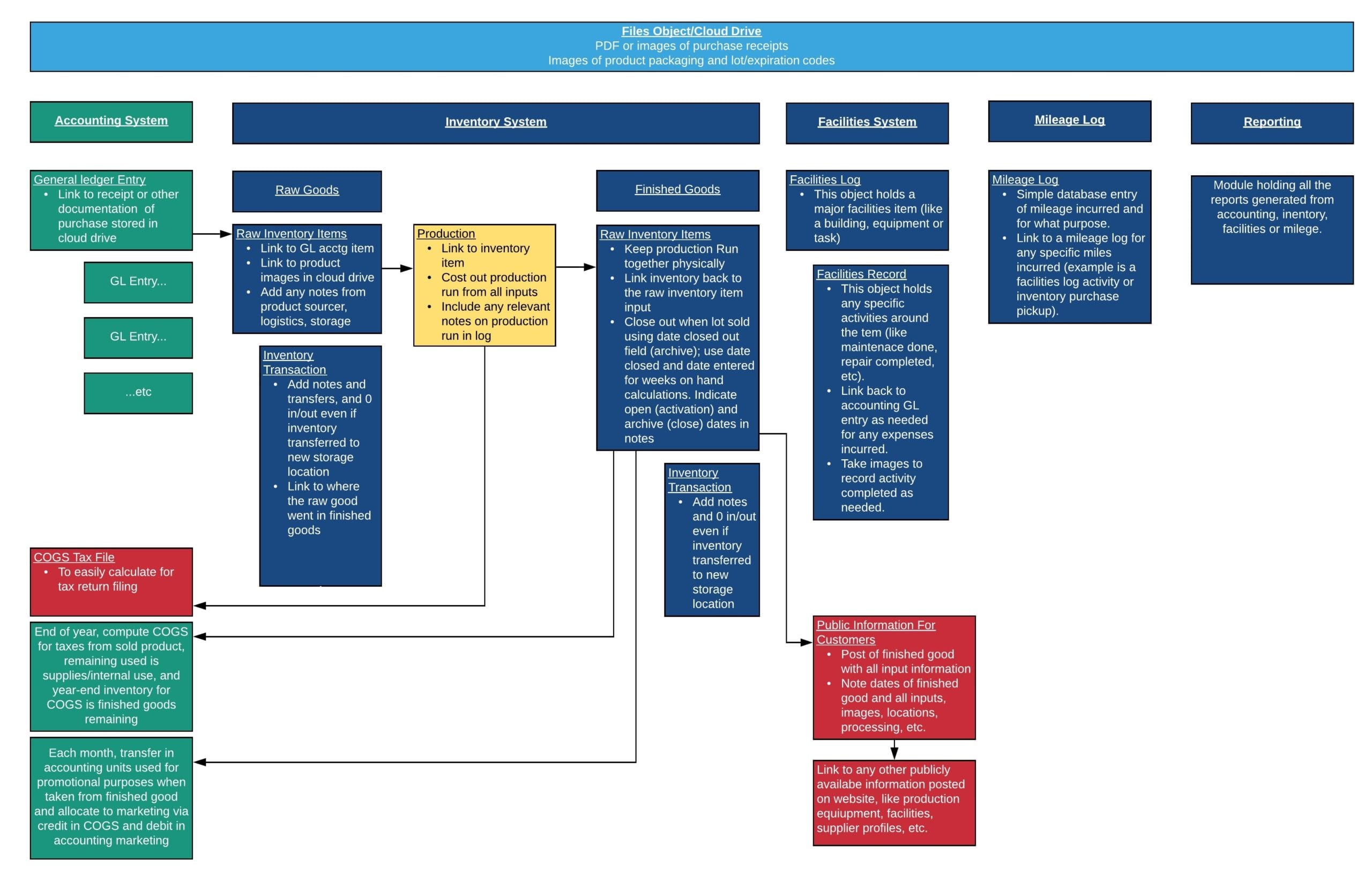](https://eddiesoehnel.com/wp-content/uploads/2018/04/business_main_db.jpg)
|
||||
|
||||
My operations database is an online relational database, which I architected and had a developer build for me. It is one application with many objects (tables).
|
||||
|
||||
### Cloud Drive
|
||||
|
||||
The Cloud drive is a simple online file storage system so that I can store all copies of receipts and images. You can use any online file system as long as it generates a link to each file. Google Drive, Onedrive, Dropbox or Amazon S3 works just fine, or if you use an online database as I do, then it is more efficient to do it there.
|
||||
|
||||
### Accounting System
|
||||
|
||||
I don’t have a full fledged accounting system, but it is more of a general ledger to record all debits and credits. It is very detailed and I categorize expenses very specifically. I also include a link to the PDF or image of the original expense receipt, which is uploaded to the cloud drive.
|
||||
|
||||
So, for an inventory-related purchase, I include original receipts so I can understand costs by each individual unit for an inventory purchase.
|
||||
|
||||
### Inventory System
|
||||
|
||||
My inventory system is broken down between raw and finished goods, with the production log sitting in between (the subject of this post).
|
||||
|
||||
For raw goods, any inventory items purchased are categorized this way. I link back to the original accounting entry and I also include product images, with particular emphasis on images of any log identification and expiration dates on products.
|
||||
|
||||
A child table is included for each inventory item that allows me to record the transfer of that inventory item.
|
||||
|
||||
So, I might purchase in bulk, then use up small quantities at a time in different production runs. which I log in the child table for that inventory item and note where they went and how much was used. I setup my database to automatically reduce the total in inventory for that item from the child table entries so I can see where I stand when I review all my inventory items.
|
||||
|
||||
Raw goods and finished goods are just one database table (or object). I just categorize them as either raw or finished in a field.
|
||||
|
||||
Finished goods are linked back to any of the raw goods used, which are linked back to the original accounting entry. Also, raw goods and where they end up, via recording in the child table, are linked to the finished good.
|
||||
|
||||
This linking backwards and forwards lets me dive deep into the exact disposition of all of my production inputs.
|
||||
|
||||
### Additional Objects and Functions
|
||||
|
||||
Additional tables I use are a facilities log and a mileage log.
|
||||
|
||||
My facilities log allows me to keep track of any repair, maintenance or cleaning of my production facilities and my equipment.
|
||||
|
||||
The mileage log serves to record all vehicle mileage for the business.
|
||||
|
||||
I also have a module that holds all the various reports I have created that pull data from the various objects in the operating database.
|
||||
|
||||
Outside of the database, I am using information to do different things, which is identified in the lower red and green boxes.
|
||||
|
||||
I go into far more detail about my operating database in [Section 2: Systems of the Framework](https://eddiesoehnel.com/startup-incubator/incubator-index/lean-agile-framework-index/systems/)
|
||||
|
||||
## Product Production Log
|
||||
|
||||
The production log, from a process view, sits between my raw goods and finished goods in the yellow box. It records what happens between raw and finished.
|
||||
|
||||
Let’s start with a screen shot of the entire sheet. You can download this template from the email input at the bottom of the post.
|
||||
|
||||
[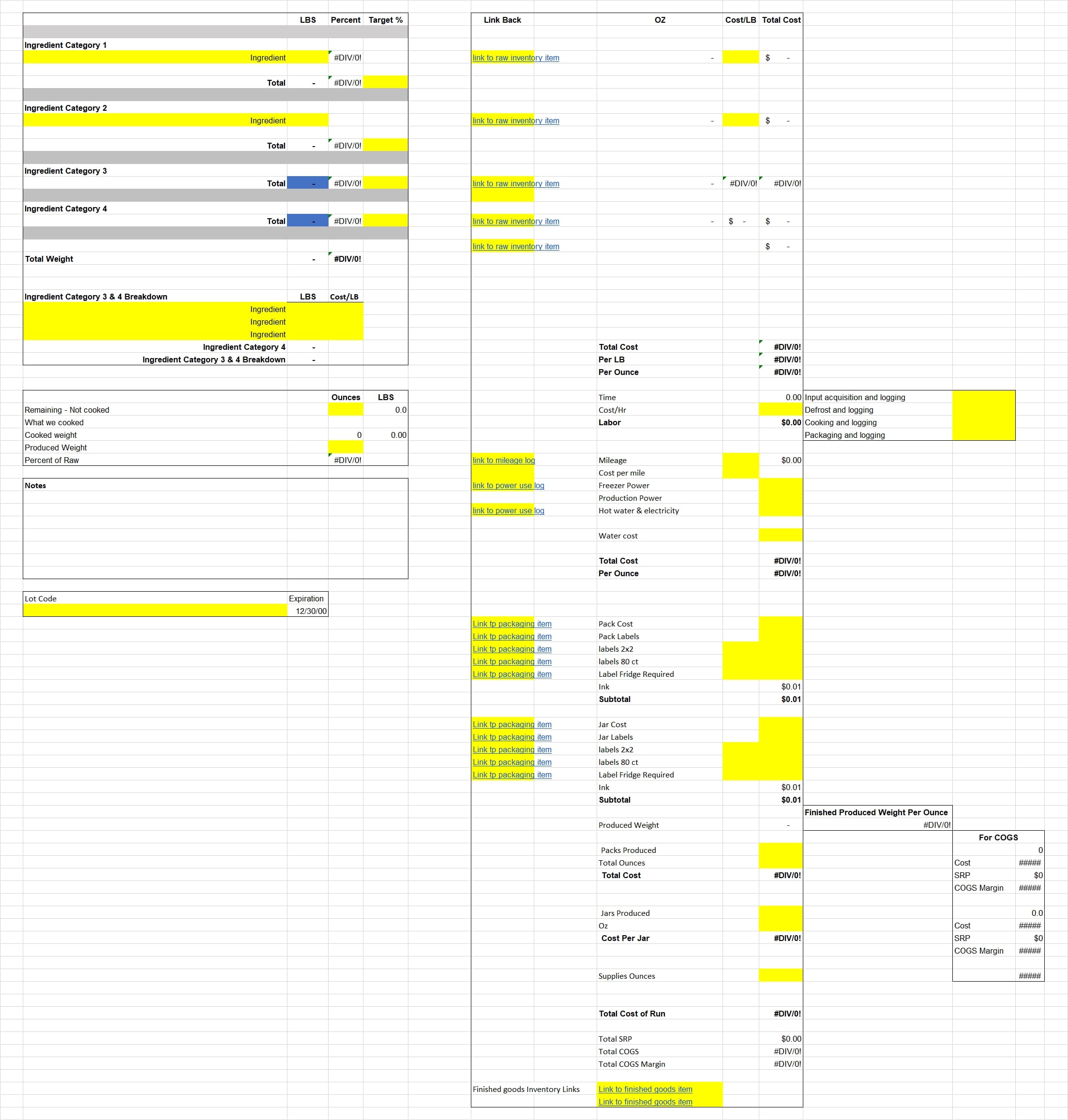](https://eddiesoehnel.com/wp-content/uploads/2018/04/production_log_complete.jpg)
|
||||
|
||||
### Production Quantities and Notes
|
||||
|
||||
[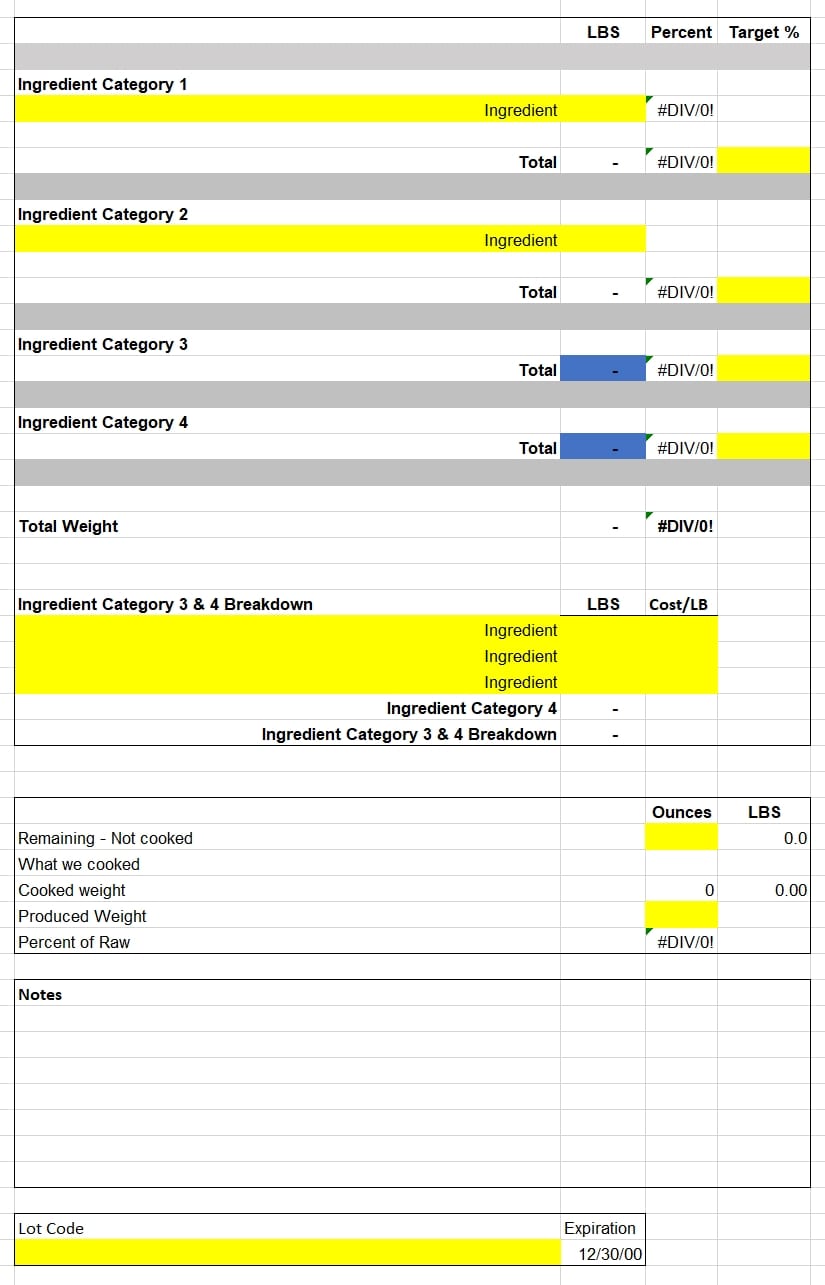](https://eddiesoehnel.com/wp-content/uploads/2018/04/production_quantities_notes.jpg)
|
||||
|
||||
This block tells me how much of each ingredient to use and allows me to record that data.
|
||||
|
||||
The yellow cells are variable requiring input from the user to compute equations.
|
||||
|
||||
Since this is a food item with multiple ingredients, I already set up the template to guide me into how much of each ingredient to use.
|
||||
|
||||
I also include some information capture for post production and take any relevant notes for this production run.
|
||||
|
||||
I keep the SOPs (standard operating procedures) for how to execute production for this particular product in a separate Google Docs file, so as not to clutter it up in this sheet. But, you could put the SOP’s here or even in a separate sheet in the same file.
|
||||
|
||||
### Ingredient Costs and Source
|
||||
|
||||
[](https://eddiesoehnel.com/wp-content/uploads/2018/04/Ingredients_cost_2.jpg)
|
||||
|
||||
This block includes the link back to the inventory raw good item in my operations database (yellow cells are variable, so the link goes there), plus any costing information.
|
||||
|
||||
In this block, I am just looking at ingredient costs for this production run.
|
||||
|
||||
### Production and Facilities Costs and Source
|
||||
|
||||
[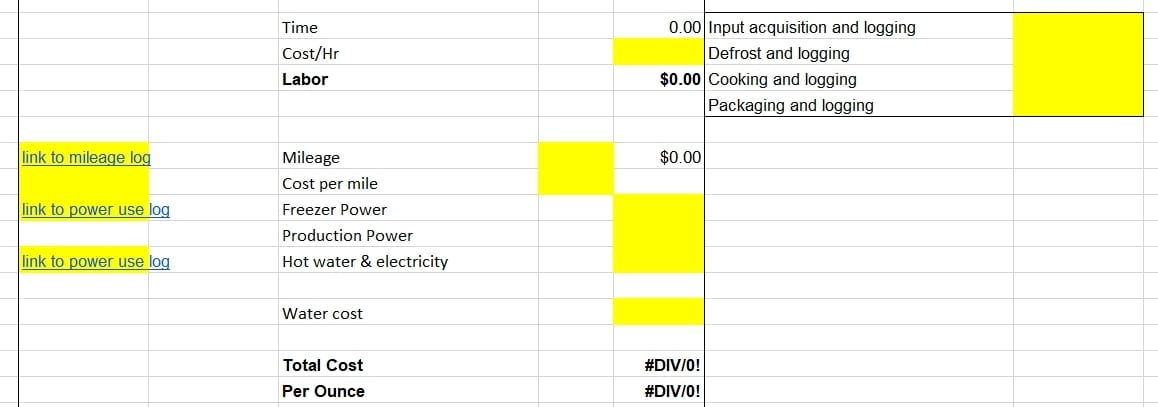](https://eddiesoehnel.com/wp-content/uploads/2018/04/production_costs.jpg)
|
||||
|
||||
This block contains my production and facility costs.
|
||||
|
||||
I also include any links associated with those costs, which usually goes back to the accounting module in my operations database, the facilities module or the mileage module.
|
||||
|
||||
These are all tables (objects) in my operations database where I keep track of all this information.
|
||||
|
||||
### Packaging Costs and Source
|
||||
|
||||
[](https://eddiesoehnel.com/wp-content/uploads/2018/04/packaging_costs.jpg)
|
||||
|
||||
This block includes my packaging costs and all specific pieces that make up my packaging for this product.
|
||||
|
||||
In yellow cells, I link back to the packaging inventory item in the inventory module of my operations database, where I can see current available quantities of this item, product images and any other information related to this packaging item.
|
||||
|
||||
### Miscellaneous Calculations
|
||||
|
||||
[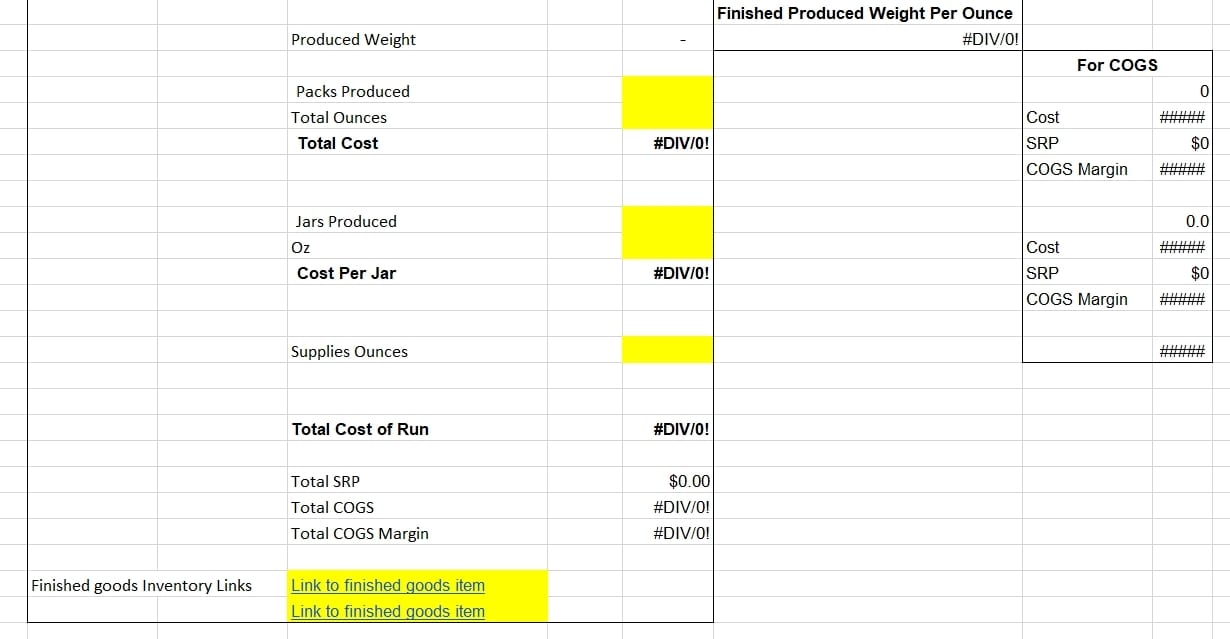](https://eddiesoehnel.com/wp-content/uploads/2018/04/misc_info_block.jpg)
|
||||
|
||||
This final block includes miscellaneous calculations.
|
||||
|
||||
I like to specifically understand my COGS for the product in this specific run against SRP (suggested retail price).
|
||||
|
||||
I also have separate calculations on the right that I use for COGS when filing my annual tax return for the business.
|
||||
|
||||
You will also see the last lines (yellow cells) would include links to the finished goods items in the inventory system.
|
||||
|
||||
All other links above go back to raw goods or back to the accounting module, while these these last links point forward to the finished goods item in the inventory module of the operations database.
|
||||
|
||||
### Summary
|
||||
|
||||
The different blocks that go into the production log template include:
|
||||
|
||||
- Production inputs
|
||||
- Production notes
|
||||
- Ingredient costs
|
||||
- Production and facility costs
|
||||
- Packaging costs
|
||||
- Miscellaneous calculations
|
||||
|
||||
Those are the major areas of information that I track for production runs.
|
||||
|
||||
I also want to show how this production log file sits in relation to my operations database, and to emphasize that you want to include links to any raw goods, finished goods, or any related expense items.
|
||||
|
||||
That way, you have an easy setup to completely track everything about your production…backwards into your supply chain, and forwards to your finished goods, and links to it all.
|
||||
|
||||
Linking makes everything in your supply chain and manufacturing easily accessible, so you want to make sure you scan/image receipts, supply packaging, lot codes, expiration, etc.
|
||||
|
||||
This reduces the need for physical file or paper-drive processes in favor of digital filing and process management.
|
||||
|
||||
[Click here to download the spreadsheet model for this post.](https://eddiesoehnel.com/ProductProductionLogTemplate)
|
||||
+17
@@ -0,0 +1,17 @@
|
||||
# How much (in % of revenues) does a food and drinks wholesaler/distributor spend in logistics, meaning, paying a 3rd party to pick up and deliver the products to the retailer’s warehouse?
|
||||
|
||||
Source: <https://eddiesoehnel.com/how-much-in-of-revenues-does-a-food-and-drinks-wholesaler-distributor-spend-in-logistics-meaning-paying-a-3rd-party-to-pick-up-and-deliver-the-products-to-the-retailers-warehouse/>
|
||||
|
||||
Tags: 3PL, income, Logistics, Profit and Loss
|
||||
|
||||

|
||||
|
||||
This is a [Quora](https://www.quora.com/How-much-in-of-revenues-does-a-food-and-drinks-wholesaler-distributor-spend-in-logistics-meaning-paying-a-3rd-party-to-pick-up-and-deliver-the-products-to-the-retailers-warehouse/answer/Ed-Soehnel) questions that I was asked to answer. Here is my answer.
|
||||
|
||||
That will depend on a lot of factors – your volume, distances, consistency, speed of delivery, does the product require cooling, how is it packaged (case and pallet configurations), carrier, etc.
|
||||
|
||||
For 8+ figures in annual sales, I have gotten that number down to as low as 5% of revenue.
|
||||
|
||||
For a small 6-figure company, I have run as high as 15% of revenue.
|
||||
|
||||
So, figure 15% on the high end for low volume and 5% on the low end for high volume.
|
||||
+29
@@ -0,0 +1,29 @@
|
||||
# Making microproduction work profitably: an example of printing labels in house rather than outsourcing
|
||||
|
||||
Source: <https://eddiesoehnel.com/making-micro-production-work-profitably-an-example-of-printing-labels-in-house-rather-than-outsourcing/>
|
||||
|
||||
Tags: Cost of goods sold, costs, economies of scale, micro-production, Production
|
||||
|
||||

|
||||
|
||||
I want to talk about micro production.
|
||||
|
||||
For background, consumer products over the last 6 decades have largely been built on mass scale, producing as much of it as possible on a mass scale, which drives economies of scale down and drives costs down to serve mass markets. That has worked up until the last decade or so.
|
||||
|
||||
Things have started to change where you’ve got more niche markets of customers looking for products that fit their particular needs. So that’s really opening up and requiring the need for smaller production lines to serve those niche markets that are also closer to the customer, as opposed to producing halfway around the world and then shipping something.
|
||||
|
||||
That is bringing forth the ability to do micro production, which is largely what I’m trying to do with my pet businesses…very small scale production serving local niche markets.
|
||||
|
||||
And I’m really trying to dive into as many of the specifics of production to essentially achieve that. For example, I have traditionally purchased my product labels for my products from a printer, and I last purchased a decent amount several years ago at $.93 cents per label.
|
||||
|
||||
But as I have used up that batch of labels, I have figured out that is is cheaper to print in house on our own inkjet printer.
|
||||
|
||||
And I can do that for $.53 a label.
|
||||
|
||||
I’ve had my graphics artist create elements of the label for me and allow me to then modify myself so that I can do a small print run and make changes to labels without incurring waste.
|
||||
|
||||
That is an example of my micro production where in my labels I’ve been able to drive costs down due to technology and do it in house.
|
||||
|
||||
Profitability on mass manufacturing is driven by economies of scale, where you need to produce a lot to earn net margin. But with micro-production, it is really important to drive profitability on small runs. My requirement is to have a net profit margin of 30% on my products that I sell. So it’s really important for me to understand my costs throughout that entire production process to drive the net profit margin I want.
|
||||
|
||||
I track all my production runs on a production log where I capture all product details and costs. To see how I do that and download my model, see this post: <https://eddiesoehnel.com/ProductProductionLog>
|
||||
@@ -0,0 +1,15 @@
|
||||
# Production & Logistics
|
||||
|
||||
Source: <https://eddiesoehnel.com/startup-roadmap/production-logistics/>
|
||||
|
||||
Tags: None listed
|
||||
|
||||
Retrieved from the supplied WordPress backup.
|
||||
|
||||
# Production & Logistics
|
||||
|
||||
### Supply chain, production, logistics and warehousing.
|
||||
|
||||
[Embedded Google document](https://docs.google.com/document/d/1e_D1K_ta-F19Vevly1KNd3Qvb-KNX66r7MbU7CRZZlo/pub?embedded=true)
|
||||
|
||||
## Questions, Feedback?
|
||||
@@ -0,0 +1,20 @@
|
||||
# Resource Security
|
||||
|
||||
Source: <https://eddiesoehnel.com/resource-security/>
|
||||
|
||||
Tags: resource, supply chain
|
||||
|
||||

|
||||
|
||||
Successfully marketing and selling a product is the goal. but you need to make sure you think through and plan for resource security – a reliable supply of your product’s raw materials in order to be successful.
|
||||
|
||||
Not being able to meet demand because of supply chain issues is just as bad as not having demand because customers and suppliers usually have other choices, whether it’s from direct competing products or substitute products. There is risk, and sometimes significant risk, that if you fail to meet demand, they will never come back again.
|
||||
|
||||
Before you start marketing and selling product, make sure you spend the time and effort to set up your supply chain. consider the following:
|
||||
|
||||
- Is your product’s supply chain sustainable? Or is it made from a depleting resource that cannot be replaced?
|
||||
- Make sure you have multiple suppliers. This is just risk management 101. Even if you are a startup or small company, always have multiple suppliers available.
|
||||
- Can you purchase raw materials year-round or do they require stockpiling that can be at risk of contamination or other market participants buying up all the supply?
|
||||
- Do your product’s raw materials require low energy and water to make and get to market? Water, certainly, is becoming a scare resource in many parts of the world where raw materials for products might be traditionally produced.
|
||||
- Do your raw materials have price stability? You really need this because it is very difficult to pass along cost increases to customers.
|
||||
- Are your raw materials made in close proximity to you and your market? This just makes it easier and cheaper to transport what you need to sell to your customers
|
||||
+18
@@ -0,0 +1,18 @@
|
||||
# A ballpark guide to relative sales of items by retail channel
|
||||
|
||||
Source: <https://eddiesoehnel.com/ballpark-guide-relative-sales-items-retail-channel/>
|
||||
|
||||
Tags: club, Drug, Grocery, mass, natural, retail, speciality
|
||||
|
||||

|
||||
|
||||
[YouTube video player 1](https://www.youtube.com/embed/CHc1d9BPr5Q?wmode=transparent&autoplay=0)
|
||||
|
||||
Assume sales of items by retail channel in units per week per retail door.
|
||||
|
||||
- Grocery: Baseline channel
|
||||
- Natural/Specialty: 2.5 x grocery
|
||||
- Drug: 1 x grocery
|
||||
- Mass: 10 x grocery
|
||||
- Club: 20 x grocery
|
||||
- C-store: 3 x grocery
|
||||
+17
@@ -0,0 +1,17 @@
|
||||
# Do most mega supermarkets charge $10,000+ one-time fees for newly registered suppliers?
|
||||
|
||||
Source: <https://eddiesoehnel.com/do-most-mega-supermarkets-charge-10000-one-time-fees-for-newly-registered-suppliers/>
|
||||
|
||||
Tags: slotting fees, tradespend
|
||||
|
||||

|
||||
|
||||
This is a [Quora](https://www.quora.com/Do-most-mega-supermarkets-charge-10-000+-one-time-fees-for-newly-registered-suppliers) question I was asked and here is my answer.
|
||||
|
||||
Yes, that is normal. Most major retailers charge up front fees, called slotting fees, some which can easily be high in the 5 figures.
|
||||
|
||||
You cannot look at slotting fees without considering the whole range of retailer tradespend requirements and terms, because most things can be negotiated and what you pay in tradespend is highly dependent on many factors.
|
||||
|
||||
You might be able to negotiate slotting fees down by shipping more units of free product to stores on opening order, higher marketing coop commitments, or offering other tradespend items.
|
||||
|
||||
But, you might not. In the end, you do not have much negotiating power as a new vendor. You often have to take what you can get, prove sell through over time and negotiate tradespend requirements down as time goes on.
|
||||
+27
@@ -0,0 +1,27 @@
|
||||
# Does it make sense for brands to have their own E-commerce teams (direct-to-consumer online) or leave it up to the retailers to sell the products online?
|
||||
|
||||
Source: <https://eddiesoehnel.com/make-sense-brands-e-commerce-teams-leave-upto-retailers-sell-products-online/>
|
||||
|
||||
Tags: direct-to-consumer online channel, online marketing, online sales, retail
|
||||
|
||||

|
||||
|
||||
I always have a direct-to-consumer online channel, and I always start that way and may or may not get to retail later. Here’s why:
|
||||
|
||||
1. Direct-to-consumer online is much more profitable than through retail. I always try to develop pricing so that I have at least a 30% net profit when selling D2C. Whereas with retail, at best I shoot for a 20% net profit, but that can still be difficult to achieve, especially with tradespend. And I never make money in the first year of retail due to additional charges imposed by retailers for new brands. I am better off building my D2C business to build sales and profits to afford retail.
|
||||
2. With D2C, you can start small, testing all elements of your product, from the product itself, to pricing and marketing message. You don’t have such wide latitude with testing in retail – actually, no latitude at all. You cannot play around with pricing at retail. You usually have to have a decent amount of inventory to support retail, so if your messaging is not right, it’s not a simple thing just to switch out packaging. With your own D2C operation, you can test sales with consumers and know if they repurchase or not. You cannot tell this with retail and it takes a long time (at least a year, in my experience) to determine if your product has legs in retail.
|
||||
3. If your product does not sell well, you get kicked out of retail, including having to purchase back product with potential for additional costs in reverse logistics. And, you risk not being able to come back. Better to test with direct sales to make sure you can sell.
|
||||
4. You really want to build your online channel because then you not only own the customer, but you can re-sell to them or hopefully, crosssell and upsell other products to the same customer.
|
||||
5. It is hard to get into retail. If you have prior sales though your direct-to-consumer online channel and can show repeat purchases, that makes it much easier to drive into retail and grow in this channel faster.
|
||||
6. Online e-commerce and marketing tools are becoming easier to use, more cost-effective and automated, so you may not necessarily need an e-commerce team, but might manage online sales with 1-person and outsourcing customer service and fulfillment.
|
||||
7. Retail in-store and online operations are still separated from a lot of retailers, and retailers are typically not good at online, compared to straight e-commerce companies. Further, retailers use legacy technologies and cannot move as fast as a small brand in their own e-commerce operation. Online marketing and sales tools are advancing at such a rapid pace that legacy and large companies cannot keep up, but small brands can adopt the latest tools much quicker.
|
||||
8. Having a retailer sell my product online only is not a long-term viable solution, in my opinion. Volume compared to in-store is quite low, again, in my experience. If all a retailer would do is sell my product online, then I would decline. The action is on shelf. But online can be a path to shelf.
|
||||
|
||||
All that said, as much as I like online, selling in retail stores is highly advantageous after a brand has proven itself online, and I usually recommend it:
|
||||
|
||||
1. Retail still commands 90% of consumer product sales in the U.S., so huge sales can be made in this channel
|
||||
2. It is a different channel for capturing customers.
|
||||
3. If sold on shelf, retail tends to entrench brands better than online. Online customers are more fickle, switching brands more quickly.
|
||||
4. There is more competition online than in stores.
|
||||
5. Consumers trust a brand more if it is sold in major retail, so that ends up benefiting the online operation
|
||||
6. M&A activity is still focused on brands that sell on shelf, not purely online, at least in my experience.
|
||||
@@ -0,0 +1,53 @@
|
||||
# Get your product and company ready for retail CPG
|
||||
|
||||
Source: <https://eddiesoehnel.com/get-your-product-and-company-ready-for-retail-cpg/>
|
||||
|
||||
Tags: CPG, retail, retail trade, Wal Mart
|
||||
|
||||

|
||||
|
||||
This post is a basic guide to get your product and company ready for retail CPG.
|
||||
|
||||
**Finance**
|
||||
|
||||
Retail takes cash. You will have to invest in product inventory that won’t realize cash very soon. Expect to pay upfront shelf fees to get your product on shelf. It could be a combination of cash, free product to stock stores or discounts on your opening order. General retailer terms range from 15 days to 60, but can be longer for new products. Some retailers will only pay you when the product rings through the register, called pay on scan. You can eventually get on normal terms when your product shows movement off the shelf.
|
||||
|
||||
Retailers have trade spend fees, which in addition to shelf fees or opening order discounts, can include: new store fee, which is a cost or free product to stock new stores that the retailer opens; product damage fees, which may be a percentage of sales, and cooperative marketing fees, which is a percentage of sales the retailer withholds for in-store or circular advertising expenses. Also expect to pay for periodic promotions and additional in-store or circular advertising. Retailers like buy one get one (BOGO) promotions; or, 2 for 3, or 3 for 5 or 8 for 10…and other combinations.
|
||||
|
||||
A few other finance items to expect: product liability insurance is a requirement and coverage amounts will depend on your product; if your product does not do well and gets booted off the shelf, there will be costs to buy product back from the retailer or support steep markdowns on close out sales.
|
||||
|
||||
**Operations and Logistics**
|
||||
|
||||
If you are a small company, you will most likely want to outsource this function to an experienced partner who already does this. They will have the experience for dealing with the myriad of packaging, routing and shipping requirements that each retailer has. However, be prepared to have your own small fulfillment operation in your office to send samples to brokers and retailers.
|
||||
|
||||
More and more retailers are moving to EDI (the largest are already there), which means that orders and logistics information are all electronic. Your warehouse may not necessarily need to be EDI, but at a minimum you must. There are many third party EDI providers that can get you setup so that you can electronically receive and communicate orders and information with the retailer.
|
||||
|
||||
You will need an accounting and inventory system that can handle retail. There are many packages available and some are hosted securely online. It is common for the bigger more established warehouses and other partners to be able to integrate data flow into your hosted data system, which is recommended.
|
||||
|
||||
Make sure your cases are configured properly to support retailers. How many units per case? How many inner cases, or “inners” per case. A retailer will likely send your case to a distribution center (DC) and then break it open to parcel out the inners to specific stores. Configure it to meet requirements for your most important retail customers. This data would be included in your product specifications sheet that retailers would use. Additional data would be the specific product dimensions, UPC and GTIN numbers and pallet information. Triple check this sheet to make sure all data is correct before it goes to retailers. I’ve seen how easy it is to get things mixed up and it can be very difficult to correct once the retailer has the data loaded into their systems. Depending upon the retailer, you may be required to utilize online product data synchronization services that are becoming the norm in retail. Retailers synchronize their systems to these data warehouses. These services require annual subscriptions and provide templates to load and manage product specifications.
|
||||
|
||||
What is your sustainable resources strategy? Wal Mart has taken the lead in this area by using its leverage to get manufacturers to adopt operational practices that promote resource conservation and minimize environmental impact. Even if you do not plan to sell to Wal Mart, retailers will follow.
|
||||
|
||||
**Retail Shelf**
|
||||
|
||||
It goes without saying, but I will say it anyway. Do your research. Who are your competitors and substitutes? What are your features and benefits and positioning relative to them and why? Who are your target customers? What kind of product sales movement can you expect? What is minimum product sales movement required by the retailer? Can you get Nielsen or IRI data to see competitor and category movement sales? When do retailers do their product reviews and shelf resets? What is the best way the retailer likes to work with its vendors – through brokers or meetings at specific trade shows, through email only? Many of these questions and data take primary research by visiting retail locations and secondary research through industry trade sources and retail brokers.
|
||||
|
||||
Your retail price is a critical piece of research that you need to get right. You want your price to be competitive on shelf to other products or substitutes but you also you want to maximize the retail price. You want to make sure you have good profit margins on the product as well as providing enough margin for the distributors and retailer. Leave room in there so that you can absorb future expense hits, such as discounts and promotions that you will be likely be required to run with the retailer, COGS increases, and the like. Note that just because your costs rise does not mean you can easily pass those on to retailers.
|
||||
|
||||
In general, it is getting harder to make it on shelf. Product ideas and manufacturing capabilities and capacities are seemingly endless, but the real estate in a store is not. You will have to compete for space with direct or substitute competitors. Further, retailers are creating space for their own brands, pushing out traditional consumer packaged good manufacturers. Retailers make more money with their own brands because they keep the margin in profits that a CPG company would have.
|
||||
|
||||
A competitive advantage over another product will not always get you in. You may have to prove that you can increase the number of consumers that buy in the store category.
|
||||
|
||||
Usually your product will define where you will be on shelf. But if you can get space in a higher traffic category, consider positioning your product to fit there. However, this could backfire if you are not careful. A higher traffic section might also have much higher shelf-movement requirements, and if your product won’t move off the shelf, you will no longer be in that retailer.
|
||||
|
||||
Make your package stand out and differentiated from competitors. Don’t underestimate the ability to market on the shelf. However, you want to be careful to differentiate within the dimensions normal for the category. That is, don’t size the packaging where it won’t fit or present well on the shelf. Think about using [QR codes](https://en.wikipedia.org/wiki/QR_Code "QR Code") or messaging on your package that drives consumers to web content via their smartphones while they are in the retailer: Content can include testimonials, Youtube videos about the effectiveness of your product, or other information that motivates a purchase.
|
||||
|
||||
If given the opportunity, take advantage of displays and other in-store signage. End-caps, shelf displays, posters and the like are a great way to increase your real estate space in addition to being on shelf. They also make great in-store banner advertisements. There will be increased costs, but can be worth it.
|
||||
|
||||
One thing to be aware of is if your product is so new and different that it does not fit into one category but straddles across several categories. In this case, the target consumer sees risk in buying something that is not normally found in the category that they buy from, making a purchase more difficult. Or, there are features and benefits not important to them, so they pass on a purchase. In this case, sampling and in-store promotions are critical to get consumer trial, which can get very expensive.
|
||||
|
||||
**Other Items**
|
||||
|
||||
If you get into retail, hopefully you already have an additional product in the works or different variations of your flagship product (flavors, sizes, colors, etc) to follow. If you want to grow, you need to capture more shelf space, and that comes from more products. Consumers can also tire of your product, so its important to offer variation, improvements or new products to compliment your brand. Unfortunately, this needs to happen faster than you might think. My rule of thumb is when I launch a product in retail, I better have the next one ready to go so if my brand really takes off, I can capitalize on the momentum. Aggressive innovation is also a good competitive strategy.
|
||||
|
||||
Retail is not hard, but there are many details to manage, so execution is important. You want to appropriate the staff, time and management tools to keep a close eye on your expenses, especially trade spend, retailer charges, the cash tied up in inventory and your logistics costs A trick I have seen retailers use is to continue taking discounts on shipments that was limited to the opening order shipment only. Or, they fine you for early or late shipments when you have documented proof that you were on time to make the delivery. Items like these can get out of hand quickly if you do not watch them carefully. Regardless of your product’s success, expenses can kill your company.
|
||||
+44
@@ -0,0 +1,44 @@
|
||||
# Growing by bypassing online sales and instead, just selling through retail (even though I dislike doing it this way)
|
||||
|
||||
Source: <https://eddiesoehnel.com/growing-bypassing-online-sales-instead-selling-retail-even-though-dislike-way/>
|
||||
|
||||
Tags: competitors, direct-to-consumer, Pricing, retail
|
||||
|
||||
|
||||
|
||||
Why I dislike launching a product direct in retail, instead of selling online first, and some tips if I can only launch a product this way.
|
||||
|
||||
[YouTube video player 1](https://www.youtube.com/embed/b3ew-wNapfE?wmode=transparent&autoplay=0)
|
||||
|
||||
## Video Transcription
|
||||
|
||||
I really dislike going straight to retail or through other resellers.
|
||||
|
||||
- Sell online direct to consumer first because you can start small and test your messaging, pricing and acceptance of product;
|
||||
- You want to have these items really dialed in before retail because you cannot play around with pricing, and it is expensive and time consuming to switch out packaging;
|
||||
- Plus if you don’t get good traction in retail, you will get kicked out and may not be able to come back;
|
||||
- Selling D2C is much more profitable and can help establish profitability to afford retail, which is rarely profitable in the first year.
|
||||
|
||||
But, I am currently working on a product that is not a good product for shipping direct to consumer. It gets damaged easily and can lead to more product returns and disgruntled consumers.
|
||||
|
||||
I can’t do smaller pack sizes for this type of product.
|
||||
|
||||
I might design packaging to help prevent this, but that may be cost prohibitive.
|
||||
|
||||
So what do I do?
|
||||
|
||||
- Do as much research online to understand what consumers like and don’t like with existing products;
|
||||
- Research this through product reviews and in online discussion groups and forums around your product category;
|
||||
- Know what pricing currently sells;
|
||||
- Look at the copy on competitors’ websites and packaging to see what they are doing;
|
||||
- Hard to know which competitors are doing well. If you know who is doing well with sales, you can model their copy, pricing;
|
||||
- You can find this out with some fuzzy accuracy for some brands via tools like SimilarWeb, but it’s not perfect;
|
||||
- Really know how your product is positioned against competitors so you have some very clear and hard-hitting differentiation when approaching retailers;
|
||||
- Have a marketing plan and budget in place;
|
||||
- Without sales history your differentiation and marketing budget will help sell into retail.
|
||||
|
||||
There is also been no innovation in this particular category I am targeting with this product, so I can sell to retailers how my product is innovative (actually, it is) and how the category needs an innovator like me to grow (the category has been flat).
|
||||
|
||||
The other products are also made with chemicals, whereas mine is not, so that is also a potential selling point to a retailer.
|
||||
|
||||
Also, the company behind this product has ample funding, so they can afford to do it this way and absorb setbacks if their product, pricing or packaging is not right in retail. But if they had no cash, then I would absolutely not recommend this route.
|
||||
+19
@@ -0,0 +1,19 @@
|
||||
# How are FMCG profit margins distributed across the supply chain?
|
||||
|
||||
Source: <https://eddiesoehnel.com/fmcg-profit-margins-distributed-across-supply-chain/>
|
||||
|
||||
Tags: broker, Co-manufacturer, fmcg profit margins, retail price, SRP, tradespend, Transportation, Warehousing
|
||||
|
||||

|
||||
|
||||
Working from SRP (Suggested Retail Price) backwards, I see the following for FMCG profit margins:
|
||||
|
||||
1. Anchor price/SRP: Start with SRP to your most expensive channel – which represents your top-most anchor price. The markup from you as vendor to retailer is 50-60% to the specialty/top priced retailers. For non-specialty channels – like drug, mass, grocery, club, figure 45%, 30%, 35% and 14% respectively.
|
||||
2. Tradespend: But, you have to figure an additional 13.5% average of your wholesale price in tradespend fees that you pay to the retailer (payment terms, damaged product allowances, in-store marketing allowances, etc). That is average across all channels. It will be highest in drug and lowest in club/mass.
|
||||
3. Broker fees: If you use them, then it will be as low as 5%, or could be as high as 12% of your wholesale price, depending upon the channel and if you are a startup or new brand, they will be on the high side.
|
||||
4. Distribution: I assume 30% of wholesale price, but that may come down depending on the channel.
|
||||
5. Co-manufacturer: If you manufacturer through a co-packer (you contract it out), assume they want a 20% net profit margin. So, take your cost of goods sold (COGS) and figure 20% of that is net profit margin to the manufacturer (product and packaging).
|
||||
6. Transportation: Assume 5-7% domestically of your wholesale price, but this is if you know how to optimize your logistics, otherwise, assume 10-12%. For international shipping, I assume another 3%.
|
||||
7. Warehousing: assume 1% of your wholesale price.
|
||||
|
||||
[Click here to download the worksheet for this post](https://eddiesoehnel.com/COGSImpactRetail).
|
||||
@@ -0,0 +1,34 @@
|
||||
# How are wholesale prices determined?
|
||||
|
||||
Source: <https://eddiesoehnel.com/how-are-wholesale-prices-determined/>
|
||||
|
||||
Tags: COGS, competitors, Margin, net income, Pricing, SRP, Wholesale Price
|
||||
|
||||

|
||||
|
||||
This is a [Quora](https://www.quora.com/How-are-wholesale-prices-determined) question I was asked to answer. Here is my answer.
|
||||
|
||||
There are many different ways to set wholesale prices and anyone that does that will probably have their own nuances and rules of thumb they follow.
|
||||
|
||||
For most product categories, consumers will compare you to competitive offerings, as they need a point of reference to gauge the value to them. Assuming that, here is my process.
|
||||
|
||||
1. Researching competitive offerings, both online and in retail, and segment by channel (specialty/high end channels vs mass/volume-base channels and everything in between).
|
||||
2. Document all quantitative factors including anchor price, sales prices, serving sizes, product sizes, etc.
|
||||
3. Document qualitative factors: in particular benefits – what value will my user / customer get out of using this; features – what part of my product lets the user / customer get that value; outcomes – what’s the end result the user wants to achieve with the product/service); pain/needs/desires satisfied.
|
||||
4. Identify the target customer/segments.
|
||||
5. Audit competitor advertising. What they say, how they say it, and their look and feel in websites, packaging and advertising, including where they advertise, communicates value, which is reflected in price.
|
||||
6. List out your benefits, features, outcomes, pain/need/desire satisfied in a table relative to competitors.
|
||||
|
||||
With all this data, you want to get a sense for where along the value spectrum you fall relative to competitors and what would be your top-most anchor price (your suggested retail price – SRP – that a consumer would pay for the product).
|
||||
|
||||
Next, develop a profit and loss statement based on your top-most anchor (SRP), with channel margin, then wholesale prices, cost of good sold (COGS), operating costs, then your net income (top to bottom flow). Everything flows to net income, so I set my target net income percentage that I want and then roll up from there.
|
||||
|
||||
You lay this out by channel – so each column is one channel, starting with your direct-to-consumer sales, then sales to specialty channel, drug, grocery, etc, etc. When you do it this way, you can see in one screen view all the important metrics to your pricing and your business. And you can see with much more clarity where things might break in your profit and loss statement.
|
||||
|
||||
If, for example, my net income drops below my threshold, it is because my COGS is too high, or my SRP is not high enough, but maybe I cannot charge a higher SRP because my benefits/features, etc do not allow me to do that. Or, maybe my pricing breaks in a specific channel based on the channel required margin, so I may need to go back to adjust my SRP. It is all a very iterative process.
|
||||
|
||||
I spend a lot of time on pricing and this model to get it right. But even then, I won’t know until I get into the marketplace. So, I always start selling online where I can much more easily adjust my pricing in my testing. I cannot do this if selling through resellers. I want my pricing to be set before I go to resellers.
|
||||
|
||||
A few other things to consider in setting price is whether your product can be considered a status symbol; if so, then a premium price may be justified. Is it a scare product? These all can be used to adjust pricing up.
|
||||
|
||||
I would no try to compete on price unless you can defend it successfully in the marketplace. Competing on price almost always means the largest competitor that can do the most volume and get economies of scale, will win. Unless that is you, better to position elsewhere.
|
||||
+23
@@ -0,0 +1,23 @@
|
||||
# How big of a deal is securing a purchase order from Urban Outfitters
|
||||
|
||||
Source: <https://eddiesoehnel.com/how-big-of-a-deal-is-securing-a-purchase-order-from-urban-outfitters/>
|
||||
|
||||
Tags: retail, Urban Outfitters
|
||||
|
||||

|
||||
|
||||
*This is a [Quora](https://www.quora.com/Retail/How-big-of-a-deal-is-securing-a-purchase-order-from-Urban-Outfitters?__snids__=145229718&__nsrc__=4) questions that I was asked to answer. My answer is below.*
|
||||
|
||||
In general, I think it is probably a big deal, since UO is a large and recognized apparel retailer. But I am not specifically an apparel expert, so that real answer is, “it depends”. But here is how I would go about answering that question.
|
||||
|
||||
How big is the PO and for how many stores? Is UO placing a small PO to test merchandise sales in a small group of stores? If so, then it might not be a big deal, especially if this is the way that large apparel retailers test new products.
|
||||
|
||||
If UO is placing a large PO for a large number of stores, then that would be a bigger deal to me because it might show that they believe in the vendor enough to be making a commitment to stock that many stores. That would certainly add more weight when approaching other apparel retailers to also stock the vendor.
|
||||
|
||||
How many SKU’s are included in the order. If it’s several product lines and SKU’s within each line, then that carries more weight than a retailer ordering 1 or 2 SKU’s only. The more shelf space a brand can capture, the more it indicates that the retailer believes in the vendor and what their products can do for the retailer.
|
||||
|
||||
Where will the product be merchandised? Is it in an attractive shelf location with good foot traffic that is eye-level? Or, is it on the bottom of the shelf in a sleepy category of the store?
|
||||
|
||||
Does UO have good recognition withing the apparel retail industry?. For example, in food, there are many channels (club, mass, grocery, drug, etc). The grocery channel includes many large and small grocers. Some of the large and well-run grocers, such as Kroger, carry more weight in the industry and if you are a food vendor, you generally want to sell to Kroger. I would place more weight on a vendor that sells to Kroger chain-wide than say SuperValu, which is not as good a grocer as Kroger. Same goes with CVS/Walgreens vs Rite Aid. The former are better drug retailers than Rite Aid. Selling to these retailers might give the vendor more leverage when approaching other “A” retailers, like Costco, Walmart, Target, etc.
|
||||
|
||||
Finally, what is the financial condition of UO? Will they be able to pay the vendor? Or, are they just ordering merchandise based on lowest cost and best terms and not on the vendor’s brand strength?
|
||||
+113
@@ -0,0 +1,113 @@
|
||||
# How can a local retail store survive, or prosper, in the age of superstores and the Internet market?
|
||||
|
||||
Source: <https://eddiesoehnel.com/can-local-retail-store-survive-prosper-age-superstores-internet-market/>
|
||||
|
||||
Tags: Amazon, customer acquisition, niche, profit margins, reseller, retail, retention marketing
|
||||
|
||||

|
||||
|
||||
This is a [Quora](https://www.quora.com/How-can-a-local-retail-store-survive-or-prosper-in-the-age-of-superstores-and-the-Internet-market/answer/Ed-Soehnel) question I was asked and here is my answer.
|
||||
|
||||
I don’t work in retail, but sell to retailers, so I can only talk from this perspective. In addition, while I predominantly sell direct-to-consumer with my products, with one of my companies, I have location-based sales that while not pure retail, is a hybrid of sorts.
|
||||
|
||||
My suggestions are as follows:
|
||||
|
||||
### Product selection
|
||||
|
||||
Passionate Market Niche
|
||||
|
||||
You want to focus on a tight niche of customers who are passionate about your product category. It is a lot easier to interest people who have an emotional connection to a product category.
|
||||
|
||||
For example, in one of my companies, we sell high quality raw dog food. Raw dog food is hard to purchase in general because it is such a small subset of the entire commercial dog food market. It must be frozen, which adds a lot of cost to transportation and storage, and there is the false stereotype that handling or feeding raw dog food is not safe due to the pathogens in raw meat. And, most vet doctors do not believe in raw, so the same customer usually has to find a different vet who does support raw, and there are not as many of them.
|
||||
|
||||
As a result, raw dog food is only of interest to a very small niche of dog owners who really care about the quality of the food they feed their dogs, are willing to pay for the extra cost and the added inconvenience of having to purchase it from non-traditional retailers who carry the brand and/or selection they want, have the freezer storage available at their home to keep frozen raw dog food, and go to a non-traditional vet doctor who support raw.
|
||||
|
||||
A lot of work, but for those that do, this means they are passionate dog owners. These kinds of customers are less concerned about cheap price and more concerned about buying the brand and products that meet their needs. This is a perfect niche for us.
|
||||
|
||||
Sales Volume
|
||||
|
||||
You want to focus on niche markets that the large resellers will not bother with because they are about sales volume, which means mass market products, and not niche products that have too low of a sales volume for them to make money. But for a small retailer, there is plenty of volume to sell into this niche.
|
||||
|
||||
Higher AOV
|
||||
|
||||
You want higher priced products, where you will need less traffic to make revenue and net income sales.
|
||||
|
||||
For example, compare your average order value (AOV) of $35 to $250. Assuming your profit margin is the same (the percent of your profit divided by your revenue), you need 7-times more traffic to make the same profit. Or, you need 7-times more sales to make the same profit.
|
||||
|
||||
For example, our raw dog food is a high-priced product, so we do not need a lot of customers to meet our sales goals.
|
||||
|
||||
Maybe you sell a lot of lower priced products, but, on average, your order value is higher than $200. That is OK. It’s when your AOV is low that it makes it harder for you to survive.
|
||||
|
||||
The exception is if your location is in a very high traffic area and where people are prone to shop and spend.
|
||||
|
||||
Unique Products
|
||||
|
||||
Small retailers may be able to outshine the larger ones by unearthing unique products from small vendors.
|
||||
|
||||
Again, large resellers are all about volume. They small vendors cannot meet their volume needs, so that is where you can make a niche for yourself.
|
||||
|
||||
Don’t use the argument…”Support me because I am small”
|
||||
|
||||
I do not believe the argument small retailers make to support small business by buying from us, not them, when it is a commodity product that is cheaper from the larger sellers.
|
||||
|
||||
That argument is falling flat on consumers who in general are always looking to save money when the same product can be purchased elsewhere for less.
|
||||
|
||||
You have to offer value for the customer’s money and time. If someone else offers the same value cheaper, then you are fighting a losing battle, because eventually they will switch to save money,
|
||||
|
||||
### Increase convenience and reduce friction
|
||||
|
||||
There is no reason why a small retailer cannot have an online store with shipping options. It is easy and cost-effective to implement this technology for any size company.
|
||||
|
||||
Technology costs have continued to drop, while sophistication has continued to increase, making it relatively cheap and easy to set up a direct-to-consumer operation.
|
||||
|
||||
I use [WordPress](https://wordpress.org/) with the [Woocommerce](http://woocommerce.com/) shopping cart for all of my businesses. These are leading technology platforms, free to install, which are well supported and used by a large number of website worldwide, so they will likely stay relevant.
|
||||
|
||||
Another excellent platform for small businesses is [Shopify](https://www.shopify.com/), although I much prefer Woocommerce because it integrates with WordPress and I have customized it highly to fit my needs. I do not know how much you can customize Shopify compared to Woocommerce.
|
||||
|
||||
One of Amazon’s biggest features, next to low prices and selection, is that it has reduced the friction to purchase with easy checkout and fast shipping.
|
||||
|
||||
Consumers want convenience and less friction in their lives.
|
||||
|
||||
It is a natural fit for a small retailer to offer online purchasing and shipping because they already have the locations in which they can maintain inventory and process shipments. And, they have an advantage in that since they operate locally, they can probably deliver faster.
|
||||
|
||||
Many hyperlocal options continue to emerge to allow fast delivery to consumers, whether that is doing it yourself (which is what I do for one of my businesses), hiring a delivery service or using the postal service. In the future, autonomous driving vehicles could create a significant advantage for local businesses. You want to be positioned to take advantage of that when it comes.
|
||||
|
||||
### Customer service through product knowledge
|
||||
|
||||
Product knowledge is an area difficult for larger resellers to leverage, but not so with small resellers. Most small resellers get into the business because of a passion and knowledge for the category, and some consumers need this kind of help.
|
||||
|
||||
Resellers can easily create their own content around products that they can publish on their website, distribute in emails to their customer base, through direct mail, or at their location through printed handouts.
|
||||
|
||||
### Marketing acquisition and retention
|
||||
|
||||
The more you know about your individual customers, the more you can segment the marketing campaigns to them through email, direct mail and when they come to your store, you can use this knowledge to offer them specific offers or value based on their past purchases. All this takes a database of some kind, but there are so many on the market, including out-of-the-box contact management and CRM systems to start using now.
|
||||
|
||||
The common data to collect on customers is their transaction history. That alone helps to segment customers to create unique marketing to them. Segments can include your top 20% by lifetime spend, your frequent buyers, your one-time or low lifetime spend buyers, and everything in between.
|
||||
|
||||
But if you have a more customized database solution like I do, you can append demographic data purchased from third parties. I am also collecting psychographic data based on my own interactions with customers and use this data when I segment my marketing campaigns to them.
|
||||
|
||||
I went the route of architecting my own relational database and having a developer build it for me. I use the [Knack](https://www.knack.com/) database platform. But, this was surprisingly inexpensive to do and is very inexpensive to maintain. All of my e-commerce data, customer data (contact information, demographic data I append from external sources and psychographic data that I am collecting) and marketing campaign data gets funneled into my database. I also added an inventory management solution to manage all of my product inventory
|
||||
|
||||
With this data collection, there is no reason why a small reseller cannot use online marketing to target their customers, given the geographic targeting capabilities of platforms.
|
||||
|
||||
All the major ad platforms have made it easy for any one to advertise on their network and use their systems to create ads.
|
||||
|
||||
There is no reason why a small reseller cannot use custom audience marketing, email and direct mail marketing to retain their existing customers. These methods are effective and relatively inexpensive to use and operate.
|
||||
|
||||
List email systems, like [Mailchimp](http://mailchimp.com/), which is what I use, are easy to set up, free in some cases and offer advanced capabilities to scale.
|
||||
|
||||
I also use direct mail. If you ship your own packages, then direct mail is easy to add-on.
|
||||
|
||||
### Offer an experience
|
||||
|
||||
Small resellers have the advantage of creating a unique store experience and selling environment that makes it interesting for consumers to visit. This includes layout, decoration, and offering events. Retail is becoming as much about buying as it is about experience. Look at some major retail chains like REI, with their demo areas for new products, climbing walls, coffee shop, etc.
|
||||
|
||||
We do production from our farm, so we have days in which we invite our customers to visit the farm with their families and dogs and hike our property and trails. This not only helps us sell, but provides a different experience for our customers.
|
||||
|
||||
### Summary
|
||||
|
||||
I think a major hindrance to implementing the above is the thinking that the technology to implement the above is too expensive or requires special expertise.
|
||||
|
||||
That is no longer the case, as technology has advanced and costs to implement have dropped, making it very cost-effective for even the smallest reseller to use advanced technology systems to market and sell.
|
||||
|
||||
And since online has advanced in the ability to target niche markets, small resellers have more capabilities to find their ideal customer.
|
||||
+43
@@ -0,0 +1,43 @@
|
||||
# How do I convince an established distributor to distribute my newly launched product when he already has many successful products?
|
||||
|
||||
Source: <https://eddiesoehnel.com/convince-established-distributor-distribute-newly-launched-product-already-many-successful-products/>
|
||||
|
||||
Tags: distributors
|
||||
|
||||

|
||||
|
||||
This is a [Quora](https://www.quora.com/How-do-I-convince-an-established-distributor-to-distribute-my-newly-launched-product-when-he-already-has-many-successful-products/answer/Ed-Soehnel) question I was asked and my answer is below.
|
||||
|
||||
These are the major considerations when selling to distributors, resellers or retailers.
|
||||
|
||||
### History/Sales Results
|
||||
|
||||
Demonstrate prior sales results of your product either direct to your consumer, or through other distributors, resellers or retailers. You want to prove that your product sells.
|
||||
|
||||
### Marketing
|
||||
|
||||
Demonstrate prior marketing to help drive sales of your product and have a commitment to continue to market.
|
||||
|
||||
If you can demonstrate prior marketing, then at some level, it must be working, otherwise you would not be doing, and this can help convince a distributor, reseller or retailer that you are serious and have a history to prove it.
|
||||
|
||||
### Differentiation
|
||||
|
||||
Show the distributor, reseller or retailer how your product fills a hole in their category or current offering.
|
||||
|
||||
Maybe your product appeals to a different demographic niche that might help the distributor, reseller or retailer better capture those buyers.
|
||||
|
||||
In the absence of sales results or marketing history, differentiation might be enough to help get you in.
|
||||
|
||||
### Terms and Tradespend
|
||||
|
||||
Offer better pricing and support through tradespend to the distributor, reseller or retailer.
|
||||
|
||||
I have found this alone will not do it, but it can help close the deal if I have the above 3 in place, or some combination of the above 3 in place.
|
||||
|
||||
I cover more about tradespend [here](https://eddiesoehnel.com/what-is-tradespend/).
|
||||
|
||||
### Operations
|
||||
|
||||
Have you been in business for awhile to prove to the distributor, reseller or retailer that you have experience running your business and can adequately meet their volume demands?
|
||||
|
||||
They need confidence that you can be a good vendor over the long haul. It is time consuming and expensive for distributor, resellers and retailers to bring on new vendors, so they want someone with staying power.
|
||||
@@ -0,0 +1,11 @@
|
||||
# How do I find consumer product distributors?
|
||||
|
||||
Source: <https://eddiesoehnel.com/how-do-i-find-distributors/>
|
||||
|
||||
Tags: distributors
|
||||
|
||||

|
||||
|
||||
In the last week alone, I got asked multiple times about how to find consumer product distributors, so it merits a quick post.
|
||||
|
||||
My answer is to contact the retailers that you want to sell to and ask them who the distributors are that they work with. Some retailers prefer that you go through a distributor, and they will tell you.
|
||||
Loaded 100 of 245 files, more files were not shown because too many files have changed in this diff.
Show more
Reference in new issue
Block a user