
14 KiB
Token Technology Overview For Consumer Brands
Table of Contents
- Admin
- What Is The Token Technology Paradigm?
- Why Are They Important?
- Leverage Tokens For An Exponential Future
- How Tokens Work
- What do companies/entities/influencers/government do with them
- Token UX
- Tokens Online & Offline
- Token Technology Paradigm Status
Admin
Google doc URL for this document: https://docs.google.com/document/d/1LpTYGPsgJyriMV-Xbjr8PB9f3PwBaIMDGwECF_6X6j4/edit?usp=sharing
This document is part of the Token Tech Knowledgbase that lives at https://eddiesoehnel.com/token-tech-for-consumer-brands/
What Is The Token Technology Paradigm?
Here’s a grand overview to consider and where tokens fit:
- The Internet: Connected everyone, like building the world’s biggest playground.
- AI: Becoming the smart helper that organizes the playground, helps us find the best games where we fit based on our interest, passions and talents.
- Tokens: Adds the prize system so everyone can earn and share rewards for playing or creating.
Tokens are used to digitally represent anything - a person/being/entity, place, thing, event, experience or value (like cash flows).
Think of them as digital certificates of authenticity (COA).
They can be static and never change once created, or they can incorporate software and data that allows them to be programmed to do things and reprogrammed in the future to change what they do.
Think of them as little apps that can live anywhere and do things based on their programming.
To tokenize means to take the token - the COA - and record it onto a programmable platform to give it more capabilities.
Why Are They Important?
At the most basic level, tokens give anyone - people and businesses alike - more power to do what they want with what they own and with whom. The current internet (what we refer to as web2) built around networks that accrue benefits mainly to the companies that run them.
Tokens shift control and profit centers of the Internet away from these centralized platforms and towards individuals - not completely, but they introduce more balance into letting people and businesses control their stuff and profit from it. The terms for these trends are decentralization, deplatformization and democratization.
Token technology is important to consumer brands because it provides tools to create new products/services and new revenue streams, offer new ways to market, distribute, sell, communicate and interact with customers, and provide new tools to control carbon footprint, and all of this easier, faster, cheaper and more securely than current technologies.
Leverage Tokens For An Exponential Future
Tokens create exponential opportunities. Let’s take offline products as a good example to present. They are static where once created, may not change. But we link these static products to their digital tokens, or COA’s, which as explained are stand-alone digital containers with data and software that can dynamically change over time to take on new capabilities. This allows static, traditionally unchangeable products to become dynamic and evolve to our online world that is always changing.
But their power extends further, where if we take the same principles around tokens for products (both physical and digital) and apply them to people, places, events, experiences or value (like cash flows) , then tokens across this whole universe can be connected.
If they are public (or elements of them are public), then that opens up exponential opportunities for entrepreneurs and consumers to create apps that leverage and use tokens. We think of linear vs exponential in terms of growth, but that is too limiting, as we can also see exponential reduction in costs or exponential growth in consumer attention when we use tokens to open up our universe across people/entities, places, things/products, events, experiences and value.
Consider Reed’s Law, which states that the utility or value of a network grows exponentially with the number of possible groups or communities that can form within it. Tokens of people, places, things, events, experiences and value can be used by people to create their own social networks, small groups or subnetworks, but with the organizing unit be a token or tokens. Thus, tokens could see exponential growth based on Reed’s Law
I am copying in the following from Peter Diamandis, a well-known entrepreneur, futurist, author and founder of the XPRIZE foundation:
| Years ago, I created something called the 6Ds framework that is your roadmap: 1. Digitize: Digitize any product or service you can. When something becomes 1’s and 0’s, it jumps onto an exponential growth curve. Think: 3D printing houses rather than brick laying. Think: wearable devices feeding your AI-physician to reinvent healthcare. 2. Deceptive: Don’t expect immediate change. The initial growth seems slow: 0.01 doubles to 0.02, then 0.04, then 0.08. But be patient... 3. Disruptive: ...20 doublings later gets you 1 million-fold, and 30 doublings gets you a 1 billion-fold increase. At this point it’s disruptive. 4. Demonetize: The cost of replicating and distributing 1’s and 0’s (i.e., digital products and services) is effectively zero. This is demonetization. Think: Zoom. Think: LLMs, the most powerful technology in the world is effectively free! 5. Dematerialize: When you turn products and services into 1’s and 0’s, they are dematerialized. Poof! Your camera, book collection, record collection, and a thousand other things are apps or files on your phone. 6. Democratize: Now your digital product is available to the 7 billion+ people on Earth with a smartphone. You’re accessing a marketplace of billions. This is 10^9+ thinking! |
|---|
Tokens do exactly what Peter talks about, which is to create something static into 1’s and 0’s so that it becomes exponential from its transformation to digital.
As said, tokens are about the era of decentralization and deplatformization, which is the biggest tech revolution coming unlike anything we have seen before because it’s about putting everything into 1’s and 0’s and creating tools for regular people to do what they want. What else is riding this wave? AI, which is letting people create the content and entertainment they want as well as the products they want. Pair AI which is a creator’s revolution, with tokens which digitize everything, and we have a global tech wave that creates exponential potential.
Tokens as Nodes
Think of anything that is tokenized as a node on the Internet. Nodes can be combined to create networks. Think of social posts - tokenize them and they can become a node that can be mixed and matched with other tokens or nodes. Think of tokenizing a clip from a movie, which then becomes its own node on the Internet. We’re taking vastly different objects - in the form of people/entities, places, things, events, experiences and value - and creating a common format to represent them online so that they become nodes on the Internet and can be mixed and matched in a vast number of creative ways.
How Tokens Work
Tokens are not a new technology but a new paradigm for ownership and control of assets. Tokens can use older and newer technology depending on what they are designed to accomplish.
A person/entity owns and controls their tokens. They can create tokens and receive them from others. Creating a token is often referred to as forging or minting, because tokens can become permanent (but not always, as their life is dependent upon what the token creator imagines for them).
Through common standards tokens can become interoperable across the Internet, which means token owners can send their tokens to different platforms and apps to manage them. 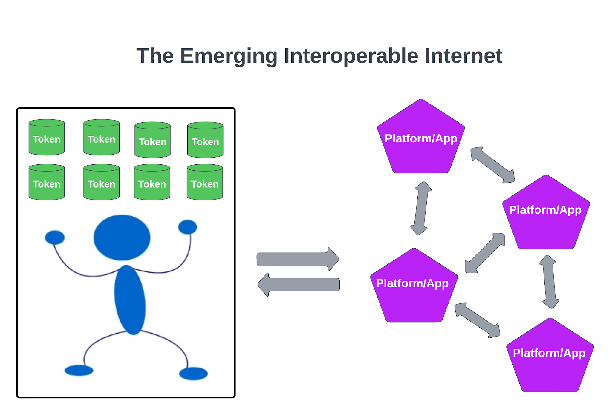
Tokens are assets but are not limited to just things (like physical things or digital things), but include:
- people or entities - think of their forms of identification, the data about them, all of which can be tokenized;
- places we visit;
- events we participate in;
- experiences in which we engage.
- and, value, like cash flows.
Anything can be tokenized. It is up to creators to imagine what they want to tokenize and ways to use the tokens. Here are the major categories in which to segment tokens by their uses:
- After creating tokens, we can update/append/reprogram existing tokens, add media and history to them;
- We can share tokens with others - it's like getting a friend or follower, or someone giving us a like or upvote from receiving a token from us;
- Communicate through tokens with others that we’ve shared them with - its like email but in context of the token, so all communication is linked to a specific token;
- Link or associate tokens to each other so that we can each see networked graphs that show the relationship we have between and amongst people/entities, places, things, events, experiences and value. Our digital lives are a collection of links, files, media and communication spread across a wide swath of platforms and devices. We can create tokens as a way to help organize this jumble of digital content.
- Because tokens are standardized, this opens them up to more transaction types that owners can engage in with them, including: (1) buying them, (2) selling them, (3) borrowing them, (4) lending them out, (5) fractionalizing them for group ownership, (6) insuring them, (7) borrowing against their value (collateralized borrowing), (8) earning royalties from them, (9) accumulate benefits like loyalty programs, (10) credentials (like an entry pass to an event).
- Tokens are open and searchable, but anonymous. As people add tokens, they build more robust data profiles about themselves that others can search for. Tokens can be made closed and not searchable, but the ethos of open but anonymous is designed to strike a balance in the need for privacy but searchability. Token owners can find each other based on shared interests and needs
- Be used as social signaling about who we are, who we are connected to, what we like, what we support, things we own, events we attend and experiences we have
- Serve as proof of what we own and what we did
- Companies can target advertising so they make effective use of their marketing spend.
What do companies/entities/influencers/government do with them
Broadly, tokens let entities create new products/services and new revenue streams, offer new ways to market, distribute, sell, communicate and interact with customers, and provide new tools to control carbon footprint, and all of this easier, faster, cheaper and more securely than current technologies.
Here’s a little more with respect to their applications:
- Tokes can be used as follows, likes, upvotes, subscribes;
- Communicate token-to-token;
- Create communities, large, small, permanent, temporary and communicate with them through tokens;
- Use as certificates of authenticity for digital or physical products (digital product passports or DPP);
- Transact tokens: sell, lend, fractionalize, insure, earn royalties, authenticate, recommerce;
- Infrastructure for loyalty programs, gift cards, affiliate programs;
- Infrastructure for emerging business models like, IP As Platform;
- More ways for marketing differentiation - 2 combo lock (what we have now) vs 22 combo lock;
- Provide tools for circularity and extended producer responsibility (EPR).
The two sections above have been copied into The Playbook Of The Future For Consumer Brands
Token UX
Tokens are represented as media (images, video, audio and/or, text), which can be static and never change once the token is forged, or dynamic with media that changes based on other variables. As a result, token creators can be very creative in how their tokens appear.
Tokens Online & Offline
Tokenizing anything gives it a unique alphanumeric identification code, which can be embedded in a URL that takes the visitor to the token’s URL page, or which can be embedded in a QR code that on scan, takes the visitor to the token’s URL page.
Token Technology Paradigm Status
Token technology is in the innovators phase of its growth, with market implementations from more than 300 brands across a variety of consumer product categories, including apparel, auto, collectibles, fashion, hospitality, luxury, membership, online gaming and travel.

The concept of tokens originated on open, cryptocurrency-based blockchains. However, progress stalled in the early 2020s due to immature technology, regulatory uncertainty, and significant usability friction.
That is starting to reverse because regulatory clarity in the U.S. has emerged; see the Generational Reset section in this document to understand the massive setup occurring to usher in the tokenization of everything. Brands need to actively develop a token strategy and begin implementation.