# **Playbook Of The Future For Consumer Brands: Strategies, Tactics, Technologies And Business Models That Unlock Enduring Value For Brands And Their Customers**
## Table of Contents
- [Overview](#overview)
- [How To Use This Playbook](#how-to-use-this-playbook)
- [Example: From First Purchase To Sustained Participation](#example-from-first-purchase-to-sustained-participation)
- [Strategy](#strategy)
- [Diversified Revenue Sources](#diversified-revenue-sources)
- [Synthetic Assets & Product Identification](#synthetic-assets--product-identification)
- [Synthetic Assets](#synthetic-assets)
- [Product Identification](#product-identification)
- [Resale/Used/Secondary Sales and Royalties/Recommerce](#resaleusedsecondary-sales-and-royaltiesrecommerce)
- [Virtual/Digital Products](#virtualdigital-products)
- [Membership And Subscriptions Programs](#membership-and-subscriptions-programs)
- [Obsolescence](#obsolescence)
- [IP As Platform/Creator To Consumer (C2C)](#ip-as-platformcreator-to-consumer-c2c)
- [User-Generated Distribution](#user-generated-distribution)
- [Examples of UGD Loops](#examples-of-ugd-loops)
- [How to Build a UGD Loop](#how-to-build-a-ugd-loop)
- [Common Pitfalls](#common-pitfalls)
- [Repairs/Maintenance/Service, Improvement/Makeovers, Upcycling](#repairsmaintenanceservice-improvementmakeovers-upcycling)
- [Refill](#refill)
- [Custom-made Using 3D Printing/Meet The Maker/Etsy 2.0](#custom-made-using-3d-printingmeet-the-makeretsy-20)
- [Side Gigs 2.0](#side-gigs-20)
- [Knowledge, Workflows And Capacity As Products](#knowledge-workflows-and-capacity-as-products)
- [Cross-Category](#cross-category)
- [Foreign Markets](#foreign-markets)
- [No Brand Vs Ultra Brand](#no-brand-vs-ultra-brand)
- [Focus on Luxury Or Technical/Die Hard Segments](#focus-on-luxury-or-technicaldie-hard-segments)
- [Big Hairy Audacious Goals](#big-hairy-audacious-goals)
- [Industry Cooperation](#industry-cooperation)
- [Shared Capabilities And Clear Boundaries](#shared-capabilities-and-clear-boundaries)
- [Everything-Level Information Collection](#everything-level-information-collection)
- [Create “WOW” To Capture Consumer Attention](#create-wow-to-capture-consumer-attention)
- [The Art of Discovering Breakthrough Products](#the-art-of-discovering-breakthrough-products)
- [What Won’t Change In Next 10-Years?](#what-wont-change-in-next-10-years)
- [Signals, Scenarios And Decision Triggers](#signals-scenarios-and-decision-triggers)
- [Market Penetration of The Leading Value Shifts](#market-penetration-of-the-leading-value-shifts)
- [Industrial Military Complex](#industrial-military-complex)
- [Sports Teams As New Brand Canvas](#sports-teams-as-new-brand-canvas)
- [Industry Sales Funnel](#industry-sales-funnel)
- [Partner Handoffs And Economics](#partner-handoffs-and-economics)
- [Solve Key Societal Problems In Context of Product/Services](#solve-key-societal-problems-in-context-of-productservices)
- [Linear To Exponential](#linear-to-exponential)
- [Age Of Unprecedented Disruption From AI](#age-of-unprecedented-disruption-from-ai)
- [Lean & Scrappy Philosophy](#lean--scrappy-philosophy)
- [Layered Reality](#layered-reality)
- [The ExO Framework](#the-exo-framework)
- [Legacy Incumbent Vs Neo - how susceptible are you to disruption?](#legacy-incumbent-vs-neo---how-susceptible-are-you-to-disruption)
- [Learning Loops](#learning-loops)
- [Run The Learning Loop](#run-the-learning-loop)
- [Token Tech](#token-tech)
- [What do companies/entities/influencers/government do with them](#what-do-companiesentitiesinfluencersgovernment-do-with-them)
- [The New B2C/B2B2C Business Stack for the AI Era](#the-new-b2cb2b2c-business-stack-for-the-ai-era)
- [Core Insight](#core-insight)
- [The Stack: Layers of a Defensible AI-Era Business](#the-stack-layers-of-a-defensible-ai-era-business)
- [When Applied to Physical Products](#when-applied-to-physical-products)
- [How?](#how)
- [Knowledge Structure, Retrieval And Tool Access](#knowledge-structure-retrieval-and-tool-access)
- [Strategic Summary](#strategic-summary)
- [The Big Idea](#the-big-idea)
- [When Building Gets Easy, Winning Gets Hard](#when-building-gets-easy-winning-gets-hard)
- [Enterprise = flip pain → pleasure](#enterprise--flip-pain--pleasure)
- [Consumer = flip guilt → permission](#consumer--flip-guilt--permission)
- [Patagonia Provisions — “Why is Patagonia making food?”](#patagonia-provisions--why-is-patagonia-making-food)
- [Moats In The AI Era](#moats-in-the-ai-era)
- [Technology & Systems](#technology--systems)
- [Product Level Tracking (Digital Product Passport)](#product-level-tracking-digital-product-passport)
- [AI & Robotics](#ai--robotics)
- [Technology Readiness Ladder](#technology-readiness-ladder)
- [Reusable Workflows And Controlled AI Operations](#reusable-workflows-and-controlled-ai-operations)
- [Product Development](#product-development)
- [Innovations That Make The Pie Bigger](#innovations-that-make-the-pie-bigger)
- [Repeat Participation](#repeat-participation)
- [Sport, Activity & Experience Innovations](#sport-activity--experience-innovations)
- [From Customer Problem To Testable Product Brief](#from-customer-problem-to-testable-product-brief)
- [AI Designer](#ai-designer)
- [Low And High Quality Products](#low-and-high-quality-products)
- [SKU Rationalization](#sku-rationalization)
- [Guided Configuration And Modular Systems](#guided-configuration-and-modular-systems)
- [Digital Prototypes And Demand Validation](#digital-prototypes-and-demand-validation)
- [Customer As Product Developer](#customer-as-product-developer)
- [Build Habits](#build-habits)
- [Build Social Into Products](#build-social-into-products)
- [Micro-costed](#micro-costed)
- [Finance](#finance)
- [Vertical integration](#vertical-integration)
- [Cost Per Useful Outcome](#cost-per-useful-outcome)
- [Debt & Equity Financing](#debt--equity-financing)
- [Production & Logistics](#production--logistics)
- [Skillshore All Goods And Services To The U.S.](#skillshore-all-goods-and-services-to-the-us)
- [Reliability And Redundancies](#reliability-and-redundancies)
- [Demand, Replenishment And Working Capital](#demand-replenishment-and-working-capital)
- [Circularity](#circularity)
- [Puma — Sustainability Practices To Examine](#puma--sustainability-practices-to-examine)
- [Marketing](#marketing)
- [Millennials, Gen Z And Incumbent Backlash](#millennials-gen-z-and-incumbent-backlash)
- [Focus On Families](#focus-on-families)
- [Build Community](#build-community)
- [Service-Led Lifecycle Communication](#service-led-lifecycle-communication)
- [All Trust Is Local](#all-trust-is-local)
- [Peer Advisers And Field Education](#peer-advisers-and-field-education)
- [Experience Marketing](#experience-marketing)
- [Other](#other)
- [Participation Systems](#participation-systems)
- [Contribution Programs: Snap For Science](#contribution-programs-snap-for-science)
- [No Stranded Marketing Costs](#no-stranded-marketing-costs)
- [Politics Marketing](#politics-marketing)
- [Heritage Marketing](#heritage-marketing)
- [Micro-Mindsets Of Outdoor Activities](#micro-mindsets-of-outdoor-activities)
- [Demand Pricing Models - Telfar](#demand-pricing-models---telfar)
- [Selling: Connoisseurs, Super Fans, Selective Buyers, Skimmers in Context of Business/Product/Brand/Audience Models](#selling-connoisseurs-super-fans-selective-buyers-skimmers-in-context-of-businessproductbrandaudience-models)
- [Earn Discovery Across Search, AI And Human Networks](#earn-discovery-across-search-ai-and-human-networks)
- [SEO>>>GEO and Findability In The AI Era](#seogeo-and-findability-in-the-ai-era)
- [Customer-Controlled Pull Distribution](#customer-controlled-pull-distribution)
- [Network Density](#network-density)
- [People Are The New Brands](#people-are-the-new-brands)
- [Love Island Formula](#love-island-formula)
- [Distribution & Sales](#distribution--sales)
- [Ecommerce-More](#ecommerce-more)
- [Offers And Transactions For Customer Agents](#offers-and-transactions-for-customer-agents)
- [Smaller Economically Viable](#smaller-economically-viable)
- [Balancing Discovery And Distribution](#balancing-discovery-and-distribution)
- [Brand DTC Retail](#brand-dtc-retail)
- [Inventory Visibility To Maximize Sales And Minimize Unsold Inventory](#inventory-visibility-to-maximize-sales-and-minimize-unsold-inventory)
- [A Practical Demand-Planning Pilot](#a-practical-demand-planning-pilot)
- [Retailers/Consignment/Gear Rental](#retailersconsignmentgear-rental)
- [Data & Systems](#data--systems)
- [Right Employees](#right-employees)
- [Experience Marketing](#experience-marketing-1)
- [Lower Price Points To Attract People](#lower-price-points-to-attract-people)
- [Add Secondary Market/Consignment model](#add-secondary-marketconsignment-model)
- [Resale Market For Kids Products](#resale-market-for-kids-products)
- [Merchandising And Layouts That Invite Customer Interaction](#merchandising-and-layouts-that-invite-customer-interaction)
- [Involvement With Local Public Lands](#involvement-with-local-public-lands)
- [Customer Experiences Off The Beaten Path And Destination Dupes](#customer-experiences-off-the-beaten-path-and-destination-dupes)
- [Clear Intent Purchasing vs Consultative Purchasing And AI](#clear-intent-purchasing-vs-consultative-purchasing-and-ai)
- [Support](#support)
- [Go Back To WFH](#go-back-to-wfh)
- [Service Context And Follow-Up](#service-context-and-follow-up)
- [Proactive Service And Recovery](#proactive-service-and-recovery)
- [AI Doppelgangers/AI Agents Scale Productivity](#ai-doppelgangersai-agents-scale-productivity)
- [AI As UX](#ai-as-ux)
- [Greater Good](#greater-good)
- [Carbon Emissions Tracking, Reporting and Reductions](#carbon-emissions-tracking-reporting-and-reductions)
- [Skills And Jobs Of A Future With AI Dominating](#skills-and-jobs-of-a-future-with-ai-dominating)
- [Skill Sets And Jobs Of The Future For Consumer Product Professionals](#skill-sets-and-jobs-of-the-future-for-consumer-product-professionals)
# **Overview**
This document is applicable to the U.S. market. It includes emerging strategies, tactics, technologies, business models and operational processes to help brands transition away from the “Old Normal” we have now that is no longer working and dying, through the difficult transition period I am calling “The Reckoning”, and into the “New Normal” for the 2030’s and beyond.
What you’ll find here is more than a static report — it’s a dynamic framework I call the Brand Unlock Graph. It maps how forward-looking brands can identify and activate value in new ways to remain competitive and culturally relevant in a rapidly changing landscape. Use it as your compass to future-proof your brand and guide decision-making into the new normal.
This document is tailored to the outdoor and active lifestyle industry, but much of what is published here can also work for other consumer product categories.
The outdoor industry has many channel types and the strategies, tactics, technologies and business models covered in this guide are applicable across many:
* Adventure Park/Ski Area/Gym
* App/Platform
* Associations/Conferences/Tradeshows
* Brand/Private Label Owner
* Consumer Group/Club/Community
* Education/Training
* Event/Races
* Gear/Equipment Rental
* Government
* Guide/Travel Planner
* Influencer/Ambassador/Athlete
* Media Publisher
* Non-profit
* Retailer/Reseller
* Service Provider/Consultant/Contractor
If not already done so, please first review the summary documents on my Future Map landing page. Reviewing the above will provide more context for this document
I organize strategies, tactics, technologies and business models in context of the traditional operational segments for a company.
* Strategy
* Technology & Systems
* Product Development
* Finance
* Production & Logistics
* Marketing
* Distribution & Sales
* Support
## How To Use This Playbook
Start with a customer problem or an operating constraint. Pick a small number of opportunities from this guide and connect the ones that depend on or reinforce each other. That is your Brand Unlock Graph. A table is enough to start; you do not need graph software.
For each opportunity, record the customer job, promised value, mechanism, prerequisites, owner, first experiment, time/cost limit, outcome measure and guardrails. Choose one experiment, establish a baseline, and set the date when you will continue, change or stop. Measure a useful result—better participation, service, retention, contribution or time saved—rather than activity alone. The detailed process is in [Learning Loops](#learning-loops).
### Example: From First Purchase To Sustained Participation
This is a proposed experiment a brand, retailer and local instructor could run together.
| Field | First paddling purchase → sustained participation |
| --- | --- |
| Customer job | Feel ready and confident enough to get on the water again. |
| Constraint | No suitable group, uncertain gear selection and no clear second outing. |
| Value offered | A compatible starter setup, introductory session, useful care guidance and a next outing. |
| Mechanism | Guided selection → successful first use → helpful follow-up → second participation → product/service feedback. |
| Partners and owner | Brand, retailer and qualified instructor/club; one person manages the handoffs. |
| Prerequisites | Accurate product/fit information, event capacity, clear responsibilities and permission for follow-up. |
| First experiment | One local cohort, a baseline/comparison approach and a fixed time/cost cap. |
| Primary outcome | Share of eligible first participants completing a second suitable activity within the chosen window. |
| Guardrails | Safety, accessibility, customer trust, staff workload and contribution after partner/service costs. |
| Evidence and decision | Use attendance, service records and customer feedback to continue, adjust or stop. Separate actual behavior from intentions. |
This connects [repeat participation](#repeat-participation), [guided product systems](#guided-configuration-and-modular-systems), [service-led communication](#service-led-lifecycle-communication) and [partner handoffs](#partner-handoffs-and-economics). The customer gets a better experience, and each partner has a clear role in making it happen.
# **Strategy**
## Diversified Revenue Sources
### *Synthetic Assets & Product Identification*
#### Synthetic Assets
The Old Normal focused on producing and selling products, which took them off the balance sheet. A brand can continue supporting a sold product through its useful life: service history, compatible upgrades, circularity and new business models. Product records also support compliance work where applicable, but identification alone does not satisfy a regulation.
#### Product Identification
Product identification gives a brand a durable way to connect a physical product with its information. Choose the appropriate level—model, SKU, batch or individual item—and an interoperable identifier that can remain useful as systems change. A serial number, QR code or NFC carrier can help people and authorized systems resolve that record.
Start with the information and service you need to deliver. Keep the identifier, record ownership and update process usable beyond one software provider. See [Product Level Tracking (Digital Product Passport)](#product-level-tracking-digital-product-passport) for the distinction between identification and passport compliance.
For example, identification can connect a product sold today with its repair, ownership and resale history years later.
### *Resale/Used/Secondary Sales and Royalties/Recommerce*
Third-party peer-to-peer platforms are rapidly growing and dominating the resale/used/secondary marketplace. They could exceed sales of new products in the future. But brands earn no revenue when their products are sold on these platforms.
To help offset lost revenue from used product sales, an industry standard 2% royalty fee is paid back to the original brand for any resale/used/secondary market sale, regardless of the platform where the sale occurred.
This fee, paid by the buyer, is highly profitable and drops directly to net income.
To receive these royalties, brands need to [uniquely ID their product lines](#product-identification) using open source technology standards ASAP, because a new product sold today could earn royalties years later if/’when it is sold on the secondary market.
Unique IDs can support Digital Product Passport readiness, but they do not establish compliance by themselves. Required data, product scope, access, interoperability and effective dates depend on the applicable legal act. See [Product Level Tracking (Digital Product Passport)](#product-level-tracking-digital-product-passport).
Like the 2% industry standard royalty fee paid by resale/used/secondary marketplaces to originating brands, the same standard can be applied to product rentals from gear rental shops.
To receive these royalties, brands need to uniquely ID their product lines using open source technology standards ASAP to make it frictionless for gear rental shops to funnel the 2% fee to the brand.
### *Virtual/Digital Products*
Create digital versions of products so that consumers can use them in metaverse applications. Digital is also a way to test products before going physical.
### *Membership And Subscriptions Programs*
Create membership or subscription programs around recurring customer value: care, useful access, instruction, replenishment where needed, or compatible upgrades. Price the benefits against the cost of delivering them and measure renewal alongside actual use. An unused benefit is a weak basis for a durable relationship.
A membership, a preorder and an ownership investment are different commitments. Keep their promises distinct; see [Debt & Equity Financing](#debt--equity-financing).
### *Obsolescence*
Connected products need a support plan as hardware, software and services change. Design for useful life, repairability, compatible upgrades and a workable exit when a connected service ends. Explain support expectations before the customer buys.
Create recurring value through care, services and new uses. Deliberately shortening replacement cycles can undermine customer trust and circularity. Where faster replacement offers a real benefit, weigh it against the full cost and lifecycle impact rather than treating turnover as the objective.
### *IP As Platform/Creator To Consumer (C2C)*
An [Ultra Brand](#no-brand-vs-ultra-brand) lets consumers use their IP to create digital products, physical products, collections from a brand, bundling from different brands and mashups.
IP As Platform/C2C (also called C2M \- creator to market) piggybacks off of the Side Gigs 2.0 economy.
* Brand stewards, herds, massages, provides light-touch leadership \- lets consumers run with IP.
* Company Assets can include Wordmarks, Trademarks, Designs, Media, Etc.
* Consumer creates for themselves or resell: Digital Products, Physical Products, Collections From A Brand, Bundling From Different Brands, Mashups: reimagine new products combining assets from different brands
Example: flower Nike shoes from generative AI went viral. In IP As Platform, Nike takes pre-orders, produces with no unsold inventory, marks up shoe 30% from average price, enjoys higher margins, and shares some of that with the creator.
![][image1]
Brands that have tested/engaged in IP As Platform:
* Nike
* Tommy Hilfiger
* Coca-Cola
* Skoda
* Lego
* Reebok
* Adore Me
* Versace
![][image2]
The IP As Platform original gangster (OG) could be considered Soylent. When Soylent first launched, it attracted a community of enthusiasts who customized the base product to create their own versions, known as "DIY Soylent" or "DIY nutritionally complete meals." These community members experimented with various ingredients, tailoring their mixtures for specific dietary needs or preferences, such as adding more protein, reducing certain carbs, or using different flavorings.
While the DIY community flourished with people sharing recipes on platforms like Reddit and the now-defunct DIY Soylent website, reselling their custom creations was less common or formally structured. The majority of activity centered around recipe sharing and home experimentation. Some individuals may have sold small batches or offered kits in more informal settings (e.g., personal websites or forums), but it didn't evolve into a mainstream or commercial resale market like other food or supplement products.
Consider how you can imitate this early Soylent model and create a base product that people can then customize on their own.
User-Generated Content (UGC) and IP As Platform is already in the music industry.
### *User-Generated Distribution*
* **Self-reinforcing loop:** Users create → others see → new users join → they create more.
* **Trust:** Peer-created content feels more authentic than brand ads.
* **Cost-efficient:** Reduces customer acquisition costs (CAC) and compounds over time.
#### Examples of UGD Loops
* **Notion:** Starter templates \+ open gallery; creators monetised and spotlighted; grew 1M → 100M largely from template sharing.
* **Duolingo:** Volunteers built courses; streaks, leaderboards, and shareable achievements drove engagement \+ bragging.
* **Canva:** 90% user-created templates, with royalties; one-click exports \+ “Made with Canva” branding turned designs into ads.
**Figma:** Multiplayer design \+ community for UI kits/templates; collaboration \= built-in invites.
* **Marketplaces (Reddit, Quora, Airbnb, Yelp):** Every post, review, or listing served both utility and distribution.
#### How to Build a UGD Loop
1. **Seed the loop (solve empty room problem):** Create starter content yourself, recruit early contributors, ensure single-player value.
2. **Incentivise & curate quality:** Offer recognition, rewards, and revenue share; actively feature the best content.
**Build compounding mechanics:** Make outputs public, portable, and branded; shorten adoption friction; add bragging/social hooks.
3. **Measure & iterate:** Track share rate and conversion; refine landing experience; align user desire to share with brand goals.
#### Common Pitfalls
* **Forcing virality:** Don’t push referrals where sharing isn’t natural.
* **Bad incentives:** Paying per referral/post \= spam; reward retention/quality instead.
* **Ignoring moderation:** Uncurated content \= noise.
* **Assuming autopilot:** Loops need seeding \+ maintenance.
* **Weak product-market fit:** Loops can’t fix a weak core product.
* **Neglecting contributors:** Treat creators as partners, not free labour.
**Core takeaway:** Design products where every user action doubles as marketing. When users proudly create, share, and collaborate, growth compounds organically.
### *Repairs/Maintenance/Service, Improvement/Makeovers, Upcycling*
Help customers keep a good product useful for longer. Repairs, fit adjustments, refurbishment, makeovers and compatible upgrades can create revenue while deepening the relationship with the owner.
Define eligible products, inspection, pricing, turnaround, parts, technician capacity, warranty and partner responsibilities. Account for collection, cleaning, rejected goods and customer support. Use service history to suggest timely care or an appropriate upgrade. A care membership works only when its recurring benefits justify the recurring fee.
Start with one service and a specialist partner. Measure contribution per completed job, turnaround, first-time resolution and repeat use. Track useful life extended where it can be observed. See [Circularity](#circularity) for the operating process and [Proactive Service And Recovery](#proactive-service-and-recovery) for customer follow-through.
![Repair and service reference screenshot][image3]
### *Refill*
Refill can work for consumables such as body care and product-care supplies. Choose between returning a container, refilling it locally or supplying an appropriate refill package based on the customer's routine and the collection/cleaning economics.
Test one product and a convenient return or refill route. Measure repeat use, packaging recovered, service cost and contribution. Environmental benefits need a defined comparison, including transport and cleaning, rather than an assumption that every refill format is better.
### *Custom-made Using 3D Printing/Meet The Maker/Etsy 2.0*
We’ve massified consumer products, but there is a return of craftsmanship by connecting consumers directly to the makers with platforms and brands facilitating
Etsy 2.0: the rise of skilled artisans, crafts and tradespeople to make for you what you want, with platforms to connect, or even brands to do the connecting in a spin on IP As Platform. Imagine Hermès elevating and promoting its craftspeople into their own personal brand and connecting Hermès customers with the craftsperson to produce for the customer what they want, at higher prices for customized work.
### *Side Gigs 2.0*
This is a recurring theme in Digital Native. Gen Z in particular wants to forgo traditional forms of work in favor of more autonomous options. Survey after survey confirms this.
For consumers/freelancers, figure out a side-gig you want to do. The tools to create and produce will be there; the challenge (as always) is distribution so that people know you exist. Start thinking about and developing a niche market and ways to reach them; build a following now so you can sell them stuff in the future
Distribution is King. If anyone can use democratized AI tools and brand assets to do what they want, barriers to entry for entrepreneurship fall to nothing, which means that distribution \- or access to customers \- is what matters.
![][image4]
Example: Slack is better, but MSFT won because of distribution
If you are a custom manufacturer or know a trade, develop it so you can do custom orders. If you are neither, you might still get into production through 3D/additive manufacturing/robots you purchase where orders get farmed out to you.
It’s all about leveraging your interests, passions, talents, know-how, who you know, your community, what you do, where you live, the assets you already have…to create a side gig that is uniquely yours.
Where consumers can create whatever they want using AI and a cottage industrial industry that makes it for them, where do consumer brands fit into this model? What if a consumer does not want to use a brand’s IP (logo, look, designs), but finds off the shelf, open source designs?
How can brands survive this paradigm shift? AI takes out the middle and gives consumers what they want. In entertainment, it currently is: Consumer\>\>\>Netflix\>\>\>Various Production Groups\>\>\>Movie/Show, or the end product. In an AI world, its consumer\>\>\>AI\>\>\>end product. In this scenario, significant value moves away from the middle to AI. Consider products: Consumer\>\>\>Retailer\>\>\>Brand Manufacturer\>\>\>Product. In an AI world, that looks like Consumer\>\>\>AI\>\>\>Custom Manufacturer\>\>\>Product. Value shifts away from the brand and to AI and the custom manufacturer.
To survive this, brands need to become [ultra brands](#no-brand-vs-ultra-brand), where consumers are so enthralled with the brand that they will still use AI and a custom manufacturer, but they will pay the brand a licensing fee to use their logo and designs. Ultra brands will leverage [creating a community](#build-community) of customers that transcends its products. Coupling this with [Experience Marketing](#experience-marketing) may be the only way to survive this shift.
### *Knowledge, Workflows And Capacity As Products*
Your brand may already hold know-how another operator needs: fitting methods, maintenance instruction, training curricula, test protocols or a useful product-selection workflow. Package one narrow outcome as an assisted service, licensed method, training product or controlled tool. Spare workshop, training, demo or event capacity may also be useful to partners.
Define what the buyer receives, permitted use, support, quality limits and ownership. Keep confidential customer records and supplier IP outside the offer. Sell one manually supported pilot to a dealer or adjacent operator before building a marketplace. Measure the customer outcome, delivery effort, support cost, willingness to renew and contribution.
See [Skills And Jobs Of A Future With AI Dominating](Skills-And-Jobs-Of-A-Future-With-AI-Dominating.md) for the wider opportunity to turn expertise and assets into useful services.
### *Cross-Category*
Grow along a customer job or capability your brand already serves. A technical garment may fit a workwear use case; gear can become a complete outing system; a consumer product may serve a team, school, outfitter or corporate buyer. Consider the moments before and after the activity as well as the activity itself.
Score an adjacent offer against credibility, required adaptation, distribution access, contribution, repeat use and operating complexity. Protect the reason core customers trust you. Test one occasion or organizational buyer with a constrained offer, then measure margin after customization/support, reorder interest and effects on core-customer preference. A small profitable segment can be enough.
Connect this work to [guided product systems](#guided-configuration-and-modular-systems) and [Micro-Mindsets Of Outdoor Activities](#micro-mindsets-of-outdoor-activities).
## Foreign Markets
Evaluate a foreign market at the customer, channel and operating level. Demographics, spending capacity, infrastructure, skills, politics, resources, currency and climate exposure all matter, but a country ranking alone does not establish demand for your product.
Start with a specific customer job and a reachable segment. Compare pricing, landed cost, local partners, service expectations and cash requirements. Test demand through a limited offer or partner before committing to a large footprint.
Use macroeconomic scenarios to prepare for upside and downside. Emerging markets may offer growth, but inflation, resource constraints and geopolitical conditions can change the economics. Define the evidence that would make you enter, expand, delay or exit; see [Signals, Scenarios And Decision Triggers](#signals-scenarios-and-decision-triggers).
## No Brand Vs Ultra Brand
Choose where your brand creates distinctive value. The diagram contrasts convenience, price and efficient distribution with identity, experience, craft and community. It is a positioning framework; a company still needs to test the actual customer job and economics of its chosen segment.
[![No Brand versus Ultra Brand: positioning, benefits, drawbacks and participation options][image5]](https://lucid.app/lucidchart/40aa92cc-8ed4-4573-b872-307699874d4f/edit?page=0&v=9688&s=612)
Between technical core users and a broad lifestyle market, compatible everyday use cases may offer room to grow. Use [Cross-Category](#cross-category) to assess those adjacencies without losing the product's core promise.
[Open in new window](https://lucid.app/lucidchart/40aa92cc-8ed4-4573-b872-307699874d4f/edit?page=0&v=9688&s=612)
Also see [Barbellization Of The Downhill Ski Resort Industry And Its Future Economic Reckoning](Barbellization-Of-The-Downhill-Ski-Resort-Industry-And-Its-Future-Economic-Reckoning.md).
[For people who don’t care that much](https://seths.blog/2025/08/for-people-who-dont-care-that-much/)
## Focus on Luxury Or Technical/Die Hard Segments
Technical enthusiasts and committed customers can be attractive segments because the activity matters deeply to them. Premium positioning may also fit a strong product and relationship. Neither segment is insulated from economic pressure, and neither is the only viable choice.
Segment by customer job, participation frequency, spending capacity, access and desired buying experience. Test technical, everyday, value-oriented and premium offers where you can deliver a distinctive outcome. Small brands can focus tightly and learn quickly.
See [Growth Strategy: Technical/Niche to Lifestyle/Mass Market](Growth-strategy_%20technical_niche-to-lifestyle_mass-market-to-capture-more-growth.md) for the opportunities and risks of moving beyond a technical core.
[See No Brand Vs. Ultra Brand graphic and considerations as an Ultra Brand using tactics for luxury marketing.](https://lucid.app/lucidchart/40aa92cc-8ed4-4573-b872-307699874d4f/edit?page=0&v=9688&s=612)
## Big Hairy Audacious Goals
Create big hairy audacious goals (BHAGs) and bold initiatives that capture the hearts, imagination and enthusiasm of customers who will want to support, encourage and enable the brands through purchases.
Consumers want to be inspired and excited by brands. They want to see brands acknowledge the need to change and solve problems.
Huge opportunities are emerging from new technologies for AI, Internet, manufacturing, material science, robotics, sustainability, software, transportation and from big secular consumer shifts.
Brands need to be bold and take risks. They need to start taking leaps, not steps. Failure to do so and there will be [incumbent backlash](#millennials-gen-z-and-incumbent-backlash)
It's not just BHAGS for customers. Create ways to fully engage employees, because if they are engaged, then they will engage customers.
![][image6]
## Industry Cooperation
Consumers want companies to cooperate to solve problems, sharing innovations and creating initiatives that capture the hearts, imagination and enthusiasm of customers.
Examples:
* Snowboards. Jones Snowboards innovation takes used snowboards and upcycles them into parts for new boards, apparently an industry first. Imagine if the industry massively and aggressively coalesces around this innovation and inside something like 3 years, there is a 10% reduction in the use of new materials. [Here’s how](https://www.linkedin.com/posts/eddiesoehnel_jones-achieves-big-first-with-re-up-snowboard-activity-7122289750085959680-LOal).
* Wetsuits. Take the same model I proposed in the above link and do this for Patagonia and wetsuits.
* And speaking about Patagonia…no other brand in the outdoor industry (or possibly across most of the consumer product industry), commands the consumer respect, attention and good will as Patagonia. Couple its massive sales and reputation, and the company could single-handedly propel the entire industry forward, leading by example in reshoring production, engaging in massive BHAG’s on sustainability and ushering in new technologies to revolutionize the industry. I feel like the company was destined to hit its stride now, through massive endeavors that help transform the industry, which no other company can do like it can. Yet the company is not stepping up, rather stepping back or engaging in the same things it did 40-years ago when it lacked the revenue and reputation. We need Patagonia to fulfill its destiny as a radical change agent, when it really matters, which is right now.
Navigating the future is too big for any one organization. Wherever possible, work together, whether through industry groups or informal groups. Especially for technologies. Why duplicate efforts?
For example, look at the money poured into autonomous vehicles from Waymo, Cruise, Tesla, Aurora Innovation, Argo AI, Zoox and Motional, which in aggregate is at least $50 billion. What if instead that money could have been combined to create a common operating system for autonomous vehicles. Think how much further we might be along if we had cooperated instead of competed. We are at the same cross-roads for robotics, where we have dozens of companies competing, but there is potential to combine efforts to create a robust robotics platform for the entire category.
Crowdsourcing everything is critical because no one person, company or group is smart enough to navigate the future. Whether through industry groups or informal groups, we need to bring people together and leverage AI to help us crowdsource to find the best solutions to our challenges and opportunities.
See [The U.S. Interconnected Ecosystems Renaissance](The-US-Interconnected-Ecosystems-Renaissance-A-Strategic-Tactical-Guide%20to%20Building-the-Next-American-Growth-Engine.md) for more strategies and tactics around industry cooperation.
### Shared Capabilities And Clear Boundaries
Cooperate on work that improves the industry without requiring every company to give up its commercial independence. Useful starting points include product definitions, interoperable identifiers, sanitized workflows, training, test methods and non-sensitive research.
Each participant keeps control of its authoritative records and commercial decisions. Agree on contribution rights, review ownership, versioning, maintenance funding, correction and exit. Shared benchmarks need credible measurement and external validation; a self-assigned score is not industry authority.
Start with three willing organizations and one shared template or workflow. Measure onboarding effort, reuse, maintenance burden and the operating benefit. Connect the work to [partner handoffs](#partner-handoffs-and-economics) and [Network Density](#network-density).
## Everything-Level Information Collection
Useful business knowledge extends beyond KPI dashboards. Service conversations, product use, failed experiments, specialist know-how and customer constraints can explain why a result occurred and what to do next.
Collect relevant information for a defined customer or operating benefit. Preserve source context and uncertainty, set appropriate access and retention, and capture expertise in a form others can use. More data is valuable only when it improves a decision or service.
Give customers meaningful control over their information. Build a relationship they choose to maintain because the service improves. See the [customer memory and trust layers](#the-new-b2cb2b2c-business-stack-for-the-ai-era) and [Knowledge Structure, Retrieval And Tool Access](#knowledge-structure-retrieval-and-tool-access).
## Create “WOW” To Capture Consumer Attention
Create an outcome customers would miss if it disappeared. Combine a useful product with less friction, clearer choices, credible proof and an experience that fits a specific audience. Start narrow enough that you can recognize whether customers care, then build on that response.
## The Art of Discovering Breakthrough Products
Begin with the customer's frustrating workaround, desired outcome and reason to change. Look for innovation in the offer, service, channel, economics and operating process as well as materials or styling. Several modest changes can combine into a much better customer experience.
Use [The Art of Discovering Breakthrough Products](The-Art-of-Discovering-Breakthrough-Products.md) to explore those dimensions, then turn the chosen hypothesis into a [testable product brief](#from-customer-problem-to-testable-product-brief).
## What Won’t Change In Next 10-Years?
We ask what will change and make predictions to position for the upside or the downside, but an equally interesting exercise is to ask “what won’t change?” Come up with a list of what won’t change with respect to your category, customer, geographic area where you sell, and build your business based on what you know will not change.
See [Skills And Jobs Of A Future With AI Dominating](Skills-And-Jobs-Of-A-Future-With-AI-Dominating.md).
## Signals, Scenarios And Decision Triggers
Build a small watchlist around decisions you actually face: supplier concentration, energy/material costs, customer affordability, channel dependence or adoption of a new technology. Separate what you observed from what you think it means and what might happen next.
For each important uncertainty, record:
* Your exposure and the decision it could change.
* A confirming signal and a disconfirming signal.
* The threshold for acting, an accountable owner and a review date.
* A reversible response and the cost of waiting or acting too soon.
Use a premortem: imagine the strategy failed and identify the causes you can test now. Prediction-market prices can be one sensor where relevant, but contract wording, liquidity and corroborating evidence matter. They are not facts or instructions to trade.
Start with one purchasing or market-entry decision and three scenarios. Measure whether the research improves timing, limits exposure or prevents a premature commitment. The purpose is a better decision, not a larger reading list.
## Market Penetration of The Leading Value Shifts
![Illustrative adoption positions for access, wellness, experiences, independence, sustainability and spendthrift values][image7]
This diagram groups possible value shifts along an adoption curve. Use the categories to frame customer research; its positions and percentages are not a verified current market-share series. Confirm the source, date and target-market evidence before using it quantitatively.
## Industrial Military Complex
Given the outsize risks we face, this sector will likely not experience degrowth. Figure out a way to sell to the industrial military complex.
## Sports Teams As New Brand Canvas
Sports offer a rich canvas for storytelling, belonging and participation. Major-team ownership takes substantial capital, but smaller brands can work with an athlete, local team, club, clinic or recurring event.
Build anticipation before the event, useful participation during it and a reason to return afterward. Connect athlete stories, teaching, watch parties, demos, hospitality and nearby businesses where they fit. Existing venues and natural access can support a compelling experience before anyone builds major infrastructure.
Confirm rights, athlete benefit and local capacity. Start with one athlete/club story series tied to one event and a next-step invitation. Measure returning participants, contribution effort, production cost, partner value and attributable revenue. Prove repeated attention before depending on sponsorship or expanding into a media platform. See [Sport, Activity & Experience Innovations](#sport-activity--experience-innovations) and [Experience Marketing](#experience-marketing).
## Industry Sales Funnel
For reference, review the [Marketing Ascension Funnel](https://lucid.app/lucidchart/b9a7e7ad-1a97-4934-a2c8-532f6076bc05/edit?page=0&v=1366&s=405)
[![][image8]](https://lucid.app/lucidchart/b9a7e7ad-1a97-4934-a2c8-532f6076bc05/edit?page=0&v=1369&s=612)
The elephants in the room across any consumer product industries are conflict between large brands and small specialty brands, conflict between D2C and retail, and conflict arising from commoditization and discounting. But industry categories (for example, biking, climbing, paddlesports, snowsports, etc) may be able to organize themselves where these conflicts become assets.
The goal is to get customers into this funnel and engage them so they flow through the funnel and up the value ladder.
Large brands and retailers may provide entry-level pricing and gear, while local instructors, guides and specialty shops help new customers choose equipment and enjoy their first experiences. Some customers then seek more instruction, service or specialist products. Others are well served by an affordable setup for occasional use.
Organize around the customer's next useful step. Media, clubs, apps, recommerce, activity locations, public-land partners and non-profits can all contribute. Agree on responsibilities and compensation across handoffs; rigid territory should not leave the customer stranded between purchase, instruction, service and resale.
On the reverse side, innovation and performance-level products start at the high-end where specialty retailers play. As those innovations mature and move into mass market, the specialty retailers can help the large brands and large retailers create entry-level products, letting them do what they do best, which is to drive down costs and efficiencies so that the recreational/entry level buyer can enjoy these innovations. This cycle may see new recreational/entry-level buyers emerge that can then be put through the funnel. Can this funnel be applied not just to consumers, but the industrial market and the military market?
Review these tools that are applicable to this industry sales funnel concept: see section [what is “WOW”](#create-wow-to-capture-consumer-attention), see section [Experience Marketing](#experience-marketing), and see section “[No Brand or Ultra Brand](#no-brand-vs-ultra-brand)”
### Partner Handoffs And Economics
Agree who handles discovery, fitting, instruction, purchase, fulfillment, repair and resale, and how each contributor earns value. Options include a demo fee credited toward purchase, a dealer-fulfilled online order, a fitting/service payment, a repair referral or an experience attached to an existing product.
Keep inventory, eligibility, referral attribution, returns and the customer relationship clear. Pilot one journey with a brand, retailer and service/experience partner. Measure completed handoffs, participation, contribution to each partner, stock accuracy and disputes. Reconcile actual completed transactions; a referral link or smart contract alone does not guarantee payment attribution.
See [Inventory Visibility To Maximize Sales And Minimize Unsold Inventory](#inventory-visibility-to-maximize-sales-and-minimize-unsold-inventory) and [Retailers/Consignment/Gear Rental](#retailersconsignmentgear-rental).
## Solve Key Societal Problems In Context of Product/Services
Be part of the solution and craft your product/services in context of solving out key challenges and not contributing to them. Consumers want companies to lead in solving problems.
Begin with a specific participant and community benefit. The [Snap For Science participation example](#contribution-programs-snap-for-science) shows how to test a small contribution loop before building a broad environmental platform.
## Linear To Exponential
Shared knowledge, repeatable workflows, participant contributions and useful network connections can reinforce one another. Identify the mechanism and test whether each cycle improves value, reach or cost. Tokens are one possible coordination tool, not a prerequisite or a guarantee of exponential growth. See [Exponential Growth Strategies](Exponential-Growth-Strategies.md).
## Age Of Unprecedented Disruption From AI
See the AI amplification discussion in [Future Of Apparel](Future-of-Apparel.md). Use its possibilities to identify experiments, then check the conditions required for your business: cost, reliability, capacity, customer adoption and physical validation.
For a major bet, state the dependency clearly: if a capability reaches a specified level, what becomes possible, what constraint remains, and what evidence would justify investment? Use [scenario triggers](#signals-scenarios-and-decision-triggers) and the [technology readiness ladder](#technology-readiness-ladder) to turn a future possibility into a bounded next step.
## Lean & Scrappy Philosophy
Whether its a startup or established brand that needs to transition to the new normal, adopt a lean and scrappy philosophy that prioritizes a startup culture, focus and execution over financial resources and brute force. Consider many examples that demonstrate when lean and scrappy beat out the better funded:
* Tesla vs. established automakers
* SpaceX vs Blue Origin
* Netflix vs. Blockbuster
* AirBnB vs traditional hospitality
* Wikipedia vs Encarta
* Warby Parker vs Luxottica
* Nintendo vs Sony and Microsoft
* Dyson vs Hoover
* Instagram vs Facebook Camera
* Shopify vs Amazon
## Layered Reality
The metaverse isn’t just about creating new virtual worlds, but enhancing our existing ones through data, connectivity, and intelligence. Figure out what data and intelligence you need to collect and enhance and how you can use it to add value for customers. Think about how you can make your products/services and entire company more connected to add value to customers. Its data, tracking tech (NFC, RFID), IoT devices, token tech, spatial computing, edge computing, broadband.
Layered reality is about blending physical and digital (goods, services, in-person, digital and virtual world experiences).
## The ExO Framework
Study this framework and see how it can apply to you.
The ExO Framework—short for Exponential Organizations Framework—was developed by Salim Ismail, founding executive director of Singularity University and author of the book Exponential Organizations. This framework outlines how modern, fast-growing companies (especially "unicorns") scale rapidly by leveraging external assets and communities, instead of owning everything internally.
Core Concept: Traditional companies grow linearly because they rely on internal assets (e.g. factories, employees, inventory). Exponential Organizations (ExOs) grow exponentially because they tap into external, scalable resources (like communities, platforms, and AI).
The ExO Framework Formula: An ExO is defined as: A company whose impact (or output) is disproportionately large—at least 10x—compared to its peers, because of the use of new organizational techniques that leverage accelerating technologies.
The key elements of the framework:
External (SCALE): These let the org grow fast without needing to own everything.
* Social Technologies – Use collaboration tools to engage teams.
* Community & Crowd – Outsource ideas, labor, and validation.
* Algorithms – Leverage AI, ML, and data to scale decisions.
* Leveraged Assets – Rent or share assets instead of owning them.
* Engagement – Gamify and incentivize community participation.
Internal (IDEAS): These ensure agility and focus within the org.
* Interfaces – Clear workflows to manage external resources.
* Dashboards – Real-time metrics for decision-making.
* Experimentation – Rapid prototyping and lean startup mindset.
* Autonomy – Small, independent, self-managed teams.
* Social Purpose – A “Massive Transformative Purpose (MTP)” that drives passion and alignment.
## Legacy Incumbent Vs Neo \- how susceptible are you to disruption?
Review your exposure to change: channel concentration, distinctiveness of the product, value customers retain by staying, rights to useful data, operating rigidity and speed of experimentation. For each, identify the constraint and the next test. An incumbent may have deep relationships and operating knowledge; a newer entrant may have fewer systems and habits to change. Neither position determines the outcome.
Use the review to choose where to adapt first, rather than assigning an unsupported probability of disruption.
## Learning Loops
Via Peer Diamandis
Forget patents, first-mover advantage, or access to capital. The real “moat,” or sustainable advantage, that startups today MUST enable in the AI era, according to past Google/Alphabet CEO Eric Schmidt, is \*learning loops\*.
“Software/AI is now a network-effect business where the fastest mover wins. The fastest mover is the fastest learner in an AI system."
Eric is describing companies that create systematic feedback loops where every user interaction teaches the system something new. And those learnings immediately improve the product for the next user.
So, what’s the result of this? "If my learning slope is steep enough, I'm essentially unstoppable," Eric explains, because by the time competitors figure out what you've done, your learning advantage has become insurmountable.
Traditional startups focus on building features, raising capital, or acquiring users.
Learning loop companies focus on one thing: how fast can we get data and insights from our users, learn something, iterate and improve?
Here's why this is revolutionary: in the AI era, your product can literally get smarter with every interaction. But only if you design the system to capture, process, and implement those learnings immediately.
The math here is devastating for traditional startups. As Eric explains: "How close can my competitor be and still lose? The answer is a few months because the slopes are exponential."
This also means a competitor can launch a product just months after you and still crush you—if they’ve built better learning loops to scale their product or service.
This isn't about being first to market. It's about being the fastest learner in the market.
Eric breaks down the mechanics: "I'll give you a simple learning loop: as you get more people, the more people click, the more you learn from their clicks, and the more they express their preferences.”
But the best companies have multiple loops: user behavior teaches the AI, the AI improves the product, better products attract more users, more users generate more data, and the cycle accelerates.
As Eric puts it, the key insight is: "If you can’t define your company’s learning loops, you're going to be beaten by a company that can define them."
Whether you're building consumer apps, enterprise software, or hardware products, the companies that survive the AI revolution will be those that learn fastest from their users.
The old playbook—build in stealth, launch with fanfare, iterate slowly—is dead. The new playbook is launch fast, learn faster, improve fastest.
Every day you're not building systematic learning into your product is a day your competitors can catch up and crush you. But once you establish exponential learning slopes, you become what Eric calls "essentially unstoppable."
The learning loop revolution isn’t off in the distant future. It’s already here. The entrepreneurs who understand this principle and implement it fastest will build the next generation of billion-dollar and trillion-dollar companies.
### Run The Learning Loop
Give each proposed unlock a record linking the customer job, constraint, promised value, mechanism, prerequisites, owner, first experiment, time/cost cap, outcome measure and guardrails. Connect records that depend on or reinforce each other. Separate controllable actions, outside conditions and observed results.
Choose one test and a baseline. Set the review date and success/stop conditions before starting. Guard against improving a headline metric at the expense of quality, customer trust, margin or staff workload. A higher click rate is not useful if it produces poor purchases and returns.
After the test, record what happened and decide to continue, change or stop. Correct the current output, convert repeat failures into a durable rule or check, and evaluate system changes before adopting them. Measure time from observation to decision and experiments that change a real operating choice. See the [worked example](#example-from-first-purchase-to-sustained-participation) and [Reusable Workflows And Controlled AI Operations](#reusable-workflows-and-controlled-ai-operations).
## Token Tech
Tokens can represent an asset, credential, participation right or other defined relationship. Start with the business requirement: what should a person be able to own, verify, share or do? Then compare the mechanism with an ordinary identifier, account, database, contract or payment service.
Use a token when a specific benefit—such as interoperable ownership or verifiable coordination—earns its added complexity. The possible applications below depend on implementation, rights, participating systems and customer adoption; they are not capabilities every token has automatically.
* After creating tokens, we can update/append/reprogram existing tokens, add media and history to them;
* We can share tokens with others \- it's like getting a friend or follower, or someone giving us a like or upvote from receiving a token from us;
* Communicate through tokens with others that we’ve shared them with \- its like email but in context of the token, so all communication is linked to a specific token;
* Link or associate tokens to each other so that we can each see networked graphs that show the relationship we have between and amongst people/entities, places, things, events and experiences. Our digital lives are a collection of links, files, media and communication spread across a wide swath of platforms and devices. We can create tokens as a way to help organize this jumble of digital content.
* Because tokens are standardized, this opens them up to more transaction types that owners can engage in with them, including: (1) buying them, (2) selling them, (3) borrowing them, (4) lending them out, (5) fractionalizing them for group ownership, (6) insuring them, (7) borrowing against their value (collateralized borrowing), (8) earning royalties from them, (9) accumulate benefits like loyalty programs, (10) credentials (like an entry pass to an event).
* Visibility and privacy depend on the design. Publicly searchable records can reveal sensitive relationships even when a person uses a pseudonym. Define what may be shared and keep private customer context out of public profiles.
* Be used as social signaling about who we are, who we are connected to, what we like, what we support, things we own, events we attend and experiences we have
* Serve as proof of what we own and what we did
* Companies can target advertising so they make effective use of their marketing spend.
### *What do companies/entities/influencers/government do with them*
Tokens may support new products, transactions or ways to coordinate participation. Evaluate each use against cost, access, reliability, customer control and the alternatives. Community, communication, circularity and customer memory can also work with conventional systems.
Here’s a little more with respect to their applications:
1. Tokens can be used as follows, likes, upvotes, subscribes;
2. Communicate token-to-token;
3. Create communities, large, small, permanent, temporary and communicate with them through tokens;
4. Link authenticity or product records to a digital or physical item; a token alone does not establish Digital Product Passport compliance;
5. Transact tokens: sell, lend, fractionalize, insure, earn royalties, authenticate, recommerce;
6. Infrastructure for loyalty programs, gift cards, affiliate programs;
7. Infrastructure for emerging business models like, [IP As Platform](https://docs.google.com/presentation/d/13hF1m5lIoOxg-w8lBlck-pwdEj6Am1WLUvuewbXxAMw/edit#slide=id.g2622e407109_0_43);
8. More ways for marketing differentiation \- 2 combo lock (what we have now) vs 22 combo lock;
9. Provide tools for circularity and extended producer responsibility (EPR).
## The New B2C/B2B2C Business Stack for the AI Era
This is a framework for building competitive moats when intelligence is free.
Original LLM research log on this topic is [here](https://docs.google.com/document/d/10Yn72xycAEYcADImPbu9ERdV1qK96ivFCXNWLo3wB6o/edit?tab=t.0).
### *Core Insight*
As AI models become cheap and interchangeable, the advantage shifts away from intelligence and toward memory, /ontology, benchmarks, and relationships. Brands—whether they sell physical or digital products—must build moats based on data uniqueness, customer connection, and network effects.
### *The Stack: Layers of a Defensible AI-Era Business*
1\. Proprietary Content
* Still valuable, but not enough by itself.
* Great content provides a foundation for LLM customization.
* BUT: Substitution risk is high—consumers often settle for 80% accuracy.
2\. Customer Memory & History – The Key Revelation Toward the Moat
* Preserve relevant customer-provided facts, transaction/service events and product-use history, with source and date.
* Keep model inferences distinct from facts; retain confidence and uncertainty and let customers correct inaccuracies.
* Collect the context needed for a defined benefit, with clear access, purpose and retention. Keep confidential interpretation separate from public identity.
* Example: permissioned dog-training and service records can help a provider offer more relevant follow-up without confusing one customer's history with another's.
* Retention comes from better service and accumulated understanding. Give customers meaningful export/delete choices; do not make their history unusable elsewhere to force them to stay.
Start with a small set of consenting records. Check identity matching, stale facts, unsupported inferences, correction, access and export before automating broad personalization. Measure service improvement and wrong-person associations, not just database growth.
3\. Ontology
* The deeper the data is labeled so AI can understand it and follow it, the more useful it becomes.
* Proprietary content, memory and history are not enough. It is making the data useful. Data by itself is useless unless it is structured and has deep meaning.
* It is giving the data meaning.
4\. Benchmarks and Scoring
* Ontology structures the data but may not be enough. Benchmarks and scoring systems turn that structure into measurable progress.
* Once entities, behaviors, relationships, and events are defined, the next competitive layer is defining what improvement looks like—and how it is measured over time.
* Benchmarks create:
* Direction – What is the system optimizing for?
* Comparability – How do we know if performance improved or declined?
* Accountability – Can outcomes be validated?
* Gravity – Others begin optimizing toward your scorecard.
* Without owned benchmarks, structured data becomes passive reference material. With owned benchmarks, it becomes the exam others must pass.
5\. Network Effects
* Social layers create stickiness and virality.
* Examples:
* Dog owners sharing progress and tips.
* Product owners sharing experiences through a community, with tokens optional.
* Network utility amplifies product value → value grows as more people connect.
6\. Experimentation & Simulation Engines
* Once structured data and benchmarks exist, the next competitive layer is the ability to run continuous experimentation on the dataset (via Autorsearch swarms).
* Proprietary datasets become living laboratories where AI can test hypotheses, simulate scenarios, and explore “what if” questions automatically.
* Instead of occasional human analysis, AI agents can run thousands of experiments across the dataset to identify patterns, strategies, and improvements.
* This converts a dataset from passive reference material into an active discovery engine.
* Examples:
* Testing which behaviors most reliably predict outcomes.
* Simulating product usage scenarios to discover new product opportunities.
* Running optimization experiments on training methods, recommendations, or interventions.
* Over time, the organization accumulates not just data, but experimental knowledge and validated insights that competitors cannot easily replicate.
* Experiments generate candidate improvements. Compare them with the current approach, check effects on protected outcomes, and promote changes only when the evidence earns it. A simulation does not replace physical product testing or a live customer experiment.
7\. Trust & Privacy
* Earn confidence through accurate records, clear permissions, limited access, sound security practices and dependable service.
* Give users appropriate control over their information, including correction, export and deletion.
* Evaluate encryption and privacy-enhancing computation against a defined threat model and workload. Fully homomorphic encryption (FHE) can enable selected computation on encrypted data, but it does not guarantee truthful outputs, authorized actions or end-to-end security.
* Keep customer data, credentials and consequential permissions within controlled boundaries. Plan for recovery and correction when something fails.
Microsoft's [SEAL security guidance](https://github.com/microsoft/SEAL/security) illustrates that homomorphic encryption still has specific assumptions and application-level responsibilities. Local or open-source systems can offer more control, but they also need secure operation. No single architecture removes the need for judgment and trust.
8\. Feedback Loops & Adaptation
* The AI system improves over time:
* Learns from user interactions
* Surfaces patterns automatically
* Becomes predictive, not just reactive
* Creates a sense of a living relationship with the brand or product.
9\. Distribution Advantage
* Partnerships that cement control over high-value points of entry:
* Breeders, trainers, vets (pet example)
* Retail ecosystems, token marketplaces (physical product example)
* Platform integrations (fitness, health, gaming)
### *When Applied to Physical Products*
Products can escape commoditization by becoming:
* Memory carriers (durable product identity linked to useful history)
* Social connectors (communities of product owners)
* Semantic networks (well-structured information and meaningful relationships)
#### How?
* Give the appropriate product, batch or model a durable identifier and a record that can be updated.
* Let customers add relevant usage, service and experience history with clear control over what is shared.
* On resale, separate transferable product history from the previous owner's personal information.
* Add semantic retrieval where it improves discovery, recommendations or service. Tokens are optional; choose them only when they add a useful capability.
* Each product becomes:
* A node in a living network
* A conversation starter
* A meaningful identity object
> Result: Owning the product \= owning a personalized experience layer, not just an object.
### *Knowledge Structure, Retrieval And Tool Access*
Start with authoritative information, stable identity, useful headings, relationships, source attribution and meaningful updates. Resolve missing values, units, permissions and stale records before relying on automated answers.
These components have different jobs:
* **Knowledge structure:** establishes what a record means, where it came from and which version is current.
* **Retrieval:** supplies relevant context for an answer or decision. Retrieval-augmented generation (RAG) uses that context when generating an answer.
* **Embeddings:** support semantic matching where it helps; they do not replace structured fields, keyword search or provenance.
* **Tool access:** interfaces such as MCP expose supported resources and authorized actions. They are not a substitute for a knowledge model or permission checks.
Choose the smallest architecture that serves the workflow, then validate extraction and answers against source records. The customer benefits when the system supplies accurate context and completes a useful task. See [findability](#seogeo-and-findability-in-the-ai-era) and [Reusable Workflows And Controlled AI Operations](#reusable-workflows-and-controlled-ai-operations).
### *Strategic Summary*
To build a moat in the AI era, combine:
1. Proprietary Content (expert knowledge or brand stories)
2. Customer Memory & Personalization (relevant history and customer control)
3. Deep and rich ontology
4. Benchmarks
5. Network Effects (social and functional connections)
6. Experimentation & Simulation (test candidate improvements)
7. Trust & Privacy (control, security and dependable service)
8. Adaptive Feedback Loops (learn from observed outcomes)
9. Distribution Channels (brand relationships and partnerships)
### *The Big Idea*
* Products and brands no longer win by being the smartest.
* They win by owning the richest, most relevant memory graph connected to people, products, and communities.
* Intelligence becomes the *commodity*. Memory \+ meaning becomes the *moat*.
## When Building Gets Easy, Winning Gets Hard
The incoming AI era will empower more people to create products/services that in the past required levels of expertise, sophistication and capital that were not available to people. This really means that where anyone can create product/services, the power shifts to differentiation.
## Enterprise \= flip pain → pleasure
1. Take something that people know they should do, but don’t like doing.
2. And turn it into something they like doing.
## Consumer \= flip guilt → permission
1. Take something we really enjoy doing, but feel guilty about.
2. And make us not feel so guilty about it\!
## Patagonia Provisions — “Why is Patagonia making food?”
Patagonia is using food as an extension of its environmental mission. This is not just product diversification. It is category expansion from apparel/gear into regenerative systems, land use, supply chains, and climate-aligned consumption.
* Regenerative business models
* Values-to-product expansion
* Brand as ecological systems actor
* Functional food / outdoor nutrition adjacency
Instead of a clothing company, is Patagonia moving into a vertically integrated company around regenerative, whose products span many categories?
## Moats In The AI Era
1. The moat is not a wall you build once. It’s a wall you iterate on and move faster than anyone can attack it.
2. The Coasean Singularity paper released from MIT and Harvard (2026) argues that when AI agents search, compare, negotiate and transact for us at near-zero cost, the customer relationship stops belonging to whoever owns the storefront and starts belonging to whoever the agent trusts. [The Coasean Singularity? Demand, Supply, and Market Design with AI Agents](https://www.nber.org/papers/w34468) was issued as an NBER working paper in November 2025, with a [book chapter published in September 2026](https://www.nber.org/books-and-chapters/economics-transformative-ai/coasean-singularity-demand-supply-and-market-design-ai-agents). It examines agents reducing transaction costs and changing market design. The storefront-to-agent-trust framing above is a strategic interpretation, rather than an established universal result of the paper. Likewise, the scarcity sequence in point 4 is a scenario to revisit as supply, substitution and customer demand change.
3. Own what is scarce that throws off cash.
4. Demand flows to what is scarce. In 2026 that is energy, semiconductors, compute, all of which will be the basis for everything (compute = intelligence that runs digital and physical via Ai and robotics, giving us what we want and need). But eventually, just like buildouts of the past, it will become saturated. Where will demand flow next? What will be scarce in the AI era? Land, human experiences, human relationships, creativity, craftmanship.
5. **Proprietary data from real use.** Build a history of product performance, fit, failures, repairs and customer outcomes that competitors cannot readily buy or recreate. Connect observations to conditions and results so the data improves products and decisions. A growing pile of generic content adds little protection. See [Everything-Level Information Collection](#everything-level-information-collection).
6. **Customer memory that earns the next interaction.** Remember relevant preferences, owned equipment, goals and service history so each interaction becomes more useful. For example, a retailer can recommend a compatible upgrade using the customer's existing setup. The advantage comes from accumulated understanding and better service; preserve correction, export and deletion choices. See [the customer memory layer](#the-new-b2cb2b2c-business-stack-for-the-ai-era).
7. **Deep domain structure and connected knowledge.** Organize relationships among people, products, parts, activities, conditions and outcomes. A reliable compatibility map or fit model can be harder to reproduce than a product catalog. The moat is the maintained domain knowledge and its proven usefulness; a database, ontology or retrieval tool alone is readily replaceable. See [Knowledge Structure, Retrieval And Tool Access](#knowledge-structure-retrieval-and-tool-access).
8. **Trusted benchmarks and proof of performance.** Develop credible ways to measure what customers care about: durability, fit, repairability, learning progress or successful participation. A history of comparable results can earn authority with customers and partners. Use transparent methods and appropriate independent validation; a self-assigned score does not create that authority. See [Benchmarks and Scoring in the business stack](#the-stack-layers-of-a-defensible-ai-era-business).
9. **Learning that accumulates faster than competitors can copy.** Connect customer use, experiments and service failures to changes in the product and operation. Save the failed approaches as well as the successful ones. Competitors may copy a feature while lacking the evidence that guides the next decision. Speed matters when it produces validated improvement. See [Run The Learning Loop](#run-the-learning-loop).
10. **Proprietary operating know-how.** Turn hard-earned fitting, inspection, production, diagnosis or maintenance methods into repeatable workflows. AI and agents can help deliver that expertise, but defensibility comes from specialized inputs, evaluation cases, exception handling and reliable outcomes. A prompt library or an agent built on a commonly available model is weak protection by itself. See [Knowledge, Workflows And Capacity As Products](#knowledge-workflows-and-capacity-as-products).
11. **Direct distribution and trusted referral paths.** Build permissioned customer contact, repeat visits, dealer relationships and referrals from people customers already trust. These relationships give a brand a route to demand without reacquiring every customer through a platform. Keep earning attention through useful service. A large rented audience is vulnerable to changes in access. See [Side Gigs 2.0](#side-gigs-20) and [Network Density](#network-density).
12. **Verifiable reliability for customers and their AI agents.** Make the offer easy to evaluate and dependable to fulfill: accurate compatibility, current availability, clear total cost, credible product evidence and reliable service. Over time, a record of successful transactions can differentiate the brand. Machine-readable information helps a brand participate; a demonstrated ability to deliver creates the stronger advantage. See [Offers And Transactions For Customer Agents](#offers-and-transactions-for-customer-agents).
13. **Trust, accountability and recovery.** Be the business people trust with their information, purchases and problems. Follow through, protect private context, explain limitations and resolve failures with an accountable person. Competitors can copy a promise more easily than a long record of keeping it. See [All Trust Is Local](#all-trust-is-local) and [Proactive Service And Recovery](#proactive-service-and-recovery).
14. **Brand identity, heritage and belonging.** Give customers a reason to choose the brand even when alternatives perform similarly. Build a recognizable point of view through consistent products, people, stories and action. Authentic history and shared meaning take time to earn; logos and AI-generated storytelling alone offer little defense. See [No Brand Vs Ultra Brand](#no-brand-vs-ultra-brand) and [Heritage Marketing](#heritage-marketing).
15. **Communities with relationships worth returning to.** Help members find companions, mentors, recognition and a place to contribute. A competitor can copy the forum or event format more easily than the relationships and shared history. Invest in hosts, moderation and recurring participation; measure member-to-member value and return participation. See [Build Community](#build-community) and [Participation Systems](#participation-systems).
16. **Network effects that improve the actual service.** Make each relevant participant increase value for others: more nearby repair partners improve coverage, more compatible inventory improves availability, and more active participants improve matching. Test whether added participation improves outcomes for existing users. Audience growth alone is not a network effect, and crowding or poor quality can reduce value. See [Network Density](#network-density).
17. **A useful ecosystem of complementary products and partners.** Connect equipment, compatible upgrades, instruction, repair, rental and resale into a dependable customer journey. Partners have a reason to stay when participation creates value for them too. Customers return because the system works together; artificial incompatibility can damage trust. See [Guided Configuration And Modular Systems](#guided-configuration-and-modular-systems) and [Partner Handoffs And Economics](#partner-handoffs-and-economics).
18. **Human relationships and experiences people specifically seek.** Build access to trusted guides, instructors, makers, hosts and recurring shared experiences. For customers who value personal presence, the relationship and memories can remain distinctive even as AI improves planning and delivery. Confirm that the target audience values and pays for this difference. See [Experience Marketing](#experience-marketing) and the Skills and Jobs document's discussion of experiential, human-centric services.
19. **Craftsmanship, taste and authentic provenance.** Develop a recognizable creative standard, skilled execution and a verifiable connection to the maker. Bespoke gear, repair artistry or a small collection can combine utility with meaning. AI can imitate styles and assist production, so the advantage depends on customer preference, quality and credible origin. See [Meet The Maker](#custom-made-using-3d-printingmeet-the-makeretsy-20).
20. **Scarce places, access and specialized capacity.** A desirable activity location, convenient service site, established venue or dependable access to a constrained resource can be difficult to replicate. Evaluate the specific location, access terms, utilization and customer demand. Widely available land, machines or compute may produce revenue without providing defensibility. See the Skills and Jobs document's Physical & Infrastructure Assets and Location-Based Scarcity Assets sections.
21. **Physical product and production capability that is difficult to reproduce.** Combine materials expertise, tooling, supplier relationships, process knowledge, testing and consistent yield. AI-generated designs still need to become reliable products at a workable cost. Validated performance and production experience can strengthen the advantage; protect distinctive know-how and relevant rights where appropriate. See [Technology Readiness Ladder](#technology-readiness-ladder).
22. **A structural advantage in cost, speed or service coverage.** Develop operating economics competitors struggle to match through local density, shared infrastructure, purchasing scale, high utilization or tightly coordinated production and delivery. For example, a dense repair route can reduce travel cost and turnaround. Compare full costs at the same quality standard; buying the same automation as everyone else may only keep you competitive. See [Vertical integration](#vertical-integration) and [Cost Per Useful Outcome](#cost-per-useful-outcome).
23. **An installed base supported through its useful life.** Build parts availability, diagnostic knowledge, trained technicians, repair history, upgrades and resale support around products already in use. Each service encounter can improve the next repair and deepen the relationship. Competitors must reproduce the support capability as well as the product. See [Repairs/Maintenance/Service](#repairsmaintenanceservice-improvementmakeovers-upcycling) and [Circularity](#circularity).
24. **Earned access, qualifications and partner confidence.** Some opportunities depend on established permission to operate, specialist qualifications, demonstrated quality or a long process of partner acceptance. These can slow imitation when they are genuinely difficult to obtain and maintain. Routine paperwork is weak protection, and requirements can change. See the Skills and Jobs document's Trust & Verification Assets and Regulatory Arbitrage Assets sections.
**How these moats reinforce each other:** A local outdoor brand could combine a recurring guided activity, a trusted community, permissioned fit and service history, and dependable repair access. The activity creates relationships; relationships generate useful feedback; feedback improves products and service; better outcomes bring people back. The combined system can be harder to reproduce than any single component.
**Choose where to build:** Pick two or three advantages that reinforce the same customer promise. For each, name the customer benefit, what a competitor would need to reproduce, what accumulates with use, how the business retains value, and what could weaken the advantage. Test retention, referrals, successful outcomes and contribution after delivery costs. Reassess scarcity as capacity expands. This follows the Skills and Jobs document's warning about asset sprawl: more assets do not automatically make a stronger business.
# **Technology & Systems**
## Product Level Tracking (Digital Product Passport)
Connect the appropriate model, SKU, batch or individual product with a durable record. A QR code, serial number or NFC carrier can make that information accessible, but the carrier is only one component. Decide who maintains the record and how identity remains usable through repair, resale and changes of software provider.
Digital Product Passport requirements are introduced progressively. The required data, product scope, access, interoperability and effective dates depend on the applicable product-specific act or separate legislation. A unique ID by itself does not establish compliance. Map your product and market to the actual requirements before choosing the implementation. See the [European Commission's DPP guidance](https://single-market-economy.ec.europa.eu/single-market/digital-product-passport_en).
Start with a reliable product record for specifications, materials, appropriate service information and lifecycle updates. Add required passport information and controls as applicable. Connect it to [Circularity](#circularity) and [customer memory](#the-new-b2cb2b2c-business-stack-for-the-ai-era), while separating personal information from transferable product history.
## AI & Robotics
AI and robotics create opportunities across design, service and production. Choose a bounded customer or operating problem first, then identify the data, tools, people and physical capability needed to solve it.
### Technology Readiness Ladder
Move a material, robot or production method through distinct gates: computational suggestion → physical sample → repeatable performance → acceptable production yield → cost at the required volume → supplier capacity → product qualification → serviceability.
A laboratory result or demonstration does not establish production readiness. Trial one component or manufacturing step against an existing alternative. Compare performance, defects, lead time and full cost, then define the condition that earns expansion. A brand can work with a specialist without becoming a materials laboratory or owning a factory. See [AI and material discovery](AI-DFT-Quantum-Based-Material-Ingredient-Design-Material%20Discovery.md) and [local production](#skillshore-all-goods-and-services-to-the-us).
## Reusable Workflows And Controlled AI Operations
Put useful AI judgment over dependable operating processes. Write the workflow contract: trigger, allowed inputs, expected output, authority, exclusions, completion evidence, budget, exceptions and recovery.
Use AI where interpretation helps and tested code or existing systems for precise actions. Save durable state, prevent duplicate side effects and isolate failures. Verify the actual output destination: a running service or successful tool call does not prove that the business task finished.
Test one constrained workflow with representative cases, including ambiguity, missing inputs, duplicate requests and partial failure. Measure accepted completion, unresolved exceptions, review effort and [cost per useful outcome](#cost-per-useful-outcome) before broadening authority. Turn recurring failures into durable checks or clearer instructions; test changes and retain a rollback path.
# **Product Development**
## Innovations That Make The Pie Bigger
What would help more people participate, enjoy a successful first experience and keep coming back? Better access, instruction, fit, affordability and confidence can expand the market alongside new products. Longer active lives and assistive technologies may create further opportunities; the [longevity discussion](https://www.diamandis.com/blog/longevity-escape-velocity) is one direction to investigate, not a timetable to build a sales forecast around.
### Repeat Participation
Design the route from first exposure to first successful use, second outing, greater confidence and sustained participation. Remove a specific barrier at each step: unclear equipment, no partner, intimidating skill level, poor fit, inaccessible location or no obvious next occasion. A brand, retailer, instructor and venue can share this work.
Start with a beginner outing, a simple equipment plan, optional peer support and a clear second event. Measure first-to-second participation over a defined window, confidence, barriers resolved and contribution after event costs. Distinguish increased activity from increased product consumption: a durable product may support many sessions before another purchase.
Exosuits, assistive devices and robotics may extend participation where performance, safety and cost fit the use. Apply the [technology readiness ladder](#technology-readiness-ladder) before making them central to an offer.
## Sport, Activity & Experience Innovations
For example:
* Surfing \>\>\> wave pools, surf parks, artificial waves, surf lakes.
* Golf \>\>\> Bucketgolf
What new sports, activities, experiences (or variations thereof) that reinvigorate interest in an existing sport or activity?
Use existing places creatively. A local waterway or venue can connect clinics, demos, events, hospitality and nearby businesses without first building a large facility. Tie the experience to a next activity and measure return participation and partner value. See [Sports Teams As New Brand Canvas](#sports-teams-as-new-brand-canvas).
## From Customer Problem To Testable Product Brief
Ask target users about actual behavior, frustrating workarounds and the outcome they want. Test a manual service or prototype before broad engineering. Interest, willingness to spend time and a paid commitment are different signals.
Translate the chosen hypothesis into a brief: intended user, use conditions, measurable performance, constraints, unacceptable failures, test method and decision owner. Keep the chain from customer evidence to specification to prototype result to the next revision. Measure task success and the assumptions invalidated. Physical products still need evidence under real use conditions.
## AI Designer
AI can help product developers explore concepts, form/function, materials, positioning, prototypes and production options. Keep the product brief and customer evidence in control of the process. A compelling render does not establish fit, demand, manufacturability or environmental performance.
Test the chosen design through the [technology readiness ladder](#technology-readiness-ladder). See [Future Of Apparel](Future-of-Apparel.md) for a wider set of possibilities.
## Low And High Quality Products
Design for the useful life the customer needs, with repairability and an appropriate route for reuse or recovery. A lower-priced product can improve access, but short life should not be justified by an unverified claim of zero emissions or full circularity.
Compare the complete customer and lifecycle outcome: performance, replacement frequency, care, material use, collection and actual recovery. Offer affordable products that earn their place through value, and higher-performance products where the customer benefits from the difference. See [care and repair](#repairsmaintenanceservice-improvementmakeovers-upcycling).
## SKU Rationalization
Reduce SKU lines and make fewer product choices available:
* Consumers are already overwhelmed with choices by brands so make it easier for them. The human brain becomes paralyzed with too many options.
* People are time-poor.
* Another consequence of too many choices is that people end up less satisfied with their decisions. A store stuffed with too many white cotton blouses can only raise doubts that a better blouse was missed somewhere in the haystack. That creates a lingering sense of regret, and less satisfaction with a purchase. Imagine that impact on return visits and customer loyalty.
* People have too much cognitive load in their daily lives, with so much competing for their attention. Anything that reduces this cognitive load is helpful to consumers.
* Future resource constraints could likely cause SKU rationalization anyway. Fewer choices piggybacks off consumer shift towards wanting more help making those choices.
![][image9]
### Guided Configuration And Modular Systems
Reduce decision complexity as well as SKU complexity. Offer compatible configurations around a named job: a beginner river day, cold/wet commute, travel kit or seasonal maintenance. Explain the tradeoffs and let customers retain useful components they already own.
Modular components can support meaningful choice without multiplying every production and inventory variation. Keep expert help available when fit, safety or use conditions need judgment. Test one guided selection flow using existing products. Measure completion, incompatibility returns, decision time, margin after service and success in the intended use—not just average order value.
## Digital Prototypes And Demand Validation
Move from problem evidence to concept preference, prototype use, a credible commitment and a small production run. A digital prototype can help explain or test a concept; likes, surveys, refundable reservations and paid orders each tell you something different.
For a limited batch, publish the production limit, lead-time range, what remains unproven, and how changes or cancellations work. Track reservation-to-order conversion, cancellations, delivery, defects, returns and cash tied up. Adjust the next batch from those results. Do not use artificial scarcity to conceal production uncertainty.
## Customer As Product Developer
Customers can help develop, test, market and share in the value of products through [IP As Platform](#ip-as-platformcreator-to-consumer-c2c). Explain design rights, ownership, attribution, quality control and any revenue share before asking for their work.
Use the [demand-validation process](#digital-prototypes-and-demand-validation) to move from preference to product evidence. Test a limited variant with a small cohort, preserve the source of useful feedback and show contributors how it changed the offer.
## Build Habits
Habits form from: (1) a cue, (2) that triggers an action, (3) which results in a reward (dopamine hit).
Think about ways in which you can build habits that result in interactions with your brand, beyond just using a product.
Outdoor is losing to activities with stronger dopamine addictions. How can this be reversed?
![][image10]
Make the next activity easy, useful and welcome. Measure whether customers return to the activity and gain confidence, rather than simply increasing screen time or promotional interactions. See [Repeat Participation](#repeat-participation).
## Build Social Into Products
Among digital natives, especially Gen Z, everything is social. Companies need to design social into the DNA of their products. Digital products are easy. For example:
1. Investing: the disruptor is AfterHour, which offers a social hub for trading and financial learning; the incumbent is now Robinhood.
2. Dating: the disruptor is Amori, which takes single-player dating and makes it collaborative and social with LLM-powered matchmakers; the incumbent is now Tinder.
3. Mental Health: the disruptor is Marble Health, which centers around group therapy for teens; the incumbent is now Teledoc.
4. Shopping: the disruptor is Flagship, a commerce infrastructure that powers creator recommendations through boutique storefronts; the incumbent is now Shopify.
These incumbents are not that old, but already, they are considered dinosaurs and are being disrupted by upstarts.
Physical products can connect people through owner communities, instruction, shared activities and service history. A conventional identifier and community system may be sufficient. Use token technology only where it adds a specific benefit; see [Build Community](#build-community).
Keep an eye on group buying. Commerce in the West has traditionally been single-player. Pinduoduo in China has been very successful at group buying. No one has nailed it yet in the U.S., but it is starting to seep into existing platforms.
Much more on product development covered in the SkillShoring document (in progress)
## Micro-costed
Lower transaction costs may make small purchases and services more practical. Evaluate the payment rail separately from the offer. FedNow is an instant-payment service for banks and credit unions, not a central bank digital currency. See the [Federal Reserve's explanation](https://www.federalreserve.gov/faqs/is-fednow-replacing-cash-is-it-a-central-bank-digital-currency.htm).
Test the smallest useful paid outcome against payment fees, support, fraud/dispute handling and operating cost. A fast payment does not make an unprofitable micro-service viable. Use [cost per useful outcome](#cost-per-useful-outcome) to decide whether the model works.
# **Finance**
## Vertical integration
“Your margin is my opportunity” \- Jeff Bezos
Own a capability when it is strategically important and you can operate it reliably. Buy it when a specialist's scale, expertise or service level earns its price. Share it when participants can agree on governance and benefit.
Compare full cost, utilization, speed, quality, required skills, failure recovery, switching cost and concentration risk. Include transition, maintenance, support and exit—not just the supplier's margin. Open-source software and owned hardware offer choices, but operating responsibilities remain.
For one real capability, build a make/buy/share comparison and test the preferred option. If owning a system, prove restoration and support before depending on it. Measure total cost and service outcomes over a representative period. Use [Industry Cooperation](#industry-cooperation) where a shared capability creates more value than duplicating it.
![][image11]
## Cost Per Useful Outcome
Measure the total cost of an accepted result: model/tool fees, infrastructure, human review, retries, rework, failed runs, maintenance and support. Compare the same workload and quality standard with the baseline.
Separate increased capacity, time actually saved, costs actually removed and incremental revenue. A saved hour is not automatically a cash saving. Use ordinary code for exact repeatable work and increase AI reasoning effort only when evaluation shows a worthwhile gain.
Test one workflow at two levels of automation or model effort. Compare accepted-result rate, total cost, latency and reviewer minutes. Set a spending cap, and stop expanding if quality, workload or contribution worsens.
## Debt & Equity Financing
Choose financing around the business's cash requirements, delivery obligations and risk. Bootstrapping can preserve control and encourage focus; debt, equity or customer commitments may fit different needs. Compare the complete terms, runway, governance and operating burden rather than assuming one approach suits every brand.
Keep three value exchanges distinct:
| Commitment | What the customer or participant is buying |
| --- | --- |
| Preorder | A future product under clear delivery/change/cancellation terms. |
| Membership | Recurring benefits whose value should justify renewal. |
| Ownership investment | An ownership interest with financial risk and its own rights and obligations. |
Customer ownership may deepen participation, but capital raised does not prove loyalty or a durable moat. Research customer appetite and the business case before soliciting funds. An actual ownership offering needs a current, jurisdiction-specific structure and qualified review. Measure customer use, renewal and operating economics separately from financing proceeds.
# **Production & Logistics**
## Skillshore All Goods And Services To The U.S.
Explore local production where automation, skills, supplier capacity and economics support it. Smaller batches can shorten lead times and reduce inventory exposure, but location alone does not establish cost, quality or resilience.
Trial one component or production step. Compare landed cost, yield, serviceability, working capital and recovery from disruption. Expand when measured performance earns it. See [Future Growth Engines for the U.S.](Future-Growth-Engines-For-The-US-The-One-Starting-Now-That-Unlocks-Americas-Next-Economic-Supercycle.md) and the [technology readiness ladder](#technology-readiness-ladder).
## Reliability And Redundancies
Build resilience around the disruptions that matter to your supply chain: concentrated suppliers, long lead times, climate events, resource constraints or geopolitical interruptions. Compare redundancy, local production, alternative sourcing and inventory buffers against their cost and recovery value.
### Demand, Replenishment And Working Capital
Clean product identities and reconcile orders, returns, cancellations, stockouts, inventory and receipts across channels. Preserve the raw inputs and include lead times, minimum orders and service targets. Observed sales are constrained by availability; they are not a perfect measure of demand.
Use deterministic calculations for quantities and uncertainty, with AI helping explain exceptions for an accountable human. Record overrides and their outcomes. The practical pilot and measures are in [Inventory Visibility To Maximize Sales And Minimize Unsold Inventory](#inventory-visibility-to-maximize-sales-and-minimize-unsold-inventory).
## Circularity
Circularity seeks to redefine growth, focusing on positive society-wide benefits by employing reuse, sharing, repair, refurbishment, remanufacturing, and recycling to create a closed-loop system.
Connect design, sourcing, production, service and end-of-life handling. Define who accepts an item, inspects it, repairs or refurbishes it, supplies parts, handles rejected goods and pays for the process. Link service history to useful product identity while keeping personal information separate.
Map producer-responsibility and passport obligations to the actual jurisdiction, product, legal act and effective date. Do not assume identical requirements for every company or category. Use [Extended Producer Responsibility Laws](Extended-Producer-Responsibility-Laws.md) as a research starting point and verify the applicable current requirements. See [Product Level Tracking](#product-level-tracking-digital-product-passport) for DPP preparation.
The data work matters. Preserve supplier evidence, units, dates and provenance across sourcing, production and logistics. AI can assist extraction and interpretation, but missing or conflicting information still needs resolution and validation. Connecting sources in different formats does not make all their claims accurate or comparable.
Pilot one [repair, care or refill service](#repairsmaintenanceservice-improvementmakeovers-upcycling). Measure contribution, turnaround, repeat use and useful life extended where observable. For an environmental claim, state the system boundary, baseline, period, method and data quality. Separate direct measurements from estimates and projected benefits.
See the [Reindustrialization Supplement](Reindustrialization-Supplement.md) for related production possibilities.
## Puma — Sustainability Practices To Examine
[Review the Puma sustainability material](https://docs.google.com/presentation/d/1btwfk_c8x6u4l7Okyl7KgyppzZfFh3Y9BM8J-0T9xJU/edit?usp=sharing) for practices worth examining. Assess each claim's boundary, period, evidence and relevance to your products before adopting it or describing the company as an overall leader. A useful example should lead to a measurable operating change.
# **Marketing**
## Millennials, Gen Z And Incumbent Backlash
Understand younger customers without treating a generation as a single market or excluding everyone else. Segment by customer job, participation frequency, spending capacity, life stage, access and preferred buying experience. Validate demand and contribution in the segment you can serve distinctively.
Established companies should take the possibility of incumbent backlash seriously: customers may lose confidence when a brand appears unresponsive to problems they care about. Earn relevance through useful products, measurable improvements, credible leadership and service. Test what matters to your customers rather than assuming age determines their beliefs.
![Generational and incumbent-backlash reference illustration][image12]
## Focus On Families
Make participation easier for the families you can serve: affordable entry points, suitable instruction, shared experiences, flexible scheduling and products that can be maintained or passed along. Different households have different constraints.
More stability and prosperity could support family formation, but an increase in births is a scenario, not a prerequisite for a useful family offer. Start with current needs, test one offer and measure participation, repeat use and contribution. Build a reputation for helping families now.
## Build Community
Emily Weiss, the Glossier founder, once said: ‘Anything can be copied or replicated online. Communities can’t, which is why they’re a brand’s most important asset’.
Roblox does not focus on game-like objectives (win, kill, shoot, defeat, score, beat), but non-game-like ones (share, create, express, identify, feel, show).
Build community around a member job: learning, solving a problem, participating together or making progress that would be harder alone. Give a new member a welcome path, a first useful action and a person who can help.
Establish roles and rhythms: hosts, mentors, curators and moderators; a recurring gathering; a concise digest; and a clear way to contribute. Turn valuable discussions into a searchable, source-linked handbook so useful knowledge survives the feed. Rotate leadership and retire formats that no longer serve members.
Start with a small cohort, a welcome partner, one useful session and a follow-up digest. Measure time to first useful contribution, questions resolved, member-led work, return rate and satisfaction. Honor communication preferences. Member voice and shared governance do not require tokens or constant online attention.
Use [Participation Systems](#participation-systems) for the wider relationship model and [Network Density](#network-density) to make useful connections between members.
## Service-Led Lifecycle Communication
Normal service encounters already create valuable context. Use it to send something helpful: setup guidance, a relevant lesson, a care reminder, a resolved issue or a compatible service. Respect the customer's stated preferences and the purpose of the communication.
In my pet business, I have been building the customer-data, capture/transcription and email components that can support this approach. In the [August 2026 PaddleNET update](https://forge.paddlenet.earth/paddlenet-hub/platform-updates/src/branch/main/paddlenet-update-august-4-august-16-start-building-one-to-one-email-marketing-and-analyzing-700-brand-emails.md), I described those pieces and the work still needed to connect the full personalized loop.
Start with one narrow after-service sequence and reviewed drafts. Measure helpful replies, issues resolved, repeat service, complaints and operator time. An email open is not proof of attention or intention. Use customer outcomes to improve the next communication; the operating steps are in [Support](#service-context-and-follow-up).
## All Trust Is Local
Trust is moving away from large, distant institutions and toward people and organizations that feel close, familiar and accountable. This matters because trust is not built through more messaging. It is built through repeated personal contact.
Local does not only mean geography. Local means getting in front of people personally—employees, investors, vendors, service providers, retailers, resellers, customers, community partners and anyone else whose trust matters to the business. Meet face to face, listen, help, follow through and stay visible. The closer and more familiar the relationship becomes, the stronger the trust.
Companies should treat personal presence as a marketing tactic and operating discipline. Put leaders and employees into stores, events, workplaces and communities. Build systems that create frequent direct contact instead of relying only on advertising, dashboards and digital communication. In a trust recession, proximity, familiarity and service create a moat.
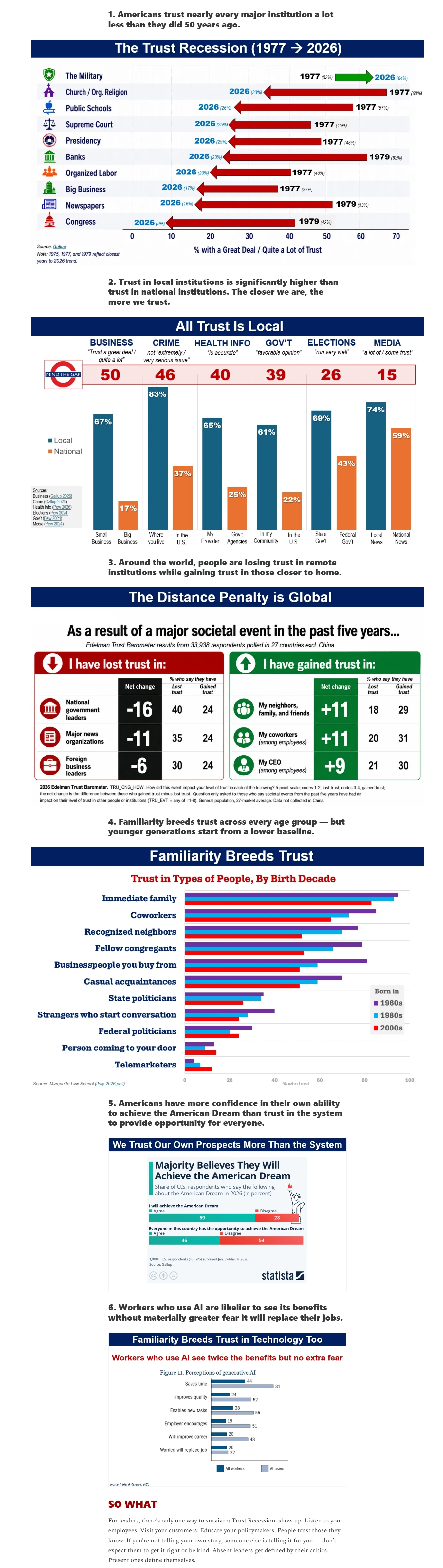
## Peer Advisers And Field Education
Recruit experienced users, technicians, guides or local experts who can help others make a better decision. Give them product education, test access, clear scope, fair compensation or benefits, and a way to report problems. Make commercial relationships clear and separate practical training from any formal certification claim.
Let advisers teach, demonstrate, compare and surface failures. Test a small local cohort with one defined education task. Measure assisted decision quality, return reasons, participant outcomes, useful product feedback and the cost of supporting the group. Follower counts alone do not establish value.
Connect advisers with [retailer employees](#right-employees), [People Are The New Brands](#people-are-the-new-brands) and [local stewardship](#involvement-with-local-public-lands). Recent field-adviser and stewardship examples are discussed in the [brand-innovation research collection](https://projects.eddiesoehnel.com/adminprojects/brand-innovation-intelligence).
## Experience Marketing
Product performance, operating capability, trusted relationships, accumulated learning and distribution can reinforce one another. Assess how easily each advantage can be copied and how well you can maintain it.
Experiences deepen that combination by giving customers a personal reason to care and return. Make the product and service earn the relationship; memorable marketing cannot repair a weak underlying offer.
How do you get brand, which gives you distribution?
Tap into emotions, not logic.
Create positive emotions about your product/company, because there is a saying: “People will forget what you said, people will forget what you did but people will never forget how you made them feel”.
AND HOW DO YOU CREATE POSITIVE EMOTIONS? CREATE EXPERIENCES, BECAUSE EXPERIENCES CREATE THE STRONGEST FEELINGS WHICH PEOPLE WILL REMEMBER.
Guru Guidance: Ty Haney, from her experience with Outdoor Voices apparel brand, says she gets 4x the value through high-touch experiential events compared to advertising.
In experience marketing, purchasing a product is no longer a core user activity. It is secondary to participating in a community, having access to quality content, benefiting from personalization, attending events, identifying with a brands vision/mission, enjoying VIP/loyalty perks, experiencing superior service.
When product differences are difficult to recognize, experiences can make the value tangible. [Ultra brands](#no-brand-vs-ultra-brand) connect products with meaningful activities, service and identity. Keep testing the role of each rather than assuming loyalty is secure: [research on how marketers assess brand loyalty](https://www.marketingweek.com/marketers-overestimate-brand-loyalty/).
Always ask customer: How disappointed would you be if our product disappeared?"
Brand Longevity Framework: Simple Formula For Long-Term Brand Success
1. Create unique and positive EXPERIENCES for your customers…which creates positive EMOTION tying them to your company…
2. helping you build BRAND…
3. which helps customers choose to return, supporting lifetime value and more efficient marketing…
4. which helps you get DISTRIBUTION…
5. which leads to company LONGEVITY
![][image13]
See [Experience Marketing Supplement To New Normal](Experience-Marketing-Supplement-To-New-Normal.md).
The outdoors is all about experiences, so it is easy for companies in the industry to create experiences around their products/services.
* [See here for more about 9dcc and its experience marketing](https://lucid.app/lucidchart/651b0b45-3909-4496-9923-312e3f44d7d0/edit?page=0&v=769&s=612)
* [See here for experience marketing in context of ultra events](https://lucid.app/lucidchart/6b88e7f1-75c3-4d27-b96c-f03e989e10e3/view?page=0_0&invitationId=inv_d062ca57-5976-4c60-ad0e-03f7c09692c3#)
### *Other*
* [Why we get hooked: The invisible threads behind product loyalty](https://uxplanet.org/why-we-get-hooked-the-invisible-threads-behind-product-loyalty-62308457a25f)
## Participation Systems
A clear pattern emerging across the consumer brand landscape is that brands are evolving from simply selling products into building what can best be described as participation systems. A participation system is a business model where the customer is no longer just a buyer at the end of a transaction, but an ongoing participant inside a broader ecosystem of experiences, identity, community, contribution, rewards, data, resale, events, content, or co-creation. This is seen repeatedly in the research and is an extension of experience marketing. Across the industry, brands are increasingly trying to create recurring engagement loops where customers contribute attention, creativity, identity, data, inventory, advocacy, or participation — not just dollars. This shift matters because participation systems create stronger retention, richer first-party data, higher switching costs, more resilient communities, and entirely new monetization layers beyond selling physical goods. In many ways, the product is becoming the entry point into an ongoing relationship system rather than the final outcome itself.
Build the operating cadence through [Build Community](#build-community), and judge the loop by [Repeat Participation](#repeat-participation). A first purchase, event attendance or upload is a beginning. Identify what helps the person take a second useful action and measure it over a defined window.
### Contribution Programs: Snap For Science
Snap For Science explores a simple waterway participation loop: one easy observation, an honest useful response, then an invitation to feedback, a local action or a later contribution. Give value before asking for optional identity or deeper involvement.
The MVP separates several questions. A successful upload establishes capture. A conference test can assess comprehension and response usefulness; a later consumer pilot is needed to assess repeat participation. A separate specialist review must establish whether the data supports an intended scientific use. The initial experience should not claim unvalidated scientific interpretation.
Apply the same discipline to a brand contribution program. Define the participant benefit, partner job, data-quality requirement and next evidence gate. Test completion, capture reliability and response usefulness before expanding geography, data collection, incentives or monetization. Keep tokens and broad platform ambitions optional until they earn a role.
## No Stranded Marketing Costs
Stranded costs in marketing occur are when the time, costs and effort associated with ascending customers up the value chain, only to see them leave, becomes stranded or sunk costs.
Reduce lost relationship value through helpful follow-up, portable customer context and relevant services. Token-based approaches are one possibility, but no technology guarantees that customers stay or that past marketing spend is recovered. [Explore the token-based marketing ascension concept](https://eddiesoehnel.com/tokentech/marketing-ascension-framework-web2-vs-web3/) alongside the [service-led approach](#service-led-lifecycle-communication).
## Politics Marketing
Companies can’t be everything to everyone. Don’t just take a stand, but market like political strategists, concentrating messaging, distribution and sales in geographic areas where customers live.
## Heritage Marketing
Old, established brands can use their history to create products and marketing around their heritage to help differentiate the brand and products. Luxury brands do this very well.
Just simply displaying (online or in-store) advertising campaigns over the decades provides a timeline for how the company has evolved. A great example is Fjällräven store in Stockholm.
Even young brands can incorporate history \- think of your own retail store in a historic district or historic building.
## Micro-Mindsets Of Outdoor Activities
![Outdoor activity mindsets: nature connection, wilderness, challenge, fitness, lifestyle and social experiences][image14]
Use the diagram to explore why people participate: connection with nature, challenge, fitness, social time, exploration or lifestyle expression. Treat it as an illustrative map rather than a fixed classification of people. Ask customers which job matters in the current occasion, then test a compatible offer through [Cross-Category](#cross-category).
## Demand Pricing Models \- Telfar
Telfar's 2023 Live Pricing experiment offers a useful historical pricing example. Contemporary reporting described prices starting at wholesale and rising toward retail during the release—not falling. See [Fashionista's March 21, 2023 report](https://fashionista.com/2023/03/telfar-live-pricing-strategy). This describes that experiment, not a claim about the brand's current universal policy.
For your own pricing experiment, make the rules clear and test whether they improve demand information, perceived fairness and contribution. Explain how buyers paying different prices are treated. Measure cancellations and trust as well as sell-through.
## Selling: Connoisseurs, Super Fans, Selective Buyers, Skimmers in Context of Business/Product/Brand/Audience Models
Use [Selling: Connoisseurs, Super Fans, Selective Buyers and Skimmers](Selling_Connoisseurs-Super-Fans-Selective-Buyers-Skimmers-in-Context-of-Business%3D-Product-Brand-Audience-Models.md) to consider how the offer and buying experience should change with the audience's level of interest and involvement.
## Earn Discovery Across Search, AI And Human Networks
Generic content is easier to produce, while discovery and referral patterns are changing. Invest in distinctive, useful evidence on channels you control and distribute it where customers seek answers. Search, AI assistants, retailers, experts and personal recommendations can each play a role.
Maintain sound search fundamentals and test outcomes by channel. Google states that these fundamentals remain relevant to its AI features and that special AI files or schema are not required for inclusion. This does not establish requirements for every other platform or guarantee indexing. See [Google Search guidance](https://developers.google.com/search/docs/appearance/ai-features).
## SEO>>>GEO and Findability In The AI Era
Make your differentiation and product knowledge understandable and current. Establish an authoritative source for specifications, fit/compatibility, price, availability, repair, warranty, locations and people. Keep meaningful text accessible, and preserve identity, relationships, attribution and actual freshness across pages, feeds and partner systems.
Publish useful proof: test conditions, relevant expertise, delivery performance and resolved product questions. Add semantic indexes or tool endpoints when they serve a real consumer or workflow. They do not replace a useful product, credible information or human trust.
Start by auditing the questions people ask about your top products. Correct omissions and contradictions, then test factual retrieval and task completion across selected channels. Measure incorrect answers, stale offers, qualified visits and conversions where attributable. A citation is not a guaranteed sale.
Use the maintained [Master Findability Framework](https://projects.eddiesoehnel.com/adminprojects/master-findability-framework-OPEN), [AI Knowledge Structure](https://projects.eddiesoehnel.com/adminprojects/ai-knowledge-structure-OPEN) and [Future Of Apparel](Future-of-Apparel.md) for the deeper methods. Shared industry knowledge can help where participants maintain quality and clear ownership; see [Industry Cooperation](#industry-cooperation).
### Customer-Controlled Pull Distribution
Let a customer or their assistant retrieve the updates they want: product changes, events, care guidance or useful resources. Start with current pages, feeds or supported connectors. Add a skill or MCP interface when it provides useful access, keeping public information separate from account-specific history.
This is an emerging channel to test. Invite a small willing cohort to retrieve one category of updates on its own terms. Measure retrieval, freshness, relevance and resulting actions, and record attribution gaps. Keep conventional channels available while learning what customers use. See [Balancing Discovery And Distribution](#balancing-discovery-and-distribution).
## Network Density
Build more useful connections between customers, partners and contributors. Match an active need with relevant capabilities, offers or available assets, and explain why both parties could benefit now.
Distinguish an immediate business match, a strategic relationship and an exploratory introduction. Check evidence, timing, feasibility and whether each party is open to that relationship. Keep rejection and sensitive feedback private, and use it to avoid unhelpful repetition. Shared interests alone do not establish commercial fit.
Start by manually curating a small set of dealer, instructor, maker or service-provider introductions. Measure accepted introductions, useful conversations, completed collaborations and repeat value. The number of suggestions is not success, and a match-strength score is not a probability of success. Connect this work to [Industry Cooperation](#industry-cooperation) and [Build Community](#build-community).
![][image15]
## People Are The New Brands
Help customers connect with the people behind the product: makers, advisers, employees and community leaders. Give them useful work and a credible voice. See [People Are The New Brands](People-Are-The-New-Brands.md) and [Peer Advisers And Field Education](#peer-advisers-and-field-education).
## Love Island Formula
Immersive+participatory+online-to-offline+network effects.
A hit show that broadcasts 6 days per week, making it immersive, allowing the audience to participate, then creating mechanisms that take the digital to offline for social connections, which allows network effects to apply. It's a variation of experience marketing.
# **Distribution & Sales**
## Ecommerce-More
See creator commerce and on-demand production in [Future Of Apparel](Future-of-Apparel.md).
Fashion, especially, drives off trends where brands and retailers need to respond instantly. The only way to do this sustainably at scale is AI \+ On-Demand Production For apparel, especially, there is no way to forecast demand or trends and operate on pre-season buys, open-to-buy, lead times, advance orders. It’s all moving to real-time.
AI may help identify needs and test product ideas before customers articulate a solution, but predictions still need validation against customer behavior and product performance.
### Offers And Transactions For Customer Agents
Make routine buying easy to delegate while preserving discovery, sensory experience and expert help when customers value them. Expose accurate variants, compatibility, inventory, total price, shipping, returns and warranty.
Define what an agent may do: research, quote, reserve, buy, change or return. Tie paid actions to the customer's authority, recheck terms at execution and provide clear confirmation and recovery. Keep service accessible when a marketplace or assistant mediates the order.
Test one stable replenishment item or simple accessory through an existing supported channel. Measure factual accuracy, completed orders, duplicate/incorrect orders, service failures and attributable contribution. Add specialized interfaces only when the channel supports them and the benefit earns the work. See [Agentic Commerce: When AI Does the Shopping for You](Agentic-Commerce_When-AI-Does-the-Shopping-for-You.md) and [consultative purchasing](#clear-intent-purchasing-vs-consultative-purchasing-and-ai).
## Smaller Economically Viable
Automation may make a smaller retail or hospitality location viable when labor savings exceed the added equipment, integration, maintenance and support costs. Test the actual service model, traffic, rent and contribution before expanding.
Changes in office use may create location opportunities, but a micro-retail boom is a scenario rather than a guaranteed outcome. Use a small location or temporary format to learn where the economics work.
## Balancing Discovery And Distribution
The problem in consumer product sales has always been about discovery. The market is so big and varied that it is very hard for consumers to efficiently find brands and products.
To make it easier for consumers, aggregators exist to serve as the bridge between brands and consumers. Whether it's online (for example, Google Search, Amazon) or offline (for example, Wal Mart), the bottleneck in distribution between brands and consumers is the aggregators because there is only so much product they can show (in the case of online brands) or carry on shelf (in the case of offline brands).
Discovery needs to improve, but how do you do that when consumers gravitate towards aggregators to make it easier, yet the aggregators can only show them so much, and further, the aggregators are influencing discovery to benefit them, not consumers?
This will always be a problem and its possible for online search it will get better for consumers in the future as new technologies come online.
The other problem is to balance discovery with distribution through aggregators. You want consumers to find you and be able to easily buy your products, but there is the risk where too much distribution erodes your brand.
At present, maximizing discovery online happens most effectively through customer referrals (word of mouth), social networks and influencers, whereas once discovered, people purchase brands through online aggregators. Offline, discovery happens at specialty and independent retailers.
For [ultra brands](#no-brand-vs-ultra-brand), Focus on efficient discovery both online and offline and choose carefully the distribution and aggregators you use where you won’t erode your brand. You want to try to keep a measure of scarcity with respect to your brand to maintain brand value. Getting into too many distributors or aggregators works against this.
## Brand DTC Retail
Brands with many SKU lines can go DTC with their own branded stores (mono-retail).
This strategy is currently working, which brands are using and this will likely lead to saturation of outdoor retail stores in local markets, the negative effects which will only magnify in future recessions.
Brands need to be careful in using this strategy and not get too extended.
## Inventory Visibility To Maximize Sales And Minimize Unsold Inventory
Develop an industry-specific platform (for example, biking, climbing, paddlesports, snowsports, etc) and participants visibility into real-time inventory, no matter where it may be (retailer, reseller/marketplace, dealer, brand warehouse), so that the point-of-sale can give the consumer what they want as quickly as possible with as little friction as possible, and the point-of-sale earns that sale without referring it away, while allowing the holders of that inventory to also profit from some of the margin coming from the sale, thereby selling product that won't need to be discounted at season-end or dumped at a loss in closeout channels.
### A Practical Demand-Planning Pilot
Shared inventory visibility complements the brand's own demand and replenishment decisions. Start with a small SKU family and weekly exports. Reconcile sales, returns, cancellations, stockouts and receipts, then include lead times, minimum orders and service targets.
Compare a simple forecast with rolling historical tests before adding outside signals. Track bias and forecast error alongside stockouts, service level, markdowns and cash tied up. Record human overrides and their outcomes. Add outside signals only when they improve results on periods not used to tune the approach.
The [Demand Signal Lab roadmap](https://forge.paddlenet.earth/innovation-lab/demand-signal-lab) describes this staged approach; it is a roadmap, not a deployed forecasting tool. Use the pilot to learn whether the decisions improve before building a larger system. See [Demand, Replenishment And Working Capital](#demand-replenishment-and-working-capital).
## Retailers/Consignment/Gear Rental
### *Data & Systems*
Use accurate inventory and customer-service records to support [demand planning](#a-practical-demand-planning-pilot) and [partner handoffs](#partner-handoffs-and-economics). Agree on availability, fulfillment, attribution and returns before connecting channels.
### *Right Employees*
Hire and develop people with relevant product, activity and local knowledge. Give them the training, time and authority to help customers, and a way to return product feedback to the business. Connect them with [Peer Advisers And Field Education](#peer-advisers-and-field-education).
### *Experience Marketing*
Add experience marketing: store activities; food/alcohol to attract people to hang out; activities for community, social engagement. People are constantly seeking meaningful and natural in-person connections \- be creative in how to use IRL spaces to foster connections and create memorable experiences for consumers. Help customer maximize their experience in the area of your location \- create maps to give to store visitors with your favorite nearby ships, restaurants and sites.
To protect against ecommerce more, retail will have to become more experiential.
Example here with [Cosm](https://www.bloomberg.com/news/features/2025-01-02/at-cosm-sports-fans-experience-live-games-on-shared-reality-screens)
### *Lower Price Points To Attract People*
Add lower-price point products to attract people, give free coffee/alcohol.
### *Add Secondary Market/Consignment model*
Choose consignment categories and responsibilities deliberately. Define eligibility, condition grading, inspection, service and warranty appropriate to the product. Safety-critical, damaged or difficult-to-assess goods may need specialist inspection or exclusion.
Offer optional services such as inventory handling or customer support where they create value. Compare the full economics of intake, inspection, rejected items and resolution before choosing transaction fees or a hands-off operating model. See [care and repair](#repairsmaintenanceservice-improvementmakeovers-upcycling).
### *Resale Market For Kids Products*
Children can outgrow products before those products lose useful life. A resale offer can improve affordability and reuse, with category-appropriate eligibility, condition and safety checks. Make the buying, return and service terms clear.
### *Merchandising And Layouts That Invite Customer Interaction*
Design retail spaces that invite useful conversation, demonstration and expert help while preserving an easy independent shopping path. Train associates to understand the customer's activity and constraints rather than forcing an interaction. See [guided configuration](#guided-configuration-and-modular-systems) and [Peer Advisers And Field Education](#peer-advisers-and-field-education).
### *Involvement With Local Public Lands*
Build a recurring relationship with the organization responsible for a place: a trail group, waterway partner, club or land manager. Help deliver a specific benefit such as tools, skilled time, stewardship labor, repair services or appropriate funding. Local permission, capacity and community priorities shape the program.
Offer an accessible first task, a clear host, shared learning and a next occasion. Support one partner-led workday or restoration activity and a follow-up gathering. Measure useful work as confirmed by the partner, repeat volunteers, inclusion and full operating cost. Assess commercial return separately; participation alone does not prove conservation impact.
Report what was accomplished and who benefited. Protect sensitive ecological locations and avoid turning every contribution into a sales pitch. Technology can help coordinate participation and appropriate donations, but token systems or revenue sharing are optional designs that need their own case. See [All Trust Is Local](#all-trust-is-local) and [Contribution Programs: Snap For Science](#contribution-programs-snap-for-science).
### *Customer Experiences Off The Beaten Path And Destination Dupes*
Gen Z in particular is traveling more than other generations and prefer authentic experiences off the beaten path, with many opting for “destination dupes” instead of traditional tourist spots.
Destination dupes are more budget-friendly alternatives to popular tourist destinations. They offer a similar vibe or experience to the more expensive or crowded location. Here's a breakdown:
* Destination: Refers to a specific place or travel location.
* Dupe: Short for "duplicate," meaning something that is similar or a less expensive copy of something else.
So, destination dupes are like "copycat vacations" that allow travelers to experience a similar atmosphere or activities without breaking the bank. They often involve:
* Less crowded destinations: You might trade the bustling streets of Santorini for the charming villages of Paros in Greece.
* More affordable options: Places with a lower cost of living can offer similar experiences for a fraction of the price.
Local retailers with local knowledge can help create these off beaten path experiences and destination dupes, partnering with guides/travel planners or creating their own.
### *Clear Intent Purchasing vs Consultative Purchasing And AI*
Some customers know exactly what they want and value a fast, accurate transaction. Others arrive with a problem and need help choosing a solution. A person may use both modes on different occasions.
Support clear-intent buying with accurate offers and appropriate delegated actions. Support consultative buying with guided configurations, explained tradeoffs and access to a knowledgeable person. Fit, safety and complex use conditions may require human judgment. Let customers choose the level of involvement they value.
Test one journey from question through use and service. Measure decision quality, successful use, returns, service effort and contribution. See [customer-agent transactions](#offers-and-transactions-for-customer-agents) and [Guided Configuration And Modular Systems](#guided-configuration-and-modular-systems).
# **Support**
## Go Back To WFH
Choose remote, hybrid or on-site work according to the task, customer needs and team evidence. Remote work can reduce commuting and improve flexibility, while product handling, service and some collaboration require physical presence.
Define the outcomes and support people need, then measure service quality, accepted work, total working time and staff experience. Evaluate emissions with a clear boundary rather than assuming one arrangement has the same effect for everyone. Use productivity gains intentionally—to improve service, support growth or reduce workload.
## Service Context And Follow-Up
Capture the useful part of a service encounter, preserve its source and uncertainty, and associate it with the correct customer and product. Propose an appropriate next action and check the communication purpose and customer preferences. Separate drafting a recommendation from authority to send it.
Keep delivery and suppression records, prevent duplicate processing and verify the completed result. Start with one reviewed after-service sequence and measure helpful replies, issues resolved, repeat service, complaints and operator effort. The [email automation reference](https://projects.eddiesoehnel.com/adminprojects/automation-based-email-list-system-OPEN) provides reusable operating patterns. See [Service-Led Lifecycle Communication](#service-led-lifecycle-communication).
## Proactive Service And Recovery
Make it easy for customers to get accurate status, reach a person and resolve a repair, return or other problem. Connect delays, defects and service events with the right product and owner so the customer does not have to reconstruct the history at every handoff.
Offer a relevant remedy under clear authority, verify it was delivered and carry the cause back into product, instructions, supplier or workflow changes. AI can help triage and draft; dependable records and accountable decisions still matter.
Start with one recurring failure, such as a fit-related return or missed follow-up. Measure resolution time, repeat contacts, recurrence, customer confidence and total resolution cost. A closed ticket is not enough evidence of a solved problem.
## AI Doppelgangers/AI Agents Scale Productivity
AI can increase capacity or improve service in suitable workflows. The result depends on task design, relevant context, evaluation, review effort and adoption. More agent runtime is not automatically more useful human-equivalent output, and more collected data is not automatically better judgment.
Map tasks before changing roles. Automate repeatable steps while preserving customer empathy, domain judgment, physical verification and accountable decisions. Help employees frame problems, evaluate outputs and maintain useful context. Preserve apprenticeships and opportunities to develop judgment.
Have one team redesign one recurring task against a simple baseline. Measure accepted output, rework, review effort, total working time and staff experience. Reduce complexity if managing agents consumes the expected gain. Decide whether the added capacity will improve service, support growth or create more free time; a four-day week is an operating choice to earn, not a universal technology promise.
Use [Reusable Workflows And Controlled AI Operations](#reusable-workflows-and-controlled-ai-operations), [Cost Per Useful Outcome](#cost-per-useful-outcome) and the [AI workflow design framework](https://projects.eddiesoehnel.com/adminprojects/ai-prompt-skill-agent-design-template-OPEN) to make the improvement repeatable.
## AI As UX
See [Future Of Apparel](Future-of-Apparel.md) and [Offers And Transactions For Customer Agents](#offers-and-transactions-for-customer-agents). Decide which tasks customers want to delegate and where they value human help or direct experience.
## Greater Good
Despite need for efficiency, there will be seismic shifts towards “greater good” efforts as we get through The Reckoning and into The Resurgence.
Companies can’t just slash headcount at the first sign of trouble. That goes against the ethos of civic activity, public consensus and solidarity.
## Carbon Emissions Tracking, Reporting and Reductions
Track and reduce the emissions relevant to your operations and value chain. Map any reporting obligation to the applicable jurisdiction, company and product; do not assume every business faces identical requirements.
For each claim, state the system boundary, baseline, period, method and data quality. Prioritize measurable reductions, useful product life and supplier improvement. Separate direct measurements from estimates, avoided impacts and purchased credits. Evaluate the quality and purpose of a credit or removal claim rather than treating the label itself as proof.
Use the same discipline for refill, repair, recycling and material claims. Select a practical change, measure its actual effect and communicate the limits of what you know. See [Circularity](#circularity).
Instead of carbon credits, consider a sector-transition acceleration contract, or STAC. While a carbon credit is supposed to represent one ton of avoided or removed CO2 from the atmosphere, often through environmental projects in developing countries, a STAC functions as a direct transaction between a company and its supplier. Companies that use STACs essentially reward their suppliers for emissions cuts by, for example, placing money budgeted for credits into escrow accounts, to be released to suppliers once they’ve met climate milestones.
## Skills And Jobs Of A Future With AI Dominating
[Published in this document.](https://docs.google.com/document/d/1_citc66qAkKL2IXAuPOvnor9P0hfxQbZ2z8daQnCxNQ/edit?usp=sharing%20)
## Skill Sets And Jobs Of The Future For Consumer Product Professionals
Build demonstrable capability in problem framing, customer context, product judgment, data modeling, workflow design and evaluation. Keep examples of work delivered and the outcomes achieved. An artifact and a verified result say more than a generic claim of AI fluency.
Use [Skills And Jobs Of The Future For Consumer Product Professionals](Skills-And-Jobs-Of-The-Future-For-Consumer-Product-Professionals.md) to plan development. Pair newer staff with experienced practitioners and retain the hands-on work needed to build judgment.
[image1]: assets/images/playbook-of-the-future-for-consumer-brands-emerging-strategies-tactics-technologies-and-business-models-that-unlock-enduring-value-for-brands-and-their-customers-image1.png
[image2]: assets/images/playbook-of-the-future-for-consumer-brands-emerging-strategies-tactics-technologies-and-business-models-that-unlock-enduring-value-for-brands-and-their-customers-image2.png
[image3]: assets/images/playbook-of-the-future-for-consumer-brands-emerging-strategies-tactics-technologies-and-business-models-that-unlock-enduring-value-for-brands-and-their-customers-image3.png
[image4]: assets/images/playbook-of-the-future-for-consumer-brands-emerging-strategies-tactics-technologies-and-business-models-that-unlock-enduring-value-for-brands-and-their-customers-image4.png
[image5]: assets/images/playbook-of-the-future-for-consumer-brands-emerging-strategies-tactics-technologies-and-business-models-that-unlock-enduring-value-for-brands-and-their-customers-image5.png
[image6]: assets/images/playbook-of-the-future-for-consumer-brands-emerging-strategies-tactics-technologies-and-business-models-that-unlock-enduring-value-for-brands-and-their-customers-image6.png
[image7]: assets/images/playbook-of-the-future-for-consumer-brands-emerging-strategies-tactics-technologies-and-business-models-that-unlock-enduring-value-for-brands-and-their-customers-image7.png
[image8]: assets/images/playbook-of-the-future-for-consumer-brands-emerging-strategies-tactics-technologies-and-business-models-that-unlock-enduring-value-for-brands-and-their-customers-image8.png
[image9]: assets/images/playbook-of-the-future-for-consumer-brands-emerging-strategies-tactics-technologies-and-business-models-that-unlock-enduring-value-for-brands-and-their-customers-image9.png
[image10]: assets/images/playbook-of-the-future-for-consumer-brands-emerging-strategies-tactics-technologies-and-business-models-that-unlock-enduring-value-for-brands-and-their-customers-image10.png
[image11]: assets/images/playbook-of-the-future-for-consumer-brands-emerging-strategies-tactics-technologies-and-business-models-that-unlock-enduring-value-for-brands-and-their-customers-image11.png
[image12]: assets/images/playbook-of-the-future-for-consumer-brands-emerging-strategies-tactics-technologies-and-business-models-that-unlock-enduring-value-for-brands-and-their-customers-image12.png
[image13]: assets/images/playbook-of-the-future-for-consumer-brands-emerging-strategies-tactics-technologies-and-business-models-that-unlock-enduring-value-for-brands-and-their-customers-image13.png
[image14]: assets/images/playbook-of-the-future-for-consumer-brands-emerging-strategies-tactics-technologies-and-business-models-that-unlock-enduring-value-for-brands-and-their-customers-image14.png
[image15]: assets/images/playbook-of-the-future-for-consumer-brands-emerging-strategies-tactics-technologies-and-business-models-that-unlock-enduring-value-for-brands-and-their-customers-image15.png