The concern is how these supports hold up together.
::: {.aside} Author thesis · Connected demand channels, not measured GDP shares. ::: ::: {.notes} Infrastructure can raise earnings before users realize returns. Asset-owning households draw on investment wealth. Public transfers and health services support households and providers. Transfers and subsequent purchases must not be counted as separate GDP additions. Other sectors are not uniformly contracting. [Goldman Sachs](https://www.goldmansachs.com/insights/articles/can-ai-investment-drive-s-and-p-500-earnings-even-higher); [JPMorgan](https://www.jpmorganchase.com/institute/all-topics/household-financial-health/drawing-on-investment-wealth-full-report); [BEA accounting](https://bea.gov/help/faq/1033); [CBO baseline](https://www.cbo.gov/publication/62105). Source resource: sections 2.1–2.4 of *Emerging Undercurrents: The Transition From Legacy to Emergent*. ::: ## Investment wealth reaches household cash flow {#wealth-cash-flow .evidence} 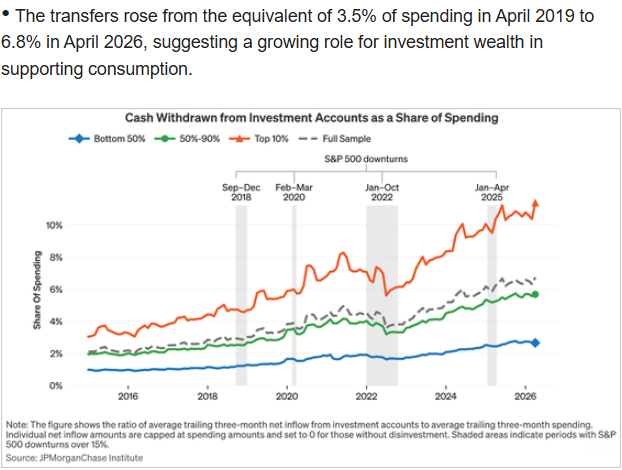{width="1280"} ::: {.aside} 3.5% → 6.8% of spending · April 2019 to April 2026 · JPMorgan sample ::: ::: {.notes} Trailing three-month investment-account withdrawals into checking relative to spending. Income groups are not wealth groups. Transfers do not show that every dollar was spent or came from capital gains. The sample is not national consumption accounts. The practical concern is discretionary-demand sensitivity to asset values and liquidity. [JPMorgan report](https://www.jpmorganchase.com/institute/all-topics/household-financial-health/drawing-on-investment-wealth-full-report); Hub 8080. Source resource: sections 2.2 of *Emerging Undercurrents: The Transition From Legacy to Emergent*. ::: ## Profit gains remain concentrated {#profit-concentration .evidence} 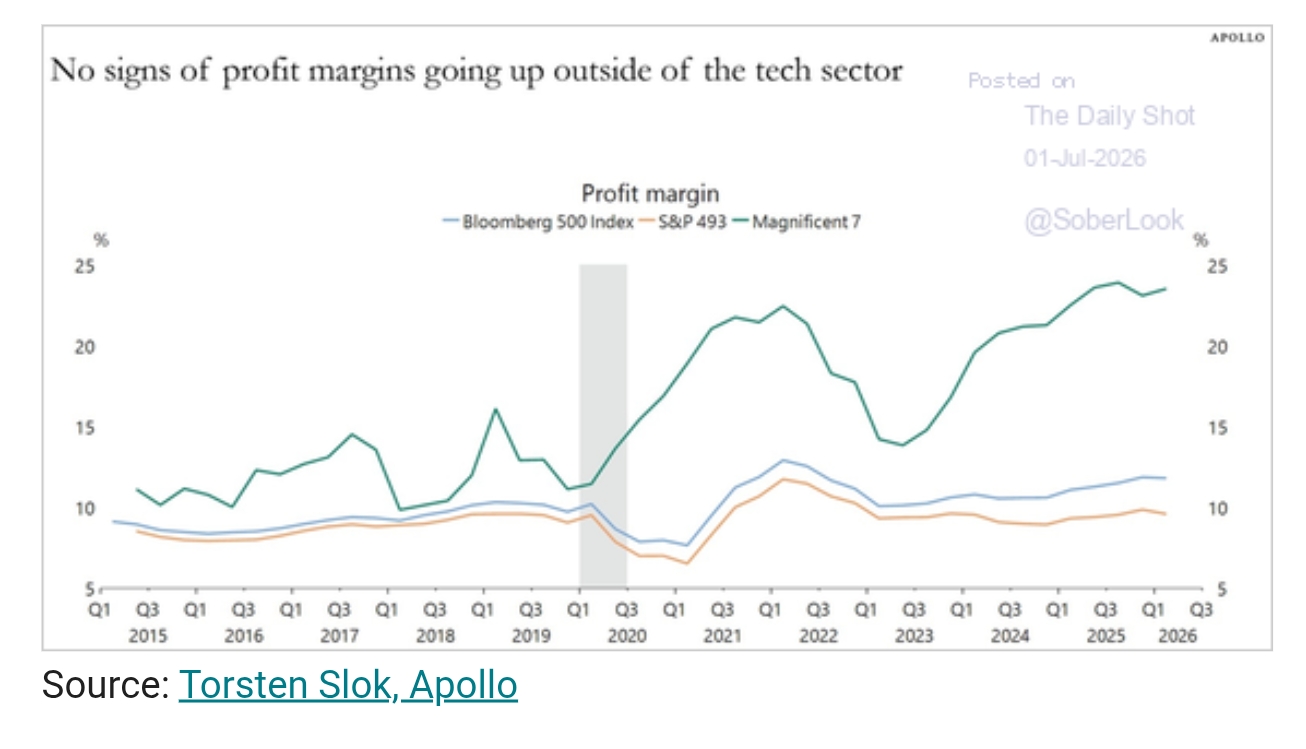{width="1250"} ::: {.aside} Torsten Slok / Apollo · The Daily Shot, July 1, 2026 · Signal 6031 ::: ::: {.notes} The Magnificent Seven series rises after 2023; the S&P 493 remains comparatively flat. Listed-company margins do not isolate AI causality or represent every business. Strong index earnings do not establish broad productivity gains. Ordinary businesses need to capture useful benefits themselves. Signal ID: fm-signal-6031. Source resource: sections 3.1 of *Emerging Undercurrents: The Transition From Legacy to Emergent*. ::: # The productivity handoff {#productivity-handoff .major-divider} ## The infrastructure must become useful output {#payback-test}Building capacity and earning a return are different milestones.
::: {.aside} Two tests: buyer productivity · returns expected by investors ::: ::: {.notes} My concern is that reorganization has not broadened enough to validate all investment assumptions. Goldman estimates that AI investment supports almost half of 2026 S&P 500 EPS growth; its base case is deceleration rather than collapse. Cheaper compute can improve social productivity while disappointing supplier returns. [Goldman Sachs, September 23, 2026](https://www.goldmansachs.com/insights/articles/can-ai-investment-drive-s-and-p-500-earnings-even-higher). Source resource: sections 3.1, 3.4, 3.6 of *Emerging Undercurrents: The Transition From Legacy to Emergent*. ::: ## Business AI use is still uneven {#ai-use} ::: {.aside} Any business use · Period ending May 3, 2026 · Census BTOS ::: ::: {.notes} Dated Census estimates: 19.8%, 39.7%, 33.9%. Any use is not connected operations or a measured return. The November 2025 question change interrupts comparability with earlier data. [Census, May 2026](https://www.census.gov/library/stories/2026/05/ai-use-businesses.html). Source resource: sections 3.3, 3.6 of *Emerging Undercurrents: The Transition From Legacy to Emergent*. ::: ## Useful infrastructure can outlast a correction {#infrastructure-history} ::: {.aside} Average annual spending / GDP · Hub 8077 transcription · AI estimated ::: ::: {.notes} Lasting infrastructure and investor losses can coexist. Categories, periods and financing systems differ; this is not proof of overbuilding. Values are transcribed from the inspected Stijn van Nieuwerburgh / WSJ graphic republished by The Daily Shot. AI 2025–2032 is explicitly estimated. No raw historical series was reconstructed. Source resource: sections 3.2 of *Emerging Undercurrents: The Transition From Legacy to Emergent*. ::: ## 2027–2032: the handoff risk {#handoff-window} | Path | What happens | | --- | --- | | Productive transition | Useful returns broaden before investment support fades | | Digestion and repricing | Adoption takes longer; cheaper capacity supports the next wave | | Compounding stress | Weak returns, spending and fiscal pressure reinforce one another | ::: {.aside} My vulnerability window · A 2027/2028 repricing phase is a scenario, not a fixed date. ::: ::: {.notes} My concern is that investment momentum can weaken before ordinary firms have reorganized enough to earn the expected returns. Slower capex growth can reduce its incremental contribution even while spending stays high. The Goldman September 23 research anticipates a fading investment contribution toward 2028, while its earnings base case is deceleration rather than collapse. Successful technology and successful investments are different. These are alternative paths, not recession probabilities. The window should move when broad adoption, operational returns, household income or shocks change. Source: [Goldman Sachs](https://www.goldmansachs.com/insights/articles/can-ai-investment-drive-s-and-p-500-earnings-even-higher). Resource sections 3.6 and 4.1–4.4. ::: ## Physical productivity may arrive after the gap {#physical-timing} | Planning window | What must develop | | --- | --- | | 2026–2027 | Useful digital workflows | | Late 2027–2032 | Broad returns and household benefits | | Early to mid-2030s | Reliable physical automation at scale | ::: {.aside} Author scenarios · Overlapping windows, not rollout commitments ::: ::: {.notes} The robot 'iPhone moment' means reliable, affordable physical capability in broad use. Specialized deployments may succeed earlier. Hardware, dexterity, safety, uptime, maintenance and total cost matter. Time saved produces income only when capacity creates paid work, output or household savings. Move the dates when evidence moves. Source resource: sections 3.5, 3.7, 4.1 of *Emerging Undercurrents: The Transition From Legacy to Emergent*. ::: ## Manufacturing strength needs to broaden {#manufacturing-breadth .evidence} 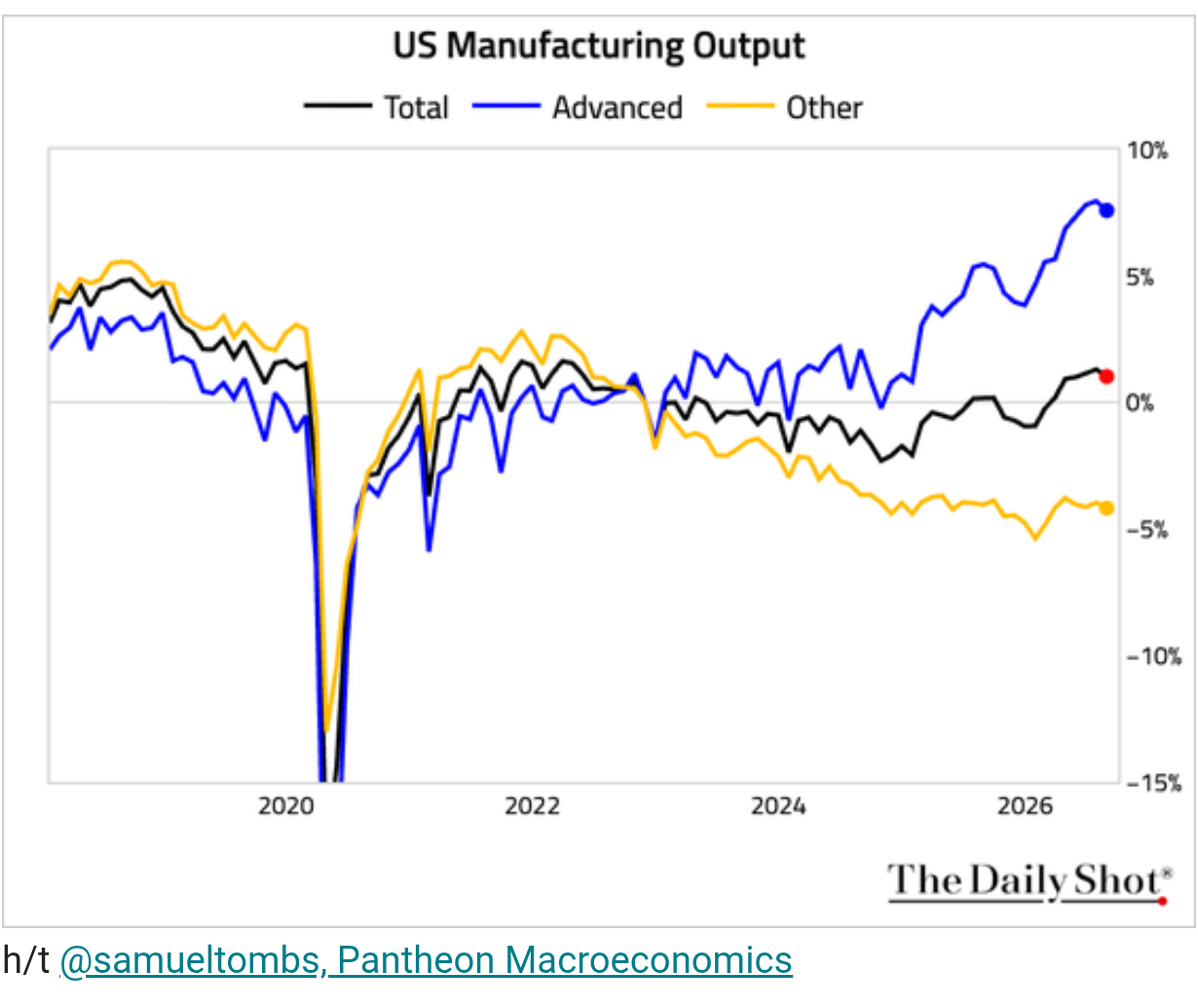{width="1230"} ::: {.aside} Pantheon / Samuel Tombs · Federal Reserve data · Hub 8070 ::: ::: {.notes} The image appears to show annual changes through August 2026. Its advanced-manufacturing definition is not supplied. Announced plants are not operating output. Policy, skills, energy, financing, installed systems and competing supply chains affect deployment. Export dependence differs by country; there is no basis for predicting uniform Southeast Asian collapse. Source resource: sections 2.3, 3.7 of *Emerging Undercurrents: The Transition From Legacy to Emergent*. ::: # The transition pressures {#transition-pressure .major-divider} ## A job is a bundle of work and income {#job-unbundling} :::: {.columns} ::: {.column width="48%"} ### What can shrink Tasks per employee Hiring for a given output Entry-level pathways ::: ::: {.column width="48%"} ### What can grow Output per person New firms and services Complementary work ::: :::: ::: {.notes} Adjustment can occur through slower hiring, attrition, contracting, wage pressure or layoffs. Entrepreneurship and displacement can coexist. More businesses do not guarantee proportional payroll jobs. Andreessen emphasizes demand growth; Amodei warns about entry-level displacement. These are possible outcomes, not settled economy-wide evidence. [Amodei](https://darioamodei.com/essay/the-adolescence-of-technology); [Andreessen](https://a16z.com/ai-will-save-the-world/); [a16z counterargument](https://a16z.com/the-ai-job-apocalypse-is-a-complete-fantasy/). Source resource: sections 5.1–5.3 of *Emerging Undercurrents: The Transition From Legacy to Emergent*. ::: ## Early-career workers show a warning signal {#early-career} ::: {.large-stat} 19% ::: Below the employment path of less-exposed peers Workers aged **22–25** in AI-exposed occupations ::: {.aside} Stanford / ADP · Through June 2026 · Revised August 12 ::: ::: {.notes} No widespread economy-wide displacement is found, but the exposed young-worker employment gap has widened, primarily through lower hiring. Authors describe early indicators, not causal estimates. Education, earlier trends and sample differences qualify the finding. Experienced workers show no comparable gap. [Stanford Digital Economy Lab](https://digitaleconomy.stanford.edu/publication/canaries-in-the-coal-mine-six-facts-about-the-recent-employment-effects-of-artificial-intelligence/). Source resource: sections 5.4 of *Emerging Undercurrents: The Transition From Legacy to Emergent*. ::: ## Cost cutting can reinforce weaker demand {#cost-feedback}The offset is capacity that creates new value.
::: {.aside} Scenario mechanism · No demand multiplier estimated ::: ::: {.notes} One firm's cost reduction can be another firm's lost revenue. Many firms cutting without redeploying resources can compound weak demand. AI also enables lower prices, better service and new output. Combine efficiency with innovation rather than stopping at a smaller cost base. Source resource: sections 4.4, 4.6 of *Emerging Undercurrents: The Transition From Legacy to Emergent*. ::: ## Infrastructure needs a local bargain {#community-legitimacy} - People experience costs before benefits. - Communities need a voice in decisions. - Promises need delivery and accountability. - Useful technology depends on earning acceptance. ::: {.aside} Land, water, power prices and access are part of the business case. ::: ::: {.notes} Sun's reporting connects opposition to data centers with distrust and local costs/benefits. Ratepayer protection, environmental performance, restoration and community participation are concrete questions. Messaging cannot replace accountable delivery. This principle also applies to local outdoor infrastructure. [Jasmine Sun](https://jasmi.news/p/no-data-centers-in-my-backyard); [IEA](https://www.iea.org/news/data-centre-electricity-use-surged-in-2025-even-with-tightening-bottlenecks-driving-a-scramble-for-solutions). Source resource: sections 7.2–7.3 of *Emerging Undercurrents: The Transition From Legacy to Emergent*. ::: ## Weak demand can coexist with sticky costs {#supply-pressure} :::: {.columns} ::: {.column width="48%"} ### Demand pressure Slower investment Income disruption Less discretionary spending ::: ::: {.column width="48%"} ### Supply pressure Energy and materials Climate and environmental damage Trade and conflict ::: :::: ::: {.notes} Demand weakness does not guarantee easy inflation relief when supply is constrained. Outdoor exposures include heat, smoke, floods, drought, water quality, access, insurance and travel disruption. Sources support these mechanisms, not the author dates. [IEA](https://www.iea.org/news/data-centre-electricity-use-surged-in-2025-even-with-tightening-bottlenecks-driving-a-scramble-for-solutions); [IMF](https://www.imf.org/en/publications/wp/issues/2023/09/28/geoeconomic-fragmentation-and-commodity-markets-539614); [IPCC](https://www.ipcc.ch/report/ar6/wg2/chapter/summary-for-policymakers/). Source resource: sections 4.5, 8.1 of *Emerging Undercurrents: The Transition From Legacy to Emergent*. ::: ## Debt narrows the room for adjustment {#fiscal-pressure} ::: {.aside} Federal debt held by the public / GDP · CBO February 2026 baseline ::: ::: {.notes} CBO projected a $1.9 trillion 2026 deficit, 5.8% of GDP, and public debt of 101% of GDP rising to 120% in 2036. Baseline projections, not final outcomes. Fiscal pressure can prompt reform, restraint, revenue changes, borrowing or new delivery. Rate cuts alone are not financial repression; inflation, indexed spending and refinancing complicate debt relief. [CBO baseline](https://www.cbo.gov/publication/62105). Source resource: sections 2.1, 4.4, 4.7 of *Emerging Undercurrents: The Transition From Legacy to Emergent*. ::: ## Policy faces a harder tradeoff {#policy-tradeoff} - Weak demand calls for easier financing. - Supply constraints can keep inflation elevated. - Debt financing can increase institutional pressure. - Financial repression becomes one possible response. ::: {.aside} Rate cuts alone do not establish repression or guarantee currency collapse. ::: ::: {.notes} The adverse scenario combines demand weakness with sticky supply costs and fiscal constraints. Financing-driven policy, explicit yield controls, institutional pressure and real purchasing power matter. Currency exchange rates are relative; domestic purchasing power can fall without the currency weakening against every foreign currency. Inflation may erode fixed nominal debt, but indexed costs, refinancing and new deficits can offset the effect. Asset prices respond differently to rates, income, liquidity and default risk. There is no guarantee that every real asset rises or every nominal asset fails. Resource sections 4.4, 4.7 and 9.6; supporting fiscal and supply sources appear on the adjacent slides. ::: ## Housing can remain stuck after rate cuts {#housing-lock-in} - Cheap existing mortgages discourage moving. - Policy rates and mortgage rates differ. - Prices, income and supply affect affordability. - Relief can reach households unevenly. ::: {.aside} Mortgage lock-in is documented · No universal 3% threshold established ::: ::: {.notes} FHFA supports the effect of the rate gap on mobility. Study-period estimates are not October 2026 observations. The Fed's overnight target is not the rate written in a fixed mortgage. The below-3% hypothesis needs a specified rate, borrower group and outcome before a numerical claim. [FHFA](https://www.fhfa.gov/research/papers/wp2403); [Federal Reserve Consumer Help](https://www.federalreserveconsumerhelp.gov/loans-mortgage/). Source resource: sections 4.7 of *Emerging Undercurrents: The Transition From Legacy to Emergent*. ::: ## Discretionary demand needs household security {#discretionary-demand}Cheaper intelligence alone does not complete this chain.
::: {.aside} Scenario · Involuntary unemployment is not abundant leisure ::: ::: {.notes} Disinflation is slower price growth, deflation is falling prices, and affordability concerns income/access relative to cost. Cash or cheap digital services cannot by themselves fix scarce housing, care, energy or local capacity. Build offers that fit the discretionary budget people have today. Source resource: sections 8.1–8.3 of *Emerging Undercurrents: The Transition From Legacy to Emergent*. ::: # What could change the path {#possible-responses .major-divider} ## Corporate sovereigns have precedents {#corporate-history} | Example | Commercial power became public influence | | --- | --- | | Hudson’s Bay Company | 1670 charter; territorial control and trade | | East India Company | Administration and armed power | Who controls the systems we depend on today? ::: {.aside} Historical delegated authority and modern platforms have different legal powers. ::: ::: {.notes} HBC's charter granted exclusive trade in Rupert's Land, transferred to Canada in 1870 after the 1869 surrender. Parliament transferred East India Company administration, possessions and forces to the Crown in 1858. These colonial precedents illustrate concentrated power. Today's analogy concerns compute, energy, connectivity, payments, logistics and services. [Archives of Manitoba](https://gov.mb.ca/chc/archives/hbca/glossaries.html); [UK Parliament](https://www.parliament.uk/about/living-heritage/evolutionofparliament/legislativescrutiny/parliament-and-empire/parliament-and-the-american-colonies-before-1765/east-india-company-and-raj-1785-1858/). Source resource: sections 7.1 of *Emerging Undercurrents: The Transition From Legacy to Emergent*. ::: ## Income, services and compute are different {#social-contract} | Response | What reaches people | | --- | --- | | UBI | Recurring cash | | UBS | Access to defined services | | Compute access | Tools for learning, building and delivery | | Wider ownership | Participation in productive returns | **UHI is an abundance scenario, not an enacted program.** ::: {.notes} Connect productive gains to people's ability to obtain essentials and participate. Compute needs dependable delivery and physical capacity. Design, funding, quality and governance determine outcomes. Diamandis's UBI-to-UHI framing is a proposal, not proof of feasibility or timing. [UBI-to-UHI proposal](https://metatrends.substack.com/p/from-ubi-to-uhi-in-3-steps). Source resource: sections 6.1–6.2, 6.5 of *Emerging Undercurrents: The Transition From Legacy to Emergent*. ::: ## Alaska shows one way to share returns {#alaska-precedent}A technology dividend needs its own funding and governance.
::: {.aside} Permanent Fund: 1976 · APFC: 1980 · First dividend: 1982 ::: ::: {.notes} At least 25% of specified mineral revenues go into the Fund under Alaska's constitutional structure. AI gains are not automatically public property in the same way. An annual dividend is not a complete living income or proof that national UBI/UBS scales easily. [Alaska Permanent Fund history](https://apfc.org/about/history/). Source resource: sections 6.3 of *Emerging Undercurrents: The Transition From Legacy to Emergent*. ::: ## Three levers could improve the handoff {#transition-levers} - **Innovation:** more output and useful services. - **Labor capacity:** immigration and participation with supporting infrastructure. - **Affordable essentials:** wider gains with accountable delivery. ::: {.aside} Broad implementation may take years · The 2030s upside remains a scenario ::: ::: {.notes} The levers complement one another. My judgment is that rapid coordinated deployment is unlikely, but I will revise it when outcomes improve. Physical productivity could arrive later. Immigration needs housing and integration; the five-million-per-year thought experiment is not a modeled baseline. Affordable services need a delivery model rather than just compute. Source resource: sections 6.5, 4.1, 14.1 of *Emerging Undercurrents: The Transition From Legacy to Emergent*. ::: # What businesses can do now {#business-agency .major-divider} ## A useful workflow is a starting point {#useful-workflow}Measure cost per correct completion, including rework.
::: {.notes} Examples: catalog updates, product questions, partner training, service follow-up, inventory coordination or event administration. Clear responsibility and human exceptions matter. My approach is to recover time and cognitive capacity, then use them on work we could not do before. Source resource: sections 3.4, 12.2, 13.2 of *Emerging Undercurrents: The Transition From Legacy to Emergent*. ::: ## Released capacity can build a better business {#capacity-to-value} - Less repetitive work creates room for service. - Better tools make small segments worth serving. - New capabilities become new offers. - Time with stakeholders improves the product. ::: {.notes} The goal goes beyond smaller payroll or more AI use: turn lower friction into consumer and partner value. Include total cost, quality, reliability and contribution. Hub 8095's one-sixth cloud-cost experience is workload-specific, not a universal promise. Source resource: sections 3.4, 13.1–13.2 of *Emerging Undercurrents: The Transition From Legacy to Emergent*. ::: ## Useful scarcity matters more than asset labels {#durable-value} | What remains distinctive | What creates value | | --- | --- | | Places and access | A wanted experience people can reach | | Proprietary knowledge | Better outcomes with permission | | Trusted relationships | Dependable help and cooperation | | Experiences and communities | Reasons to return and refer | ::: {.aside} Signal 7018: collectibles may face changing future demand ::: ::: {.notes} Hub 7018 concerns art/collectibles supply and changing preferences. Its image is a Bloomberg headline, not a return series; full text was inaccessible. Trust is not a quoted financial asset. Property needs viable economics and manageable risks; data needs permitted useful application. This is a business framework, not a safe-haven ranking. Source resource: sections 9.1, 9.3–9.4, 9.6 of *Emerging Undercurrents: The Transition From Legacy to Emergent*. ::: ## Partner economics shape the consumer experience {#partner-value} :::: {.columns} ::: {.column width="48%"} ### B2C The business serves the consumer directly. The whole experience must work. ::: ::: {.column width="48%"} ### B2B2C A partner delivers part of the promise. Both relationships must work. ::: :::: ::: {.notes} Retailers, operators, venues and instructors may own a key handoff. Responsibility, availability, training, fit and recovery determine the consumer experience. Respect agreed relationships and data permissions. Shared portable tools can help small firms cooperate without dependence on one platform. Source resource: sections 1.2, 9.2, 11.3, 12.1–12.3 of *Emerging Undercurrents: The Transition From Legacy to Emergent*. ::: # Experiences and trust {#experience-trust .major-divider} ## Affordability includes the whole first experience {#affordable-access} - A clear total price and a suitable place. - Equipment, instruction and confidence. - A welcoming host and someone to go with. - An easy next visit. ::: {.aside} Rental, used gear, repair and shared assets need workable economics. ::: ::: {.notes} Transport, storage, childcare, time, safety and feeling unwelcome can be barriers. Outdoor activity is not automatically inexpensive. Existing local assets can support good offers without a mega-project. Check utilization, staffing, maintenance, seasonality and contribution. Source resource: sections 10.1–10.2 of *Emerging Undercurrents: The Transition From Legacy to Emergent*. ::: ## Fandom needs a path into participation {#fandom-to-participation}Fans, participants and customers are different measures.
::: {.notes} People may enter through sport, culture, music, friends or a familiar person. Expand the audience around an activity and provide continuation. Impressions are not participants; attendance is not profit; buying gear is not a required finish line. Source resource: sections 10.3, 10.6, 11.1–11.4 of *Emerging Undercurrents: The Transition From Legacy to Emergent*. ::: ## Shared experiences build personal understanding {#human-experience} - People accomplish something together. - Good hosts create confidence and belonging. - Repeated contact replaces abstract stereotypes. - Kept commitments give people a reason to return. ::: {.aside} Cooperation, shared goals and supportive conditions matter. ::: ::: {.notes} Pettigrew and Tropp find contact typically reduces prejudice. That supports a mechanism, not a claim that one event reduces national polarization. Equal-status participation and supportive hosts matter. Emotion makes an experience memorable; follow-through creates trust. [Intergroup-contact meta-analysis](https://pubmed.ncbi.nlm.nih.gov/16737372/). Source resource: sections 10.4, 10.6 of *Emerging Undercurrents: The Transition From Legacy to Emergent*. ::: ## All trust is local {#trust-comparisons} ::: {.aside} Bruce Mehlman, July 19, 2026 · Different survey questions and periods ::: ::: {.notes} Business measures great-deal/quite-a-lot confidence (Gallup 2026); health asks about accuracy (Pew 2026); media measures a-lot/some trust (Pew 2024). Different questions and populations, not a pooled causal experiment. The full original compilation is retained in the appendix. [Bruce Mehlman](https://brucemehlman.substack.com/p/six-chart-sunday-all-trust-is-local); Hub 6093. Source resource: sections 9.2 of *Emerging Undercurrents: The Transition From Legacy to Emergent*. ::: ## Trust grows through stakeholder contact {#stakeholder-contact} - Customers need help and follow-through. - Employees need accessible leaders. - Partners need commitments and shared recovery. - Other stakeholders need visible accountability. ::: {.aside} One-on-one contact is an operating discipline, not just marketing. ::: ::: {.notes} My strategic thesis is that trust becomes the one true differentiator as features get easier to reproduce. This does not prove that other advantages vanish. Local means familiar and accountable, even at a distance. Include suppliers, investors and communities. AI can prepare context so people have more time to show up and listen. [Mehlman](https://brucemehlman.substack.com/p/six-chart-sunday-all-trust-is-local); [Trust is the only moat](https://writing.nikunjk.com/p/trust-is-the-only-moat). Source resource: sections 9.2, 10.6, 13.2 of *Emerging Undercurrents: The Transition From Legacy to Emergent*. ::: ## The thesis must change when evidence changes {#watch-the-handoff} :::: {.columns} ::: {.column width="48%"} ### Less concern Useful deployment broadens. Real incomes and affordable services improve. ::: ::: {.column width="48%"} ### More concern Investment slows before returns broaden. Demand weakens while supply costs persist. ::: :::: ::: {.notes} Track comparable adoption, output, renewals, total costs, household benefits and physical deployment. One series does not prove the thesis. Dates should move as evidence moves. Track industry trials, second participation, referrals and contribution as well. Source resource: sections 14.1–14.2 of *Emerging Undercurrents: The Transition From Legacy to Emergent*. ::: ## Your next move {#next-move} 1. Automate one recurring bottleneck. 2. Turn recovered capacity into a better offer. 3. Remove a participation barrier. 4. Make and keep a stakeholder commitment. ::: {.notes} Choose a change that works under current constraints. Test the real result rather than counting subscriptions or prompts. Keep quality and partner economics visible. Share learning that reduces repeated work without exposing private information. Source resource: sections 13.1–13.2, 15 of *Emerging Undercurrents: The Transition From Legacy to Emergent*. ::: ## More reasons to be active, together {#closing .statement} Use the new tools to create more affordable experiences. Put the time you recover into people, products and dependable delivery. **Build relationships people choose to come back to.** ::: {.notes} Powerful technology does not automatically create broad prosperity. The industry has agency: lower friction, create capability, invite people into real experiences and follow through. We do not have to wait for universal abundance. Source resource: sections 15 of *Emerging Undercurrents: The Transition From Legacy to Emergent*. ::: ## Sources: the economic handoff {#sources-economy .standalone .source-list} - [Goldman Sachs · investment and earnings](https://www.goldmansachs.com/insights/articles/can-ai-investment-drive-s-and-p-500-earnings-even-higher) - [Census · business AI use](https://www.census.gov/library/stories/2026/05/ai-use-businesses.html) - [CBO · February 2026 baseline](https://www.cbo.gov/publication/62105) - [JPMorgan · investment wealth and spending](https://www.jpmorganchase.com/institute/all-topics/household-financial-health/drawing-on-investment-wealth-full-report) - [Stanford · employment indicators](https://digitaleconomy.stanford.edu/publication/canaries-in-the-coal-mine-six-facts-about-the-recent-employment-effects-of-artificial-intelligence/) - [FHFA · mortgage lock-in](https://www.fhfa.gov/research/papers/wp2403) ::: {.notes} Sources support their attached dated claims, not the full macro scenario. Units, dates and qualifications remain on the relevant slides and in their notes. Source resource: sections 16.5 of *Emerging Undercurrents: The Transition From Legacy to Emergent*. ::: ## Sources: capacity, institutions and trust {#sources-capacity .standalone .source-list} - [IEA · infrastructure bottlenecks](https://www.iea.org/news/data-centre-electricity-use-surged-in-2025-even-with-tightening-bottlenecks-driving-a-scramble-for-solutions) - [APFC · fund history](https://apfc.org/about/history/) - [Archives of Manitoba · HBC](https://gov.mb.ca/chc/archives/hbca/glossaries.html) - [UK Parliament · East India Company](https://www.parliament.uk/about/living-heritage/evolutionofparliament/legislativescrutiny/parliament-and-empire/parliament-and-the-american-colonies-before-1765/east-india-company-and-raj-1785-1858/) - [Pettigrew / Tropp · intergroup contact](https://pubmed.ncbi.nlm.nih.gov/16737372/) - [Bruce Mehlman · All Trust is Local](https://brucemehlman.substack.com/p/six-chart-sunday-all-trust-is-local) ::: {.notes} Additional supporting links are in notes. The presentation offers strategic ideas, not guaranteed outcomes or individualized investment advice. Source resource: sections 16.5–16.7 of *Emerging Undercurrents: The Transition From Legacy to Emergent*. ::: ## Evidence appendix: familiarity and trust {#trust-original .standalone .evidence} 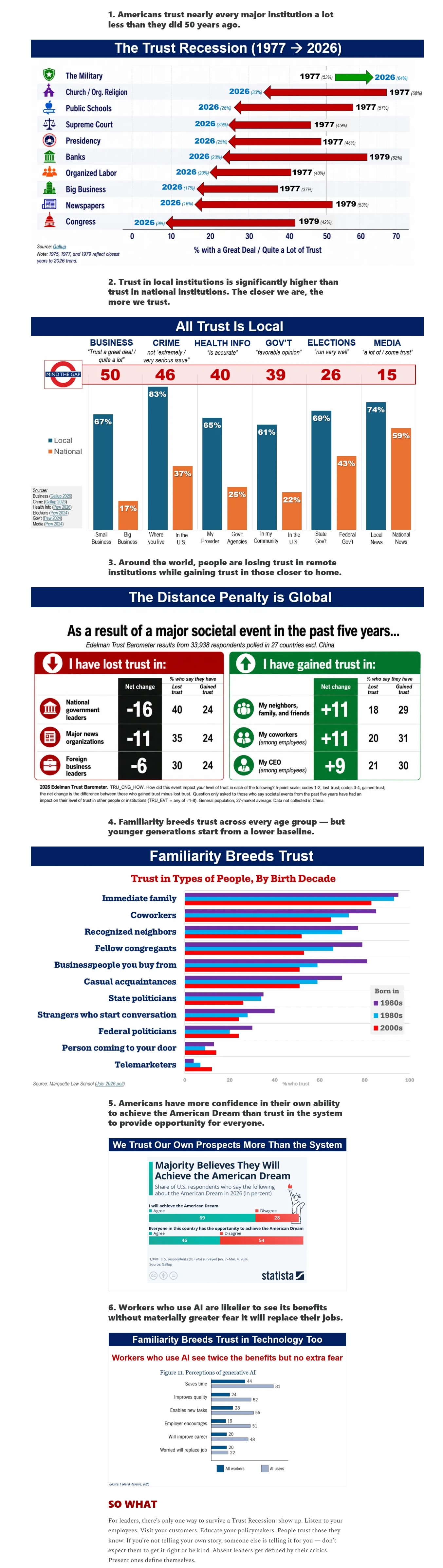{height="550"} ::: {.aside} Original compilation · Open at full size for survey labels and credits ::: ::: {.notes} Preserves all original panels and credits. Surveys differ in questions, dates and populations. The earlier selected bars are transcribed from its All Trust Is Local panel. [Bruce Mehlman, July 19, 2026](https://brucemehlman.substack.com/p/six-chart-sunday-all-trust-is-local). Source resource: sections 9.2 of *Emerging Undercurrents: The Transition From Legacy to Emergent*. ::: ## Evidence appendix: household and social strain {#turchin-original .standalone .evidence} 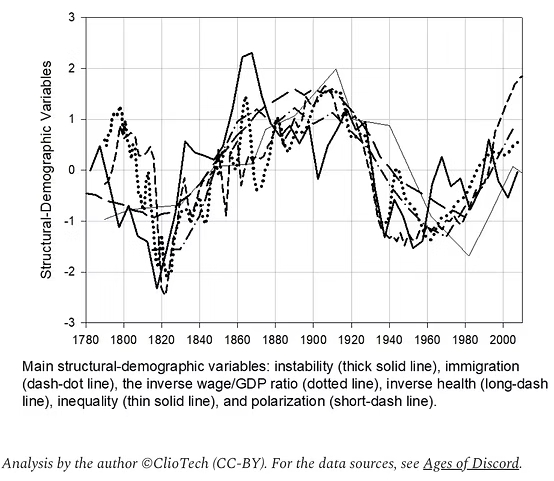{height="550"} ::: {.aside} Peter Turchin / ClioTech · CC-BY attribution · Through 2010 ::: ::: {.notes} Signal fm-signal-6056 adds historical context. It uses inverse wage/GDP and inverse health, and ends in 2010. Not a current measurement or proof of a future crisis. Image credits ClioTech and refers to Ages of Discord for data. Source resource: sections 2.2 of *Emerging Undercurrents: The Transition From Legacy to Emergent*. ::: ## Evidence appendix: smaller firms and total jobs {#firm-arithmetic .standalone} | Illustration | Firms | Average team | Total workers | | --- | ---: | ---: | ---: | | Starting point | 100 | 10 | 1,000 | | 5× firms; 75% smaller | 500 | 2.5 | 1,250 | | 5× firms; 90% smaller | 500 | 1 | 500 | ::: {.aside} Arithmetic only · Comparable firms assumed · Team sizes are averages ::: ::: {.notes} Five times as many firms with teams one quarter as large implies 1.25 times total workers under these assumptions. More firms and smaller teams do not settle the labor-market result. This is not an employment forecast. Source resource: sections 5.5 of *Emerging Undercurrents: The Transition From Legacy to Emergent*. :::